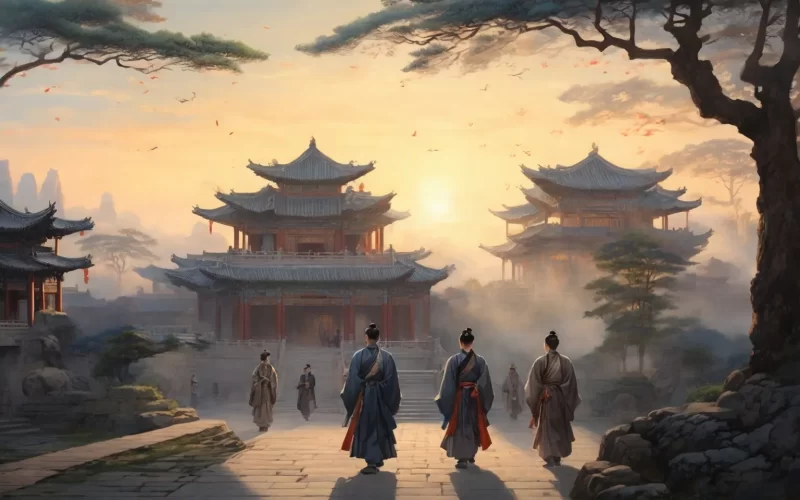



It's a long way home, a long way east.
I am old and my sleeve is wet with tears.
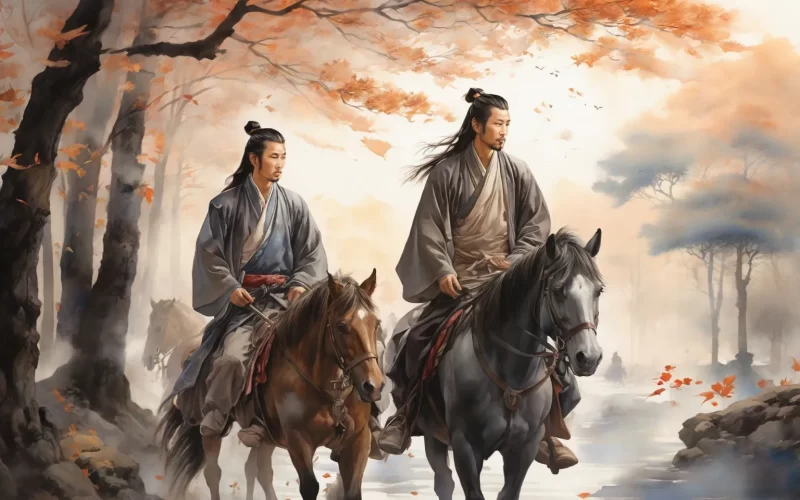
We meet on horseback. I have no means of writing.
Tell them three words: "He is safe."
Original Poem
「逢入京使」
岑参
故园东望路漫漫,双袖龙钟泪不乾。
马上相逢无纸笔,凭君传语报平安。
Interpretation
This poem was composed in 749 AD, during the eighth year of the Tianbao era of Emperor Xuanzong of the Tang Dynasty. It captures a moment during Cen Shen's first journey beyond the frontier, as he traveled to take up a post in the military headquarters of Gao Xianzhi, Military Governor of Anxi. As a scholar-official harboring the lofty ambition that "merit and fame are to be won only on horseback," this westward expedition was a consciously chosen path, aiming to achieve distinction on the frontier battlefield. However, once the battlements of Chang'an finally vanished behind him, and familiar homeland gave way to boundless desert and the unknown, a deeply ingrained cultural attachment to native soil and tender thoughts of family and friends could surge forth in an unguarded instant.
This work precisely seizes such a "moment." It records not a planned correspondence, but a purely chance encounter, happening on the jolting back of a horse. The messenger entering the capital was like a rope suddenly cast into a vast sea, allowing the poet a brief, urgent spiritual connection to his native place. Thus, the poem transcends ordinary works of homesickness, becoming an intensely private yet highly representative psychological slice of the collective "going beyond the frontier" experience among High Tang scholar-officials—it reveals, beneath the soaring pursuit of achievement, the undimmed, tender common feelings of humanity, and the subtle, genuine tension between the two.
First Couplet: "故园东望路漫漫,双袖龙钟泪不干。"
Gù yuán dōng wàng lù màn màn, shuāng xiù lóng zhōng lèi bù gān.
I look eastward, long, long my homeward road appears; / My old arms tremble and my sleeves are wet with tears.
The opening directly expresses pent-up feelings, giving full vent to the psychological pressure created by spatial separation. "I look eastward" is the body's direction, and even more, the heart's orientation. "Long, long my homeward road appears" is both a statement of objective geographical distance and a metaphor for the psychological length of an uncertain return date. The word "look" freezes the poet's instant posture of reining in his horse and looking back, full of a sense of powerlessness. The next line, "My old arms tremble and my sleeves are wet with tears," pushes this emotion to an extreme. "Tremble" describes the disheveled state of being drenched with tears, a plain, realistic technique that paints the uncontrollable, surging grief with utmost authenticity. The words "wet with tears" not only mean the continuous flow of tears but, more significantly, suggest the endless, uncontainable nature of the sorrow. These two lines, in the plainest language, construct the most powerful impact of homesickness.
Second Couplet: "马上相逢无纸笔,凭君传语报平安。"
Mǎ shàng xiāng féng wú zhǐ bǐ, píng jūn chuán yǔ bào píng'ān.
Meeting you on horseback, with what brush can I write? / I can but ask you to tell them I am all right.
This couplet is the soul of the entire poem, abruptly shifting from intense lyricism to restrained narrative, with emotion bursting forth with even deeper power in the vast contrast. "Meeting you on horseback" points to the hastiness and rootless feeling of the encounter. "With what brush can I write?" is a true record of a practical predicament, yet it becomes a major obstacle to emotional expression—a thousand words, with no means to carry them. However, it is precisely this obstacle that forces out the most classic, most moving line: "I can but ask you to tell them I am all right." Under the limitation of being unable to pour out his heart, a thousand thoughts and feelings ultimately condense into the simplest, most essential request: to report he is safe and sound. These two characters bear immense weight. They omit all hardships, longing, and loneliness, conveying only the most reassuring aspect to his family. Behind them lies all the love and responsibility of a distant traveler for his family—consideration born of helplessness, and strength born of vulnerability.
Holistic Appreciation
This heptasyllabic quatrain is a pearl of exceptionally high emotional intensity within High Tang frontier poetry. It discards all scenic embellishment and literary allusion, striking directly at the heart with pure descriptive realism, containing immense emotion within an extremely concise form.
The poem's emotional structure exhibits a dramatic shift from "outburst" to "restraint." The first two lines are like a bursting dam, releasing the bitterness of leaving home and native soil to the fullest; the last two lines are like a torrent meeting a sluice gate. Under the realistic constraint of "Meeting you on horseback, with what brush can I write?", emotion sharply converges, condensing into the three words "tell them I am all right." Between this release and restraint, immense emotional energy is compressed into the seemingly plain request of the final line, producing an artistic effect akin to "wishing to speak yet hesitating, then remarking instead, 'What a nice cool autumn day!'" This is more evocative and profoundly powerful than sustained lyrical outpouring.
The poem's charm lies in its unparalleled sense of authenticity and immediacy. It depicts not a polished "poetic emotion," but the most genuine human reaction in a specific situation: weeping upon gazing toward home, urgently wanting to send word upon meeting someone from home, and settling for the next best thing when lacking the means. This raw, sincere emotional texture drawn from life itself allows it to resonate instantly across a millennium with any reader who has experienced parting.
Artistic Merits
- The Eternal Capture of a Fleeting Moment: The poet possesses an extraordinary ability to seize and immortalize a decisive instant. The entire poem revolves around the fleeting event of "meeting on horseback," compressing the accumulated emotion before it (gazing east, tears flowing) and the urgent action within it (no writing tools, sending a verbal message) into twenty-eight characters. Thus, a chance fragment of life attains artistic eternity, bearing universal emotion.
- Contrast and Restraint in Emotional Expression: The first couplet's "wet with tears" is the direct outpouring of emotion; the second couplet's "tell them I am all right" represents the ultimate restraint and condensation. The dramatic shift from the overwhelming sorrow of "My old arms tremble and my sleeves are wet with tears" to the calm request of "tell them I am all right" not only aligns with the realistic logic of the scene but also profoundly reveals the traveler's complex inner world: it contains vulnerability, yet demonstrates even more strongly the resilience to transform that vulnerability into responsibility and steadfastness.
- Highly Refined, Descriptive Language: The poem uses not a single ornate character or obscure allusion, employing only plain language akin to the colloquial speech of its time. Phrases like "long, long my homeward road appears," "wet with tears," "with what brush can I write," and "tell them I am all right" combine like recorded speech, yet achieve depth within simplicity and profound feeling within plainness, reaching the artistic pinnacle of "like a lotus rising clear from water, natural, with ornamentation removed."
- Unity of the Lyric Subject's Typicality and Individuality: The poem's lyrical protagonist is both a typical representative of the thousands of scholars going to the frontier (harboring high aspirations, feeling deep homesickness) and bears the distinct imprint of Cen Shen's individuality (intense emotion, candid expression). This technique of reflecting a generation's collective psychology through a highly individualized moment is key to the poem's wide resonance.
Insights
This poem is like a clear mirror, reflecting some of the plainest yet most solid cornerstones of human emotion. It tells us that the grandest ambitions and the softest homesickness can, and must, coexist in the same heart. The poet whose "sleeves are wet with tears" and the determined man who aims to "win merit and fame on horseback" are two sides of the same whole. The poem shatters one-dimensional imaginings of heroic spirit, revealing the richness and authenticity of complete humanity.
It further enlightens us about the essence of "communication." In ancient times with blocked communication, "meeting on horseback, with no writing tools" was the norm. In today's world of information overload, we seem to possess countless means of communication, yet effective, genuine emotional transmission may have become thin. The preciousness of "I can but ask you to tell them I am all right" lies in its tenacious adherence, under the most limited conditions, to the essence of communication: conveying the most crucial concern and feeling. This reminds us that the value of true communication lies not in the convenience of the channel or the volume of information, but in the sincerity of the intent and the preciousness of the word.
Finally, this small poem, with its timeless power to move, proves that human attachment to home, concern for loved ones, and the cherishing of and wish for "safety" while adrift are eternal emotions transcending specific eras and places. Cen Shen's look back and entrustment on the vast Western Region road thus becomes a common spiritual homeland and emotional solace for all who walk the "long, long" road of life.
Poem translator
Kiang Kanghu
About the poet
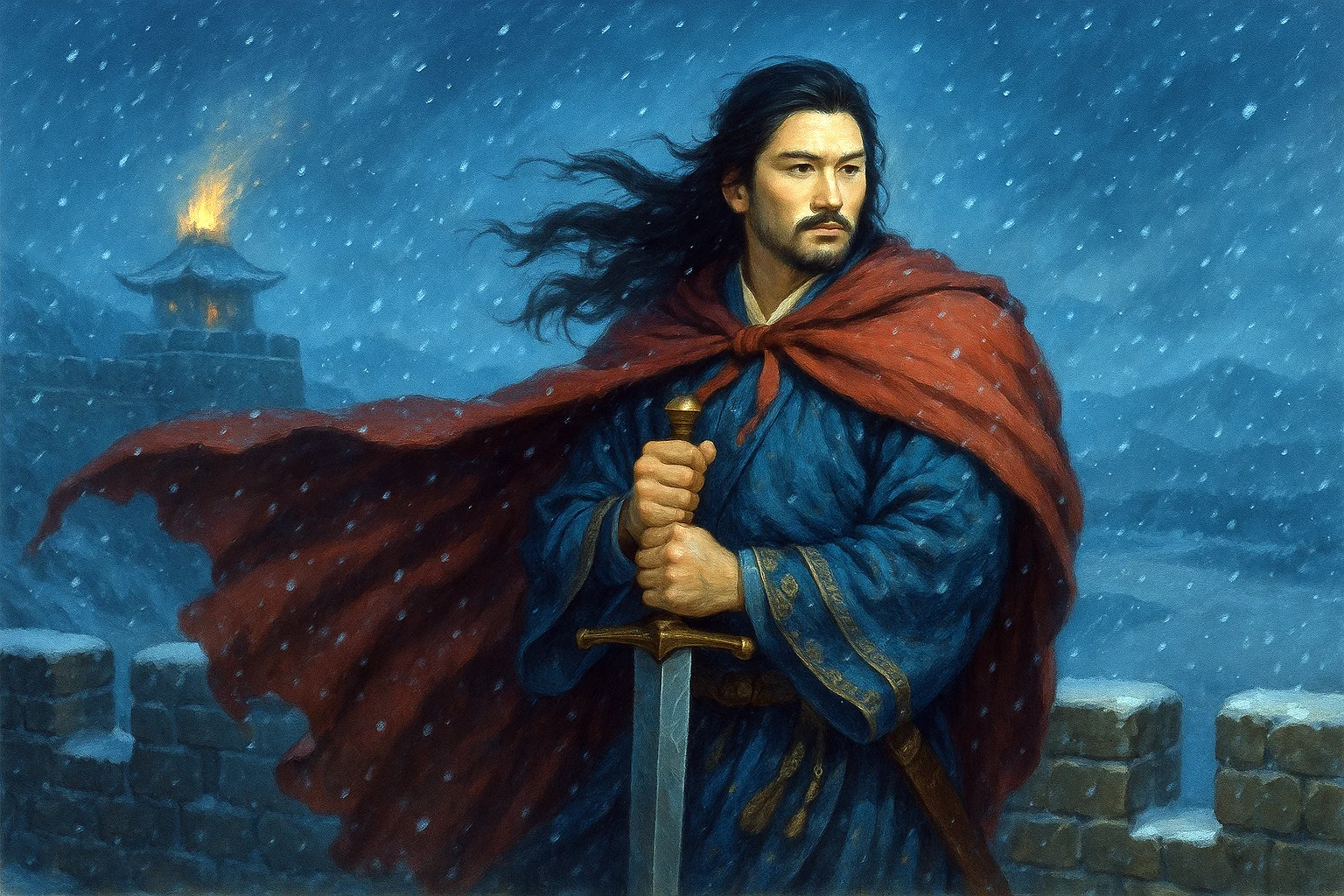
Cén Cān(岑参), 715 - 770 AD, was a native of Jingzhou, Hubei Province. He studied at Mt. Songshan when he was young, and later traveled to Beijing, Luoyang and Shuohe. Cén Cān was famous for his border poems, in which he wrote about the border scenery and the life of generals in a majestic and unrestrained manner, and together with Gao Shi, he was an outstanding representative of the border poetry school of the Sheng Tang Dynasty.