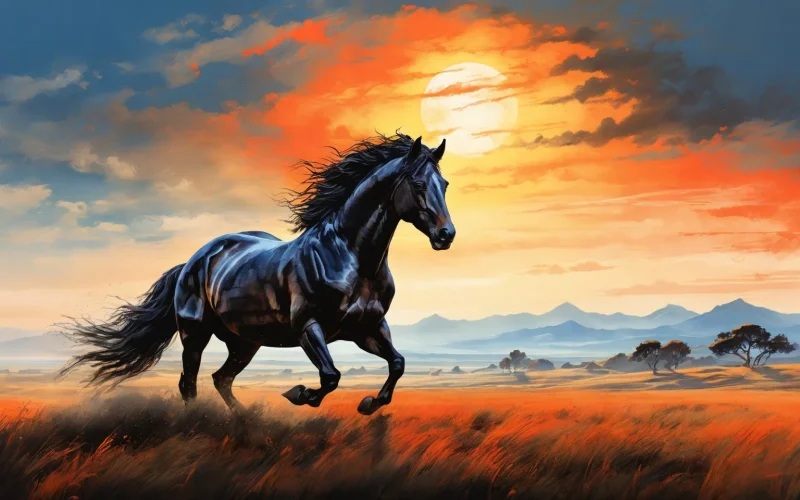
The steed from the barbaric west
Has angular frame and strong chest.
Like pointed bamboo its sharp ear,
As swift wind its fleet hoofs, O hear!
The way it runs will never end;
Life or death on it may depend.
When you have such a fiery steed,
You can ride where you will indeed.
Original Poem
「房兵曹胡马」
杜甫
胡马大宛名,锋棱瘦骨成。
竹批双耳峻,风入四蹄轻。
所向无空阔,真堪托死生。
骁腾有如此,万里可横行。
Interpretation
This poem was likely composed between 740-741 CE, during the Kaiyuan era of Emperor Xuanzong, a time when Du Fu, in the prime of his life, was traveling through the Qi and Zhao regions, living with the untamed elegance of a youth in fine furs and spirited horses. Through an ode of extreme praise for a steed from Dayuan (the Ferghana Valley in Central Asia), the poem gives full expression to the young Du Fu's soaring ambition and fervent desire to achieve greatness and render service. It stands as a model of the vigorous style and romantic aspirations that characterize his early poetry.
First Couplet: “胡马大宛名,锋棱瘦骨成。”
Hú mǎ Dàyuān míng, fēng léng shòu gǔ chéng.
Steed of the Western Regions, from Ferghana famed; / With edges sharp and angles gaunt, its bony frame is framed.
The opening immediately establishes the horse's noble lineage and distinctive form. "From Ferghana famed" carries the romance of distant lands. "Edges sharp and angles gaunt" represents Du Fu's unique aesthetic insight: he rejects the traditional ideal of a "well-fed, stout body," using "gaunt" to highlight its lean toughness and "edges sharp" to describe its powerfully angular bone structure. The steed's physique already reveals a heroic quality that eschews superficial grace for intrinsic, resilient strength.
Second Couplet: “竹批双耳峻,风入四蹄轻。”
Zhú pī shuāng ěr jùn, fēng rù sì tí qīng.
Bamboo-sliver ears rise steep and keen; / Wind enters its four hooves, a fleet, unseen machine.
This couplet uses exquisite metaphor and synesthesia to capture the horse's alert demeanor and speed. "Bamboo-sliver ears rise steep" compares the ear's shape to the sharp, straight cut of a bamboo tube, depicting handsomeness and vigilance within stillness. "Wind enters its four hooves" is a masterstroke of dynamic description: the word "enters" lends the wind active agency, as if it willingly lends its aid; "fleet" captures the marvelous sensation of effortless, weightless speed in full gallop. In just ten characters, the horse's dashing grace and extraordinary swiftness spring to life.
Third Couplet: “所向无空阔,真堪托死生。”
Suǒ xiàng wú kōngkuò, zhēn kān tuō sǐshēng.
No distance daunts it, however vast the span; / One could indeed entrust to it one's life, this peerless steed of man.
The poet's focus shifts from outward form to inner spirit, moving from physical description to a paean of the horse's character. "No distance daunts it" expresses the ultimate sense of spatial conquest, showcasing its bravery that ignores obstacles and charges forward. "Entrust to it one's life" elevates it to the status of comrade and confidant, bestowing upon it a loyalty and trustworthiness that transcends mere animality. This describes not just the horse, but also projects Du Fu's vision of an ideal character: one capable of conquering vast distances while also being worthy of the deepest trust.
Fourth Couplet: “骁腾有如此,万里可横行。”
Xiāo téng yǒu rú cǐ, wàn lǐ kě héngxíng.
Valiant and soaring, a creature of this might; / For ten thousand miles it could gallop, free in its flight.
The final couplet concludes with an exclamation, driving the emotion to its peak. "Valiant and soaring" summarizes all the qualities praised earlier—courage, agility, and rugged strength. "For ten thousand miles it could gallop" is both a prophecy of the steed's destiny and, more importantly, the poet's own bold declaration of a desire to transcend life's limitations and fulfill his aspirations across the wide world. The tone is decisive, brimming with the confidence and soaring spirit characteristic of the High Tang era.
Holistic Appreciation
The success of this object-poem lies in its achievement of the highest artistic realm: "conveying emotion through the object, uniting steed and man in spirit." The structure is rigorous: the first two couplets emphasize "form"—using quintessential details such as "edges sharp and angles gaunt," "bamboo‑sliver ears," and "wind enters its four hooves" to outline the extraordinary physicality of the horse. The latter two couplets emphasize "spirit"—employing heroic phrases like "no distance daunts," "entrust one’s life," and "gallop for ten thousand miles" to reveal its inner core, its capacity to conquer space and remain true to its mission. The poet’s praise progresses layer by layer: from noble lineage, to extraordinary form, to fearless spirit, finally sublimating into a heroic passion for sweeping across the world.
The image of the steed is undoubtedly the externalization of the young Du Fu's ideal self. It is lean and powerful, not fat; agile, not clumsy; loyal, not servile. It embodies precisely the kind of personal beauty the poet admired: austere yet full of strength, noble yet ready to shoulder responsibility. In Du Fu's writing, praising the horse is an expression of his own will. The steed's posture of "galloping for ten thousand miles" is a poetic rehearsal of his own political aspiration to "set his sovereign above the sage-kings Yao and Shun, and restore once more a pure and honest way."
Artistic Merits
- Keen Observation, Novel Metaphor: The poet focuses on key features—"gaunt bones," "ears," "hooves"—depicting them with fresh, apt metaphors and synesthesia like "edges sharp," "bamboo-sliver," and "wind enters." This makes the image exceptionally vivid and unforgettable.
- From Form to Spirit, Clear Progression: The poem follows a logical, layered progression: "external form (bones, ears, hooves) → inner quality (courage, loyalty) → symbolic meaning (galloping ten thousand miles)." The conception is meticulous, with the artistic conception continuously升华.
- Concise Language, Potent Force: The verbs and adjectives are highly expressive. Words like "sliver" (pī), "enters" (rù), "entrust" (tuō), and "gallop" (héng) are precise and powerful, lending the lines strong dynamism and vigorous strength.
- Seamless Fusion of Object-Praise and Personal Expression: Every line describes the horse, yet every line reveals the man. Praise for the steed's "entrusting of life" and ability to "gallop far" seamlessly transforms into an expression of the poet's own desire to achieve greatness and his esteem for loyalty and courage, achieving perfect unity between object and self.
Insights
This poem shows us a high-spirited, vigorous, and idealism-filled young Du Fu. It reminds us that a great poet is not defined solely by a "deeply poignant" style; in the prime of his life, he was equally stirred by the passion to open new frontiers and master his own destiny. The poem is like a hymn to youth, celebrating that resolute spirit which is clear in purpose, charges forward unwaveringly, and dares to entrust life to a great journey.
In our own time, the "steed of the Western Regions" in the poem remains a highly inspiring symbol. It teaches us that true talent and value ("edges sharp and angles gaunt") lie in intrinsic quality, not external showiness. True success ("galloping for ten thousand miles") is inseparable from the focused transcendence of goals ("no distance daunts") and a trustworthy character ("entrust one's life"). What Du Fu expresses through the horse is a philosophy of striving and a vision of life that, spanning a millennium, still resonates powerfully today.
Poem translator
Xu Yuanchong (许渊冲)
About the poet
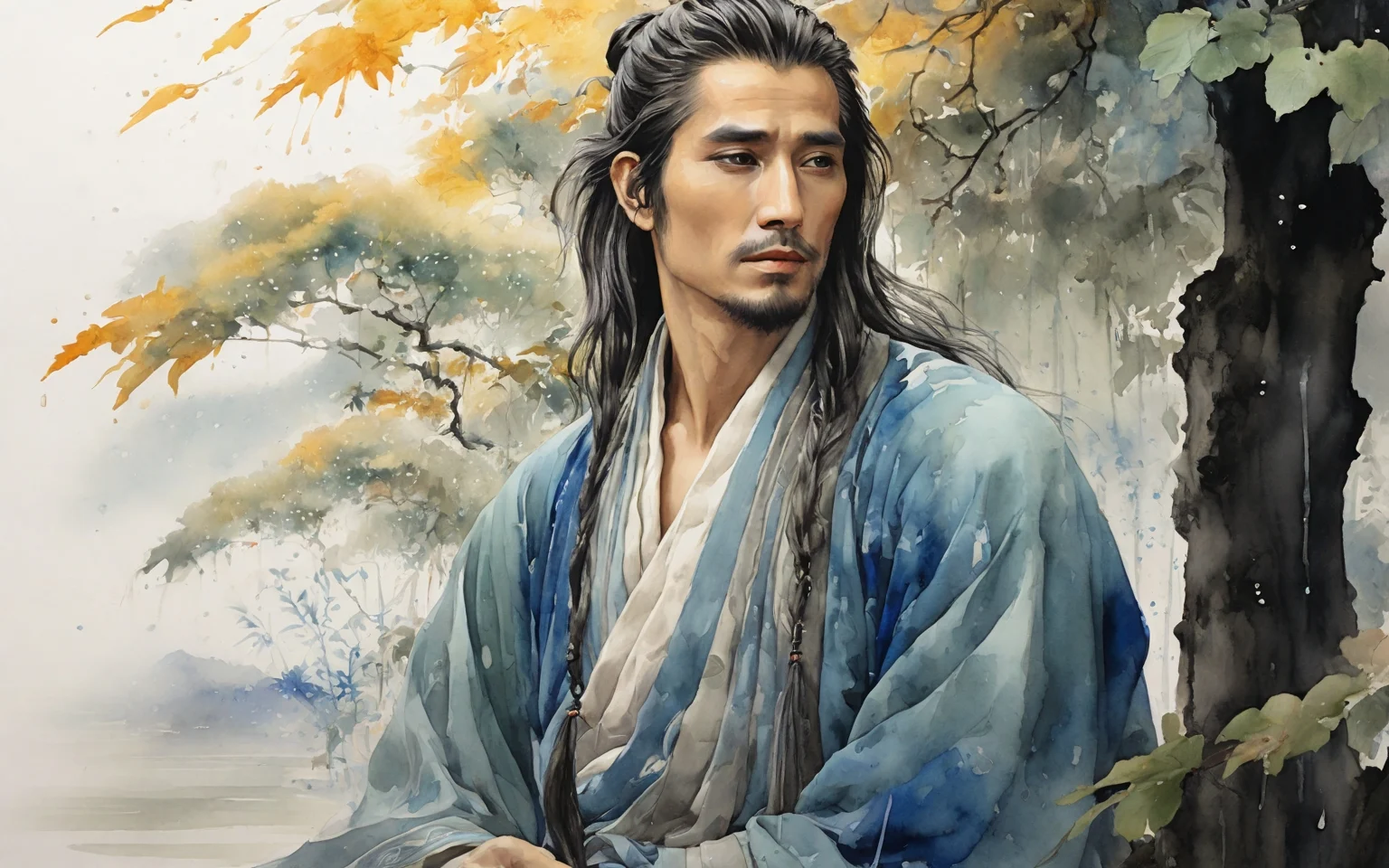
Du Fu (杜甫), 712 - 770 AD, was a great poet of the Tang Dynasty, known as the "Sage of Poetry". Born into a declining bureaucratic family, Du Fu had a rough life, and his turbulent and dislocated life made him keenly aware of the plight of the masses. Therefore, his poems were always closely related to the current affairs, reflecting the social life of that era in a more comprehensive way, with profound thoughts and a broad realm. In his poetic art, he was able to combine many styles, forming a unique style of "profound and thick", and becoming a great realist poet in the history of China.