


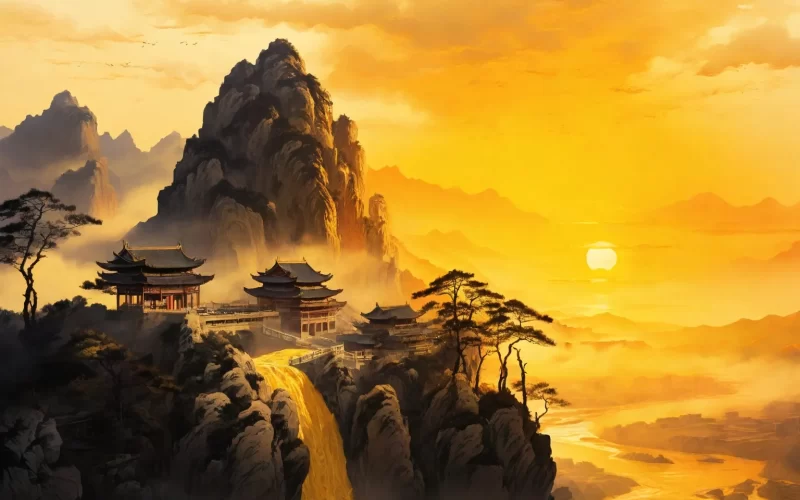
Mountains cover the white sun,
And oceans drain the golden river;
But you widen your view three hundred miles
By going up one flight of stairs.
Original Poem
「登鹳雀楼」
王之涣
白日依山尽,黄河入海流。
欲穷千里目,更上一层楼。
Interpretation
This poem is a timeless masterpiece by the High Tang poet Wang Zhihuan, composed during his ascent of the Stork Tower. Located in present-day Yongji, Shanxi, on the banks of the Yellow River, the Stork Tower was named for the storks that frequented it and was a famous scenic spot for outings in the Tang dynasty. Wang Zhihuan, renowned for his frontier poetry and often ranked alongside Gao Shi and Wang Changling, was described as "bold and grand in vision, untrammeled and exceptionally talented." Sadly, only six of his poems survive, yet each is a classic.
This poem was written during the High Tang period, a time of national strength and prosperity, when scholars possessed broad minds and lofty aspirations. Ascending the tower and gazing into the distance, the poet looked west to the vast, fading sunset where "the sun along the mountain bows" and east to the mighty, surging flow of the "Yellow River seawards flows." What welled up in his heart was not only awe at the natural wonders but also profound reflection on the realm of life. The desire expressed in "You will enjoy a grander sight" embodies the enterprising spirit of High Tang scholars; the admonition in "If you climb to a greater height" represents the poet's shared aspiration for himself, for his era, and for posterity. In just twenty characters, magnificent landscape and life's philosophy are fused into one, creating an enduring masterpiece.
First Couplet: "白日依山尽,黄河入海流。"
Bái rì yī shān jìn, huáng hé rù hǎi liú.
The sun along the mountain bows; The Yellow River seawards flows.
The poem opens with the most economical brushstrokes, outlining a magnificent panorama between heaven and earth. "白日依山尽" describes the western view—that bright sun, leaning against the mountain range, slowly sets. The word "依" (along/leans against) captures the interdependent posture of the setting sun and the mountains, suggesting both reluctance and composure. The word "尽" (bows/ends) conveys the passage of time and the vastness of the world. The next line, "黄河入海流", describes the eastern view—the Yellow River surges mightily, flowing directly toward the sea. The three words "入海流" (seawards flows) use "入" (into) to denote its destination and "流" (flows) to convey its motion, capturing the Yellow River's majestic momentum in full. One west, one east; one setting, one flowing; one still, one moving—together they form a grand picture encompassing heaven and earth, linking past and present.
Second Couplet: "欲穷千里目,更上一层楼。"
Yù qióng qiān lǐ mù, gèng shàng yī céng lóu.
You will enjoy a grander sight If you climb to a greater height.
This couplet shifts from describing scenery to expressing philosophy; it is the soul of the entire poem. "欲穷千里目", with the word "欲" (will/want to), expresses an inner desire—dissatisfaction with what is before the eyes, wanting to see further, to gaze broader. "更上一层楼", with the word "更" (greater), points out the necessity of action—to reach that realm of "a grander sight", one must ascend another level. This word "更" is the "poetic eye" of the entire poem: it signifies both an increase in physical height and an ascent in spiritual realm; it is both a realistic description of the act of climbing the tower and a metaphor for the pursuit in life. The poet does not directly say "one must strive" or "one must advance"; he only uses this simple phrase, "更上一层楼", to articulate an eternal truth: only by constantly transcending can one constantly expand; only by daring to climb the heights can one exhaust the view of a thousand li.
Holistic Appreciation
This is Wang Zhihuan's most widely circulated and profoundly influential masterpiece. The entire poem consists of four lines and twenty characters. Using the ascent of a tower and gazing afar as its entry point, it fuses magnificent landscape with life's philosophy, showcasing the broad-mindedness and enterprising spirit of High Tang scholars.
Structurally, the poem shows a progression from scene to principle, from external to internal. The first couplet unfolds a grand panorama between heaven and earth with "the sun along the mountain bows" and "the Yellow River seawards flows"—a visual feast. The second couplet concludes the whole piece with "You will enjoy a grander sight" and "If you climb to a greater height", elevating the scene before the eyes to a principle of the heart. Between the two lines, the poem moves from the concrete to the abstract, from object to heart, from imagery to philosophy, each layer deepening, forming a seamless whole.
Thematically, the core of this poem lies in the interplay between the word "穷" (to exhaust/to see to the utmost) and the word "上" (to ascend). The "穷" in "欲穷千里目" embodies the desire for exploration—humanity's insatiable drive to see farther. The "上" in "更上一层楼" captures the posture of action—the courage to continually transcend. Between this "穷" and "上" lies the most precious quality of High Tang scholars: dissatisfaction with the status quo, refusal to be bounded by the immediate, forever climbing toward what is higher and farther. Using the ascent of a tower as a metaphor, the poet renders this quality with such simplicity yet such depth that every reader draws from it the power to ascend.
Artistically, the poem's most moving aspect lies in the ingenious conception of "using imagery to convey philosophy." The poet does not say "one must strive and advance"; he only says "更上一层楼". He does not say "vision determines one's realm"; he only says "欲穷千里目". He embodies abstract philosophy within concrete imagery, allowing readers to naturally grasp the profound meaning within the unfolding of the picture. This technique of "not using a single word to preach, yet capturing all the grace" is precisely the highest realm of classical Chinese poetry: "words end but meaning is endless."
Artistic Merits
- Vast Imagery, Boundless Realm: Using the two grand images of "the sun" and "the Yellow River", it outlines a magnificent picture encompassing heaven and earth, linking past and present.
- Interplay of Stillness and Motion, Distinct Rhythm: The first line, "依山尽", shows motion within stillness; the second line, "入海流", shows momentum within motion. The stillness and motion complement each other perfectly.
- Natural Transition from Scene to Principle, Seamless Unity: The first two lines describe scenery; the last two lines convey a principle. The transition is natural, without a trace of artifice.
- Concise Language, Rich Meaning: Within twenty characters, there is painting, emotion, and principle. Each word is ordinary, yet each carries immense weight.
Insights
This poem, through an ascent of a tower, speaks to an eternal theme—only by constantly transcending can one constantly expand; only by daring to climb the heights can one exhaust the view of a thousand li.
First, it lets us see "the limits of vision." Standing below the tower, one's view is limited; ascending one level, one's vision broadens. Life is also like this—confined to the immediate, one sees only a small space; elevating one's realm, one can see the vastness of heaven and earth. It reminds us: often, it is not that the world is too small, but that we stand too low.
On a deeper level, this poem makes us contemplate "the eternity of pursuit." "欲穷千里目" is a kind of desire, humanity's insatiable thirst for knowledge and exploration. Yet beyond a "thousand li", there are "ten thousand li"; above "one level", there are "higher" levels. True pursuit never has an endpoint; true climbing never has a summit.
And what is most inspiring is the proactivity of that "更上一层" in the poem. The poet does not linger in admiration of the scenery; he concludes with "更上一层楼", transforming the posture of viewing into the power of action. This shift from "seeing" to "doing" is precisely the core of the enterprising spirit—not passively appreciating the world, but actively expanding one's own world.
This poem writes of an ascent during the High Tang, yet allows everyone with dreams to find resonance within it. The vastness of that "the sun along the mountain bows" is the distant horizon in the eyes of every climber; the grandeur of that "the Yellow River seawards flows" is the journey in the heart of every dream-chaser; the admonition of that "If you climb to a greater height" is the shared belief of everyone unwilling to be mediocre. This is the vitality of poetry: it writes of a poet's reflections, but one reads of all people, in all times, who strive to climb upward.
Poem Translator
Kiang Kanghu
About the Poet
Wang Zhihuan (王之涣 688 - 742), a native of Taiyuan, Shanxi Province, was a renowned frontier fortress poet of the High Tang period. In his youth, he was chivalrous and spirited; in middle age, he reformed his ways and devoted himself to study. He served as Records Official of Hengshui in Jizhou but resigned due to false accusations and returned to his hometown. In his later years, he was appointed Sheriff of Wen'an County and died while in office. His poetry is celebrated for its frontier themes, characterized by boldness, vigor, and strong musicality, and was set to music and widely sung by court musicians during his time. Although only a few of his poems survive, he is regarded as one of the "Four Great Frontier Fortress Poets" of the Tang Dynasty, alongside Gao Shi, Cen Shen, and Wang Changling. His works fully embody the grandeur and solemn pathos characteristic of the High Tang spirit.