


All flowers in late spring have fallen far and wide,
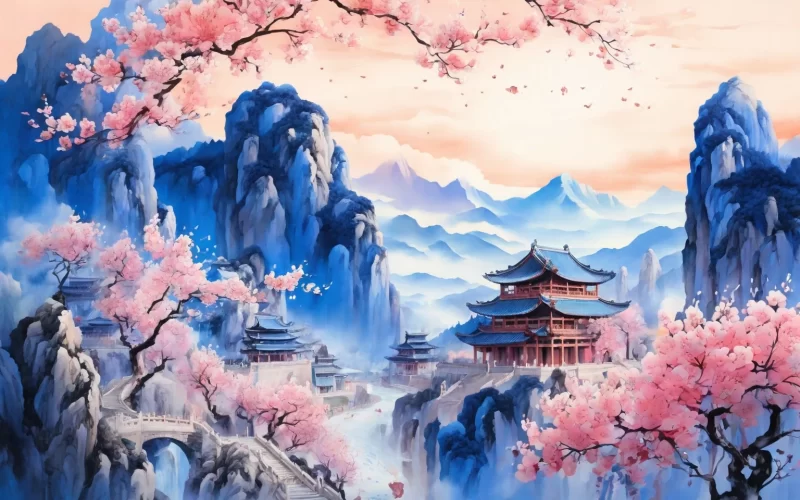
But peach blossoms are full-blown on this mountainside.
I oft regret spring's gone without leaving its trace;
I do not know it's come up to adorn this place.
Original Poem
「大林寺桃花」
白居易
人间四月芳菲尽,山寺桃花始盛开。
长恨春归无觅处,不知转入此中来。
Interpretation
This poem was composed in the early summer of 817 CE, during Bai Juyi's tenure as the Marshal of Jiangzhou, in the third year of his exile to this provincial post. In the late spring, when blossoms had faded in the lowlands, the poet climbed to the Great Forest Temple atop Mount Lu's Incense Burner Peak. There, in that high, cold, and secluded place, he came upon a grove of peach trees in full, unexpected bloom. This natural anomaly shattered his conventional understanding of the seasons and quietly illuminated the undimmed poetic spirit and latent vitality within him, even in adversity. Written in language as plain as speech and as fresh as a mountain spring, the poem captures this moment of surprise and insight, standing as a model Tang quatrain that seamlessly blends quiet wisdom with vivid scenery.
First Couplet: “人间四月芳菲尽,山寺桃花始盛开。”
Rénjiān sì yuè fāngfēi jìn, shān sì táohuā shǐ shèngkāi.
In the world of men, all fragrant blooms have faded in fourth moon; / Here at the mountain shrine, peach flowers have just burst in boon.
The poem opens with a simple contrast, yet one charged with spatial and temporal depth. "The world of men" and "the mountain shrine" denote not just a difference in altitude but suggest distinct realms—the transient, bustling world below versus the secluded, timeless space of the mountain retreat. The stark opposition between "have faded" and "have just burst" breaks the common-sense, linear progression of the seasons. The statement reveals the poet's astonishment at nature's secret workings and his dawning recognition of life's persistent, resilient force.
Second Couplet: “长恨春归无觅处,不知转入此中来。”
Cháng hèn chūn guī wú mì chù, bùzhī zhuǎn rù cǐ zhōng lái.
I've long lamented spring's departure, finding nowhere it lay; / Little I knew it had turned and hidden itself here, away.
The focus shifts from observation to a personal, emotional response. "Long lamented" expresses the universal sorrow over spring's end, tinged with the poet's own melancholy over his exile and passing years. "Finding nowhere it lay" deepens this sorrow into a sense of helpless loss. The word "little I knew" introduces a sudden, joyful reversal. The phrase "turned and hidden" is wonderfully alive; it personifies spring as a playful, willful entity and suggests hidden cycles within the natural world. This is more than a geographical discovery; it is an expansion of the mind's eye—a realization that beauty and renewal persist, often awaiting discovery in unexpected places.
Holistic Appreciation
This 28-character heptasyllabic quatrain traces a complete arc from puzzled observation to enlightened delight. The first two lines objectively record a natural phenomenon that defies expectation. The last two lines translate that physical fact into a personal and philosophical insight. Using the "peach blossoms" as a catalyst, the poem transforms the conventional theme of mourning for spring's end into an active, hopeful quest. It embodies Bai Juyi's poetic ideal: profound meaning and quiet wisdom conveyed through the simplest, most accessible language.
Artistic Merits
- Masterful Juxtaposition and Reversal: The contrasts between "the world of men" and "the mountain shrine," between "faded" and "burst," and between "long lamented" and "little I knew" create a powerful tension that is delightfully resolved by the final, clever image of spring's playful hide-and-seek.
- Personification Infused with Insight: By imagining spring as an entity that can "turn" and "hide," the poet injects whimsy and warmth into the seasonal cycle, effortlessly guiding the reader toward a gentle philosophical truth: what is lost in one place may be found in another.
- Utterly Natural Diction: The poem's language is colloquial and clear, using common words like "the world of men," "little I knew," and "here." This simplicity makes the moment of discovery and the feeling of joy immediately accessible, demonstrating the poet's supreme skill in achieving depth through clarity.
- Expansion of Poetic Space: The poem uses vertical movement—from the lowland to the mountaintop—to challenge a flat, linear experience of time. It reveals a multi-dimensional world where different temporal rhythms coexist, enriching the classical poetic imagination of time and space.
Insights
The poem's lasting appeal stems not just from its charming scene but from the liberating perspective it offers. The poet, in the personal "fourth moon" of exile and disappointment, ascends the mountain and finds an unexpected "burst in bloom." This is a potent metaphor: when prospects seem bleak in one dimension of life, a shift in perspective—a climb to a different vantage point—can reveal unexpected vitality and hope.
It reminds us that our sorrows often arise from a limited view ("finding nowhere it lay"). The world's abundance does not follow our expected scripts. By maintaining curiosity, openness, and the willingness to explore, we may discover that what we thought was gone has merely "turned and hidden" elsewhere, waiting for our gaze to find it. The poem is thus both a celebration of nature's surprises and a gentle guide for the heart: true renewal exists as much in a receptive spirit as it does in the turning world.
Poem translator
Xu Yuanchong (许渊冲)
About the Poet
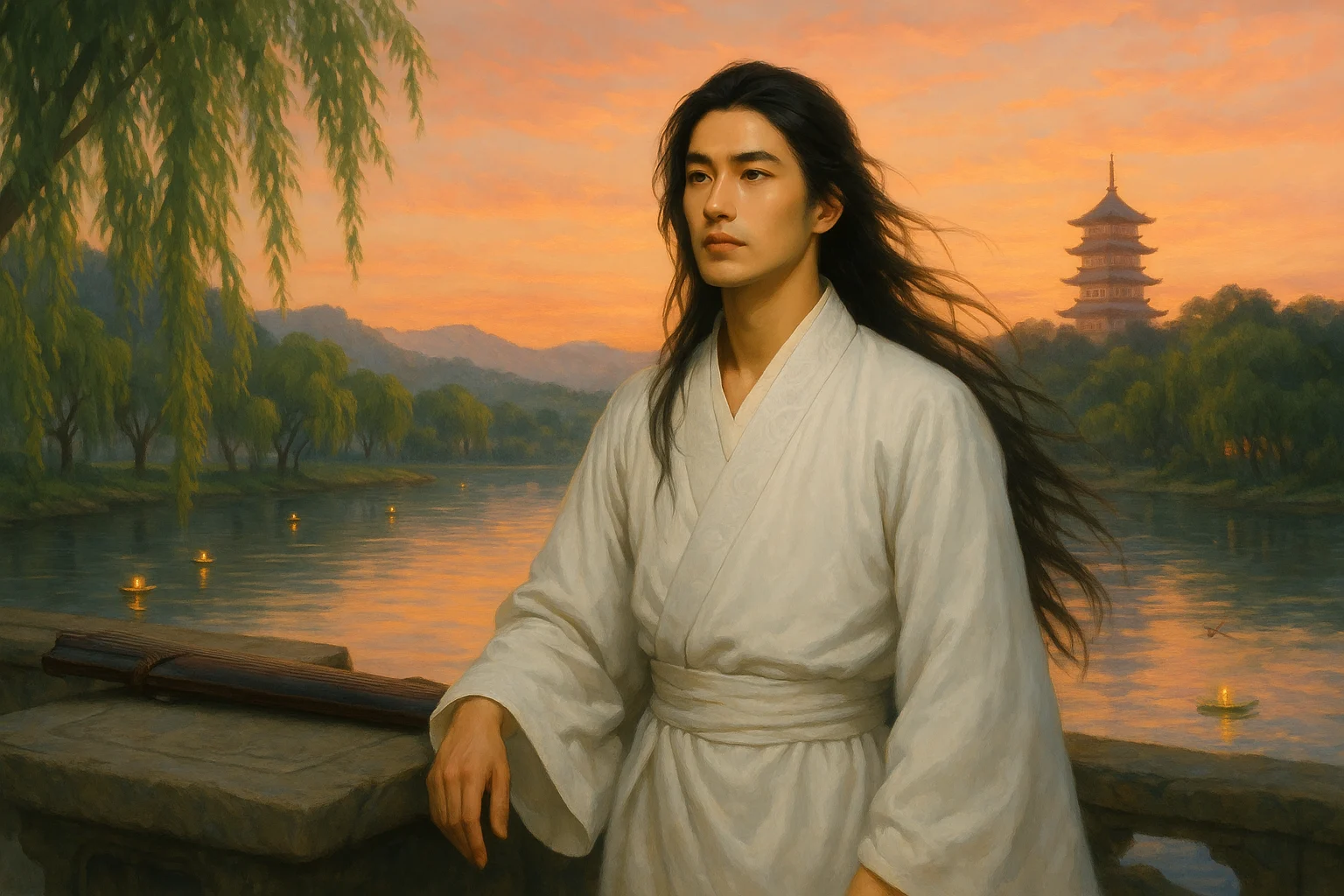
Bai Juyi (白居易), 772 - 846 AD, was originally from Taiyuan, then moved to Weinan in Shaanxi. Bai Juyi was the most prolific poet of the Tang Dynasty, with poems in the categories of satirical oracles, idleness, sentimentality, and miscellaneous rhythms, and the most influential poet after Li Bai Du Fu.