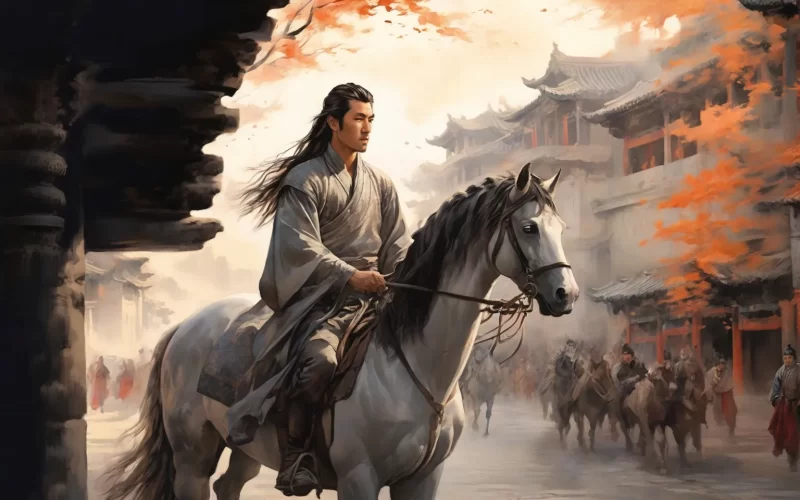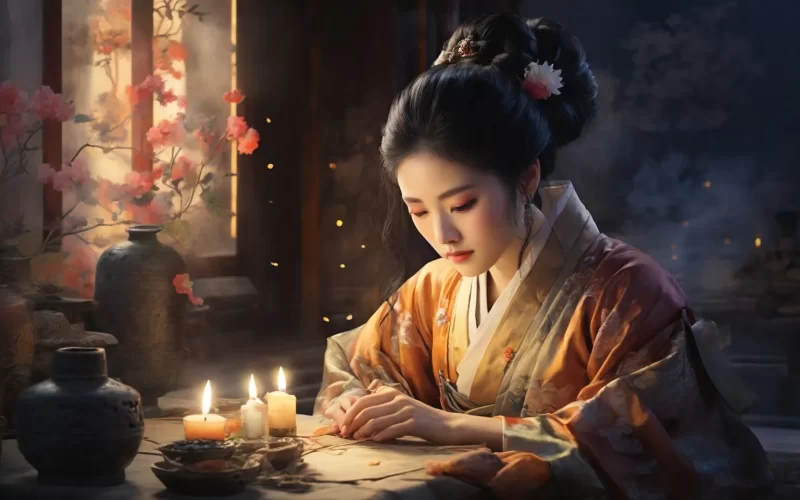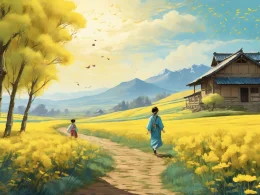



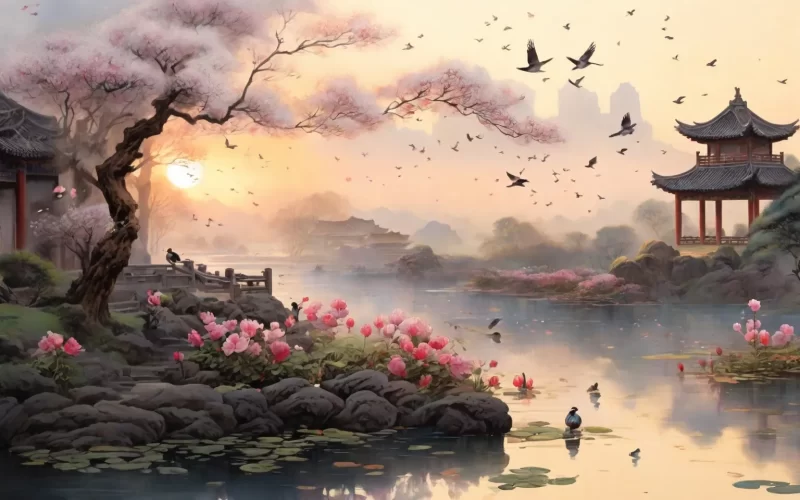
I awake light-hearted this morning of spring,
Everywhere round me the singing of birds --
But now I remember the night, the storm,
And I wonder how many blossoms were broken.
Original Poem
「春晓」
孟浩然
春眠不觉晓,处处闻啼鸟。
夜来风雨声,花落知多少。
Interpretation
This famous poem was composed after Meng Haoran's final retirement to his hometown, Xiangyang, though the exact year is unknown. Judging by the poetic state of mind, it likely belongs to the period between 729 and 740 AD—the final chapter of his life, following the disappointment in Chang'an, his wanderings in Wu and Yue, and his eventual return to Lumen Mountain.
These were years free from thoughts of courtly service or sighs of unfulfilled ambition. He was no longer the office-seeker lamenting "in solitude, what do I await?"; nor the wanderer who would "send two lines of tears"; nor the destitute man whose "gold is spent." He was simply a commoner outside Xiangyang, in the Lumen hills, waking to birdsong at dawn, retiring to the sound of wind at night, rousing on an ordinary spring day and writing this ordinary poem. Yet this "ordinary" poem became one of the most extraordinary works in Chinese poetic history. For a millennium, three-year-old children have memorized it, and centenarians have grasped its meaning; peddlers and porters love its simplicity, while learned scholars savor its depth. In twenty characters, it contains a state of mind Meng Haoran reached only after a lifetime: no longer questioning the world, no longer resentful of fate, but simply perceiving quietly and cherishing tenderly.
This poem was not written; it grew naturally from the daily breath of a man who had come home.
First Couplet: "春眠不觉晓,处处闻啼鸟。"
Chūn mián bù jué xiǎo, chù chù wén tí niǎo.
Slumbering in spring, unaware of dawn; / Everywhere, I hear the chorus of the birds.
The poem begins with a moment of awakening—not a jarring one, but a natural rousing. "Unaware of dawn" perfectly captures the deep, satisfying sleep of spring. This is not a night mooring on a journey, nor fitful sleep in a hostel, nor the half-awake state of "my boat moves and moors by a mist-veiled sandbar. / As daylight fades, a traveler's sorrow stirs anew." This is the complete relaxation possible only in one's own home, in one's own bed, with nothing to worry about. "Everywhere, I hear the chorus of the birds" is the first message from the world received upon waking. The poet does not write of "seeing," but of "hearing"—his eyes are not yet open, yet birdsong flows into his ears from all directions. "Everywhere" pushes the sense of spring's presence to its limit: it is not one bird singing, not song from a single direction, but the entire space filled with birdsong. This sound is not a disturbance, but a welcome; not a clamor, but spring's own announcement of itself.
Final Couplet: "夜来风雨声,花落知多少。"
Yè lái fēngyǔ shēng, huā luò zhī duōshǎo.
Through the night, the sounds of wind and rain; / I wonder how many blossoms fell.
The poem shifts from morning to night, from the tangible to the intangible, from hearing to recollection. "The sounds of wind and rain" are sounds from memory—the poet is not writing during the stormy night, but on the following quiet morning, retrieving from the present stillness the clamor of the past night already swept away by time. The temporal structure here is exquisite: the poet stands in the "present," looks back to "last night," separated by mere hours yet feeling like an entire spring. "How many" is a question needing no answer. This is not an inquiry into the number of fallen blossoms, but a gaze upon passing itself. The poet does not lament, does not question, does not climb to look, does not count. He simply lies in bed, listens to the present birdsong, thinks of last night's wind and rain, and softly, almost to himself, asks.
This question is the poem's most moving point, the most concentrated expression of Meng Haoran's late-life state of mind. He is no longer the anxious man "wishing to cross, but finding no boat," nor the resentful man lamenting "for lack of talent, I'm ignored by the wise lord," nor even the man who would "send two lines of tears" to a distant friend. He simply lies still, lets last night's wind and rain flow through his heart, lets those unseen petals drift down, one by one, in his imagination.
He knows the blossoms have fallen. He knows spring is passing. But he no longer tries to grasp a single one.
Overall Appreciation
This is Meng Haoran's shortest poem, yet the terminus of his lifelong spiritual journey. The poem depicts a morning of homecoming. For thirty long years prior, he had left the mountains, sought office, failed the exam, wandered, faced hardship, aged, journeyed towards Chang'an, and finally walked back to Xiangyang. The resolve of "I've given up seeking office at the northern gate," the sorrow of "send two lines of tears," the hardship of "my gold is spent," the anguish of "my ambition's worn out"—all gently fade on this spring morning. He is no longer a "traveler" in any sense—not in Chang'an, not in Wu and Yue, not on the River at Tonglu. He is the master of his own home, the recluse of Lumen's moon, the dweller resting deeply in spring.
Yet the poem's profundity lies in not resting on the contentment of "dwelling." The final couplet, "Through the night, the sounds of wind and rain; / I wonder how many blossoms fell," gently unveils a trace of existential poignancy within profound peace. This is not sadness, not regret, not a protest or accusation against fate. It is a tender awareness: he knows spring will pass, blossoms will fall, just as he knows he approaches the evening of his own life. He knows, and he accepts.
Thus, this poem becomes Meng Haoran's ultimate answer to his own life. What Chang'an did not give him, fame and fortune did not give him, patronage-seeking did not give him, even poetry did not give him—spring gave him. Not a specific spring, but this morning he finally awoke in spring, this moment filled with birdsong, after the wind and rain.
Artistic Features
- Circular, Nested Temporal Structure: Twenty characters build three layers of time. "Slumbering in spring, unaware of dawn" is the present awakening; "Everywhere, I hear the chorus of the birds" is perception in the now; "Through the night, the sounds of wind and rain" is the echo of last night; "I wonder how many blossoms fell" is a question suspended towards the future. Tracing from now to then, from then to now, and from now gazing towards an unknown tomorrow. This circular, nested structure gives the brief four lines a profound sense of temporal depth.
- The Absolute Dominion of Sound: Three of the four lines describe sound—birdsong, wind and rain, the falling blossoms (an imagined sound). Meng Haoran deliberately blocks sight, not describing lush blossoms, sparkling sunlight, or even whether his eyes are open. This monopoly of hearing grants the poem a unique purity: it is not the world filtered through the eyes, but the world flowing directly into the soul.
- The Complete Concealment of the Subject: The poem contains not a single "I," yet nowhere does it fail to write of the "I." The sleeper is "I," the perceiver is "I," the listener is "I," the rememberer is "I," the questioner is "I." This hidden subjectivity is more inclusive than directly stating "I"—every reader can place themselves into this spring morning, becoming the one lying in bed, listening to birds, wondering about flowers.
- The Aesthetics of the Suspended Question in "How Many": The poem ends with a question requiring no answer. This is the most mature expression of emotion in classical Chinese poetry—a question not seeking a solution is itself the answer. The poet is not seeking knowledge, but offering a salute; not questioning the world, but bowing to the passage of time.
- The Paradoxical Unity of Extreme Simplicity and Extreme Depth: Twenty characters, not a single obscure word, not a single allusion, not a single complex sentence structure. A three-year-old can read it; a centenarian can comprehend it. Yet these twenty characters contain Meng Haoran's entire life—his ideals, his hardships, his wanderings, his return, his letting go, his tenderness. The simplest language carries the deepest life.
Insights
This work tells us: One can, after experiencing everything, still maintain a tender awareness of the world.
Meng Haoran saw Chang'an's splendor and also the desolation of failure; he experienced the hardship of "my gold is spent" and the wanderings of "send two lines of tears." He knew spring would pass, flowers would fall, people would age. He knew fate had not given him what he wanted. Yet, awakening on this spring morning, he held no resentment, no lament, no self-pity. He simply listened to the birdsong, thought of last night's wind and rain, and softly, almost tenderly, asked: I wonder how many fell. This is not regret for spring; it is respect for life itself—respect for its brevity, for its beauty, for its constant coming and going, its endless cycle of life and death, in its own unique way.
Contemporary life is filled with the pursuit of certainty: we want answers, we want control over outcomes, we want to predict the future, we want to grasp fate in our own hands. Yet, in this small poem, Meng Haoran offers a completely different posture towards life: not controlling, yet still being present; not certain, yet still caring. He did not know how many blossoms fell. This did not prevent him, on this spring morning, from thinking of those blossoms. For a thousand years, countless people have awoken on such a spring morning, heard the birdsong, and thought of last night's wind and rain. They may not know who Meng Haoran was, where Lumen Mountain is, or that a commoner-poet wrote such a poem during the Kaiyuan era. But in their hearts, that question will gently surface.
It is no longer Meng Haoran asking. It is spring itself asking.
I wonder how many blossoms fell.
Poem translator
Kiang Kanghu
About the poet
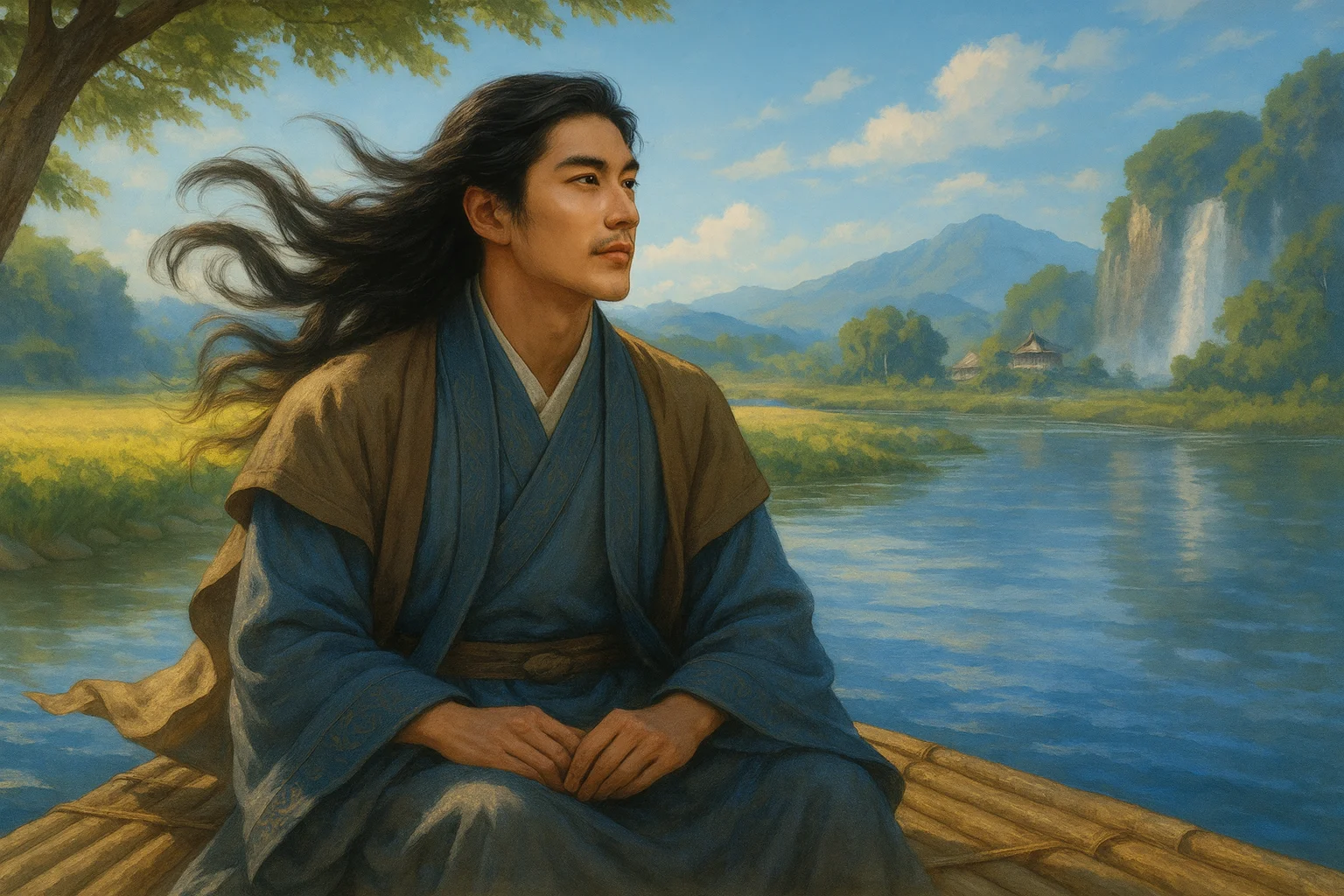
Meng Haoran (孟浩然), 689 - 740 AD, a native of Xiangyang, Hubei, was a famous poet of the Sheng Tang Dynasty. With the exception of one trip to the north when he was in his forties, when he was seeking fame in Chang'an and Luoyang, he spent most of his life in seclusion in his hometown of Lumenshan or roaming around.