


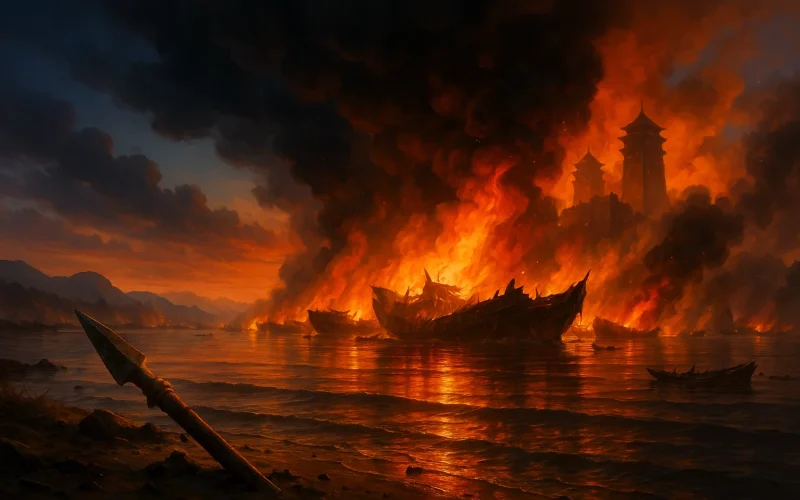
A broken spear in sand still unrusted lies;
I clean and see the past before my eyes.
Had the east wind not helped General Zhou’s fleet,
The two fair brides in spring would be captives sweet.
Original Poem
「赤壁」
杜牧
折戟沉沙铁未销,自将磨洗认前朝。
东风不与周郎便,铜雀春深锁二乔。
Interpretation
This poem was composed between 842 and 844 AD during the Huichang reign of Emperor Wuzong of Tang, while Du Mu was serving as the Prefect of Huangzhou, an assignment away from the capital. Near the administrative seat of Huangzhou was a site known as Red Cliff (Chibi, not the actual location of the famous Three Kingdoms battle). This geographical misidentification恰恰 sparked the poet's historical imagination and creative inspiration. The Huichang era was marked by crises such as Uighur incursions and rebellions in the Ze and Lu provinces. Although the chief minister Li Deyu implemented measures to address these, the overall decline of the dynasty's strength was difficult to reverse. Du Mu, who always considered himself a talent capable of aiding a ruler, found himself repeatedly posted to regional positions, far removed from the central decision-making apparatus. His state of mind, one can well imagine, was deeply frustrated.
This poem is a product born from this intertwining of personal circumstance and the prevailing mood of the era. Visiting this historic site, the poet's intent was far from simple nostalgia or lamenting the present through the past. Instead, he re-examined that famous battle—long enshrined in orthodox narratives celebrating the righteous victory of the Sun-Liu alliance—with the detached and critical gaze of a historical commentator. Bypassing direct praise of Zhou Yu's heroic brilliance, Du Mu isolated the "east wind" as the decisive, yet utterly contingent, factor and boldly deduced its opposite outcome. This move not only displays his unconventional historical perspective but also, on a deeper level, uses the role of chance within the historical chess game to serve as a metaphor for the vulnerability and helplessness of individual talent when confronted by the relentless tide of history and the opportune moments of an era. Renowned for its startling conception and incisive argument, this poem became a model work within the ancient Chinese tradition of "subverting conventional views" and "presenting historical theses" through poetry. Its influence extended far beyond the realm of literature, establishing it as a classic text that later generations could not bypass when pondering the relationship between historical necessity and contingency.
First Couplet: 折戟沉沙铁未销,自将磨洗认前朝。
Zhé jǐ chén shā tiě wèi xiāo, zì jiāng mó xǐ rèn qián cháo.
A broken halberd buried in sand, its iron not yet corroded away; I retrieve it, clean and polish, and find relics of an earlier day.
The poet engages with history through an act reminiscent of an archaeologist. "A broken halberd buried in sand" is the brutal residue of war, a relic worn by time; "its iron not yet corroded away" suggests that the material traces and latent energy of that earth-shattering conflict have not been completely erased by time. The series of actions—"retrieve it, clean and polish"—is deeply symbolic: "clean and polish" represents an attempt to scrub away the rust of time, to restore history's original face; "and find relics of" is an act of identification and authentication, representing the poet's active effort to engage in dialogue with history, to "identify" and "reinterpret" that past. In merely ten characters, the poet transforms from a passive observer in the present into an active participant in and interpreter of history.
Final Couplet: 东风不与周郎便,铜雀春深锁二乔。
Dōngfēng bù yǔ Zhōu Láng biàn, tóngquè chūn shēn suǒ Èr Qiáo.
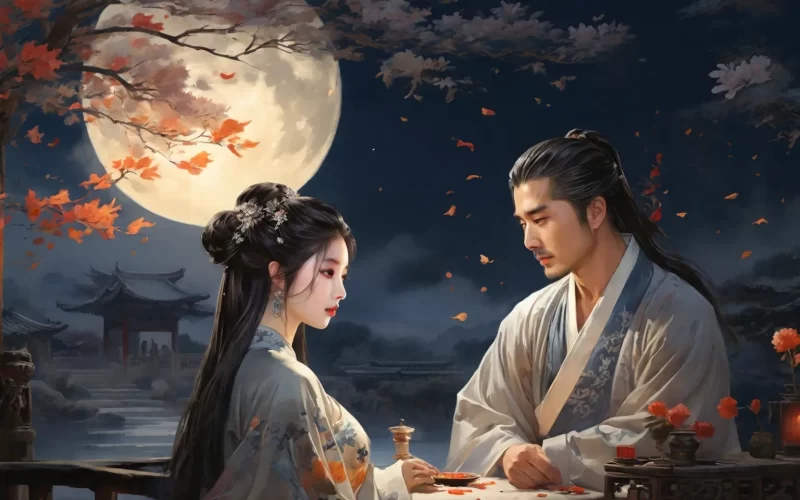
Had the east wind not lent General Zhou Yu its timely aid, In the deep spring of Bronze Bird Tower, the two Qiaos would be captive maids.
This couplet delivers the poem's startling historical thesis and forms its very soul. The poet employs a profoundly subversive line of hypothetical reasoning. He does not deny Zhou Yu's talent but attributes the decisive victory to the "east wind"—an uncontrollable natural force. This stroke ruthlessly exposes the disquieting role of contingency underlying the grand historical narrative. The deduced consequence, however, does not land on themes of dynastic change or widespread suffering but focuses instead on the fate of the "two Qiaos." The "Bronze Bird Tower" was Cao Cao's pleasure palace in his capital Ye; "captive maids" envisions the wives of Eastern Wu's highest leaders (Elder Qiao, wife of Sun Ce, and Younger Qiao, wife of Zhou Yu) as spoils of war. Du Mu modifies "Bronze Bird Tower" with "deep spring," embedding a chilling assertion of power dynamics within a seemingly sensual and lush image. This hypothesis uses the personal fate of two women to leverage, with elegant yet devastating effect, the entire weight of historical consequence, reducing a battle that decided the tripartite division of the realm to a question of control over women's destinies. Its unique angle and profound irony are unparalleled.
Holistic Appreciation
This heptasyllabic quatrain is a paradigmatic example within Chinese historical poetry of "using poetry for argumentation" without succumbing to dry abstraction. It perfectly integrates the concrete discovery (the broken halberd), the personal action (cleaning and polishing), the bold hypothesis (the east wind failing to aid), and the symbolic outcome (the captive Qiaos), constructing a complete and tension-filled world of meaning within just twenty-eight characters.
The poem's power lies in its multiple layers of reversal and contrast. First, a reversal of perspective: it does not celebrate the victor's glory but contemplates the possible fate of the vanquished (Cao Cao's victory); it does not depict the grand spectacle of war but focuses on a minuscule relic (the halberd) and the intimate consequence of defeat (the captive Qiaos). Second, a reversal of logic: it does not emphasize the inevitable success of human strategy but highlights the decisive role of chance and opportunity. Finally, a reversal of imagery: it employs the soft, beautiful imagery of "deep spring" and "the two Qiaos" to carry the brutal reality symbolized by "captive maids." This consistent strategy of inverting conventional narrative forces readers to abandon familiar historical conclusions and reconsider fundamental questions of success and failure, heroism, chance, and necessity.
Du Mu's brilliance lies in enveloping his profound historical insight and sharp critique entirely within beautiful imagery and an implied hypothesis. The poem's surface is cool and detached, yet powerful undercurrents surge beneath. It contains both a deep recognition of historical complexity and a subtle intimation of the poet's own profound frustration regarding his unrecognized talent and the "east wind" of opportunity that never arrived.
Artistic Merits
- The Art of "Expansive Insight from a Minute Detail": The poet begins with the "broken halberd"—an insignificant battlefield relic—and from it unravels thread by thread until he arrives at a grand pronouncement on historical trajectory. This narrative path from a microscopic object to macroscopic history is both tangible and deeply philosophical, showcasing Du Mu's masterful conceptual skill.
- The Literary Presentation of Hypothetical Historical Thought: "Had the east wind not lent…" is a classic counterfactual hypothesis. This mode of thinking belongs to deep historical analysis; by introducing it into poetry, Du Mu unfolds a line of reasoning about historical possibilities through the vehicle of literary imagination. This broke the mold of historical poetry being largely confined to description and lament, inaugurating a new realm of historical discourse through poetic form.
- The Political Metaphorical Function of Female Imagery: The "two Qiaos" are not ordinary female figures; as wives of the central figures of the Eastern Wu regime, their status carries potent political symbolism. "The two Qiaos would be captive maids" thus becomes the ultimate metaphor for national humiliation and the overthrow of a state. By writing of the fate of the state through the fate of these women, Du Mu presents political brutality in an intensely personal and emotional manner, achieving a startling artistic effect.
- The Mutual Reinforcement of a Dispassionate Historical Eye and Poetic Diction: Phrases like "broken halberd buried in sand" and "deep spring of Bronze Bird Tower" are highly visual and poetically evocative, while logical connectors and verbs like "had…not…" and "would be captive" are marked by cool, analytical force. The poetic beauty and the rigor of the historical argument support and enhance one another, forming the distinctive "vigorous and incisive" style characteristic of Du Mu's historical poems—works that are both brilliantly crafted and penetrating in their insight.
Insights
This work acts as a sharp scalpel of thought, dissecting the thick shell encasing historical certainties to expose the nerves of contingency and veins of fragility within its very fabric. First, it challenges our linear understanding of "heroes" and "success." Du Mu reminds us that the great achievements recorded in history often rely on a series of specific, unrepeatable conditions (like that timely east wind). This is not to deny human effort and talent but to point out the openness of historical processes and their profound dependence on chance and circumstance. For the individual, the insight is this: while exerting one's utmost effort, it is necessary to maintain a sense of reverence and clarity toward fate (opportunity, the spirit of the times). In success, one need not claim all credit; in adversity, one need not bear all blame.
Secondly, it demonstrates another possibility for historical narrative—re-examining the center and the powerful from the perspective of the margins and the vulnerable (as symbolized by the "two Qiaos"). When history is typically written by the victors, focusing on the achievements of emperors and generals, Du Mu turns his gaze toward women who might have become war trophies. This is undoubtedly a historical perspective imbued with humanistic concern and a critical spirit. It enlightens us that to understand the full weight of history, we must listen for the subtle cries and silences drowned out by grand narratives.
Ultimately, this poem is Du Mu's nuanced expression of his relationship with his own era. Was not Zhou Yu, waiting for the "east wind," also the poet himself, waiting for an opportunity to fully apply his talents? And the potential outcome of "the two Qiaos captive in Bronze Bird Tower's deep spring" perhaps allegorizes the poet's deep-seated dread that, should the nation's fortunes not revive, the very essence of its civilization might be plundered. Therefore, this poem is not merely a lament over an ancient battlefield from a millennium past; it is the ardent heart of a loyal son, filled with anxiety and longing, beating amidst the storms of the late Tang. With every beat, it questions opportunity, warns of crisis, and yearns for that "timely aid" of the east wind that would allow talent to blaze forth in its full brilliance.
About the poet
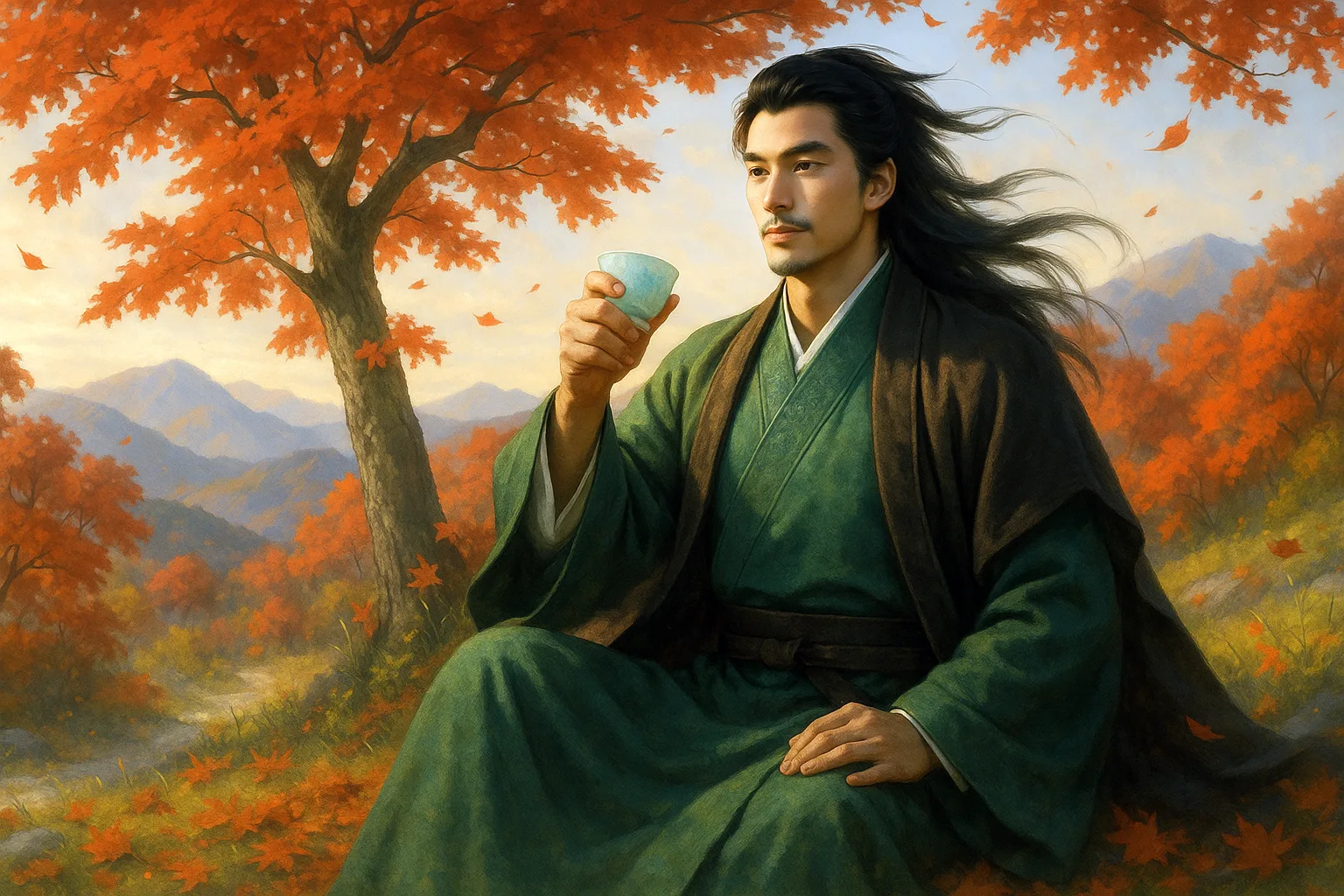
Du Mu (杜牧), 803-853 AD, was a native of Xi'an, Shaanxi Province. Among the poets of the Late Tang Dynasty, he was one of those who had his own characteristics, and later people called Li Shangyin and Du Mu as "Little Li and Du". His poems are bright and colorful.