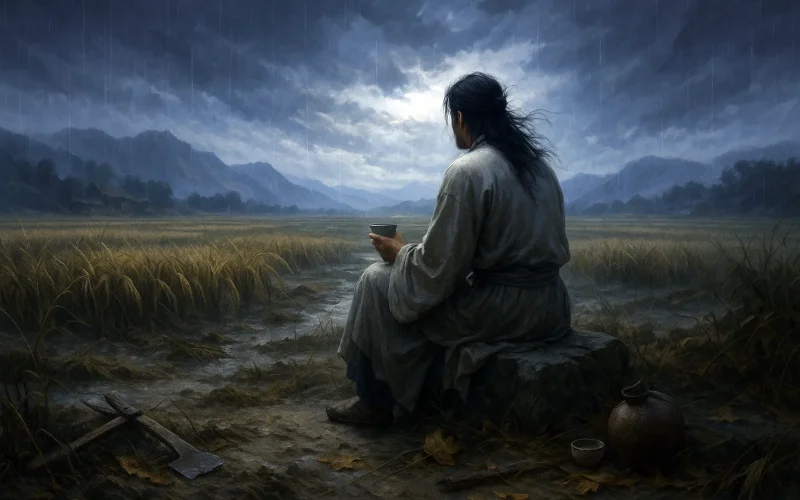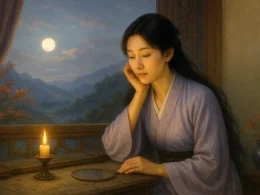



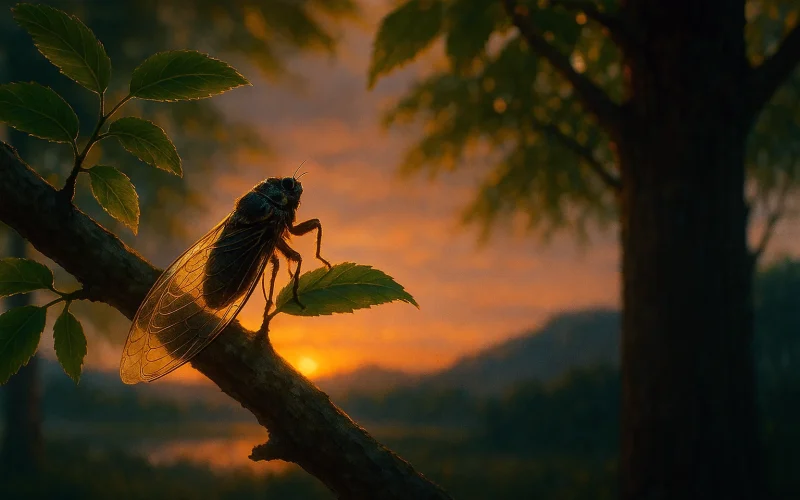
Pure of heart and therefore hungry,
All night long you have sung in vain -
Oh, th is final broken indrawn breath
Among the green indifferent trees!

Yes, I have gone like a piece of driftwood,
I have let my garden fill with weeds.
I bless you for your true advice
To live as pure a life as yours.
Original Poem
「蝉」
李商隐
本以高难饱,徒旁限费声。
五更疏欲断,一树碧无情。
薄宦梗犹泛,故园芜已平。
烦君最相警,我亦举家清。
Interpretation
This poem was written in the autumn of 851 AD, during Li Shangyin's service as a Salt and Iron Monopoly judge, marking the late phase of his official career. That spring, his wife of many years, née Wang, passed away after a prolonged illness, plunging the poet into emotional and spiritual collapse. "The Cicada" was born within this personal winter—the "purity and want" it describes is no longer mere material scarcity but a state of desolation following the complete erosion of his inner world.
The circumstance depicted in "my humble post is like a drifting stalk" encapsulates the poet's entire official life. Having been ensnared in the Niu-Li factional strife, Li Shangyin spent years navigating the narrow spaces between powerful factions, much like the peach-stalk puppet adrift on water (an allusion to Strategies of the Warring States), rootless and directionless. The imagery of "my old garden's weeds grow level" refers not only to the physical neglect of his hometown but, more significantly, implies the loss of his spiritual homeland after long years of wandering. For the poet at this juncture, the cicada's song is no longer a simple natural phenomenon but a piercing, resonant call from fate itself.
First Couplet: 本以高难饱,徒劳恨费声。
Běn yǐ gāo nán bǎo, túláo hèn fèi shēng.
Your nature is to dwell on high, hard-pressed to feed;
In vain your bitter cries expend themselves, a wasted need.
Explication: The word "high" is the poem's inaugural keyword, signifying both the cicada's physical perch and serving as a metaphor for the poet's elevated spiritual plane and official standing. By deliberately pairing "high" with "hard-pressed to feed," Li Shangyin deconstructs the traditional scholar's assumption that "high position ensures ample provision." The "bitterness" in "bitter cries" belongs not to the insect but reveals the poet's projection of his own emotions onto the creature, transforming natural sound into conscious lament. This very act of projection demonstrates the poet's profound empathy with the cicada.
Second Couplet: 五更疏欲断,一树碧无情。
Wǔgēng shū yù duàn, yī shù bì wúqíng.
By the fifth watch, your thinning song frays near its end;
The tree stands wholly green, a callous, untouched friend.
This couplet presents one of the most powerfully tense images in classical Chinese poetry. "Your thinning song frays near its end" portrays life's extremity through the衰竭 of sound, a diminishment along the temporal axis. "The tree stands wholly green" portrays environmental indifference through visual lushness, a plenitude within the spatial dimension. The tree's "callous" nature—not literally unfeeling—highlights the残酷 objectivity of natural law: an individual's struggle is insignificant against the backdrop of universal vitality. This is both an unflinching observation of natural order and a profound metaphor for the human condition.
Third Couplet: 薄宦梗犹泛,故园芜已平。
Bó huàn gěng yóu fàn, gùyuán wú yǐ píng.
My lowly office: a stalk that drifts, unbounded;
My homeland garden: choked by weeds, leveled, unfounded.
Here lies the crucial pivot from creature to man. "A stalk that drifts" alludes to the fable of the peach-stalk puppet from Strategies of the Warring States, defining the essence of an official's itinerant life as rootless, passive drifting. "Choked by weeds, leveled" employs the image of wild grasses overgrowing and flattening garden paths to suggest the utter severance of the return journey. These allusions lend historical depth to the poet's personal rootlessness: he wanders not only in space but has also lost his mooring within the long flow of civilization. The desolation of home and the desolation of spirit here mirror each other.
Fourth Couplet: 烦君最相警,我亦举家清。
Fán jūn zuì xiāng jǐng, wǒ yì jǔjiā qīng.
And yet your call disturbs, warns most acutely;
I share this lot—my whole house, pure and destitute.
The final coupleet completes the ultimate identification between man and insect. "Disturbs" is masterfully nuanced, conveying both a sense of intrusion and a note of gratitude, reflecting the poet's cognitive shift from hearing the cicada's song as a nuisance to receiving it as a revelation. "Warns most acutely" clarifies the song's essential value: it is not complaint, not supplication, but a piercing reminder of one's existential state. The concluding confession, "my whole house, pure and destitute," elevates personal "purity/poverty" into a familial, transgenerational spiritual condition, thereby endowing privation with a kind of solemn, tragic beauty.
Holistic Appreciation
This is a poem of dialogue concerning spiritual resonance and existential predicament. It traces the poet's deepening identification with the cicada: the first couplet establishes situational analogy (both dwelling high, finding sustenance difficult); the second, shared fate (both confronting indifference); the third, mutual metaphor for existence (both rootless and displaced); the fourth, confirmation of shared values (both adhering to purity/enduring want). This layered progression elevates the nature poem beyond simple metaphor, making it a profound existential dialogue between two beings.
The poem's structure exhibits a rigorous symmetry: the first two couplets focus on the cicada (the object), the last two on the self (the person); yet the description of the cicada already implies human sentiment, and the description of the self resonates with the insect's nature. Particularly striking is the parallelism between "The tree stands wholly green, a callous, untouched friend" and "My homeland garden: choked by weeds, leveled": the former depicts the indifferent plenitude of the other, the latter the desolate loneliness of the self. Together, they chart the lonely coordinates of the individual within the cosmos—abandoned by nature and exiled from home.
In this poem, Li Shangyin achieves a philosophical leap for the nature-poem genre: the cicada ceases to be a mere lyrical vehicle and becomes an embodiment of existential dilemma. Its "height" corresponds to human spiritual aspiration; its "hard-pressed to feed" corresponds to the eternal gap between ideal and reality; its "wasted cries" correspond to the futility yet necessity of utterance; its "thinning song" corresponds to the limits of endurance. In this sense, "The Cicada" is an existentialist poem composed in imagery.
Artistic Merits
- Gradual Fusion of Object and Self: From "your nature is to dwell on high" (analogy) to "your call disturbs, warns" (dialogue) to "I share this lot" (identification), the relationship evolves through three stages. This gradual process of identification lends the emotional progression psychological authenticity.
- Aesthetic of Sensory Antagonism: The fading sound of the "thinning song" and the vibrant visual of the "wholly green" tree create a potent sensory conflict. This is not merely a technical device but an essential representation of the relationship between life and nature—the individual's fragility stands in perpetual disproportion to the world's vast immensity.
- Self-Referential Use of Allusion: The allusion "a stalk that drifts" not only suggests rootlessness but implicitly references the dialogue in Strategies of the Warring States between the "clay man" (who, though dissolved by water, returns to his native earth) and the "peach stalk" (who drifts aimlessly). By invoking this, Li Shangyin implies he has lost even the clay man's sense of belonging, achieving a deeply self-referential layer of meaning.
Insights
This work reveals the eternal conflict between spiritual pursuit and material survival: the higher one ascends in spiritual aspiration, the more likely one faces material hardship. Li Shangyin pushes this conflict to its extreme—not only is the individual pure and wanting, but so is his "whole house." This transgenerational "purity and want" transcends personal choice, becoming the fateful mark of a spiritual lineage.
The realization in "The tree stands wholly green, a callous, untouched friend" offers a fundamental insight: nature and society often operate by their own inherent logic, unresponsive to individual suffering. The cicada's song may fade, but the tree's green remains indifferent. This is not a moral failure but systemic indifference. Recognizing this indifference leads not to despair but to clarity—an individual's worth cannot be validated by external response.
Ultimately, the poem provides a paradigm for maintaining lucidity in extremity. The cicada sings even when "hard-pressed to feed"; it voices even as its "song frays near its end." The poet writes even as a "drifting stalk"; he reflects even when "weeds" have "leveled" his home. This persistence despite known futility is the highest expression of spiritual freedom: we cannot choose our circumstances, but we can choose our posture toward them. In this light, "The Cicada" is not merely a lament but a hymn to life that sustains its spiritual song amidst material want.
Poem translator
Xu Yuanchong (许渊冲)
About the poet
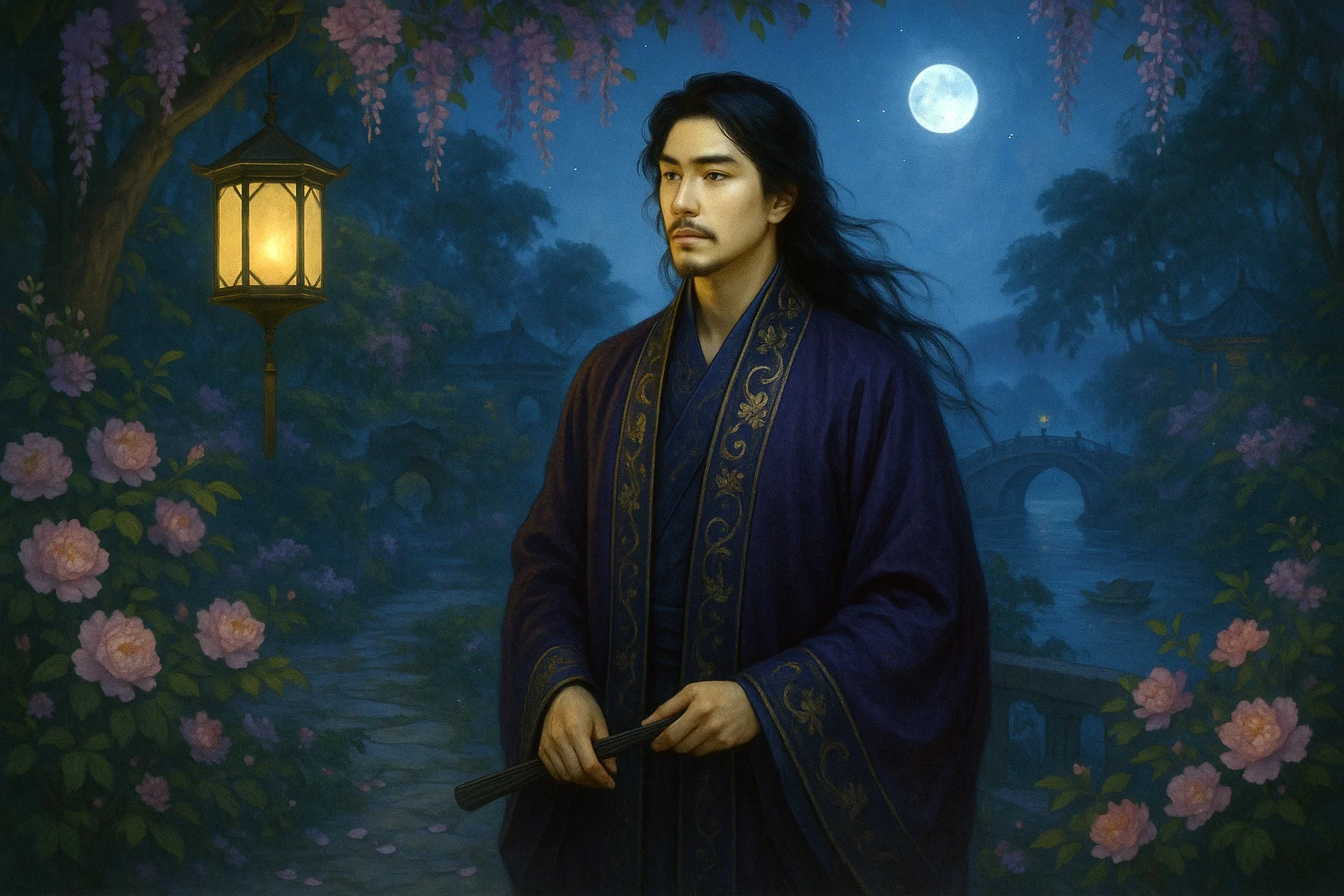
Li Shangyin (李商隐), 813 - 858 AD, was a great poet of the late Tang Dynasty. His poems were on a par with those of Du Mu, and he was known as "Little Li Du". Li Shangyin was a native of Qinyang, Jiaozuo City, Henan Province. When he was a teenager, he lost his father at the age of nine, and was called "Zheshui East and West, half a century of wandering".