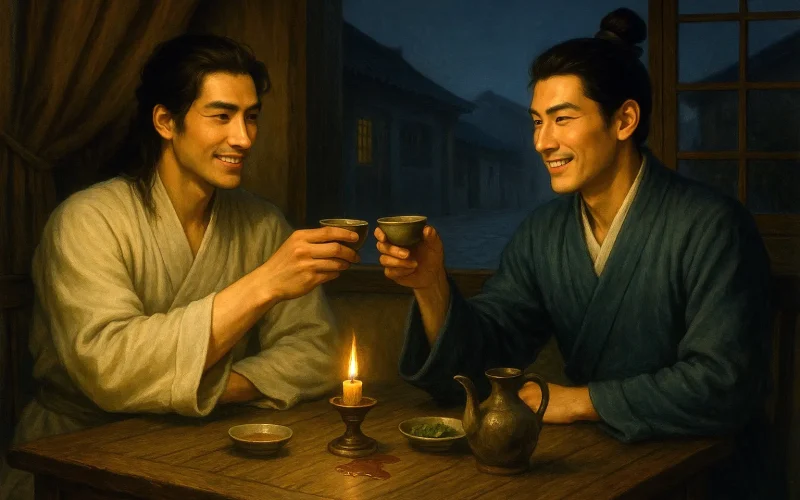




Eastward before the pagoda the river does flow;
Spring, languid and tired, leans on the breeze soft and slow.
A riot of peach blooms with no master to own —
Which do you prize more, the deep red or the faintly shown?
Original Poem
「病中五绝句 · 其五」
白居易
交亲不要苦相忧,亦拟时时强出游。
但有心情何用脚,陆乘肩舆水乘舟。
Interpretation
This poem was written in Bai Juyi’s later years, a highly concentrated reflection of his twilight state of mind and life philosophy. By this time, the poet had weathered the vicissitudes of an official career, retired to Luoyang, and was spending his remaining years in leisure with the sinecure of Junior Tutor to the Heir Apparent, assigned to the Eastern Capital. Yet time shows no mercy; aging and illness had become his constant companions. Though titled "While Ill," the poem contains not a trace of despondency. Instead, with humorous and从容 language, it displays a kind of life freedom that transcends physical limitations, governed by the spirit—a radiant embodiment of his "contented" philosophy during life's most difficult stage.
First Couplet: “交亲不要苦相忧,亦拟时时强出游。”
Jiāo qīn bú yào kǔ xiāng yōu, yì nǐ shí shí qiǎng chū yóu.
My kin and friends, I pray you, do not worry for me so; / I still intend, from time to time, to rouse myself and go.
The opening reads like a sincere, face-to-face conversation with loved ones, its tone intimate and free-spirited. "Do not worry for me so"—the word "so" conveys both the depth of their concern and, implicitly, the poet's acknowledgement and gentle refusal of this pity; he does not desire sorrowful sympathy. The phrase "I still intend" carries a sense of mild consultation and autonomous resolve. "To rouse myself and go" is the cornerstone of the poem's spirit. Here, "rouse myself" does not mean reluctant compulsion but an active resistance to the inertia of age, the will lifting the body, embodying the Confucian spirit of "unceasing self-strengthening" as practiced in the final scene of an individual life. The poet transforms "going out" from a casual act of youth into a life attitude and spiritual rite that requires active effort to maintain.
Second Couplet: “但有心情何用脚,陆乘肩舆水乘舟。”
Dàn yǒu xīnqíng hé yòng jiǎo, lù chéng jiānyú shuǐ chéng zhōu.
If the mood and will are present, what need have I for feet? / On land, a palanquin I'll take; on water, a retreat.
This couplet answers, with wit and wisdom, the challenge of how to achieve "rous[ing] myself and go," lifting the poem to its climax. "If the mood and will are present, what need have I for feet?" is a declaration, a philosophy. "The mood and will" is the internal, subjective driving force; "feet" are the external, objective tools. The poet severs the absolute dependence of action on physiological condition, establishing the relationship where the "heart/mind" is sovereign and the "body" is subordinate. As long as the "mood and will" persists, the mode of action can be infinitely adaptable. The following line, "On land, a palanquin I'll take; on water, a retreat," is the concrete implementation plan for this philosophy, recounted as naturally as listing household items, with perfect composure. A palanquin (sedan chair) and a boat might seem like luxuries or necessities to others, but in the poet's hand, they become tools of wisdom that safeguard spiritual freedom. This is not merely a list of methods but a display of the art of living: adapting to different objective conditions (land/water) by taking the most suitable means (palanquin/boat) to achieve an unchanging goal (to go). The flexible wisdom of "no set method" contained within it captures the essence of both Confucian "adaptation to circumstance" (quanbian) and Daoist "accordance."
Holistic Appreciation
This heptasyllabic quatrain can be called a "Declaration of Autonomy for the Aged Life." It perfectly showcases the highest realm of Bai Juyi's late poetic style and character: profundity within plainness, solemnity within humor, freedom within limitation. The poem begins in a dialogic tone, drawing the reader close. It establishes a positive key with the word "rouse." Then, through the contrast between "mood and will" and "feet," it completes the crucial leap from the material to the spiritual, from limitation to freedom. Finally, it concludes with a concrete, feasible plan, grounding sublime philosophy firmly in daily life. The four lines are interlocked: from reassuring others ("do not worry"), to stating one's own resolve ("intend…to go"), to clarifying the principle ("mood and will" is paramount), and finally providing the method ("palanquin/boat"). The logic is clear, combining reason and sentiment, shaping the image of a wise man who, though frail and ill, remains vigorous in spirit; though aged, is vibrant with the joy of living.
Artistic Merits
- Perfect Fusion of the Colloquial and the Philosophical: The lines seem spoken as casually as everyday talk, especially phrases like "do not worry for me so" and "what need have I for feet," which are vivid and colloquial. Yet, it is precisely within this plain speech that the profound life philosophy of "the mind governing the body" and "tools as means" is contained, reaching the transformative state of "deep meaning in shallow words."
- Skillful Unification of Opposing Concepts: "Illness" and "going out," "rouse" (will) and "weak" (body), "mood and will" (infinite) and "feet" (finite) are inherently contradictory oppositions. Through words like "intend," "if…are present," and "take," the poet harmoniously unites them under the sovereign personality of "contentment and understanding of destiny," demonstrating superb mastery of thought.
- Precise Diction, Interplay of Abstract and Concrete: The word "rouse" is the poem's linchpin, masterfully chosen, containing multiple meanings of effort, perseverance, and invigoration. "Mood and will" is abstract, "feet" is concrete; one abstract, one concrete, highlighting the主导 role of spirit. The repeated use of "take" not only creates a lively rhythm but also emphasizes the diversity of methods and the从容 of choice.
- Vivid Self-Portraiture: In just four lines, the vivid image of an open-minded, wise, humorous, life-loving, and intensely self-directed old man leaps off the page. This is one of the "self-portraits" that Bai Juyi carefully constructed and successfully presented in his later years.
Insights
At its core, this work reveals a principle of life: True freedom lies not in the unconstraint of the body, but in the sovereignty of the heart/mind and its capacity to adapt. When external conditions (like health, strength) change, does one complain about the limitations and stop, or adjust methods, utilize tools, and shift perspectives to continue the pursuits of the heart? Bai Juyi chose the latter.
This poem is a gentle rebuttal to "ableism" or the "cult of youth." It tells us that the value and joy of life are not necessarily bound to the peak of physiological function. As long as the "mood and will" persists—that is, curiosity about the world, love for life, the pursuit of beauty—life always holds the possibility of "going out." So-called "obstacles" often stem from our rigid belief that a goal can only be achieved in one specific way (e.g., "with feet").
In our present era, which reveres efficiency and robustness, Bai Juyi's wisdom is especially precious. It encourages us, when facing personal limitations or the dilemmas of our time, to maintain mental elasticity and subjective agency, to skillfully use all available "palanquins" and "boats" (technology, tools, assistance, new ideas) to realize the spirit's "excursion." This is a resilient wisdom for life—advancing through compromise, creating freedom within constraints.
About the Poet
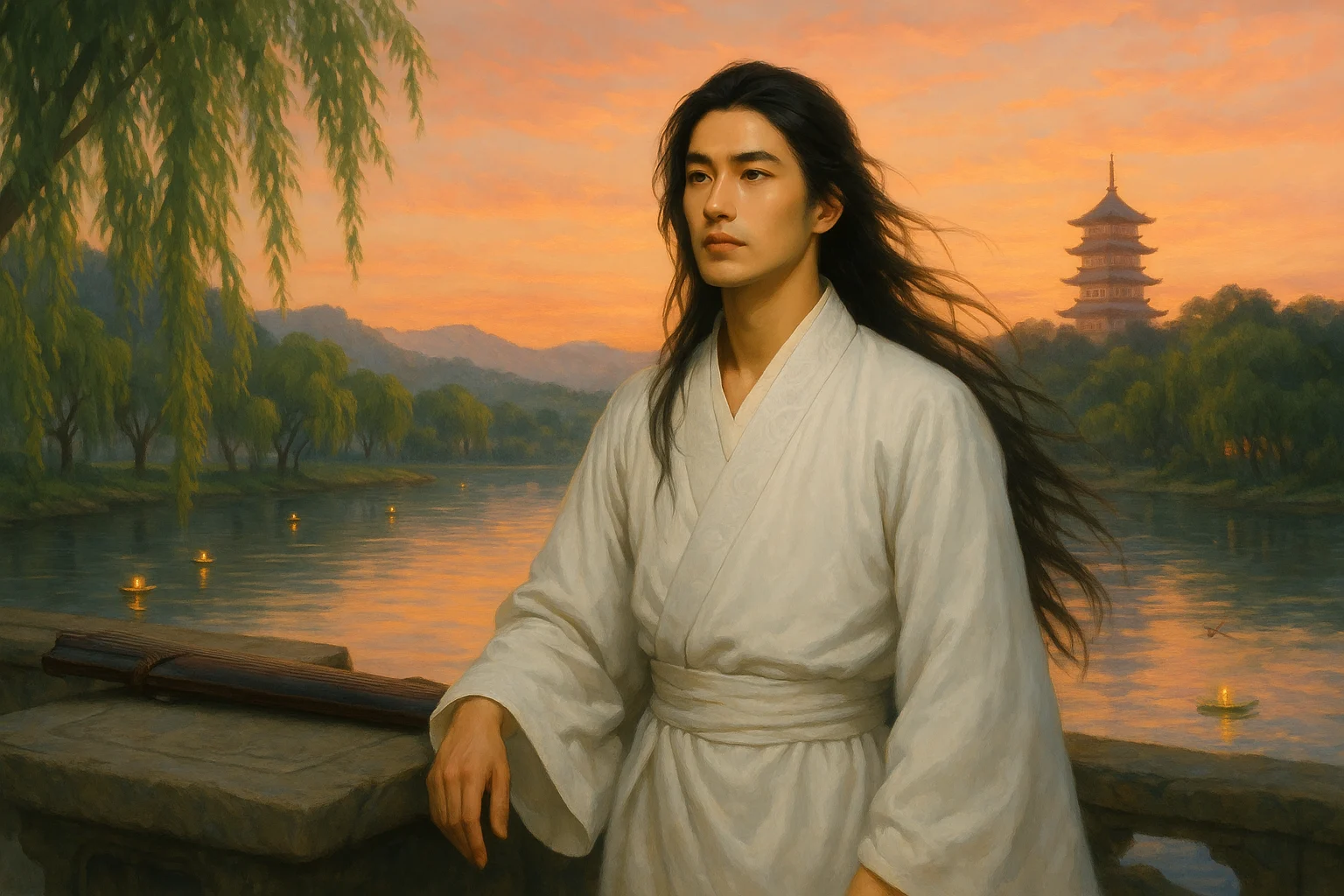
Bai Juyi (白居易), 772 - 846 AD, was originally from Taiyuan, then moved to Weinan in Shaanxi. Bai Juyi was the most prolific poet of the Tang Dynasty, with poems in the categories of satirical oracles, idleness, sentimentality, and miscellaneous rhythms, and the most influential poet after Li Bai Du Fu.