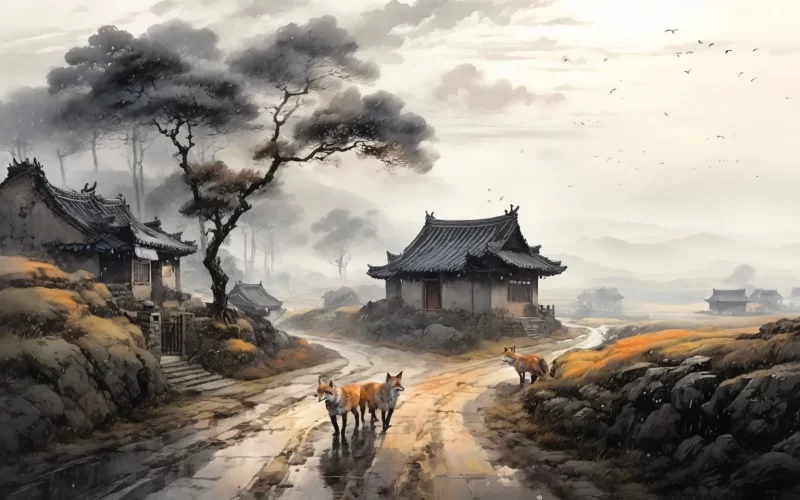



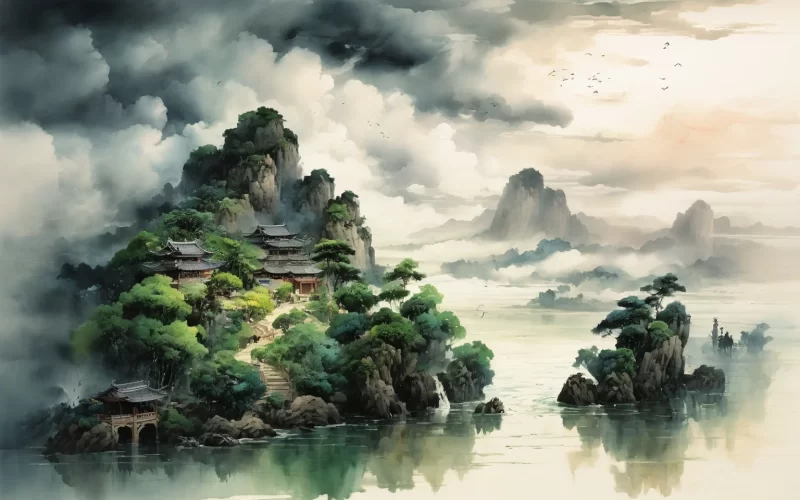
From Baidi’s walls, clouds surge through open gates;
Below its heights, a rain like overturned bowls pours.
Through high gorges, swift torrents thunder as heaven debates;
‘Mid ancient trees, dark vines shroud sun and moon indoors.

The battle-steed knows less peace than the plow-horse at rest;
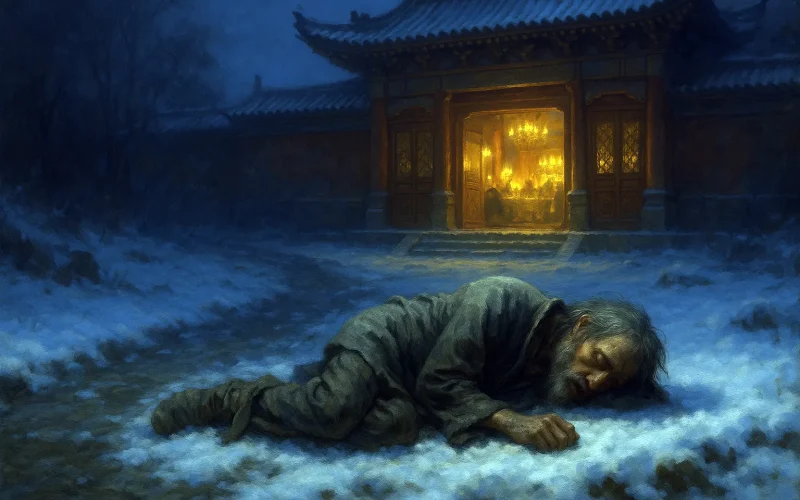
From a thousand homes, but hundred households still remain.
Widows, drained bare by levy’s unrest,
On autumn plains—which village grieves its pain?
Original Poem
「白帝」
杜甫
白帝城中云出门,白帝城下雨翻盆。
高江急峡雷霆斗,古木苍藤日月昏。
戎马不如归马逸,千家今有百家存。
哀哀寡妇诛求尽,恸哭秋原何处村?
Interpretation
This masterpiece was composed in the autumn of 766 CE, the first year of the Dali era under Emperor Daizong, while Du Fu was residing in Kuizhou (present-day Fengjie, Chongqing). Although the An Lushan Rebellion had been quelled, separatist warlords remained powerful, Tibetan incursions continued, and the region of Shu itself was not free from disturbance. Living in White Emperor City, high atop the mountains at the entrance to the Qutang Gorge, the poet beheld both the perilous majesty of the river landscape shaped by nature and the desolate social spectacle of a people impoverished and subjected to relentless exploitation in the aftermath of war. The violence of the natural world and the cruelty of the human era resonated profoundly within him, transforming into this poem. Here, White Emperor City is not merely a geographical location but the commanding vantage point—the very eye of the storm—from which to observe that fractured age.
First Couplet: “白帝城中云出门,白帝城下雨翻盆。”
Báidì chéng zhōng yún chū mén, Báidì chéng xià yǔ fān pén.
From White Emperor's walls, the clouds through city gates seem born; / Below its heights, a furious rain as from upended basins is torn.
The opening uses anadiplosis and hyperbole to evoke the unique, three-dimensional atmosphere and sense of tumult inherent to the mountain city. "The clouds through city gates seem born" lends the clouds a vital, rushing agency, hyperbolizing the city's loftiness—the clouds appear to originate within the walls themselves, spilling forth, an image both fantastical and oppressive. "A furious rain as from upended basins is torn" employs a startling metaphor to convey the storm's savage intensity. The verbs "born" and "torn" (reflecting 出 and 翻), one suggesting emergence, the other violent discharge, vividly render White Emperor City's dramatic topography—towering into the clouds above, overlooking the depths below—and the chaotic, violent spectacle encompassing heaven and earth. This establishes the poem's fundamental tone of upheaval and impending cataclysm.
Second Couplet: “高江急峡雷霆斗,古木苍藤日月昏。”
Gāo jiāng jí xiá léi tíng dòu, gǔ mù cāng téng rì yuè hūn.
Through the high gorge, the torrents crash in thunderous fight; / 'Mid ancient trees, dark vines plunge sun and moon in blight.
This couplet extends the vision, carrying both sight and sound into the broader river gorge and introducing the dimension of time. "Through the high gorge, the torrents" describes the perilous spatial constriction; "crash in thunderous fight" depicts a titanic clash of forces, rendering the raw conflict of natural power in heart-stopping terms. "'Mid ancient trees, dark vines" embodies the weight of accumulated time; "plunge sun and moon in blight" signifies the extinction of light. The lines are perfectly parallel, densely packed with imagery. They are a true depiction of the fiercely majestic natural environment of the Kuimen area, yet also a profound symbol for the violent conflicts of the age—of warfare, taxation, and power—and the society's descent into shadowy chaos.
Third Couplet: “戎马不如归马逸,千家今有百家存。”
Róng mǎ bù rú guī mǎ yì, qiān jiā jīn yǒu bǎi jiā cún.
War-horses know less ease than plow-horses homeward led; / Of a thousand households, scarce a hundred now are fed.
The focus turns abruptly from the natural world to social reality, creating a staggering leap in meaning and a precipice of emotional descent. The contrast between "War-horses" and "plow-horses" constitutes an utter negation of war—if even creatures bred for battle are deemed inferior to those engaged in peaceful labor, what value remains for human life? Immediately, the numerical contrast between "a thousand households" and "scarce a hundred" is stark and cruel, encapsulating with devastating efficiency the catastrophic depopulation wrought by war. This is not mere statistics but the concentrated essence of countless shattered families and lives—the language is brutally concise, the pain immeasurably deep.
Fourth Couplet: “哀哀寡妇诛求尽,恸哭秋原何处村?”
Āi āi guǎ fù zhū qiú jìn, tòng kū qiū yuán hé chǔ cūn?
A widow wails, by ruthless levy stripped to skin and bone; / Her heartbreak sobs on the waste autumn plain—from which ruined home?
The poem culminates by focusing on the most emblematic tragic figure—the widow. Having lost her husband to war, a profound grief in itself, she is further subjected to the extortion of being "stripped to skin and bone"—adding desolation to despair, the era's most callous deprivation of the vulnerable. The doubling of "wails" and "heartbreak sobs" drives the sound of mourning to its extremity. Yet the poet does not rest with individual suffering. He concludes with a devastating question: "from which ruined home?" The weeping seems to rise from every corner of the barren autumn plain; it no longer belongs to a specific village but has become the collective lament of the entire war-ravaged, scarred earth. This question elevates personal tragedy into the anguished cry of an epoch, allowing the poem's critical power and depth of compassion to reach their zenith.
Holistic Appreciation
This poem stands as a pinnacle of Du Fu's regulated verse from his Kuizhou years. Its power lies in achieving a grand synthesis and profound fusion of "natural imagery," "historical reality," and "the poet's impassioned response." The structure is masterful: the first two couplets, with broad, ink-splashed strokes, depict the perilous, awe-inspiring scenery of White Emperor City—storm, thunder, and darkened heavens. This is both realistic landscape and a projection of the era's atmosphere and the poet's own tormented psyche. The latter two couplets shift to the fine-line clarity of a documentary sketch, pointing directly to the cruel reality of a devastated populace and unremitting exploitation in the war's aftermath. The movement is from scene to sentiment, from the vast to the particular; the imagery shifts from the majestic to the desolate, the emotion from a brooding intensity to an eruption of grief and righteous anger.
The poem's core tension resides in the juxtaposition and mutual metaphor of "the savagery of natural force" and "the cruelty of human agency." Is not the "furious rain" and the "thunderous fight" of the gorge also a metaphor for that society of incessant conflict and extraction? And the imagery of a "plunged" sun and moon is the precise reflection of the human reality where "scarce a hundred now are fed" and the widow is "stripped to skin and bone." With consummate skill, Du Fu forges a profound structural homology between nature and society within the world of the poem.
Artistic Merits
- Overlapping Imagery and Spatiotemporal Compression: The poem densely layers images—"clouds," "rain," "torrents," "gorge," "thunder," "ancient trees," "dark vines," "sun," "moon," "war-horses," "plow-horses," "widow," "autumn plain"—compressing immense space (city, river, chasm) and deep time (antiquity, celestial cycles, the before and after of war) into a single lyric. The effect is one of monumental density and powerful artistic tension.
- Formal Parallelism Charged with Volatile Meaning: The parallelism in the two central couplets is exquisitely crafted. "High gorge" parallels "torrents"; "ancient trees" parallels "dark vines"—this is natural parallelism. "War-horses" parallels "plow-horses"; "a thousand households" parallels "a hundred"—this is social parallelism. Yet, in terms of meaning, the lines execute a dramatic pivot from nature's fury to human misery, containing an emotional earthquake within a framework of impeccable formal order.
- The Shocking Power of Numerical Contrast: The contrast between "a thousand households" and "scarce a hundred" quantifies the disaster of war with devastating concision. It strikes the eye and pierces the heart, revealing the chasm between former prosperity and present ruin more effectively than any cluster of adjectives.
- The Expansive Force of the Concluding Question: Ending with "from which ruined home?"—offering no answer—the poem directs the reader's gaze and mind toward that weeping, boundless autumn waste. This open-ended, resonant question vastly expands the poem's imaginative space and critical dimension, allowing its grief and indignation to echo without end, shaking the reader's soul.
Insights
This work offers profound insights concerning "the relationship between the poet and his time" and "the art of giving voice to suffering." Du Fu does not linger on mere description of sublime scenery, nor does he sink into solipsistic sorrow. From his perch on White Emperor's heights, with a poet's synoptic vision, he sees simultaneously nature's awesome power and society's festering wounds, forging them into a more universal, profound imagery concerning chaos, oppression, and the struggle to survive.
It reminds us that genuine social conscience and historical insight often require the ability to contemplate specific suffering against a vaster backdrop—whether natural or historical. The "widow's" weeping seems all the more isolated and piercing for echoing within the "high gorge" where "torrents crash in thunderous fight." The tyranny of "ruthless levy" appears all the more shameless and cruel against the backdrop where "scarce a hundred now are fed."
For our own age, faced with various forms of social distress, both visible and hidden, Du Fu's poem serves as a guide. It shows that incisive critique and authentic compassion require both the elevated perspective of a "White Emperor City" and the courage and power to translate the "thunderous fight" of natural forces into the surging currents of one's art. It reminds us that the greatest poetry is always the unwavering echo of a heart that beats in unison with the widest suffering of life, sounded from within history's storm.
About the poet
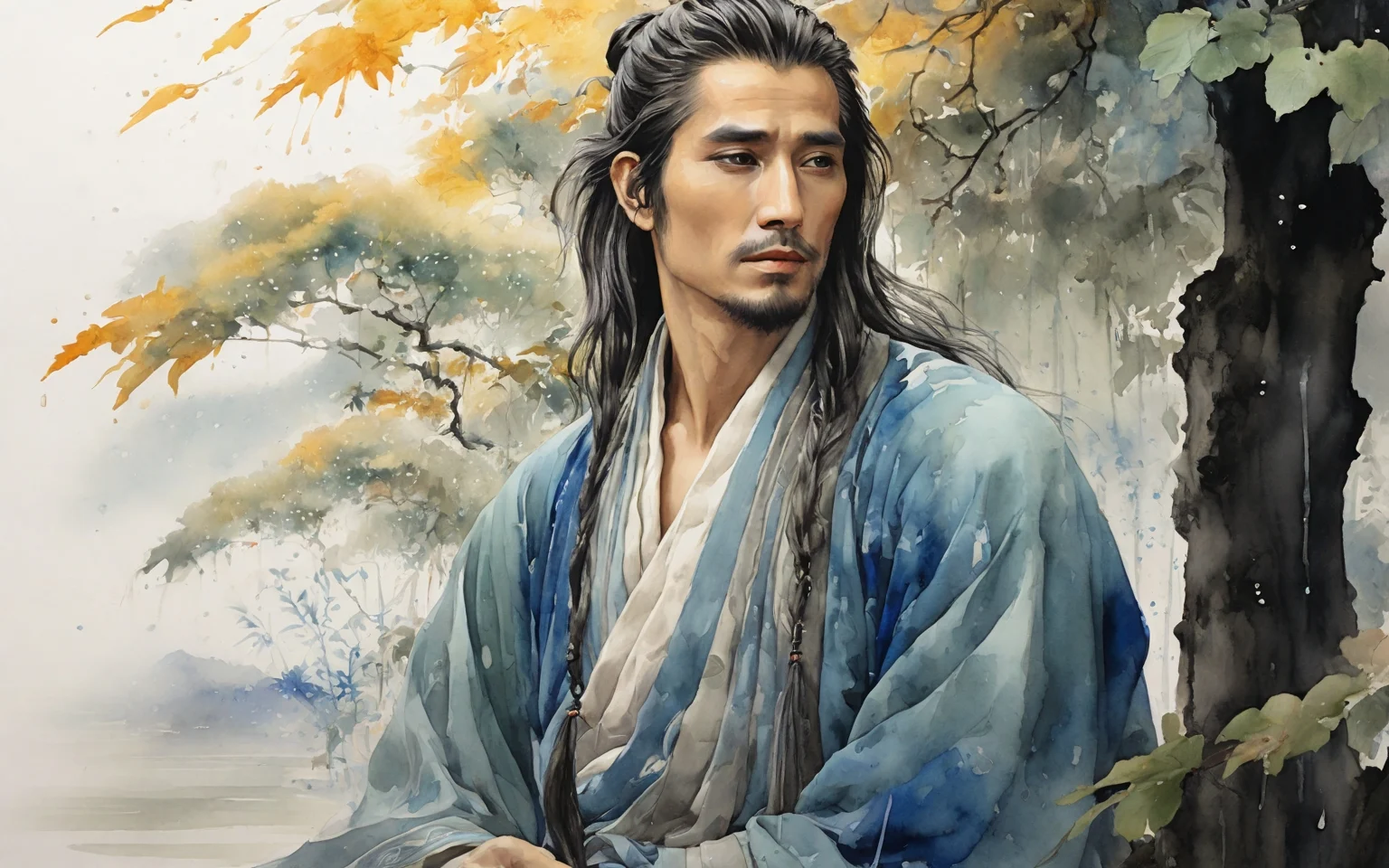
Du Fu (杜甫), 712 - 770 AD, was a great poet of the Tang Dynasty, known as the "Sage of Poetry". Born into a declining bureaucratic family, Du Fu had a rough life, and his turbulent and dislocated life made him keenly aware of the plight of the masses. Therefore, his poems were always closely related to the current affairs, reflecting the social life of that era in a more comprehensive way, with profound thoughts and a broad realm. In his poetic art, he was able to combine many styles, forming a unique style of "profound and thick", and becoming a great realist poet in the history of China.