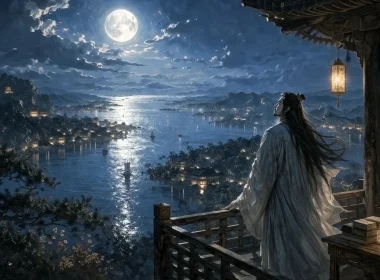
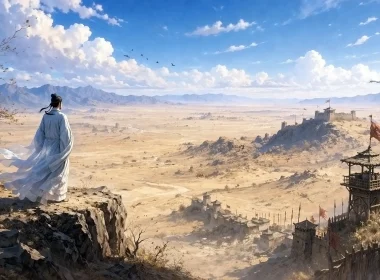
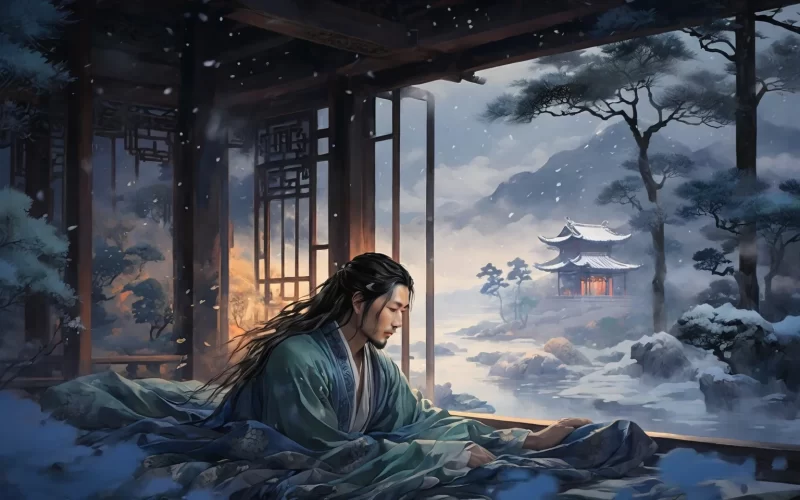
At dayfall, the hills go grey and far;
Against the cold, a white roof shows how spare.

A dog barks at the hurdle‑gate. And then,
Through wind and snow, comes a man home again.
Original Poem
「逢雪宿芙蓉山主人」
刘长卿
日暮苍山远,天寒白屋贫。
柴门闻犬吠,风雪夜归人。
Interpretation
This poem is a divine masterpiece among Tang dynasty five-character quatrains, composed during the Dali era of Emperor Daizong of Tang (AD 773-777). It was a time when Liu Zhangqing, known for his integrity, was demoted for offending his superiors. The phrase "刚而犯上,两遭迁谪" succinctly captures the trajectory of his later life. Around fifty years old and with an already checkered official career, this renewed banishment undoubtedly cast a profound gloom over his spirit. Travelling east from E-Yue to assume his new, lowly post of Sima in Muzhou (present-day Chun'an, Zhejiang), he passed through the 芙蓉山 mentioned in the title, likely somewhere in modern Zhejiang. On a bitterly cold, snowy winter day, as dusk descended on the long road ahead, the poet, finding the weather worsening, was compelled to seek shelter in a poor mountain dwelling.
This chance encounter amidst the wind and snow crystallizes into one of the warmest, yet most desolate, moments in Chinese poetry. Lodging overnight in a humble home while himself in exile, the poet witnessed the austerity of the "白屋", heard the barking at the "柴门", and perceived the hardship of the "夜归人". He was confronted not just with a mountain dweller's late return, but with the day-to-day reality of countless common folk—toiling through storm, returning in the cold of night, persisting in poverty. In that moment, the poet's personal plight seamlessly merged with the universal fate of the people: both were souls struggling to survive in the world, both were wayfarers seeking their path through the blizzard.
Having suffered two demotions and a drifting, difficult later life, Liu Zhangqing's own turbulent experiences granted him a deeper understanding than most of the distance conveyed by "苍山远" and the poverty inherent in "白屋贫". While recounting his personal experience of seeking shelter, his brush ultimately fixed its gaze on the profoundest contemplation of human suffering. Within those twenty characters lies the poet's personal sorrow, and even more, a silent compassion for the common people living in hardship. This is where Liu Zhangqing transcends the ordinary: even in his own distress, he could still see the distress of others; even with a heart in the cold of night, he could still perceive the warmth of the human world.
First Couplet: "日暮苍山远,天寒白屋贫。"
Rì mù cāng shān yuǎn, tiān hán bái wū pín.
At dayfall, the hills go grey and far; against the cold, a white roof shows how spare.
With his opening stroke, the poet sketches a stark, desolate picture of a traveler's journey. "日暮" establishes the time. The three characters "苍山远" are particularly masterful—mountains are static, yet the word "远" injects a human perspective and state of mind. As dusk envelops the vast, uncertain road ahead, those blue mountains recede ever farther into the gathering dark, as remote and unreachable as the poet's own exiled fate. The second line, "天寒白屋贫", settles on the lodging place. The "白屋", a simple thatched hut, is the dwelling of the poor. "寒" (cold) and "贫" (poor) reflect and amplify each other: they describe the bitter weather and the family's poverty, but also evoke the chill in the poet's heart and the bleakness of his destiny. In just ten characters, heaven, earth, and man merge; a scene of vast, cold, austere loneliness is completely realized.
Second Couplet: "柴门闻犬吠,风雪夜归人。"
Chái mén wén quǎn fèi, fēng xuě yè guī rén.
A dog barks at the hurdle‑gate. And then, through wind and snow, comes a man home again.
The visual silence of the first couplet is suddenly broken by sound. "柴门闻犬吠" describes the deepening night and rising wind. From the silence of all things, a dog's bark pierces the cold—the faithful watchdog is first to sense its master's return. The five characters "风雪夜归人" are the celebrated poetic essence passed down through the ages. The poet does not describe the returnee's face, using only "风雪" to highlight their hardship and "夜归" to show their diligence. That figure, braving wind and snow, groping home in the dark—perhaps snow-covered, certainly exhausted—brings, in the moment of crossing the wicker gate, a human warmth to the frigid night. The poet, lodging there as a mere passerby, finds in the sound of barking a spiritual encounter with this unseen host. Both are wanderers under heaven; upon meeting, need they have been acquainted before?
Holistic Appreciation
This is a divine work among Liu Zhangqing's five-character quatrains. In just four lines and twenty characters, using the search for shelter on a cold night as its entry point, it blends visual vastness, tactile sharpness, and auditory movement, revealing the poet's profound observation of human life during his journey of exile.
Structurally, the poem progresses clearly from far to near, stillness to movement, outside to inside. The first couplet presents distant, still scenes—"日暮苍山远" offers a vast visual horizon, "天寒白屋贫" a chilling sensation upon stopping, both painting a desolate backdrop purely through sight. The second couplet shifts to close, active scenes—"柴门闻犬吠" breaks the silence with sound, and "风雪夜归人" concludes with a human figure. From distant mountains to thatched hut, from hut to wicker gate, from gate to dog's bark, from bark to person's return—the lens draws steadily closer, the emotion subtly warms, achieving a seamless unity.
Thematically, the poem's core lies in the concept of "归" (return/homecoming). The first two lines emphasize "远" (distance) and "贫" (poverty). The distant mountains symbolize the uncertain road ahead, the hopelessness of a return date; the poor hut represents the poet's own austere circumstances and bleak fate. These two words describe the scene, but even more, they capture the poet's state of mind at that moment: exiled, with the world a vast, dim expanse—where is the road home? The last two lines suddenly pivot to "归". The dog barks at the gate because someone is returning; braving the snow at night, someone is coming home. This "归" forms a powerful contrast with the earlier "远" and "贫": the host has a home to return to, but where is the poet's home? The host battles the storm to return, yet the poet knows not when he can return, or to where. This self-evident contrast forms the deepest emotional core of the poem.
Artistically, the poem's most moving quality is its use of "the most minimal brushstrokes to depict the most profound realm." The poet does not write directly of his loneliness or sorrow; he writes only what he sees and hears—the blue mountains, the thatched hut, the wicker gate, the dog's bark, the wind and snow, the returning figure. Each stroke is an objective sketch, yet together they form a subjective history of the heart. How much trepidation about the vast, uncertain road is hidden in the word "远"? How much bitterness of a drifting, rootless life is contained in "贫"? And how many sighs for a home one struggles to return to are held within "归"? This technique of writing the heart through objects, seeing emotion in the scene, is the highest achievement of classical Chinese poetry: "not using a single explicit word, yet capturing the entire spirit."
Artistic Merits
- Clear Structure, Progressive Layers: From far to near, dusk to night, sight to sound, the poem completes a spatial contraction and temporal progression within twenty characters.
- Concise Language, Fused Scene and Emotion: The first couplet is purely scenic description, yet every line is imbued with feeling; the second couplet appears narrative, yet is thoroughly atmospheric—descriptive language is emotional language, narration is lyrical expression.
- Portraying People Without Showing Them, Artful Use of Blank Space: The poem does not use a single word to describe the host's appearance, only hinting with "夜归人", yet it allows the reader to distinctly sense that figure returning in the snow—diligent, simple, and worthy of respect.
- Finding Warmth in the Cold, Evocative Artistic Conception: The first two lines describe extreme cold and desolation; the last two suddenly reveal a person's return. The dog's bark and the returning shadow in the cold night become the only human warmth in that icy world.
Insights
This poem, with twenty characters, sketches a picture of a nighttime return in a snowstorm. Yet behind this extremely simple image lies a mood of immense depth.
It first allows us to see the meaning of "远" and "贫". That "日暮苍山远"—is it merely that the mountains are far? It is, even more, the uncertainty of the future, the hopelessness of return in the eyes of the exiled. That "天寒白屋贫"—is it merely that the hut is poor? It is, even more, the chill of one's circumstances, the desolation of fate in the heart of a wanderer. When in hardship, one looks at mountains and they seem distant, looks at a dwelling and it seems poor—all things are projections of the mind's state.
On a deeper level, this poem prompts us to contemplate the meaning of "归". The title is "逢雪宿芙蓉山主人"; the poet was originally a passing guest seeking lodging, yet in the deep night he hears the dog bark at the host's return. In that moment, he and this never-before-seen mountain dweller form a poignant contrast: the host has a home to return to, but where is the poet's home? The host braves wind and snow to return, yet the poet knows not when he can return, or to where. That bark awakens not only awareness of the host, but also confirmation of his own rootless drifting.
And what is most moving is the warmth within the poem's cold night. The poet writes of the blizzard, the cold sky, the poor hut, yet does not dwell in misery. That dog's bark, that returning shadow, gives this frozen night a breath of human life. The poet never met the host, yet in that barking, he perceived a simple warmth—in this world, there are always people toiling through the storm, and always people waiting behind wicker gates; there are always people drifting, and always people returning.
Liu Zhangqing, in his state of disgrace, lodging overnight in a poor home, nonetheless wrote such a warm poem. This warmth does not stem from material abundance, but from the most genuine observation of the human world, from the simplest respect for all who toil to make a living. Those five characters, "风雪夜归人", have since become one of the most moving figures in the history of Chinese poetry—he is the mountain dweller, he is the traveler, he is every person who presses forward, teeth gritted, through the wind and snow of life.
About the Poet
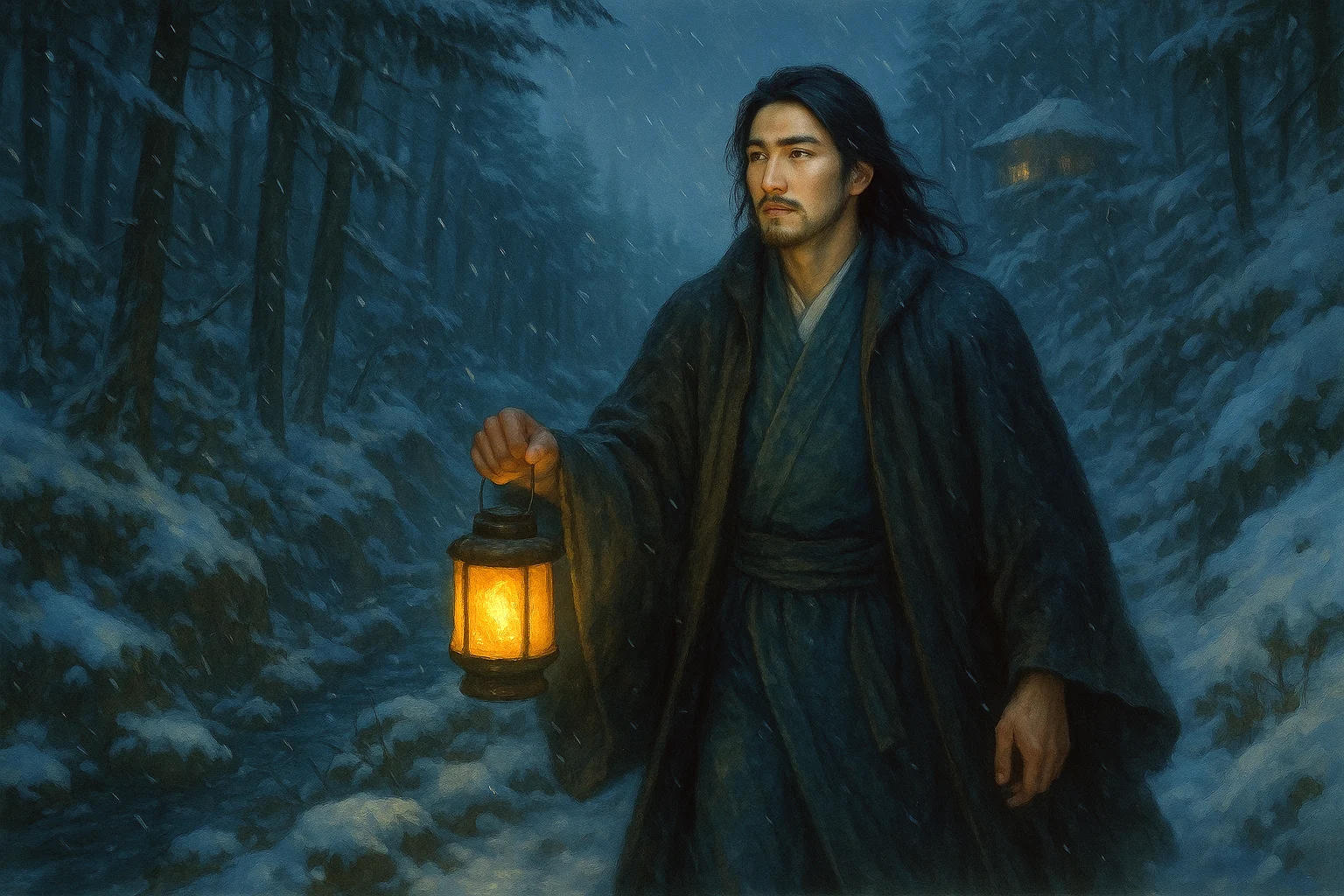
Liu Zhangqing (刘长卿 c. 726 – c. 786), a native of Xuancheng, Anhui Province, was a poet of the Mid-Tang Dynasty. He obtained the jinshi degree (presented scholar) in the late Tianbao era and successively held official posts such as Sheriff of Changzhou and Investigating Censor. Due to his upright and unyielding character, he was exiled twice. His poetry, particularly his five-character verses, achieved the highest distinction, often depicting the melancholy of exile and the joys of reclusion in landscapes. His poetic style is refined, elegant, and ethereal, blending a desolate undertone with the meticulousness characteristic of the Ten Talented Poets of the Dali era. He excelled in using plain sketching to create an atmosphere of tranquil emptiness and profound remoteness. As a pivotal poet bridging the High Tang and Mid-Tang periods, his work inherits the idyllic charm of Wang Wei and Meng Haoran while foreshadowing the bleak and cool elegance of Dali poetry. He exerted a certain influence on late Tang poets such as Yao He and Jia Dao, who belonged to the "painstaking school."