
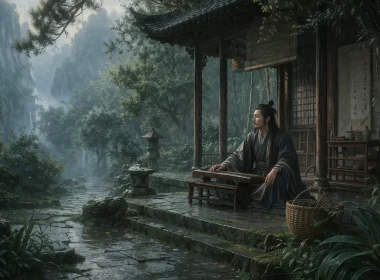
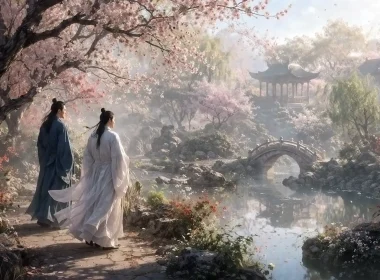
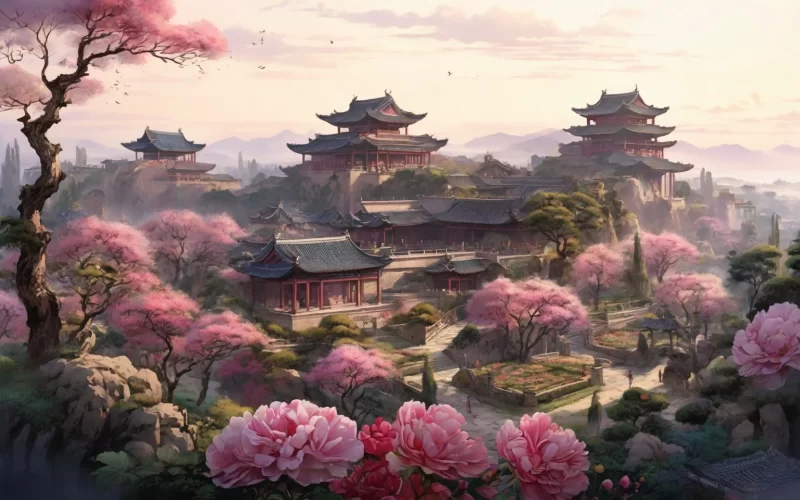
To build one pond, a thousand homes you raze;
Forgo the useful trees for roses’ vain parades.

But autumn comes, the rose its glory sheds,
And all the court with thorny ruin spreads.
Original Poem
「题兴化寺园亭」
贾岛
破却千家作一池,不栽桃李种蔷薇。
蔷薇花落秋风起,荆棘满庭君始知。
Interpretation
This poem was composed by the Tang Dynasty poet Jia Dao, most likely during the Taihe era (827-835) of Emperor Wenzong's reign. Jia Dao's life was marked by official frustration; he became a monk in his youth and, though he later returned to secular life, repeatedly failed the imperial examinations. He lived in hardship in Chang'an for a long time, giving him direct observation and deep insight into the arrogance and extravagance of the powerful and the suffering of the common people.
The target of satire in this poem is traditionally considered to be the famous Tang chancellor Pei Du. Although Pei Du had significant political achievements, including pacifying the Huaixi rebellion, and rose to the position of chancellor, even he in his later years succumbed to the prevalent extravagance of the upper echelons of society. He built the "Green Field Hall" at Wuqiao in Luoyang, excavated a large pond, and extensively planted flowers and trees, indulging in extreme luxury. Jia Dao's poem uses the "Xinghua Temple Garden Pavilion" as a point of entry, employing the pretext of describing an object to deliver its satire. The seven characters, "破却千家作一池" (Shattering a thousand homes to make one pond), directly point to the cruel reality of the powerful ignoring the people's suffering to satisfy their own desires; "不栽桃李种蔷薇" (Not planting peach and plum, but planting roses) subtly satirizes their neglect of benevolent governance and their pursuit of empty show.
First Couplet: "破却千家作一池,不栽桃李种蔷薇。"
Pò què qiān jiā zuò yī chí, bù zāi táolǐ zhòng qiángwēi.
Shattering a thousand homes to make a single pond, for pleasure's end;
Not planting peach or plum, but only roses, for the eyes to tend.
The poem opens with startling language that directly confronts reality. "Shattering a thousand homes" and "making a single pond" form a shocking contrast—the homes, fields, and livelihoods of a thousand families utterly destroyed for the private desire of one powerful figure. The word "shattering" conveys utter force and cruelty; the word "single" conveys pure self-interest and greed. The next line, "Not planting peach or plum, but only roses," deepens the satire through the choice of plants. Peach and plum trees bear fruit that can benefit the people, symbolizing pragmatism and virtuous governance; roses are merely for ornamental show, empty splendor with no practical use. The powerful chose roses over fruit trees, a perfect portrait of neglecting fundamentals for superficial display. This couplet, through the use of contrast, lays bare the arrogance, extravagance, and inhumanity of the powerful.
Second Couplet: "蔷薇花落秋风起,荆棘满庭君始知。"
Qiángwēi huā luò qiūfēng qǐ, jīngjí mǎn tíng jūn shǐ zhī.
When autumn winds arise and all the roses shed their bloom,
Thorns fill your court—then you will know, too late, your coming doom.
This couplet moves from present opulence to imagined future decline, using the passage of time to reveal the principle that extreme prosperity must decay. "When autumn winds arise and all the roses shed their bloom" describes a natural scene but also serves as a metaphor for the shifting of power and the transience of glory. Those once-delicate, vibrant flowers will inevitably wither; that once-overweening power will inevitably crumble. The line "Thorns fill your court—then you will know, too late, your coming doom" concludes with the piercingly satirical phrase "then you will know." "Then you will know" implies that regret comes too late—only when the court is filled with thorns and all splendor has fallen will you realize how short-sighted your former arrogance was, and understand that the price of "shattering a thousand homes" will ultimately be paid by yourself. Yet, by then, this realization will be of no use.
Holistic Appreciation
This is a heptasyllabic quatrain that uses the description of an object as its surface to convey sharp satire as its core. In its four lines and twenty-eight characters, using the construction and subsequent neglect of a garden as its thread, the poem progressively reveals the inevitable downfall that awaits the arrogant and extravagant powerful.
Structurally, the poem displays a clear progression of "introduction, elaboration, transition, and conclusion." The first line, "Shattering a thousand homes to make a single pond," introduces the theme, directly attacking the cruelty of the powerful. The second line, "Not planting peach or plum, but only roses," elaborates, further exposing their superficial nature. The third line, "When autumn winds arise and all the roses shed their bloom," transitions, moving from prosperity to decay, from the present to the future. The final line, "Thorns fill your court—then you will know, too late, your coming doom," concludes, wrapping up the entire poem with satirical force. The four lines are tightly interlocked, logically rigorous, progressively building the satirical intent to its peak.
Conceptually, the poem's core lies in its warning of "karmic retribution." The powerful build their pond and plant their flowers at the cost of destroying a thousand homes—this is the "cause." The inevitable end result is a courtyard full of thorns and fallen splendor—this is the "effect." With a cool, detached brushstroke, the poet outlines this chain of cause and effect, embedding his critique deeply within, seemingly without raising a finger. This technique of conveying condemnation without a single explicit word of blame represents the highest achievement of satirical art.
Artistically, the poem's most striking feature is the multiple layers of symbolism in its imagery. The "pond" is not just a pond but a symbol of power and luxury; "roses" are not just flowers but a symbol of empty show and vain reputation; "thorns" are not just thorns but a symbol of decay and retribution. Through the skillful combination of these images, the poet constructs a complete system of meaning, allowing these four short lines to carry the weighty burden of social criticism.
Artistic Merits
- Vivid Contrast, Full of Tension: The numerical contrast between "a thousand homes" and "a single pond"; the contrast between utility and empty show in "peach and plum" versus "roses"; the contrast between prosperity and decay in "flowers fall" and "thorns fill"—these layered contrasts intensify the satirical force. Critique resides in the contrast; sharpness is revealed in the tension.
- Using Objects to Satirize Society, Profound Allegory: Using garden imagery to allude to social reality, using the rise and fall of scenery to hint at the fate of the powerful—the words speak of one thing, the meaning points to another—subtle yet profound. Expressing intent through objects, satirizing without being overt.
- Simple Language, Sharp Satire: The entire poem uses not a single difficult or obscure phrase; it is as plain as spoken language, yet every word pierces like a needle to the bone. Profound meaning within simple words; sharpness concealed within plainness.
- Meticulous Structure, Progressive Layers: The poem traces the arc from building the garden to what is planted within, from the moment the flowers fall to the sorrowful outcome. The logic across the four lines is tightly woven, each layer building upon the last. The four parts—introduction, elaboration, transition, and conclusion—are seamlessly and naturally connected.
- Concluding with Scene, Enduring Resonance: The final line, "Thorns fill your court—then you will know, too late, your coming doom," concludes with an image, embedding boundless satire and warning within a scene of utter desolation, leaving endless aftertaste. Words end but meaning persists, prompting deep thought.
Insights
Using the rise and fall of a single garden, this poem reveals the eternal truth that arrogance and extravagance lead to downfall, offering a profound warning. It allows us to see the limitations of power and wealth. Those ponds built by "shattering a thousand homes," those roses planted instead of "peach and plum"—how glorious, how overweening they must have seemed in their time. Yet, with the rise of the autumn wind, the flowers fall, the courtyard fills with thorns, and former splendor vanishes in an instant. It enlightens us: Pleasure built upon depriving others ultimately cannot last; power that possesses only empty show and no true virtue will inevitably be mercilessly eliminated by time.
The three characters "君始知" (then you will know) in the poem articulate humanity's most universal tragedy—realization always comes after the fact. In their moments of arrogance and extravagance, did those powerful figures ever imagine the outcome of a "court full of thorns"? Only when the splendor has completely fallen, when regret is too late, do they "then… know" the error of their former ways. This tragedy of being "wise after the event" is played out not only among the powerful but is repeated in everyone's life. It reminds us: Rather than regretting afterward, it is better to be vigilant beforehand; rather than "knowing" when the outcome arrives, it is better to maintain clarity and restraint throughout the process.
On a deeper level, this poem also leads us to contemplate the choice between "peach and plum" and "roses." Peach and plum, though plain, can benefit others; roses, though beautiful, will ultimately wither and become thorns. This is not merely a choice for a garden but a choice for one's path in life. It tells us: What is truly worth pursuing is not the showy "roses" but the seemingly ordinary "peach and plum" that can bear fruit. Whether in governance, in character, or in action, only by being down-to-earth and benefiting others can one withstand the test of time, and not be left, when the autumn wind rises, with nothing but a courtyard full of thorns.
Poem translator
Xu Yuanchong (许渊冲)
About the Poet
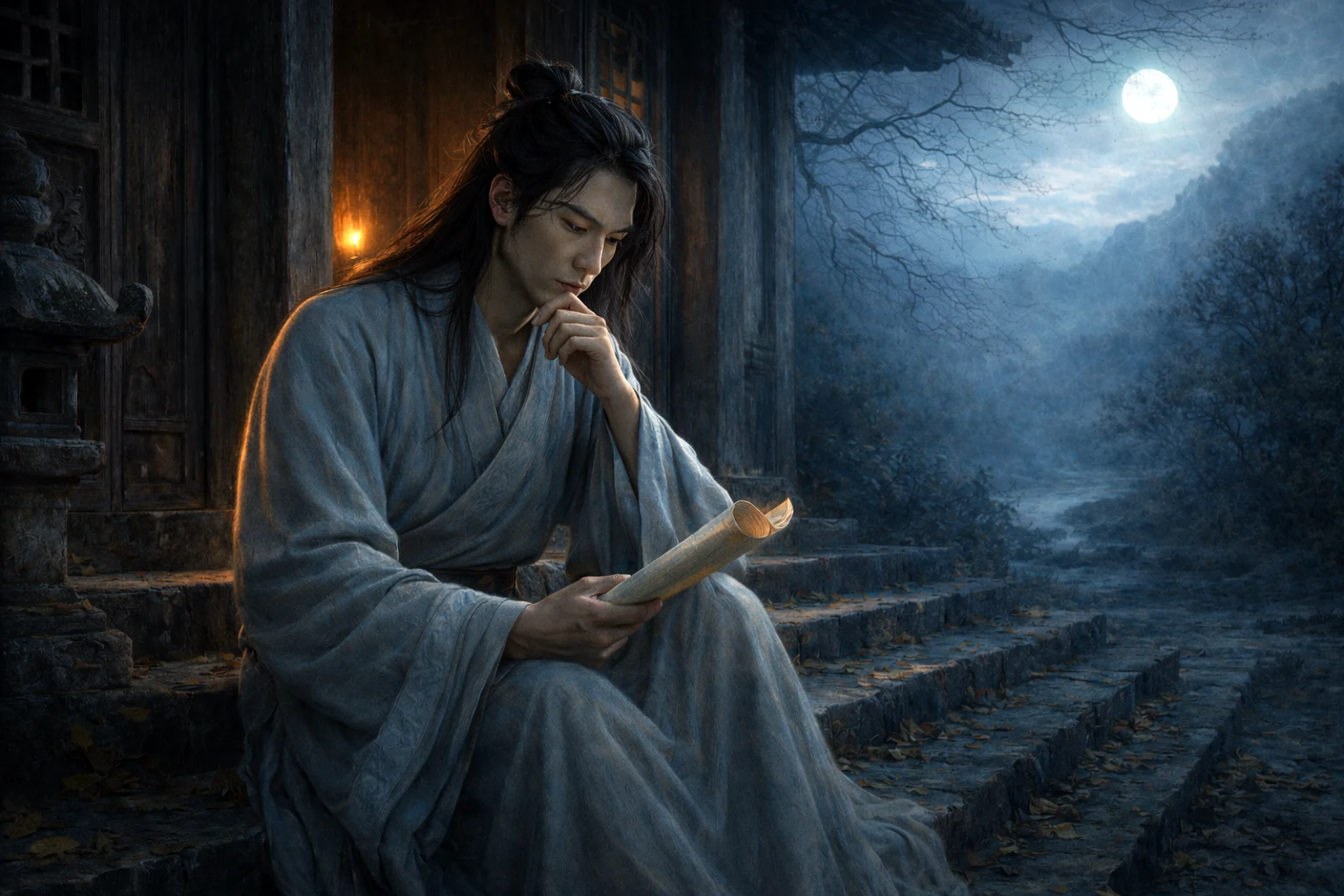
Jia Dao (贾岛 779 - 843), a native of the vicinity of present-day Beijing, was a renowned poet of the Mid-Tang dynasty. In his early years, he became a Buddhist monk under the dharma name Wuben. Later, he returned to lay life to sit for the imperial examinations, but never passed them throughout his life. In his later years, he served as Registrar of Changjiang County, earning him the sobriquet "Jia Changjiang." He was famous for his "painstaking composition" (ku yin), and together with Meng Jiao, they were known as "Meng's cold, Jia's thinness." His poetry pursued meticulous refinement of every word and line. His poems often depict desolate, barren, and lonely landscapes, excelling in the five-character regulated verse form. He exerted a profound influence on later "painstaking" poets such as Li Dong of the Late Tang and the "Four Lings" of the Southern Song.