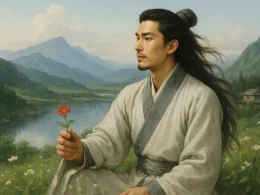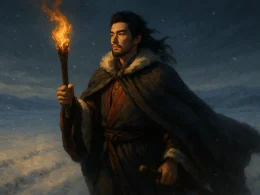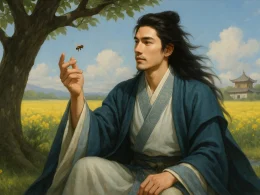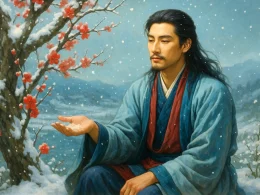

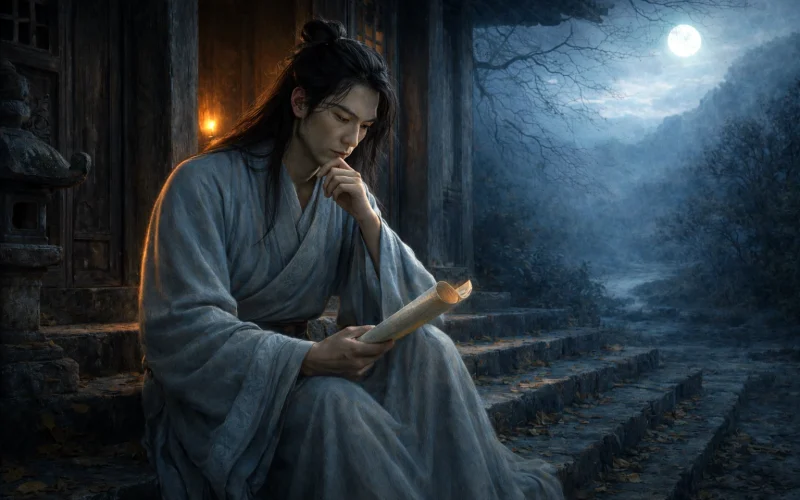
Jia Dao (贾岛 779 - 843), a native of the vicinity of present-day Beijing, was a renowned poet of the Mid-Tang dynasty. In his early years, he became a Buddhist monk under the dharma name Wuben. Later, he returned to lay life to sit for the imperial examinations, but never passed them throughout his life. In his later years, he served as Registrar of Changjiang County, earning him the sobriquet "Jia Changjiang." He was famous for his "painstaking composition" (ku yin), and together with Meng Jiao, they were known as "Meng's cold, Jia's thinness." His poetry pursued meticulous refinement of every word and line. His poems often depict desolate, barren, and lonely landscapes, excelling in the five-character regulated verse form. He exerted a profound influence on later "painstaking" poets such as Li Dong of the Late Tang and the "Four Lings" of the Southern Song.
Major Works


Life
Jia Dao's early life was deeply intertwined with Buddhism. Born into a poor family, he became a monk in his youth, taking the dharma name Wuben. He resided at Fashan Temple in Youzhou and Longmen in Luoyang. His long years of monastic life cultivated a personality characterized by quietude, introversion, and meditative contemplation—traits that would later profoundly influence his poetic creation. Within the temple walls, he was able to devote himself to reading and studying poetry and prose, laying the foundation for his future literary achievements.
The turning point in Jia Dao's life occurred around the fifth year of the Yuanhe era (810). In Luoyang, he met the renowned literary figure Han Yu, who was then serving as Magistrate of Henan. Han Yu greatly appreciated his poetic talent, believing that his extraordinary literary gift should not be buried within the monastic community. Encouraged and persuaded by Han Yu, Jia Dao resolutely returned to lay life and prepared to sit for the imperial examinations. This bond of mentorship became a celebrated tale in literary history. Han Yu not only provided him with financial support but also guided him in poetic creation, establishing Jia Dao as an important poet under Han Yu's tutelage, with close associations with Meng Jiao, Zhang Ji, and others.
After returning to lay life, Jia Dao arrived in Chang'an, embarking on a long and arduous path toward officialdom through the examinations. However, his experience was extremely unfortunate; he failed repeatedly. Several factors contributed to this: on one hand, his peculiar and reclusive poetic style clashed with the contemporary preference for ease and fluency; on the other, his solitary and upright nature made him poor at social networking and courting favor, putting him at a disadvantage in the examination arena. Prolonged hardship and failure filled his heart with indignation and bitterness, emotions deeply reflected in his poetry.
The most widely circulated anecdote about Jia Dao is the story of "deliberating over 'push' and 'knock'" (tui qiao). According to the Talks from the Hermit's Fishing Lodge in the Brook, Jia Dao, while riding a donkey one day, composed the lines, "Birds perch on the tree by the pool's edge, / A monk knocks at the moonlit gate." He hesitated over whether to use the word "push" (tui) or "knock" (qiao), gesturing repeatedly on the donkey's back, so absorbed that he unknowingly collided with the procession of Han Yu, the Mayor of the Capital. When Han Yu inquired about the situation, far from blaming him, he joined Jia Dao in deliberation and ultimately settled on the word "knock." This anecdote vividly illustrates Jia Dao's creative attitude of "painstaking composition"—a dedication so intense that he could become oblivious to his surroundings in pursuit of the perfect word or line. It also testifies to Han Yu's appreciation and support for this younger talent.
It was not until the second year of the Kaicheng era of Emperor Wenzong of Tang (837), when Jia Dao was nearly sixty, that he finally obtained an official post, albeit due to circumstances involving demotion. He was first appointed Registrar of Changjiang County in Suizhou (present-day Daying County, Sichuan), earning him the title "Jia Changjiang." After three years in Changjiang, he was transferred to be Administrator of the Granary in Puzhou (present-day Anyue County, Sichuan). In the third year of the Huichang era of Emperor Wuzong (843), Jia Dao died in his official residence in Puzhou, ending a life marked by poverty, hardship, and unwavering dedication to poetry. After his death, friends collected funds to bury him, and his grave remains in Anyue, Sichuan, to this day.
Throughout his life, Jia Dao oscillated between pursuing an official career and retreating into reclusion, between ideals and reality. Although he had returned to lay life from monkhood, he maintained the pure and quiet temperament of a monk throughout his existence. Though he painstakingly sought official position, he remained mired in lowly posts his entire life. This contradiction and hardship became the most central emotional source of his poetry. He lived for poetry, delighted in painstaking composition, and treated every word and phrase with an almost devout reverence, ultimately forging his unique poetic style.
Work Style
Jia Dao's highest achievements in poetry are in the five-character regulated verse. His style can be summarized in the four-character phrase "pure, strange, secluded, and bitter" (qing qi pi ku). Along with Meng Jiao, he represents the "painstaking poetry" school. However, while Meng Jiao's "coldness" focuses on emotional poverty and bitterness, Jia Dao's "thinness" emphasizes the leanness, barrenness, and loneliness of artistic conception.
- The Spirit of Painstaking Composition and Creative Attitude
"Painstaking composition" (ku yin) is the key to understanding Jia Dao's poetry. He approached writing with extreme diligence, claiming, "Two lines I composed after three years' toil, / Reciting them makes two streams of tears flow" ("Written After a Poem"). This almost self-lacerating creative attitude stemmed from his ultimate pursuit of linguistic precision. For him, poetic creation was not casual expression but meticulous carving of every word and image. He sought, from the limited lexicon, the one unique word that could best convey his state of mind and best fit the artistic conception. The anecdote of "deliberating over 'push' and 'knock'" is a vivid portrayal of this spirit. This devout approach to language made his poems, though short, refined in every word, with nothing superfluous. - Choice of Imagery: Secluded and Austere
In selecting poetic imagery, Jia Dao displayed strong preferences: he loved to depict secluded, austere, and silent things. Ancient temples, desolate gardens, cold springs, solitary clouds, lone cranes, sick cicadas, falling leaves, dying lamps—these images recur in his poems, collectively constructing a poetic world far from the madding crowd, characterized by pure coldness and lonely stillness. For example, in "Viewing the Scene on a Clear Evening After Snow": "Stream clouds press down the pine-tree path, / Mountain snow sprinkles the monk's robe." The scene is clear and cold, the artistic conception secluded and still. This preference for such imagery is closely related to his life experiences: his early years as a monk and his later years of hardship. - Creation of Artistic Conception: Barren, Secluded, and Profound
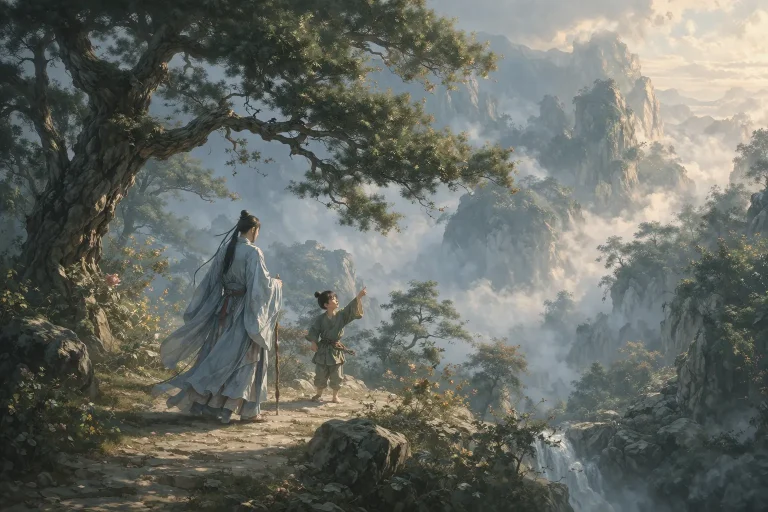
Jia Dao excelled at creating a profound and barren artistic conception. His poems contain no magnificent landscapes, no fervent emotions; instead, they offer a gaze upon minute details and immersion in silent realms. For instance, in his famous piece "Failing to Meet the Recluse": "Beneath the pine I asked the boy, / Who said, 'Master's gone for herbs to employ. / Deep in these mountains, hidden by clouds, / I know not where his steps now enshroud.'" In just twenty characters, it fully conveys the profundity of the recluse's dwelling, the emptiness of the failed visit, and the distant, hazy atmosphere of the cloudy mountains—words exhausted yet meaning inexhaustible. This kind of artistic conception is less a depiction of scenery than a projection of his inner world: a solitary soul seeking another solitary soul, ultimately leaving only the melancholy of not knowing where amidst the deep clouds. - Refinement of Language: Concise and Unconventional
Jia Dao's language is highly condensed, his word choice unconventional yet precise. He favored novel phrasing and rugged syntax, striving to avoid the familiar and escape the commonplace. For example, "Strange birds cry o'er the wilderness bare, / The setting sun makes the wayfarer scared" ("Passing by a Mountain Village at Dusk"). The word "scared" vividly captures the traveler's terror at sunset. This ultimate refinement of language gives his poems, despite their modest scope, a brilliant luster that withstands repeated savoring. - Range of Subject Matter: Relatively Concentrated
The subject matter of Jia Dao's poetry is relatively concentrated, mostly dealing with daily life, the melancholy of travel, visits to recluses, and inscriptions for temples. He seldom addressed major social or political themes. This relates to his life experiences and personal temperament. He was not a poet concerned with the nation and its people like Du Fu, nor a transcendent spirit roaming freely like Li Bai. He was simply a painstaking composer, indulging in words and immersed in his inner world, pursuing artistic perfection within a narrow range of themes.
Literary Influence
Jia Dao occupies a unique and important position in the history of Chinese poetry. Although not a grand master, his distinctive personality and profound influence make him an indispensable link in the Mid-Tang poetic scene.
- The Established Critical Judgment of "Meng's Cold, Jia's Thinness"
Since Su Shi's famous assertion of "Meng Jiao's coldness and Jia Dao's thinness," Jia Dao has been regarded, along with Meng Jiao, as a representative of the "painstaking poetry" school. This evaluation accurately summarizes the core characteristics of his poetic style: though not grand in scope, his poems carved out a separate realm through their lean, barren, and secluded artistic conception and refined, unconventional language, after the proliferation of great masters in the High Tang. Together with Meng Jiao, he constituted an important pole in the diverse landscape of Mid-Tang poetry. - Spiritual Idol of Late Tang and Five Dynasties Poets
Jia Dao's influence on later generations reached its peak during the Late Tang and Five Dynasties. Late Tang poets such as Li Dong, Cao Song, and Yu Fu all held him in the highest esteem. Li Dong even cast a bronze statue of Jia Dao, worshiping it daily as a poetic deity. Poets of this period universally studied Jia Dao's spirit of painstaking composition and his secluded, austere poetic style, forming what was called the "Jia Dao Style." Yan Yu of the Southern Song, in his Canglang's Remarks on Poetry, specifically listed the "Jia Langxian Style" when discussing poetic forms, demonstrating the depth of his influence. - Continued Influence on Song Dynasty Poets
Jia Dao's influence extended into the Song dynasty. Early Northern Song "Late Tang Style" poets such as Lin Bu and Wei Ye largely emulated Jia Dao. The "Yongjia Four Lings" of the Southern Song explicitly championed Jia Dao and Yao He, using their lean and austere style to counter the rigidity and obscurity of the Jiangxi School. Their veneration of Jia Dao actually injected a fresh breath of clarity and agility into Song poetry through his style. - The Paradigm of "Painstaking Composition" as a Creative Attitude
Jia Dao's creative attitude of "painstaking composition" has become an important category in Chinese poetics. What he represents is a devotion to language, an obsession with art, and a pursuit of perfection. This attitude transcends eras and schools, serving as a model emulated by countless poets throughout history. Whether in the Song poets' "refining words" or the Qing poets' "deliberating over 'push' and 'knock,'" the continuation of Jia Dao's spirit can be discerned.
In summary, Jia Dao was a poet famous for his painstaking composition, whose pure and unconventional style made him a unique figure in Mid-Tang poetry. His life experiences—early years as a monk and later years of hardship—shaped his poetic world of seclusion, barrenness, and solitude. He treated every word with the devotion of "two lines composed after three years' toil," pursuing artistic perfection within limited subject matter. His influence spanned the Late Tang, Five Dynasties, and both Northern and Southern Song, establishing him as the highest representative of the painstaking composition spirit in the history of Chinese poetry. Though not a great master of the High Tang, his unique artistic individuality and profound influence ensure him an enduring place in literary history.