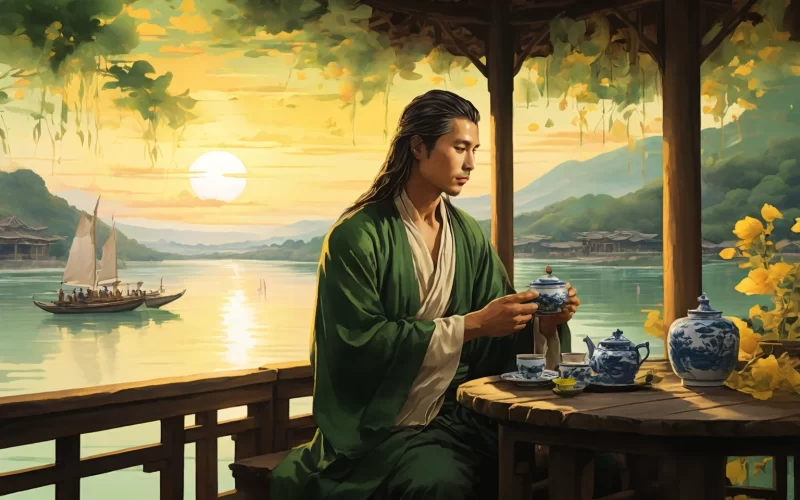

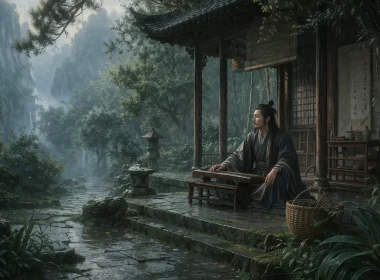

The mountain’s colour, and the river’s tone,
Grow clear together. I have raised the screen
And wait the growing moonlight, here alone.

Then from a boat that rides the wave nearby,
A flute‑note comes — and all the ancient pain
Of parting friends is uttered in that cry.
Original Poem
「奉答李和甫代简 · 其一」
黄庭坚
山色江声相与清,卷帘待得月华生。
可怜一曲并船笛,说尽故人离别情。
Interpretation
This poem was composed during Huang Tingjian's period of political exile. While the exact year is difficult to confirm, it is estimated to have been written after the Shaosheng era (1094-1098). Huang Tingjian's official career was fraught with hardship, especially in his later years. In 1094, the first year of the Shaosheng era, he was accused of "slandering the late emperor" due to his work on the Veritable Records of Emperor Shenzong. As a result, he was demoted to the post of Assistant Prefect of Fuzhou and sent to reside in Qianzhou. In 1098, he was further relocated to Rongzhou. During his years in exile, the poet was far from his homeland, cut off from correspondence with friends, his heart accumulating endless longing and solitude.
Historical records provide little information about Li Hefu, who is presumed to have been a friend of Huang Tingjian. The poem's title, "奉答李和甫代简", means "In Reverent Reply to Li Hefu, Using This Poem as a Letter." In ancient times, with transportation and communication being difficult, poetry was often used as a medium to convey feelings. Stationed in his place of exile, surrounded by the serene hues of the mountains and the murmuring river, Huang Tingjian felt a profound longing for his distant friend well up in his heart, prompting him to write these two heptasyllabic quatrains as poetic letters.
Although both poems express longing, they each emphasize distinct aspects. The first poem focuses on "embedding emotion within the scene." The poet, alone in exile, faced with the hues of the mountains and the sounds of the river, rolls up the curtain and awaits the moonlight. Suddenly, the sound of a flute is heard; the melody, drifting over by chance from a nearby boat, seems to articulate all the complex sentiments of parting from an old friend. The poem opens with a serene scene and closes with the plaintive notes of the flute, lodging its feeling of longing within the landscape, the moonlight, and the happenstance melody. Its effect is subtle, profound, and resonant. The second poem leans more toward the "direct expression of heartfelt emotion." While its specific content is unverifiable, judging by the structure of the paired poems and Huang Tingjian's consistent style, it likely serves as a more immediate response and personal outpouring to his friend. It may articulate his state of mind in exile or express his cherishing of their friendship, thereby forming a complementary contrast to the subtle restraint of the first poem. Together, the two works—one implicit and the other forthright, one scenic and the other directly emotional—combine to form a complete and profoundly sincere expression of affection for his friend.
First Couplet: "山色江声相与清,卷帘待得月华生。"
Shān sè jiāng shēng xiāng yǔ qīng, juǎn lián dài de yuè huá shēng.
The mountain's hue, the river's sound, together cool and clear;
I raise the blind, sit and wait for the moon's bright sphere to appear.
The opening line juxtaposes "mountain's hue" and "river's sound," blending sight and hearing to evoke a pervasive sense of 清 (qīng)—clarity, coolness, and serenity. The phrase "together" suggests they complement and enhance this quality, the mountain's stillness deepened by the river's murmur, the river's fluidity anchored by the mountain's solidity. This "clarity" describes not only the external scene but also the poet's internal state of quiet solitude. The following line depicts action to reveal mood. "Raising the blind" is an act of quiet expectation; "sit and wait" implies patient attentiveness. Alone by the window, the poet lets the scene in, opening himself to the moonlight. This "waiting" marks the passage of time and, more importantly, reveals a heart focused on anticipation—he waits for the moonlight, and for that light to carry his thoughts to his friend.
Second Couplet: "可怜一曲并船笛,说尽故人离别情。"
Kělián yī qǔ bìng chuán dí, shuō jìn gùrén líbié qíng.
How touching, a single air played on a flute from a boat close by,
That tells completely of the parting grief shared by an old friend and I.
This couplet shifts from stillness to sound, from the visual to the aural, from anticipation to shared feeling. Here, "可怜" (kělián) is not "pitiable" but an exclamation of endearment and poignant appreciation—"how lovely," "how touching"—revealing the poet's deeply stirred emotions. "Flute from a boat close by" suggests the melody came from a nearby vessel, perhaps a neighbor or a passing boatman. Its notes, plaintive and pure, seem to voice the very sorrow of separation. Hearing it, the poet's heart is struck—does this flute not speak the words lodged in his own heart? Thus, "tells completely of the parting grief" describes both the expressive power of the melody and the resonance it finds within the listener. The flute speaks for him; its song becomes an intangible bond linking his heart to his friend's.
Holistic Appreciation
This heptasyllabic quatrain, serving as a poetic letter, moves in twenty-eight characters from landscape to moonlight, from the onset of a flute's song to the feelings of parting, embedding a profound longing for a friend within a scene of serene clarity.
Structurally, the poem progresses from stillness to sound, from scene to emotion. The first two lines establish a quiet scene—the clear mountain and river, the poet raising the blind and awaiting the moon—creating an atmosphere of focused stillness. The final two lines introduce action—the sudden flute song breaks the quiet and also releases the poet's pent-up longing. Throughout, stillness and sound give birth to each other, scene and feeling fuse seamlessly.
In its conception, the poem's core lies in the act of substitution, denoted by 代 (dài). The title announces it as a "substitute letter." The poet does not state his longing directly. Instead, through the clear landscape, his posture of waiting, and his sigh upon hearing the flute, he entrusts all the unspeakable weight of parting to these twenty-eight characters. That which "tells all the sorrow" is both the flute's melody and the poet's own verse. The flute conveys feeling through sound; the poem carries it through text—both are vessels, bridges connecting separated hearts.
Artistically, the poem's power lies in its subtlety—"speaking by not speaking"—and its use of empathetic resonance—"another's voice expressing the self." The poet never says "I miss you," only "the mountain's hue, the river's sound, together cool and clear." He does not lament parting's grief, only notes "how touching" the flute is that "tells completely" of it. This indirect expression through scene and borrowed voice renders the emotion more nuanced, resonant, and enduring. The chance arrival of the "flute from a boat close by" is a masterstroke—it is both realistic detail and potent symbol of the unspoken understanding between friends.
Artistic Merits
- Fusion of Feeling and Scene, Serene and Expansive Conception: The foundational "clarity" of mountain and river, deepened by the act of "awaiting the moon," and finally colored by the poignant "flute," creates a world where feeling permeates the scene and the scene embodies the feeling. Emotion and landscape blend into a natural whole.
- Action Reveals Stillness, Sound Highlights Silence: The flute's melody breaks the visual and auditory stillness, thereby making the preceding quietude feel even more profound and expansive. Movement and stillness define and enhance each other.
- Allusion Without Trace, Meaning Deep and Lasting: The "flute from a nearby boat" subtly recalls the famous story of Xiang Xiu, who heard a neighbor's flute and was overcome with longing for his departed friend Ji Kang. The allusion is woven in so seamlessly it feels inherent to the moment. It uses classical reference without being bound by it, transforming tradition into fresh expression.
- Concise Diction, Lingering Resonance: Not a word is wasted. Terms like "clear," "await," "how touching," and "tells completely" are precise and evocative, concentrating a world of complex feeling into a concise form. The words are finite, but the meaning they suggest is boundless and invites reflection.
- Ingenious Conception, Poetry as Missive: Using a poem as a letter is itself a gesture of deep regard, a treasuring of the friendship. The form perfectly complements and elevates the content. Form and meaning enhance one another.
Insights
Through a scene of serene beauty and the chance note of a distant flute, this poem speaks of deep longing for a friend, offering lasting insight. It shows us the purity and power of yearning. The poet, in exile, his career thwarted and life constrained, expresses no resentment—only a pure longing for his friend. The focused anticipation, the resonant response to the flute—this is yearning in its essential form. It reminds us: No matter one's circumstances, to hold a friendship worthy of such longing in the heart is itself a profound solace. Longing, in its purity, is a form of strength.
The flute that "说尽故人离别情" invites reflection on resonance and tacit understanding in human connection. The melody was not played for the poet, yet it gave perfect voice to his heart. Such unintended resonance is often more powerful than any direct statement. It shows us: The deepest bonds do not always require many words. A chance melody, an unthinking word, a shared memory can say everything.
Finally, the poem reveals the depth implied by the act of "substitution." Using a poem for a letter, a flute's song for speech—the poet and his friend are separated by vast distances, yet through this verse, this melody, their hearts meet. **It teaches us: True connection is not finally hindered by distance or dimmed by time. Where hearts hold one another, a means of conveyance will be found—a poem, a song, the shared light of a moon once waited for together.
About the Poet
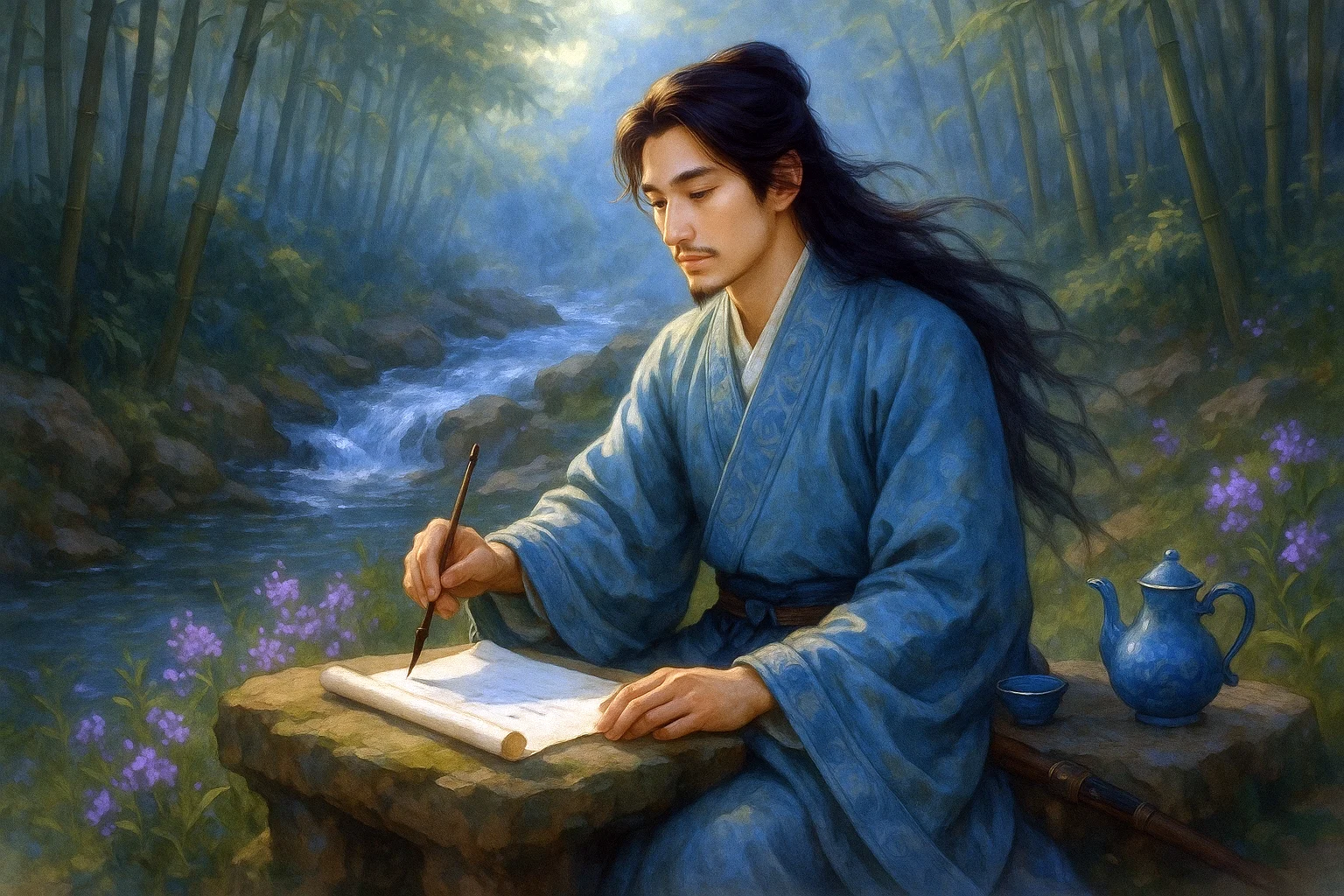
Huang Tingjian (黄庭坚 1045 - 1105), a native of Xiushui, Jiangxi Province, was a renowned poet and calligrapher of the Northern Song Dynasty. He became a jinshi (presented scholar) in the fourth year of the Zhiping era (1067 AD) and held various official posts, including Professor at the Imperial Academy and Secretary to the Imperial Archives. Later, he became entangled in the political strife between the conservative and reformist factions, suffering repeated demotions. As the foremost of the "Four Scholars of the Su School," he was often paired with Su Shi as "Su-Huang" in literary circles. Modeling his poetry on Du Fu, he founded the "Jiangxi School of Poetry" and proposed the influential creative theory of "transforming the bones and seizing the embryo, turning iron into gold," emphasizing that every word in poetry should have its origin. His work established a new paradigm for Song Dynasty poetics, exerting a profound and lasting influence on subsequent generations.