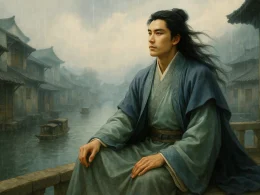
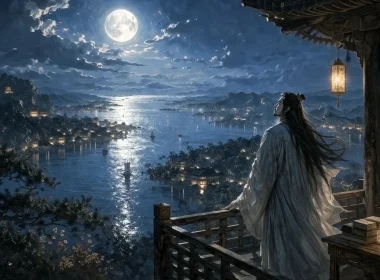
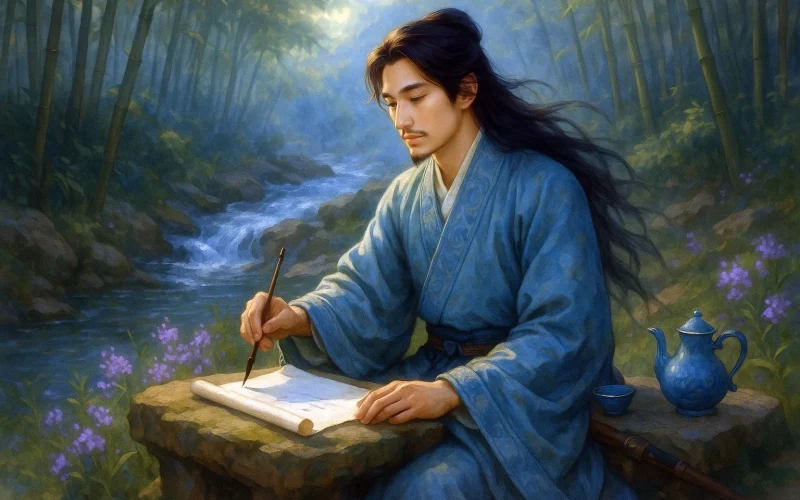
Huang Tingjian (黄庭坚 1045 - 1105), a native of Xiushui, Jiangxi Province, was a renowned poet and calligrapher of the Northern Song Dynasty. He passed the jinshi examination in the fourth year of the Zhiping era (1067 AD) and held various official posts, including Professor at the Imperial Academy and Secretary of the Imperial Archives. Later, he became entangled in the political strife between the Reformist and Conservative factions, suffering repeated demotions, and eventually died in exile in Yizhou. As the foremost of the “Four Scholars of the Su School,” he was often paired with Su Shi as “Su-Huang.” Modeling his poetry on Du Fu, he developed his own distinctive style and founded the influential “Jiangxi School of Poetry.” His poetic theory advocated “transforming the bones and seizing the embryo” and “turning iron into gold,” emphasizing that every word should have its origin, with meticulous attention to word refinement, literary allusions, and structural artistry. His novel, lean, and vigorous style corrected the flat and superficial tendencies of early Northern Song poetry. His collected works, Shangu Ji, have been handed down, and his poetry, calligraphy, and prose all reached the highest level of artistic mastery, making him one of the great synthesizers of Song Dynasty culture and art.
Major Works
Life
Huang Tingjian was born into a scholar-official family in Shuangjing Village, Xiushui, Jiangxi. His sixth-generation ancestor, Huang Zhan, moved to Fening. Through his great-grandfather Huang Yuanji, his grandfather Huang Zhongli, and his father Huang Shu, the family prospered and was renowned for scholarship for generations. His father, Huang Shu, was a poet who specialized in studying Du Fu and served for a long time as a subordinate official in various prefectures, living in modest circumstances. His mother, née Li, was the sister of Li Chang, a famous bibliophile. Huang Tingjian was the second among his brothers, with an elder brother, Huang Dalin, and three younger brothers.
Huang Tingjian was intelligent and studious from a young age. He could compose poetry at seven. His poem "The Buffalo Boy" (牧童) — "骑牛远远过前村,短笛横吹隔陇闻。多少长安名利客,机关用尽不如君" — already displayed remarkable precocious talent. In the third year of the Jiayou era (1058 AD), his father, Huang Shu, died of illness while in office. The fourteen-year-old Huang Tingjian's family fell into decline. Thereafter, he traveled with his maternal uncle, Li Chang, to Huainan, where he read widely. Li Chang was not only a famous bibliophile but also a poet, and he had a profound influence on Huang Tingjian's development. At seventeen, Huang Tingjian married Lanxi, the daughter of Sun Jue. Sun Jue was also a well-known scholar of the time and later became a friend of Su Shi, introducing Huang Tingjian to him.
In the fourth year of the Zhiping era (1067 AD), at the age of twenty-three, Huang Tingjian passed the Jinshi examination. The average age of Jinshi candidates in the Song dynasty was between thirty and thirty-five, so passing at twenty-three was a sign of early success. After passing, he was appointed Sheriff of Yexian County in Ruzhou. While serving in Yexian, his wife, née Sun, died of illness in the official residence. In the fifth year of the Xining era (1072 AD), Huang Tingjian took the imperial examination for Academy instructors in the Four Capitals and ranked among the top, receiving an appointment as Professor of the National Academy in Beijing (present-day Daming, Hebei). He served in Beijing for a total of seven years, living a frugal life and often comparing himself to Zheng Qian, the "Guangwen Scholar" of Du Fu's poetry. During the Xining era, his second wife, née Xie (daughter of Xie Jingchu), also died of illness in his place of posting.
In the first year of the Yuanfeng era (1078 AD), the thirty-four-year-old Huang Tingjian sent a letter with two ancient-style poems, "Two Ancient Poems to Su Zizhan" (古风二首上苏子瞻), to Su Shi, who was then Prefect of Xuzhou. This marked the beginning of their friendship. After reading them, Su Shi was full of praise, calling them "transcendent and sublime, standing alone above all things." In the third year of the Yuanfeng era (1080 AD), Huang Tingjian was transferred to the post of Magistrate of Taihe County in Jizhou. On his way to his new post, he passed by the Valley Temple on Mount Sanzu in Shuzhou. Enchanted by its beautiful forests and springs, he adopted the art name "Shangu Daoren" (Mountain Valley Daoist).
In the eighth year of the Yuanfeng era (1085 AD), Emperor Shenzong of Song passed away, and the Old Party came to power. Huang Tingjian was summoned to the capital and appointed Collator of the Imperial Library. The following year, he was promoted to Editorial Examiner of the "Veritable Records of Emperor Shenzong" (神宗实录), overseeing its compilation. During this period, Huang Tingjian associated and exchanged poems with Su Shi, Zhang Lei, Chao Buzhi, Qin Guan, and others in the capital. His creative output in poetry, prose, and calligraphy reached its peak. In the sixth year of the Yuanyou era (1091 AD), weary of the factional struggles in the capital, Huang Tingjian twice submitted memorials requesting a post outside the capital. That same year, his mother passed away, and he escorted her coffin back to his hometown to observe the mourning period.
In the first year of the Shaosheng era (1094 AD), the New Party regained power and launched a large-scale persecution of the Yuanyou faction. Huang Tingjian, because his compilation of the "Veritable Records of Emperor Shenzong" was accused of being "filled with fabricated slanderous statements that disparaged the political affairs since the Xining era," was demoted to Vice Prefect of Fuzhou and placed under house arrest in Qianzhou (present-day Pengshui, Chongqing). The fifty-year-old Huang Tingjian lived in Qianzhou for three full years, personally managing his residence, buying land, and growing vegetables, calling himself "an old farmer of Qianzhou." In the first year of the Yuanfu era (1098 AD), he was transferred to Rongzhou (present-day Yibin, Sichuan). He spent nearly six years of exile in the Bashu region. In the third year of the Yuanfu era (1100 AD), Emperor Huizong of Song ascended the throne and issued a general amnesty. Huang Tingjian was recalled to the capital.
In the first year of the Jianzhong Jingguo era (1101 AD), on his way back, Huang Tingjian wrote the "Stele of the Songfeng Pavilion" (松风阁诗帖), in memory of his deceased friend Su Shi. In the first year of the Chongning era (1102 AD), he was appointed Prefect of Taipingzhou but was dismissed after only nine days. In the second year of the Chongning era (1103 AD), Transport Judge Chen Ju, acting on the instructions of Chancellor Zhao Tingzhi, reported that Huang Tingjian's "Inscription on the Chengtian Temple Tower in Jingzhou" (荆州承天院塔记) contained "rejoicing in misfortune and slandering the state." Huang Tingjian was stripped of all his posts and exiled to Yizhou (present-day Yishan, Guangxi) under surveillance. In the fourth year of the Chongning era (1105 AD), Huang Tingjian died of illness in his place of exile in Yizhou. After his death, friends and family escorted his coffin back to be buried in the ancestral cemetery at Shuangjing, Fening. The court posthumously awarded him the title of Academician of the Longtu Pavilion and the posthumous name "Wenjie."
Stylistic Characteristics
Huang Tingjian's literary and artistic achievements are mainly reflected in three areas: poetry, ci poetry, and calligraphy, with poetry being the most prominent and influential.
Poetry: Fresh, Lean, and Firm, a School of His Own
Huang Tingjian is one of the most original poets of the Northern Song poetic scene. His extant poems number over 1,900. His style is unique and established a school of his own, known as the "Shangu Style."
In poetic theory, Huang Tingjian put forward the doctrines of "点铁成金" (turning iron into gold) and "夺胎换骨" (transforming the embryo and changing the bones), emphasizing that "there is not a single word without a source." His poetic style emphasizes compositional structure, makes good use of oblique tones, seeks strangeness and novelty, and is lean and firm in style. In terms of subject matter, Huang Tingjian's poems include works that observe the people's condition, such as "Lament for the Refugees" (流民叹), "Climbing Damenglong" (上大蒙笼), and "Diaopi" (彫陂). However, more numerous are works expressing personal feelings and displaying literati tastes, refining poetic meaning from everyday life—including family and friend interactions, garden pleasures, reading and scholarship, and inscriptions on paintings and calligraphy. Therefore, Huang Tingjian's poetry is heavily imbued with the atmosphere of the scholar, reflecting a noble character and literati integrity that did not follow common trends.
In terms of intellectual inclination, Huang Tingjian's literary views show a tendency to turn inward, emphasizing the preservation of inner cultivation and sanctity. He believed that literature's purpose was not to argue with others about right and wrong but to nourish the mind and cultivate one's nature. He was deeply influenced by Daoist and Buddhist thought, formed deep friendships with many monks, and became an initiated disciple of Chan Master Zuxin of the Huanglong sect of the Linji school. He believed that Buddhist scriptures could help one realize the true meaning of life and assist in escaping worry and distress.
Ci Poetry: Diverse Styles, a School of His Own
Huang Tingjian's extant ci poems number over 180. His ci poems primarily focus on romantic themes, with a small number of bold and unconstrained pieces. Overall, although his ci achievements do not match his poetry, they still establish him as a major figure in the Northern Song ci world.
Calligraphy: Strange and Daring, a School of His Own
Huang Tingjian was a renowned calligrapher of the Northern Song dynasty, counted among the "Four Masters of the Song" together with Su Shi, Mi Fu, and Cai Xiang. His calligraphy achieved the highest distinction in running script and cursive script, known for its "strangeness and daring." He broke away from the gentle and restrained style that had been revered in calligraphy since the Jin and Tang dynasties, creating a new paradigm full of visual tension.
Huang Tingjian initially studied calligraphy under Zhou Yue. Later, he was influenced by Yan Zhenqing, Huaisu, Yang Ningshi, and the "Epitaph of the Buried Crane" at Jiaoshan, forming his own style. He originated the "oar-stroking brush technique," deriving the mystery of calligraphic movement from observing boatmen battling the currents. He proposed that "learning calligraphy requires having moral principles in the heart, and further enriching oneself with the learning of the sages; only then is calligraphy valuable," emphasizing that calligraphy is not merely a display of brushwork technique but an externalization of the calligrapher's personal cultivation. His large-character running script is condensed and powerful; his cursive script is like dragons and serpents dancing, bold and unrestrained, and is praised as "having a brush within the characters."
Literary Influence
Huang Tingjian occupies an extremely important position in the history of Chinese literature and art. His influence was profound, and among poets of the Song dynasty, few could match him.
Founding Patriarch of the Jiangxi Poetry School
This is Huang Tingjian's most central contribution to literary history. Lü Benzhong of the Southern Song dynasty, in his "Genealogical Chart of the Jiangxi Poetry Society" (江西诗社宗派图), listed Huang Tingjian first as the patriarch of the school. The Jiangxi Poetry School thus became the first formally named poetic school in Chinese literary history, its influence dominating the Southern Song poetic scene for over a century. Fang Hui of the Yuan dynasty, in his Yingkui Lüsui (瀛奎律髓), proposed the theory of "One Patriarch and Three Masters," with Du Fu as the patriarch and Huang Tingjian, Chen Shidao, and Chen Yuyi as the three masters. Although Huang Tingjian was a disciple of Su Shi, he went further than Su Shi in seeking novelty and change in poetry. Therefore, in literary history, he is paired with Su Shi as "Su-Huang." Because he pioneered a path that could be followed and practiced, his influence even surpassed that of Su Shi.
Profound Influence of Poetic Theory
Huang Tingjian's poetic theories of "点铁成金," "夺胎换骨," and "无一字无来处" provided later poets with concrete methods and rules. Their core spirit lies in correctly handling the relationship between inheritance and innovation, exerting a continuous and profound influence on later poets.
Enduring Contribution to Calligraphy
His position as one of the "Four Masters of the Song" made his calligraphy a model for later generations to study. His unique running script structure and bold cursive style had a profound influence on calligraphers of the Yuan, Ming, Qing dynasties, and even modern times. The Southern Song, Yuan, and Ming dynasties all had many followers, and his influence was immense and enduring.
Model of Character and Literati Spirit
Huang Tingjian's unwavering integrity in political turmoil, his dedication to scholarship even in adversity, had a great influence on later literati. Although repeatedly exiled, he remained unperturbed by his demotions, finding pleasure in writing and calligraphy and pursuing inner tranquility. His reputation for "filial piety and fraternal love" was also praised by later generations. His pursuit of "refinement" — that is, personal independence, profound scholarship, and artistic transcendence — became one of the models of Song dynasty literati spirit.
Evaluations Through the Ages
- Su Shi: "Transcendent and sublime, standing alone above all things."
- Liu Kezhuang: "Huang Tingjian came a little later, synthesized the strengths of the prosodic rules of a hundred schools, exhaustively studied the changes of various literary forms throughout history, searched out rare books, delved into unusual lore, composed ancient-style and regulated verses, and established a school of his own. He never produced even half a word lightly, and thus became the patriarch of the poets of our dynasty."
- Yan Yu, Canglang Shihua: "It was only with Su Shi and Huang Tingjian that Song poetry began to express its own ideas; the style of Tang poetry had changed."
- Zhao Yi, Oubei Shihua: "Northern Song poetry is dominated by Su Shi and Huang Tingjian, for their talent and learning were both vast, and their powers were truly equal."
- Fang Hui, Yingkui Lüsui: Promoted Huang Tingjian as one of the "One Patriarch and Three Masters," establishing his central position in the Jiangxi Poetry School.
In summary, Huang Tingjian is an outstanding representative of the cultural spirit of the Song dynasty. He was born into poverty and lost his father young, yet with extraordinary talent and profound learning, he reached the highest levels of achievement in poetry, ci poetry, and calligraphy. He was the founding patriarch of the Jiangxi Poetry School, and together with Su Shi, he was known as "Su-Huang," jointly representing the highest achievements of Song poetry. He was one of the "Four Masters of the Song," and his calligraphy, strange and daring, influenced nearly a thousand years of later generations. Throughout his life, he experienced political turmoil and repeated exiles, yet he always maintained inner purity, finding pleasure in writing and upholding himself through scholarship, establishing a model of literati spirit for later generations. His character and his art, even after a thousand years, still allow us to imagine his transcendent spirit, as he wrote: "风流犹拍古人肩."