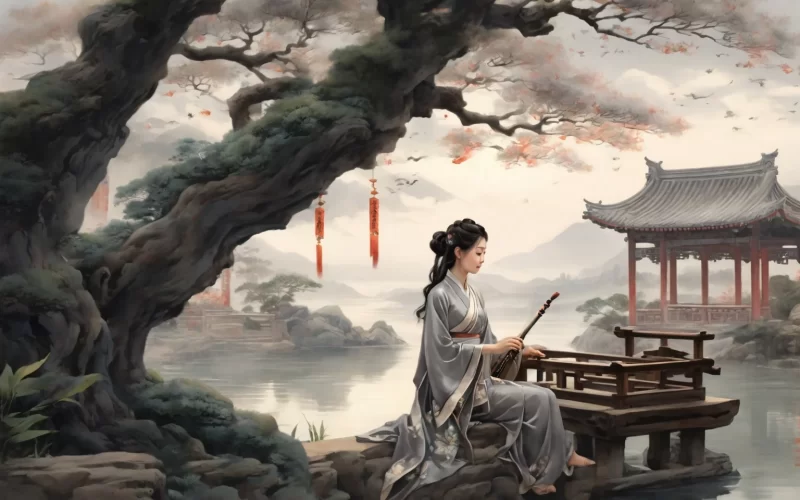
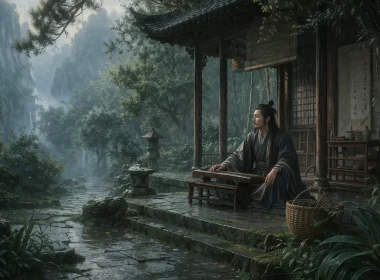
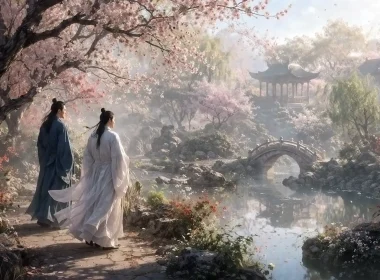
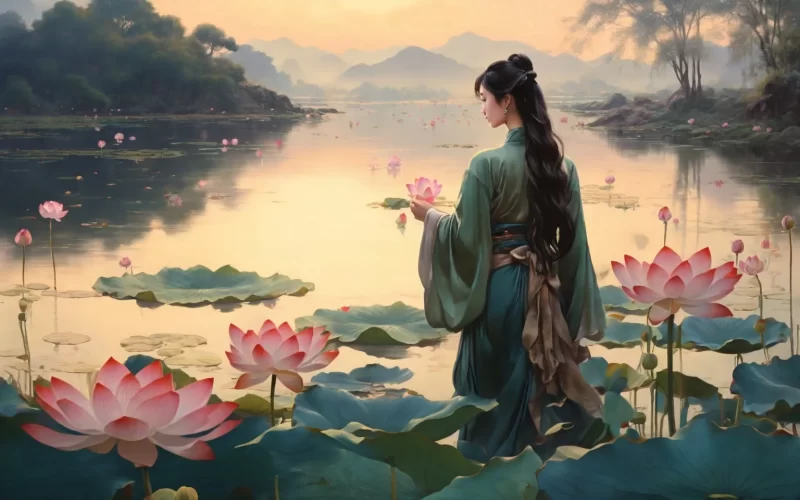
Their skirts are cut from the lotus‑leaf’s own hue;
The lotus‑flowers to their rosy faces sue.

They melt into the pond, and none can tell them there —
Till a song springs, and tells you maidens yet are near!
Original Poem
「采莲曲」
王昌龄
荷叶罗裙一色裁,芙蓉向脸两边开。
乱入池中看不见,闻歌始觉有人来。
Interpretation
This poem was composed in the summer of 748 AD, the 7th year of the Tianbao era, after Wang Changling was demoted to the post of Sheriff of Longbiao. Longbiao, located in present-day Qianyang, Hunan, lies in western Hunan, a region dotted with many lakes and waterways. In summer, lotus blossoms bloom, and young women picking lotus appear among them—a quintessential scene of the Jiangnan water country. At this time, Wang Changling was in the twilight of his life, his official career fraught with setbacks, far from his homeland. Yet, this poem shows not a trace of the bitterness of banishment, only a keen observation and passionate praise for life and beauty. The girl whose "荷叶罗裙一色裁", the face framed by "芙蓉向脸两边开", the elusive mystery of "乱入池中看不见", and the delighted surprise of "闻歌始觉有人来"—all reveal that even in exile, the poet retained his sensitivity to beauty and his love for life.
This poem is a hymn of praise Wang Changling wrote with the lightest touch, dedicated to this summer, these young women, and this world. It shows us that the poet who wrote "黄沙百战穿金甲" could also compose lines so fresh and graceful; the poet who chanted "不破楼兰终不还" could also be moved by the songs of the lotus-pickers.
First Couplet: "荷叶罗裙一色裁,芙蓉向脸两边开。"
Héyè luó qún yī sè cái, fúróng xiàng liǎn liǎng biān kāi.
Their silk skirts share the color of lotus leaves, seemingly cut from the same cloth;
Lotus blooms seem to part on both sides, opening towards their faces.
The opening employs a marvelous association, merging the figures with the scenery. "荷叶罗裙一色裁"—lotus leaves are green, and the silk skirts are green. But the poet does not simply say "their colors are alike"; he says "seemingly cut from the same cloth," as if the lotus leaves and the skirts were tailored from the same bolt of fabric. This imaginative leap not only notes the similarity in color but, more importantly, conveys a harmony between humanity and nature—as if the young women grew from the lotus pond itself, an integral part of the scene.
"芙蓉向脸两边开"—the lotus blooms, also a metaphor for the young women's faces. The lotus flowers bloom beside their cheeks, as if vying with their beauty. The word "towards" (向) gives life and feeling to the flowers—they open towards the faces, as if paying homage. This couplet places the young women amidst the lotus flowers, making them the most beautiful sight in the pond.
Second Couplet: "乱入池中看不见,闻歌始觉有人来。"
Luàn rù chí zhōng kàn bú jiàn, wén gē shǐ jué yǒu rén lái.
They mingle into the pond, disappearing from sight,
Only upon hearing a song do we realize someone is there.
This couplet brilliantly uses "invisibility" to suggest "presence," and "hearing a song" to signal "someone"—a clever technique that creates a dreamy, elusive atmosphere. "乱入池中看不见"—the young women wander deep into the lotus pond, blending completely with the flowers and leaves, becoming indistinguishable. Their emerald-green skirts, their rosy faces, are all swallowed by the pond's overwhelming green and red. The poet uses the word "mingle" (乱入), vividly capturing both the luxuriance of the pond and the agility of the young women—they are not standing demurely, but moving freely through the pond, "mingling" within it, dancing with the flowers and leaves.
"闻歌始觉有人来"—suddenly, a song rises. Following the sound, we then realize someone is there. That song belongs to the young women, and also to the lotus pond; it is real, and yet poetic. This line transforms visual ambiguity into auditory clarity, turning the entire poem from a static picture into a dynamic scene. The unseen person exists because of the song; the elusive scene comes alive because of the song.
Holistic Appreciation
This poem, with the lightest touch, paints the most charming picture of a summer lotus-picking scene. The first two lines depict the interplay between the young women and the lotus flowers, merging person and scenery through the wonderful conceits of "一色裁" and "向脸开". The last two lines describe the young women disappearing into the lotus and communicating through song, using the interplay of the tangible and intangible in "看不见" and "闻歌" to give the image sound and the stillness motion.
The entire poem is graceful in language and ethereal in mood. There is no complex rhetoric, no abstruse philosophy; it merely uses the simplest language to capture a most beautiful moment. The young women's silk skirts, the blooming lotus, the elusive figures, the clear song—all are frozen in eternity within these twenty-eight characters. Compared to Wang Changling's stirring and solemn frontier poems, this poem is of a completely different style. It shows us that a Tang dynasty poet could write both "黄沙百战穿金甲" and "荷叶罗裙一色裁"; he could possess both the heroic spirit of "不破楼兰终不还" and the tender sentiment of "闻歌始觉有人来". This very diversity of style is the most captivating aspect of High Tang poetry.
Artistic Merits
- Unity of Person and Scene, Fusion of Subject and Object: "荷叶罗裙一色裁" merges person and scenery; "芙蓉向脸两边开" allows flower and face to reflect each other, blurring the line between subject and object.
- Interplay of Tangible and Intangible, an Elusive Mood: "乱入池中看不见" describes visual ambiguity; "闻歌始觉有人来" describes auditory clarity. The combination of the tangible and intangible creates endless charm.
- Graceful Language, Unadorned Simplicity: The entire poem contains not a single difficult or obscure word. Like clear water and lotus blossoms, it is natural and innate, yet its artistic conception is profound.
- Combination of Motion and Stillness, a Vivid Picture: The first two lines present a static image; the last two introduce song, giving the picture sound and life.
Insights
This poem first reveals to us how to discover poetry in the ordinary. Picking lotus is the most commonplace labor in the Jiangnan water country; the lotus-picking girls are the most ordinary of people. Yet, in Wang Changling's eyes, everything was filled with poetry—lotus leaves and silk skirts "一色裁", lotus flowers "向脸" "两边开", young women "乱入" the pond, and a song making us "始觉" someone is there. With a poet's vision, he transformed these ordinary things into the most beautiful verse. It tells us: Poetry is not somewhere distant; it is in daily life. If we feel with our hearts, even the most ordinary life is full of potential beauty.
The word "乱" (mingle) in "乱入池中看不见" also prompts us to reflect on the relationship between order and freedom. Those young women are not standing neatly in one place; they are "乱入" the pond, moving about freely. It is precisely this "乱" that allows them to merge with the lotus, to become part of the pond. It reveals: True beauty is often not uniform and orderly, but grows freely. Often, beyond rules and order lies the most moving scenery.
The mood evoked by "闻歌始觉有人来" further leads us to contemplate the relationship between existence and perception. The young women exist, but we cannot see them; we cannot see them, but the song lets us know they exist. This mode of "existence" is more moving and profound than direct sight. It reveals: Some things are not seen with the eyes, but perceived with the heart. True beauty is often not immediately obvious; it needs to be discovered with the heart, listened to with the ears, and felt with one's entire being.
The image of the young woman who "乱入池中" and announces her presence with song is especially unforgettable. She is not a passive object to be looked at, but an active presence—she "mingles" into the lotus pond, she starts to sing, she uses her song to tell the world: I am here. This active stance is more vivid than any passive waiting. It teaches us: Do not merely be the scenery that is seen; be an active presence. Do not merely wait to be discovered; use your own voice to announce your presence. Like the lotus-picking girl, even if "看不见", let the world "闻歌" and know someone is there.
About the poet
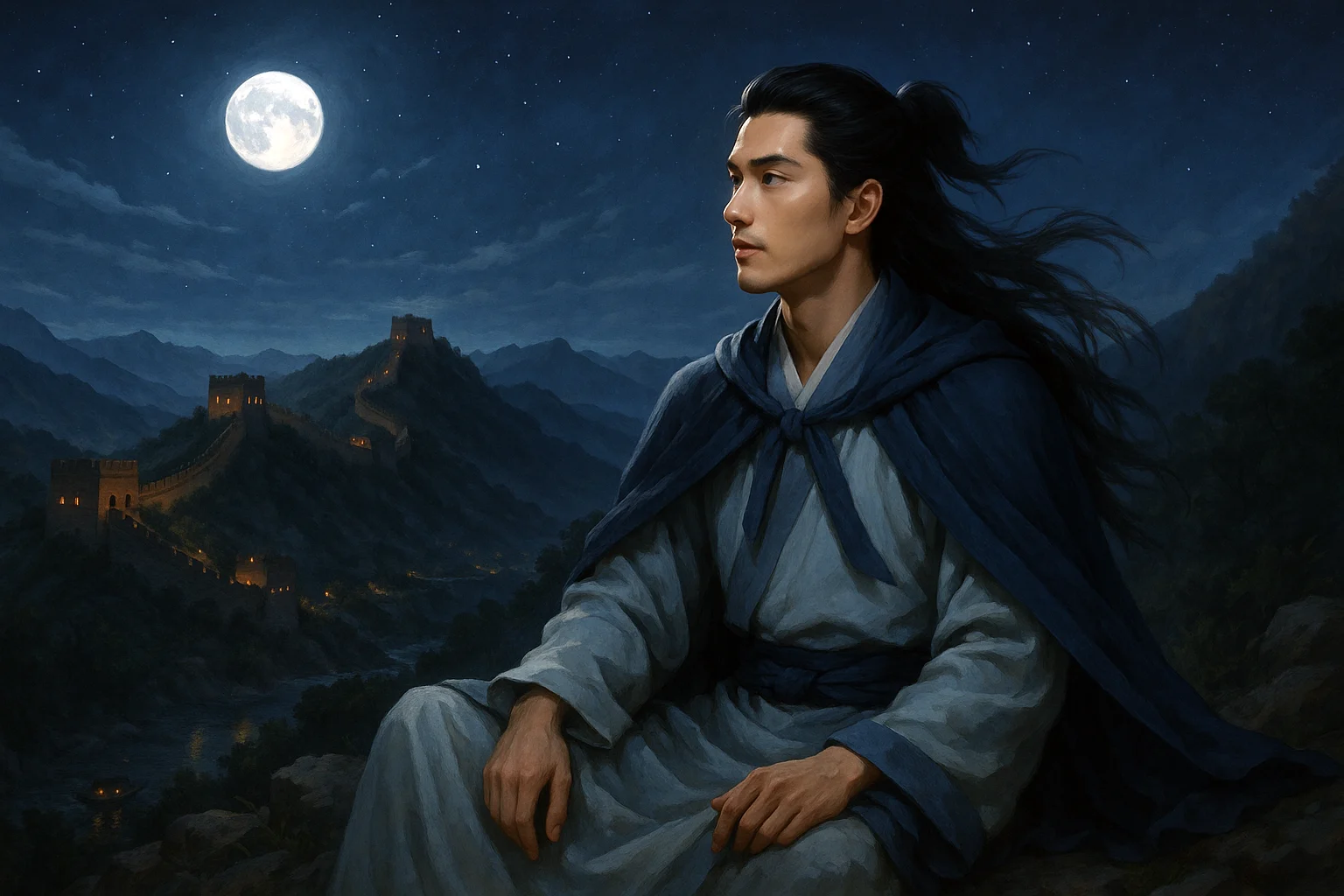
Wang Changling (王昌龄), circa A.D. 690 - 756, was a native of Xi'an, Shaanxi Province. Wang Changling's poems were mostly about the Border Places, love affairs and farewells, and he was well known during his lifetime. His seven poems are equal to those of Li Bai, and he is known as the “Master of seven lines”.