
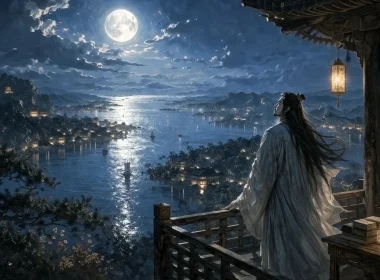
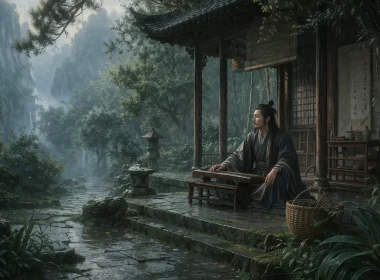
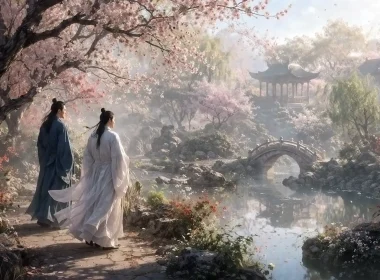
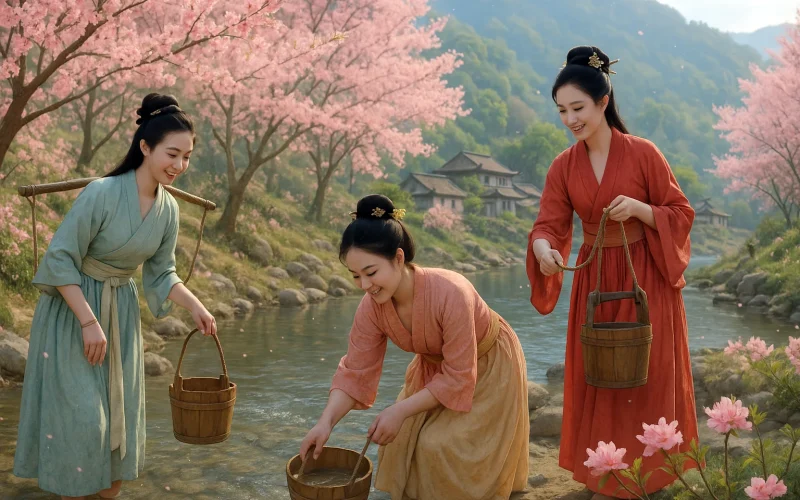
Peach and plum blossoms layer the hill, tier on tier;
Amid the clouds, smoke rises — there dwell people here.

Women with silver bracelets and gold hairpins come to carry water;
Men with long knives and short bamboo hats go to slash-and-burn, tilling the quarter.
Original Poem
「竹枝词 · 山上层层桃李花」
刘禹锡
山上层层桃李花,云间烟火是人家。
银钏金钗来负水,长刀短笠去烧畲。
Interpretation
This poem was composed in the second year of the Changqing era of Emperor Muzong of Tang (822 AD), at a time when Liu Yuxi was exiled to the land of Ba and Shu, serving as Prefect of Kuizhou. This was yet another post in the series of remote prefectures to which he was transferred following the failure of the "Yongzhen Reform." From Langzhou to Lianzhou, and then to Kuizhou, his long years of exile, while distancing him from the political center, also afforded him the opportunity to deeply engage with the folk life and culture of various regions. It was against this backdrop that he was drawn to the simple, robust folkways and the uniquely beautiful landscapes of the Kuizhou area, and he began to deliberately study and imitate the local "Bamboo Branch Songs" folk songs of eastern Sichuan.
These folk songs were originally rustic tunes sung impromptu by the local people, accompanied by dance, with content often concerning love between men and women, or local landscapes. With a poet's sensitivity, Liu Yuxi discovered the genuine, unadorned beauty contained within them. He then selected their melodies and transformed them into poetry, creating a set of nine "Bamboo Branch Songs," becoming a model of the perfect integration of literati poetry and folk literature. It is important to note specifically that before Liu Yuxi, literati rarely ventured into composing such folk songs. His attempt was groundbreaking, infusing Tang poetry with fresh folk vitality.
This poem, the ninth of the set, can be seen as the poet's artistic distillation of a panoramic view of the mountain people's life in Kuizhou. Like a vivid and lively genre painting of mountain dwelling, it thoroughly depicts the daily labor scenes of the villagers in the Badong mountain area, brimming with rich life and local character.
First Couplet: "山上层层桃李花,云间烟火是人家。"
Shān shàng céng céng táo lǐ huā, yún jiān yān huǒ shì rén jiā.
Peach and plum blossoms bloom tier upon tier upon the mountain;
Through the clouds, smoke rises—there, where people make their home.
The poet begins with the word "mountain," instantly transporting the reader into the unique topography of the Ba-Shu region. On the spring mountainside, peach and plum blossoms vie in splendor, tier upon tier, a magnificent sight. The words "tier upon tier" not only depict the three-dimensional layers of mountain vegetation but also hint at the unique flowering periods created by the mountainous climate—blossoms have faded below while blooming gloriously above, forming a naturally staggered spectacle. The four words "through the clouds, smoke rises" shift the gaze from the profusion of flowers to human habitation: amidst the curling clouds and mist, a wisp of worldly smoke rises leisurely, as if at the boundary where an ethereal fairyland intertwines with reality. The poet gently clarifies this with the three words "where people make their home," pulling the elusive fairyland back to the human world, revealing that behind this beautiful scenery lies the living world created by the mountain people's own hands. This technique, moving from scene to people, from distant to near, reflects the poet's deep appreciation of the harmonious coexistence between humanity and nature.
Second Couplet: "银钏金钗来负水,长刀短笠去烧畲。"
Yín chuàn jīn chāi lái fù shhuǐ, cháng dāo duǎn lì qù shāo shē.
With silver bracelets and golden hairpins, they come to fetch water;
With long knives and short bamboo hats, they go to burn the slopes for sowing.
This couplet pulls the lens closer, focusing on the mountain people's daily labor, infusing dynamic vitality into the static beauty of the previous lines. The poet skillfully employs synecdoche, using "silver bracelets and golden hairpins" to represent the adorned women, and "long knives and short bamboo hats" to represent the equipped men. With just eight characters, vivid character images are outlined: the silver bracelets on the women's wrists and the golden hairpins in their hair glint by the mountain spring; the long knives at the men's waists and the short bamboo hats on their heads gleam in the firelight. This technique of representing people by their objects, depicting spirit through form, not only makes the lines concise and refined but also imbues the characters with distinct local color and tangible life. Particularly commendable is the neat parallelism within these two lines—"silver bracelets" pairs with "golden hairpins," "long knives" pairs with "short bamboo hats"—demonstrating the poet's mastery in refining language while maintaining a natural fluency.
Holistic Appreciation
Though this short poem has only four lines and twenty-eight characters, it resembles a meticulously composed landscape painting with figures. The first two lines offer a distant view: spring mountains like a sea, masses of blossoms, deep within the clouds and mist, smoke rises lazily, drawing the reader into a poetic, picturesque realm. The latter two lines provide a close inspection: village women fetch water, farmers burn the slopes for sowing—ordinary labor that nonetheless radiates the fervor and fulfillment of life. The poet does not directly praise the beauty of life; instead, through the harmonious interplay between nature and labor, he allows readers to perceive for themselves that it is precisely this seemingly mundane daily toil that nourishes the vitality and beauty of this land. The detailed depiction of "silver bracelets and golden hairpins" and "long knives and short bamboo hats" not only makes the characters leap off the page but also carries profound folk cultural connotations, making the entire poem an ethnic genre painting brimming with local color.
Artistic Merits
- Leading with Scene, Fusing Scene and Emotion: The poet excels at starting from the natural landscape, delving deeper layer by layer, and finally settling on human activity, making the scenery vibrant because of human presence.
- Vivid Synecdoche, Creating Lifelike Images: Using ornaments and tools to represent people avoids straightforward narration and makes the images more sharply defined, embodying the artistic charm of "conveying much with little."
- Spatial Composition, Combining Distant and Near: The four lines form a spatial progression from distant to near, from broad scene to specific point, possessing a painterly sense of layers and three-dimensionality.
- Fresh Language, Folk Song Flavor: The lines are simple and fluent, absorbing the rhythmic sense and colloquial expression of folk songs, yet refined by the poet, achieving the artistic effect of "seeming ordinary, yet most extraordinary."
Insights
This poem first inspires us to reconsider the relationship between humanity and nature. The juxtaposition of "Peach and plum blossoms bloom tier upon tier upon the mountain" and "Through the clouds, smoke rises—there, where people make their home" reveals a precious sense of homeland—a homeland is not an artificial fortress opposed to nature, but a dwelling for life integrated within the landscape. The tier upon tier of blooming peach and plum are both nature's creation and nurtured by the mountain people's care; the smoke amidst the clouds is both the smoke of human hearths and blends with the mountain mist. This state of living in harmony between heaven and humanity appears especially precious against the backdrop of today's rapid urbanization—we have gained more convenient lives but may have lost the warmth of intimacy with the land.
Secondly, the poem contains a poetic understanding of labor. The two lines, "With silver bracelets and golden hairpins, they come to fetch water; / With long knives and short bamboo hats, they go to burn the slopes for sowing," seemingly depict labor scenes plainly, yet hold deeper meaning: the poet deliberately selects decorative objects like "silver bracelets and golden hairpins" and "long knives and short bamboo hats," implying these mountain people are not disheveled laborers, but rather people who maintain dignity and beauty within their labor. This perspective that combines labor with beauty remains thought-provoking today—when we habitually view labor merely as a means of livelihood, can we still discover that composure and dignity within ordinary toil?
Ultimately, when Liu Yuxi wrote this poem, he was in the midst of exile, politically frustrated and far from his native place. Yet the poem contains not a trace of resentment, only a sincere appreciation for the life before his eyes. This ability to discover beauty in adversity, to find poetry in the everyday, is perhaps the greatest spiritual legacy this poem leaves us. Life always has its ups and downs, but as long as one can still see spring in the tier upon tier of peach and plum blossoms, and see home in the smoke amidst the clouds, life will never lose its luster.
About the poet
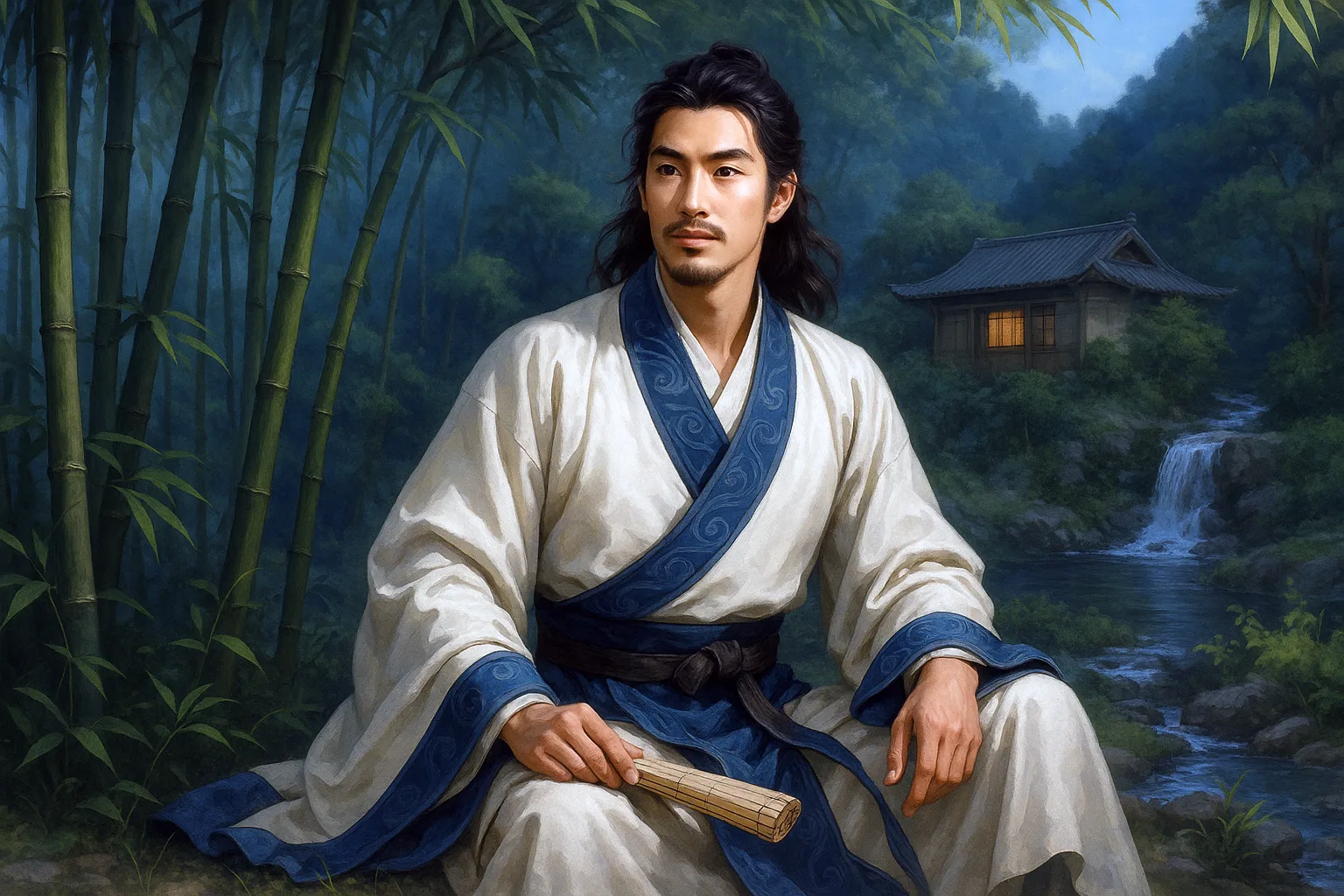
Liu Yuxi(刘禹锡), 772 - 842 AD, was a native of Hebei. He was a progressive statesman and thinker in the middle of the Tang Dynasty, and a poet with unique achievements in this period. In his compositions, there is no lack of poems reflecting current affairs and the plight of the people.