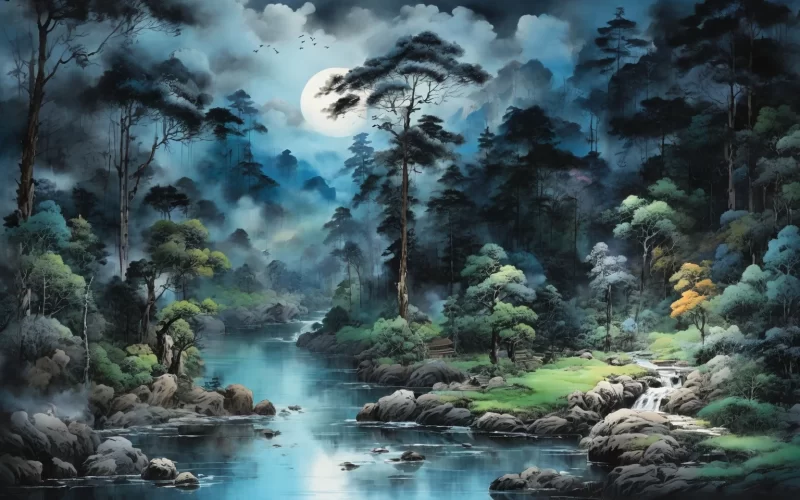

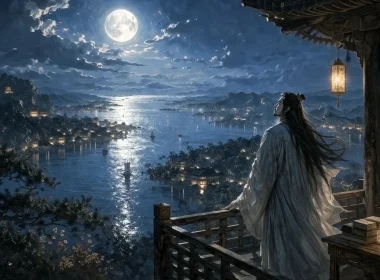

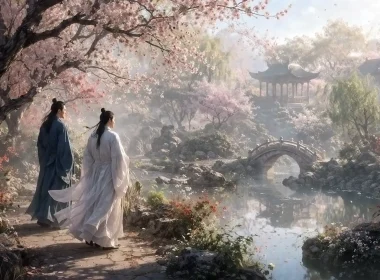
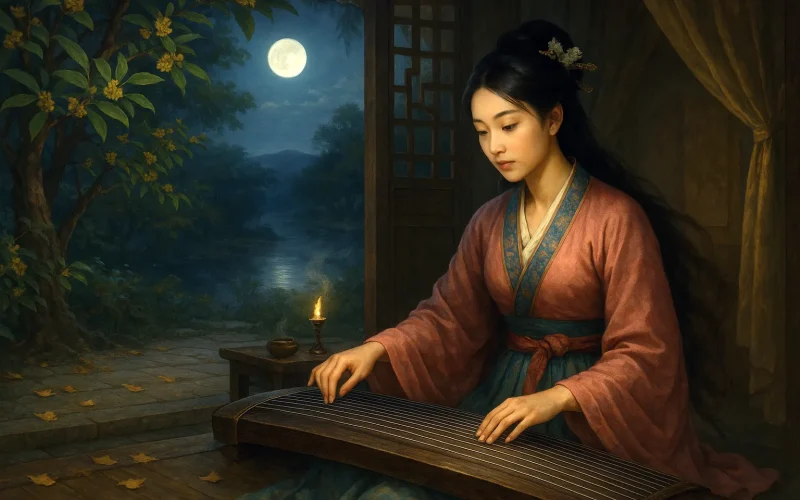
Under the crescent moon, cold is the autumn dew;
Unchanged her gown, colder her sorrow feels anew.
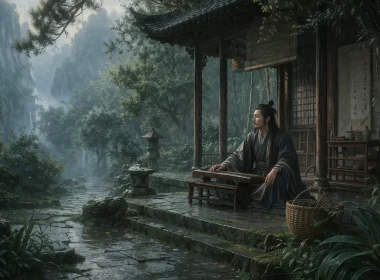
She plays on silver strings till night is worn away,
Afraid of empty room when ends her music’s sway.
Original Poem
「秋夜曲」
王维
桂魄初生秋露微,轻罗已薄未更衣。
银筝夜久殷勤弄,心怯空房不忍归。
Interpretation
This poem is a uniquely evocative miniature on the theme of the boudoir lament within Wang Wei's oeuvre, revealing a different dimension of his artistic world—one of subtle depth and melancholic resonance, where sound and image coalesce. Though spoken in a feminine voice to express the loneliness of an autumn night, it transcends the conventional plaintiveness of the genre. Through Wang Wei's signature ethereal brushwork and synesthetic artistry, it constructs a poignantly beautiful atmosphere of interwoven light and sound, where the outer scene mirrors the inner world. It elevates the specific pain of longing into a universal meditation on the solitude of existence and the passage of time.
First Couplet: 桂魄初生秋露微,轻罗已薄未更衣。
Guì pò chū shēng qiū lù wēi, qīng luó yǐ bó wèi gēng yī.
The cassia-scented moon is new, the autumn dew grows chill;
My gossamer robe feels thin, unchanged against my will.
The opening delineates the clear, desolate framework of the autumn night with exquisite delicacy. "Cassia-scented moon" metaphorically refers to the crescent, cool and luminous—it is both the source of light and the soul of the poem's mood. "Autumn dew grows chill" further evokes the moisture and encroaching cold, an extension of tactile sensation. Together, they create a transparent yet fragile visual and sensory field. The second line turns inward to the figure: "My gossamer robe feels thin" is the body's direct perception of the cold; "unchanged against my will" reveals an inner resistance to the external environment. This detail holds profound psychological depth: it is not ignorance, but a form of unconscious self-neglect or absorption in a particular state of mind, hinting at the protagonist's distracted solitude, indifferent to her own physical comfort. The external "chill" and the internal "indifference" resonate subtly here.
Final Couplet: 银筝夜久殷勤弄,心怯空房不忍归。
Yín zhēng yè jiǔ yīnqín nòng, xīn qiè kōng fáng bù rěn guī.
The silver lute I ply with care deep into the night;
My heart fears the empty room—I cannot face its quiet.
This couplet shifts from silent perception to active engagement and candid emotion, sharply intensifying the lyrical concentration. "The silver lute I ply with care deep into the night" portrays sustained action: the "silver lute" is ornate with a clear, piercing tone; "deep into the night" marks the passage of hours and the persistence of the act; "ply with care" suggests a focus verging on compulsion—as if only by filling the night with this crystalline sound can one momentarily hold something at bay. "My heart fears the empty room—I cannot face its quiet" lays bare the underlying psychological motive. The word "fears" is piercingly precise. It is not anger, nor sorrow, but a tender dread and instinctive recoil from vast emptiness. The "empty room" is physical space and the ultimate symbol of a psychological state—that absolute solitude with no shared presence. "I cannot face its quiet" and "unchanged against my will" form an emotional circuit: the former is an unwillingness to confront the inner "emptiness"; the latter is a disregard for the outer "chill." Both point to a state of existence that is unmoored, suspended only in music and the deepening night.
Holistic Appreciation
This is a "mood poem" that condenses boundless psychological drama into an exquisitely simple scene. Its structure is refined, following a clear progression: the first line paints the moon in the sky (distant), the second the robe on her form (intimate), the third the lute in her hands (action), the fourth the fear in her heart (stillness). The four lines are like four consecutive frames, moving from a wide shot (the autumn night sky) to a close-up (slender fingers on the strings), finally resting on a charged interior monologue.
Wang Wei's genius lies in treating the conventional "pining wife" theme with exceptional restraint, elegance, and timeless resonance. The poem contains not a single mention of "longing" or "husband." Instead, through the indifference of "unchanged," the absorbed focus of "ply with care," and the vulnerability of "my heart fears," the profound loneliness and unspoken waiting reveal themselves. More remarkable is the sensory interplay: sight (fragrant moon, autumn dew), touch (thin robe, chill), and hearing (sound of the lute) are perfectly fused, serving to create a holistic, pervasive atmosphere of solitude. The lute's melody seems a weapon against the silence of the night and the void of the heart, yet its very clarity makes the surrounding silence and emptiness seem all the more profound and unfathomable.
Artistic Merits
- Exquisite Imagery and Concentrated Atmosphere: "Cassia-scented moon" (cool glow), "autumn dew grows chill" (deepening cold), "gossamer robe" (thinness and fragility), "silver lute" (ornate and plaintive sound), "empty room" (devouring void). These images are light in texture, elegant in hue, yet all point to a weighty emotional core, achieving an artistic effect of conveying profound meaning with apparent lightness.
- Psychological Revelation through Contradictory Actions: The two seemingly contradictory behaviors—"unchanged" (not guarding against cold) and "ply with care" (consuming spirit)—precisely reveal the character's psychological state of being immersed in inner distress, even带有 a tendency toward self-depletion. This is precise, analytical portraiture of emotion.
- Suspension and Intensification of Temporal Sense: "Is new" and "deep into the night" create temporal tension. The moon's rising, which should be full of promise, corresponds to the indifference of "unchanged"; the depth of night, which should be for rest, corresponds to the persistence of "ply with care." This dislocated sense of time intensifies the experience of solitude—of being derailed from the diurnal rhythm, trapped in emotional duration.
- Lucid Diction and Profound Feeling: The poem's language is crystalline, unadorned, yet every word carries feeling. Words like "fears," "cannot face," "with care," "chill," "thin" show subtlety within plainness, containing sorrow within clarity, exemplifying the consummate realm of Wang Wei's linguistic art.
Insights
This work is like a faint bronze mirror, reflecting an eternal human condition: the profound "fear" and "inability to face" when confronting the "empty room" in life—the absence of meaning, of affection, of companionship. The woman in the poem, by "plying the silver lute with care," attempts to use creation (music) to fill the void, and focus to escape fear. Is this not a universal spiritual metaphor?
In modern society, we may no longer play the silver lute, but we often engage in various forms of "plying with care"—frantically working, lost in the digital realm, constantly socializing—to ward off the potential feeling of an "empty room" within. Wang Wei's poem invites us to bravely confront that "fear of the heart," to examine whether we are truly seeking "warmth" (changing clothes) or merely "plying the lute" to avoid returning to our dwelling. It reminds us: true peace lies perhaps not in forever fleeing the "empty room," but in cultivating the ability to dwell within it, even to transform its emptiness into inner space.
This poem is not only about longing; it is a profound meditation on the nature of solitude, the courage to exist, and art (the silver lute) as a potential path to confront nothingness. It is a short song of an autumn night, yet it echoes with the eternal inquiry into how humanity, amidst boundless loneliness, seeks and confirms its own existence.
Poem translator
Kiang Kanghu
About the poet
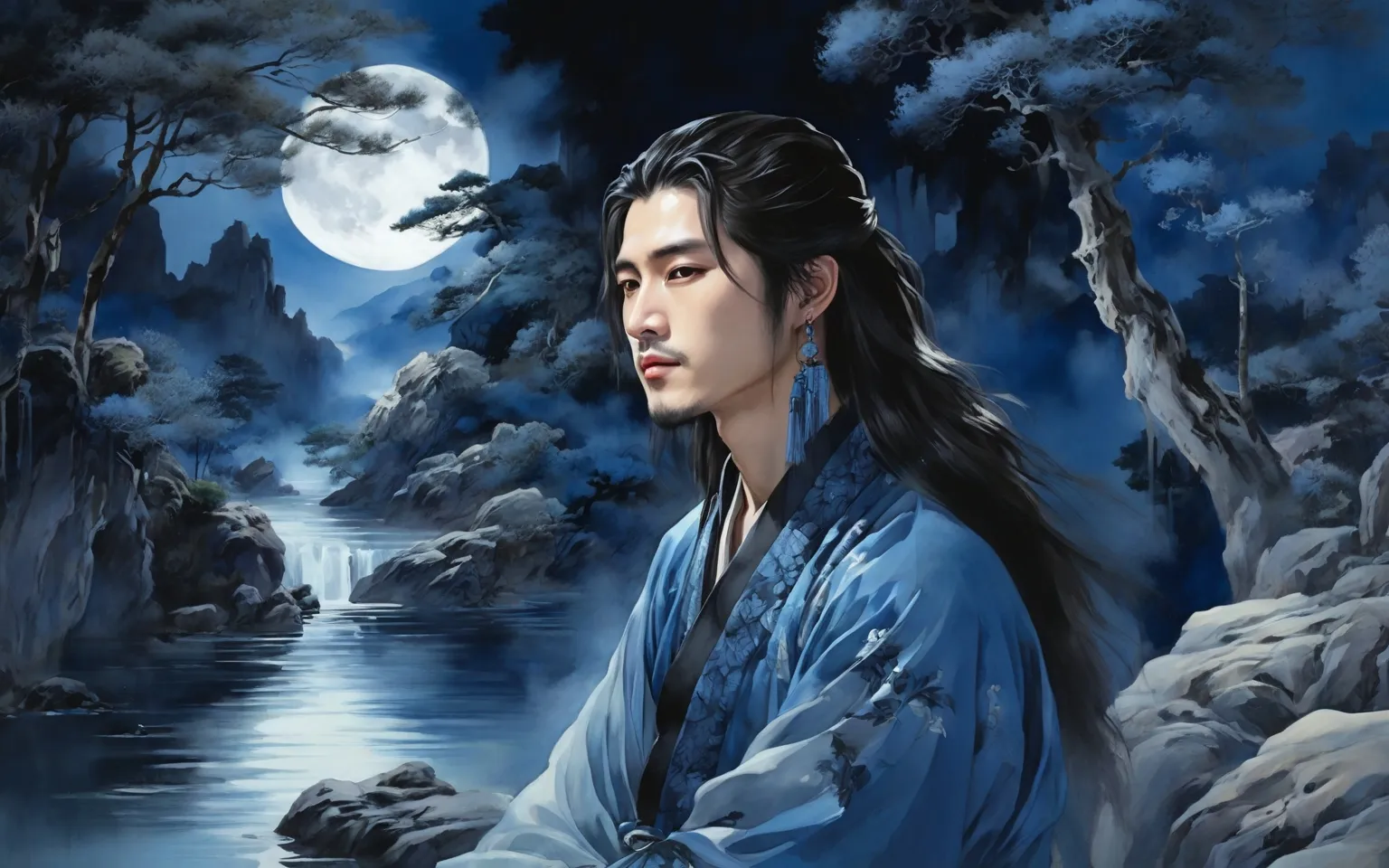
Wang Wei (王维), 701 - 761 A.D., was a native of Yuncheng, Shanxi Province. Wang Wei was a poet of landscape and idylls. His poems of landscape and idylls, with far-reaching images and mysterious meanings, were widely loved by readers in later generations, but Wang Wei never really became a man of landscape and idylls.