


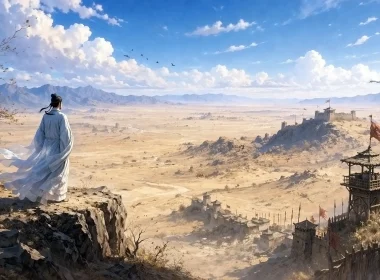



With this cold night-rain hiding the river, you have come into Wu.
In the level dawn, all alone, you will be starting for the mountains of Chu.
Answer, if they ask of me at Loyang:
"One-hearted as ice in a crystal vase."
Original Poem
「芙蓉楼送辛渐」
王昌龄
寒雨连江夜入吴,平明送客楚山孤。
洛阳亲友如相问,一片冰心在玉壶。
Interpretation
In the 29th year of the Kaiyuan era of Emperor Xuanzong of Tang (741 AD), after setbacks in his official career, Wang Changling was demoted to the position of County Magistrate of Jiangning, located in present-day Nanjing, Jiangsu. Furong Tower stands northwest of Zhenjiang, facing the Yangtze River, and was a place where he saw off friends. Xin Jian was a friend of Wang Changling, about to travel north to Luoyang. On an autumn night, a cold rain fell over the river. The poet braved the rain to hurry to Furong Tower to bid Xin Jian farewell. At dawn, the rain ceased, and his friend boarded the boat to depart. The poet stood alone before the tower, gazing at the distant mountains of Chu, and composed this poem.
At this time, Wang Changling was nearly fifty years old, having repeatedly suffered setbacks in his career, demoted from the capital to the provinces. But the poem does not pour out his grievances, nor does it complain about the injustice of fate. He only entrusts his friend: If my kin and friends in Luoyang ask after me, tell them my heart is still pure, like ice in a jade vessel, clear and clean, unchanged.
First Couplet: "寒雨连江夜入吴,平明送客楚山孤。"
Hán yǔ lián jiāng yè rù Wú, píngmíng sòng kè Chǔ shān gū.
Cold rain mingles with the river, night steals into Wu;
At dawn I bid you farewell, mountains of Chu stand lone.
The opening commences with descriptive language, evoking a desolate atmosphere. "寒雨连江" (Cold rain mingles with the river)—The rain is cold, the river is vast, the chill spreads from the river's surface, soaking the whole world. "夜入吴" (night steals into Wu)—The rain fell all night; the poet surely lay awake all night. That all-night rain mirrors the poet's all-night state of mind.
"平明送客楚山孤" (At dawn I bid you farewell, mountains of Chu stand lone)—Dawn breaks, the rain stops, time to part. As his friend is about to leave, the poet stands alone on Furong Tower, gazing at the distant mountains of Chu. Those mountains are "lone." Mountains, of themselves, are without feeling; how can they be lonely? It is the poet's heart that is lonely, and thus the mountains seem lone. This couplet uses the cold rain to depict the desolation of parting, the lone mountains to depict the loneliness of farewell, fusing scene and emotion into one.
Second Couplet: "洛阳亲友如相问,一片冰心在玉壶。"
Luòyáng qīn yǒu rú xiāng wèn, yī piàn bīng xīn zài yù hú.
If kin and friends in Luoyang should ask how I am,
My heart's a piece of ice, flawless, in a jade pot.
This couplet shifts from the parting to an entrustment, from descriptive language to expressive language. "洛阳亲友" (kin and friends in Luoyang)—That is a place where the poet once lived; there are his old acquaintances, his past. They will surely ask: How is Wang Changling now? Is he well? Is he still the man he was?
"一片冰心在玉壶" (My heart's a piece of ice, flawless, in a jade pot)—The poet does not answer "well" or "unwell." He simply says: My heart is like ice in a jade vessel—clear, crystalline, unchanged. "冰心" (heart of ice) metaphorically represents a noble, pure character; "玉壶" (jade pot) represents a clear, bright state of mind. This imagery originates from Bao Zhao of the Six Dynasties period ("清如玉壶冰"), but Wang Changling adapts it naturally and originally, as if it were his own creation.
This line is the poet's affirmation of himself, and his response to fate. You may demote my office, you may confine my person, but you cannot change my heart. I am still myself, pure and unsullied, my heart unchanged.
Holistic Appreciation
The first two lines of this poem describe the scene, the last two express resolve, achieving a profound self-affirmation within the framework of a farewell. The first two lines, with "cold rain" and "lone mountains of Chu," evoke the desolate atmosphere of parting, setting an emotional foundation for the declaration of resolve in the latter lines. The last two lines use the "heart of ice in a jade pot" to metaphorically declare his unsullied character, elevating personal feeling to a universal ideal of integrity.
The entire poem is economical in language, profound in artistic conception. The vastness of the "cold rain mingling with the river," the solitude of the "lone mountains of Chu," the clarity of the "heart of ice in a jade pot"—all are projections of the poet's inner world. Especially the final line, using ice to symbolize the heart and a pot to symbolize the mind, presents a novel image with deep resonance, becoming an immortal, celebrated line. Compared to farewell poems that express feelings more directly, this one is more restrained, subtle, and more elevated and refined. The poet does not speak of the pain of parting, does not express resentment over his career; he simply, calmly, tells his friend: My heart has never changed. This calmness holds more power than any intense emotion.
Artistic Merits
- Scene and Emotion Fused, Profound Conception: Using "cold rain mingles with the river" and "mountains of Chu stand lone" to depict the desolation of parting, scene and emotion are seamlessly fused, creating a profound artistic conception.
- Novel Imagery, Deep Meaning: "冰心玉壶" (heart of ice in a jade pot) uses ice to symbolize the heart and a pot to symbolize the mind; the imagery is novel yet rich in meaning, becoming an immortal famous line.
- Concise Language, Restrained Emotion: The poem's language is concise and plain, its emotion restrained and subtle, yet it contains a deep self-affirmation and steadfastness of character.
- Complete Structure, Natural Transition: The first two lines describe the scene, the last two express resolve, moving from external to internal, from scene to feeling, with a natural and fluid transition.
Insights
This poem first reveals to us how to maintain one's self in adversity. Wang Changling was demoted to Jiangning, his career stalled, yet he did not blame fate or abandon himself. He simply, calmly, told his friend: My heart is still the same heart. This steadfastness in affirming oneself even in hardship is precisely the strength we most need when facing setbacks. It tells us: The external world can change your circumstances, but it cannot change your essence. As long as you hold fast to your "heart of ice", you can never be truly defeated.
The self-metaphor of "一片冰心在玉壶" also prompts us to contemplate the purity and steadfastness of character. A jade pot is transparent; ice is crystalline. Their combination symbolizes a state of character that is completely transparent, untainted by dust. This is a realm not all can attain, but Wang Changling shows us: It can be pursued, aspired to, and approached with effort in every choice. Even if perfection is unattainable, one must preserve that original intent towards goodness.
The supposition in "洛阳亲友如相问" (If kin and friends in Luoyang should ask) further leads us to consider the self in the gaze of others. Kin and friends will ask after me; they will care; they will want to know what I have become. This imagining of "being asked" is, in truth, the poet's reminder to himself: You must live up to those who care for you; you must become someone worthy of their care. It reveals: Our existence is not isolated. There are always people who care about us, always eyes watching us. This caring, this gaze, is both pressure and motivation—it makes us dare not be negligent, dare not fall.
Finally, the figure who braved the "cold rain" at night to see his friend off, who stood at dawn gazing at the lone mountains, is especially moving. He did not complain of hardship, did not voice resentment; he simply stood quietly on Furong Tower, watched his friend depart, and then spoke that immortal line. This posture of maintaining grace amidst hardship, of preserving integrity amidst parting, is the most precious spiritual legacy Wang Changling leaves us. It teaches us: No matter what befalls you, maintain the clarity of your inner heart; no matter what you face, hold fast to your "heart of ice." For that "heart of ice" is the true you.
Poem translator
Kiang Kanghu
About the poet

Wang Changling (王昌龄), circa A.D. 690 - 756, was a native of Xi'an, Shaanxi Province. Wang Changling's poems were mostly about the Border Places, love affairs and farewells, and he was well known during his lifetime. His seven poems are equal to those of Li Bai, and he is known as the “Master of seven lines”.