
On Wheel Tower parapets night-bugles are blowing,
Though the flag at the northern end hangs limp.
Scouts, in the darkness, are passing Quli,
Where, west of the Hill of Gold, the Tartar chieftain has halted
We can see, from the look-out, the dust and black smoke
Where Chinese troops are camping, north of Wheel Tower.
...Our flags now beckon the General farther west-
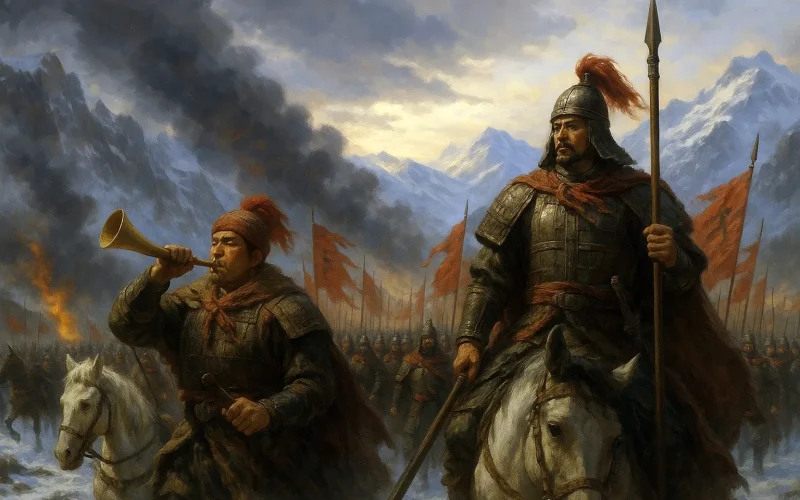
With bugles in the dawn he rouses his Grand Army;
Drums like a tempest pound on four sides
And the Yin Mountains shake with the shouts of ten thousand;
Clouds and the war-wind whirl up in a point
Over fields where grass-roots will tighten around white bones;
In the Dagger River mist, through a biting wind,
Horseshoes, at the Sand Mouth line, break on icy boulders.
...Our General endures every pain, every hardship,
Commanded to settle the dust along the border.
We have read, in the Green Books, tales of old days-
But here we behold a living man, mightier than the dead.
Original Poem
「轮台歌奉送封大夫出师西征」
岑参
轮台城头夜吹角,轮台城北旄头落。
羽书昨夜过渠黎,单于已在金山西。
戍楼西望烟尘黑,汉兵屯在轮台北。
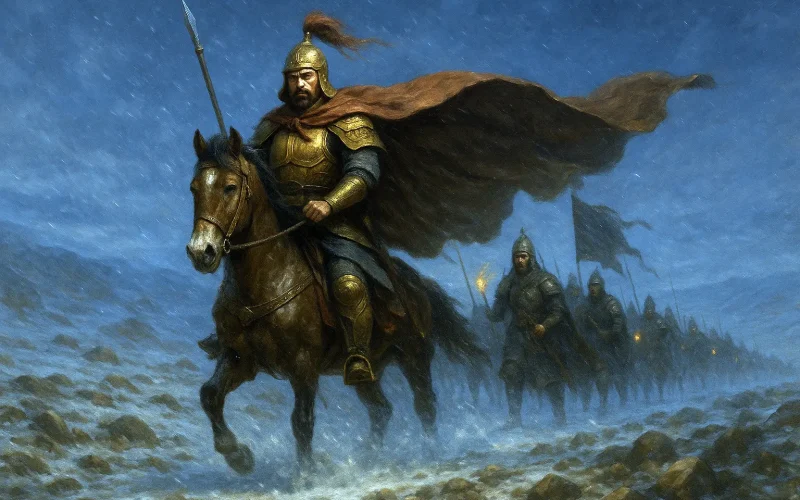
上将拥旄西出征,平明吹笛大军行。
四边伐鼓雪海涌,三军大呼阴山动。
虏塞兵气连云屯,战场白骨缠草根。
剑河风急雪片阔,沙口石冻马蹄脱。
亚相勤王甘苦辛,誓将报主静边尘。
古来青史谁不见?今见功名胜古人。
Interpretation
This poem was composed between the thirteenth and fourteenth years of the Tianbao era (754–755 CE), during Cen Can's second tour of duty beyond the frontier, when he served as Administrative Judge of the Anxi and Beiting Protectorates. At that time, Feng Changqing, the Protector-General of Anxi, led a western expedition to quell rebellions in the Western Regions and consolidate the northwestern frontier defenses. Cen Can accompanied the army as a staff officer, personally experiencing the atmosphere of warfare and the extreme conditions of the borderlands. Though titled "Sent in Farewell," the poem is in fact an artistic reconstruction of an entire military campaign—from pre-war intelligence, to the army's departure, to imagined scenes of battle—advancing layer by layer. It is both a celebration of Feng Changqing's military prestige and a refined distillation of the High Tang aesthetic of frontier warfare. The poem incorporates Cen Can's firsthand geographical experience of the Western Regions (Luntai, Jinshan, Jianhe), authentic observations of military life, and the characteristic historical self-confidence of the High Tang, ranking as one of the most epic in spirit among Cen Can's frontier poems.
Section One: "轮台城头夜吹角,轮台城北旄头落。羽书昨夜过渠黎,单于已在金山西。"
Lúntái chéng tóu yè chuī jiǎo, Lúntái chéng běi máo tóu luò. Yǔ shū zuó yè guò Qúlí, Chányú yǐ zài Jīnshān xī.
Atop Luntai's walls, the horn sounds in the night;
North of Luntai city, the barbarian banner-star has fallen.
Last night, dispatches flew past Quli—
The Chanyu's host is already west of the Gold Mountains.
The opening cuts in with two images of extreme tension: "the horn sounds in the night" tears through the border silence with its sound, signaling the urgency of military affairs; "the barbarian banner-star has fallen" uses an astronomical portent to foretell the decline of the northern tribes, ingeniously linking celestial phenomena with the augury of war. The following two lines, through the spatial leap of "dispatches flew past Quli" and the enemy positioning of "the Chanyu's host is already west of the Gold Mountains," instantly construct a strategic vista spanning a thousand li. These four lines unfold across multiple dimensions—time (from last night to this moment), space (Luntai—Quli—Jinshan), and the relationship between heaven and humanity (celestial omens and human affairs)—establishing the poem's grand and tense foundation.
Section Two: "戍楼西望烟尘黑,汉兵屯在轮台北。上将拥旄西出征,平明吹笛大军行。"
Shù lóu xī wàng yān chén hēi, Hàn bīng tún zài Lúntái běi. Shàng jiàng yōng máo xī chū zhēng, píng míng chuī dí dà jūn xíng.
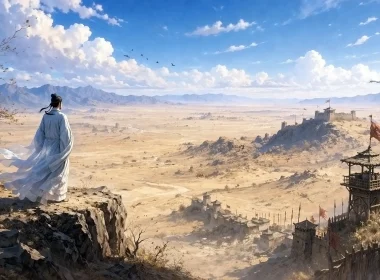
Westward from the watchtower, I see black smoke and dust—
The Han troops are encamped north of Luntai.
The supreme commander, bearing his standard, sets out west;
At dawn, with flutes playing, the great army marches forth.
The lens moves from far to near, from stillness to motion. "Black smoke and dust" conveys the visual oppression of the enemy threat, while "the Han troops are encamped" reveals the calm readiness of the Tang forces. The next two lines focus on the departure ceremony: "bearing his standard" displays the commander's authority; "with flutes playing" conveys the solemnity of the march. At the moment of "dawn"—that threshold between night and day—light and sound together weave a scene of solemn departure. The flutes replace drums and horns, infusing the scene with a touch of tragic grandeur amid the martial atmosphere, reflecting Cen Can's distinctive aesthetic treatment of warfare.
Section Three: "四边伐鼓雪海涌,三军大呼阴山动。虏塞兵气连云屯,战场白骨缠草根。"
Sì biān fá gǔ xuě hǎi yǒng, sān jūn dà hū yīn shān dòng. Lǔ sài bīng qì lián yún tún, zhàn chǎng bái gǔ chán cǎo gēn.
Drums beat on all sides, the snow-sea surges;
The three armies shout, and the Yin Mountains shake.
The enemy camp's war-aura masses to the clouds;
On the battlefield, white bones are tangled with grass-roots.
This section elevates the war to a mythical dimension through surreal imagery. "The snow-sea surges" and "the Yin Mountains shake" are not merely hyperbole but transform the natural geography into a spiritual symbol of the war's momentum—the Tang army's might is enough to shake heaven and earth. The following two lines shift perspective sharply: first looking up to the oppressive "war-aura massing to the clouds," then looking down to the grim "white bones tangled with grass-roots"—creating a dual depth of space and time. The intrusion of the white-bone imagery establishes a dialogue between the present campaign and historical sacrifice, endowing the war with a profound historical weight.
Section Four: "剑河风急雪片阔,沙口石冻马蹄脱。亚相勤王甘苦辛,誓将报主静边尘。"
Jiàn hé fēng jí xuě piàn kuò, shā kǒu shí dòng mǎ tí tuō. Yà xiàng qín wáng gān kǔ xīn, shì jiāng bào zhǔ jìng biān chén.
On the Jian River, the wind is fierce and the snowflakes broad;
At the Sand Pass, the stones freeze and horseshoes fall off.
The Vice-Councillor serves the king, willing to endure hardship;
He vows to repay his sovereign by pacifying the border dust.
From the grand battlefield, the focus narrows to immediate environmental experience. "Fierce wind and broad snowflakes" conveys the violence of the climate; "stones freeze and horseshoes fall off" depicts the harshness of the terrain—these two details concretize the material hardships of frontier warfare. The final two lines return to the praise of the commander: the honorific "Vice-Councillor" highlights Feng Changqing's stature; "willing to endure hardship" reflects his shared suffering with the troops; and "pacifying the border dust" elevates his military action to the historical level of securing the state, completing the ascent from specific battle to political significance.
Section Five: "古来青史谁不见?今见功名胜古人。"
Gǔ lái qīng shǐ shuí bù jiàn? Jīn jiàn gōng míng shèng gǔ rén.
Who has not seen the annals of green history from ages past?
Today, I see achievements and fame surpassing the ancients.
The conclusion is a bold historical judgment. The poet juxtaposes "from ages past" with "today," measuring Feng Changqing's western campaign within the river of history. The rhetorical question "who has not seen" implicitly acknowledges the famous generals of the past; the declaration "surpassing the ancients" bursts forth with the High Tang's distinctive cultural self-confidence and pride of the age. The ending resounds like a great bronze bell, its echoes lingering, elevating the poem beyond a record of a single campaign to become a celebration of the eternal value of heroism.
Overall Appreciation
This is one of the most epic in spirit among Cen Can's frontier poems. In eighteen lines, with the dispatch of Grand Mentor Feng on his western campaign as its thread, it fuses pre-war intelligence, the army's departure, imagined battle scenes, and historical resonance into a single whole, constructing a three-dimensional system of war poetics encompassing space, time, and spirit.
Structurally, the poem progresses from surface to depth, from the concrete to the abstract. The opening four lines, through the temporal-spatial leaps of "the horn sounds in the night," "the banner-star has fallen," "dispatches flew past Quli," and "the Chanyu's host is at Jinshan," instantly sketch the strategic panorama of imminent threat. The next four lines shift the lens from the distant view of "black smoke and dust" to the departure "with flutes playing at dawn," moving from stillness to motion and focusing on the solemn march at daybreak. The third section, through the surreal writing of "the snow-sea surges" and "the Yin Mountains shake," pushes the war to a mythic dimension, only to pull it back to the grim historical weight with the close-up of "white bones tangled with grass-roots." The fourth section narrows from the grand battlefield to the immediate experience of "fierce wind and broad snowflakes" and "stones freeze and horseshoes fall off," concretizing the dangers of war into bodily sensation. The final section concludes with the historical assertion of "achievements and fame surpassing the ancients," elevating a specific western campaign into an eternal celebration of heroism. The five sections move from enemy intelligence to deployment, from imagination to realism, from environment to character, from specific battle to historical judgment—layer upon layer, in seamless unity.
In terms of theme, the poem pivots on the tension between the assertion of "today" and the imagery of "white bones." The "today" of "today, I see achievements and fame surpassing the ancients" bursts forth with the High Tang's distinctive cultural self-confidence—the achievements of the present are not only comparable to history but can surpass the ancients. Yet the "white bones" of "on the battlefield, white bones are tangled with grass-roots" forms the inescapable, weighty foundation beneath this confidence. Between this "today" and these "white bones" lies the poet's complex attitude toward war: he is both impassioned by the Tang army's awe-inspiring might and keeps a clear-eyed gaze on the bloody costs of warfare. This interweaving of enthusiastic praise and historical reflection prevents the poem from becoming a one-dimensional paean to heroism, giving it a richer emotional depth.
Artistically, the most striking quality of this poem lies in the unique techniques of constructing the atmosphere of war through soundscapes and transforming natural geography into military imagery. Through the sequence of "the horn sounds in the night," "with flutes playing at dawn," "drums beat on all sides," and "the three armies shout," the poet strings together the complete rhythm of war from alert to assault, immersing the reader in the soundscape of battle. He also endows static natural geography with dynamic military attributes—"the snow-sea surges" transforms the frozen plain into an ocean boiling with drums; "the Yin Mountains shake" makes the mountain range tremble with battle cries. This "militarization" of the natural environment extends the landscape to the dominion of warfare, while the grim close-up of "white bones tangled with grass-roots" strikes a somber, minor-key note in the midst of the triumphant symphony, instantly linking the present campaign to the historical depth of generations of frontier sacrifice, injecting a profound compassion into the heroic celebration and giving the poem a timeless quality.
Artistic Features
- Soundscape as Layered Battlefield Atmosphere
The poet skillfully employs varied sound images to thread through the poem: the shrill warning of "the horn sounds in the night" at the opening, the solemn march of "with flutes playing at dawn," the thunderous shock of "drums beat on all sides," and the mountain-shaking "the three armies shout." This progression of soundscapes from alert to assault not only recreates the authentic auditory experience of war but also forms an emotional arc from tension to eruption, immersing the reader in the battlefield's sonic world. - Transforming Natural Geography into Military Imagery
Cen Can creatively endows frontier geography with dynamic military attributes: "the snow-sea surges" transforms the static snowfield into an ocean boiling with drums; "the Yin Mountains shake" makes the mountain range tremble with the roar of the army. This "militarization" of the natural environment breaks through the contemplative mode of traditional landscape description, making heaven and earth extensions of martial power and greatly expanding the spatial expressiveness of frontier poetry. - Counterpoint Structure—Historical Reflection within the Exultant Theme
At the height of the poem's exultation, the poet suddenly inserts the grim close-up of "white bones tangled with grass-roots." This line acts like a somber bass note suddenly emerging in a triumphant symphony, instantly connecting the present campaign to the historical depth of generations of frontier sacrifice. This technique of maintaining historical clarity amid passionate praise prevents the poem from becoming a one-dimensional heroic ode, giving it a more complex and profound emotional dimension. - Temporal Compression—Complete Narrative from Pre-War to Post-War in Brief Space
In just eighteen lines, the poem completes a full war narrative from the warning of "the horn sounds in the night," the departure "at dawn," to the imagined "battlefield" and the conclusion "achievements surpassing the ancients." By selecting archetypal scenes (watching dust from the watchtower, the army's departure, the battlefield slaughter, marching through snow and wind) and omitting the specific course of battle through montage-like leaps, the poet maintains narrative coherence while endowing the poem with an epic concision and rhythmic power.
Insights
This work's primary revelation for modern readers concerns how to understand the complexity of "war narrative." Cen Can both celebrates the glory of "achievements surpassing the ancients" and gazes upon the horror of "white bones tangled with grass-roots"—this dual perspective reminds us that any grand historical narrative must encompass compassion for individual fates and a clear-eyed awareness of war's costs. Feng Changqing in the poem is both a hero "bearing his standard" and one who "endures hardship"—this complete portrait of the man avoids simplistic glorification of war.
Second, the poem demonstrates the spiritual value of ritual in major undertakings. From the warning of "the horn sounds in the night" to the departure "with flutes playing at dawn," every stage is endowed with ritual significance. In our modern society, which prioritizes efficiency above all, this practice of constructing meaning and consolidating spirit through ritual retains profound relevance—major challenges require not only material preparation but also spiritual "ritual mobilization."
Finally, the poem's sense of dialogue with history, expressed in "who has not seen the annals of green history from ages past?" is particularly precious. Cen Can measures the present campaign within the river of history—this "historical immediacy" reveals that individual actions, when connected to the historical continuum, can transcend the gains and losses of the moment to attain eternal meaning. In our fragmented, instantaneous contemporary context, rebuilding this capacity for dialogue with history may be an essential path for resisting the void of meaning.
Poem translator
Kiang Kanghu
About the poet
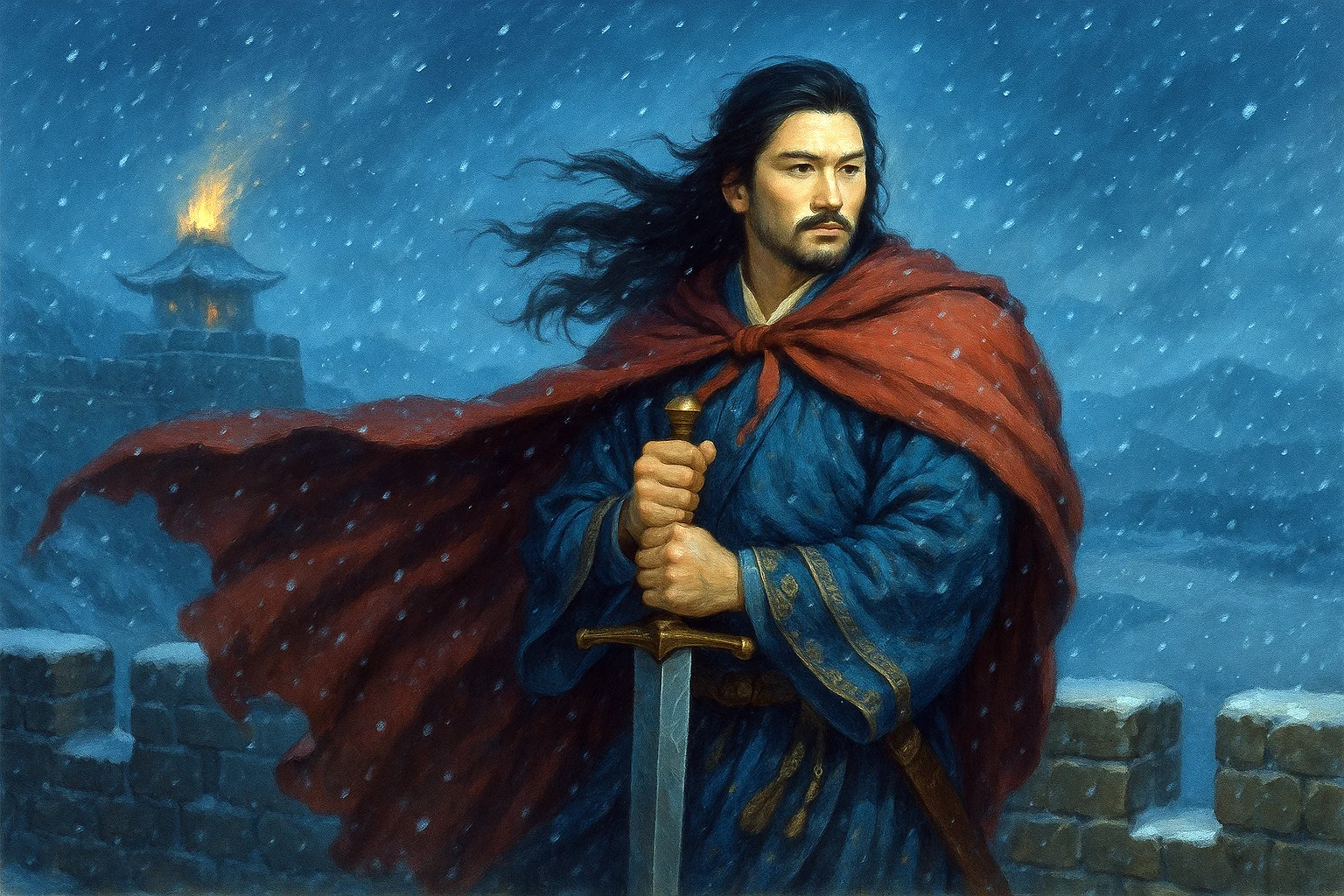
Cen Can(岑参), 715-770 AD, was a native of Jingzhou, Hubei Province. He studied at Mt. Songshan when he was young, and later traveled to Beijing, Luoyang and Shuohe. Cen Can was famous for his border poems, in which he wrote about the border scenery and the life of generals in a majestic and unrestrained manner, and together with Gao Shi, he was an outstanding representative of the border poetry school of the Sheng Tang Dynasty.