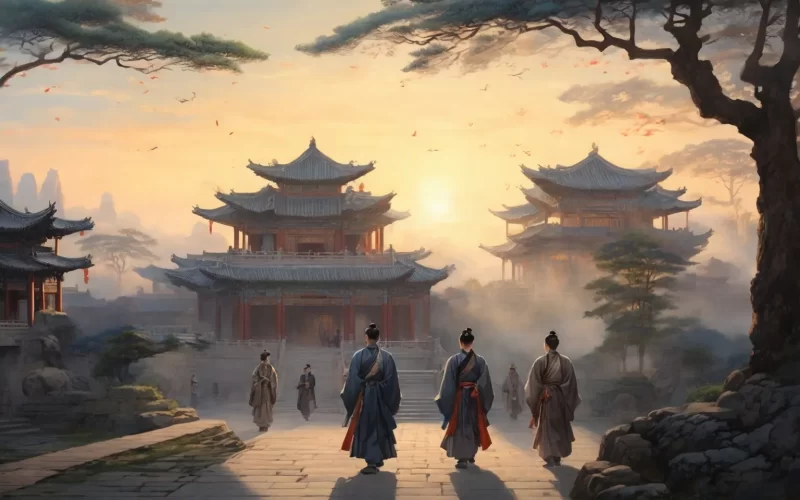

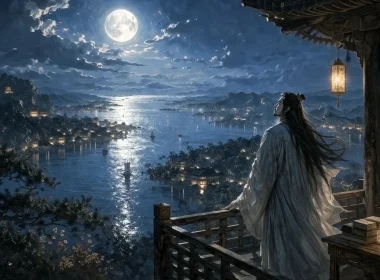
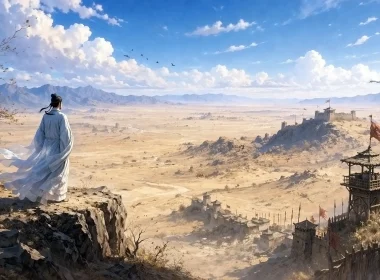
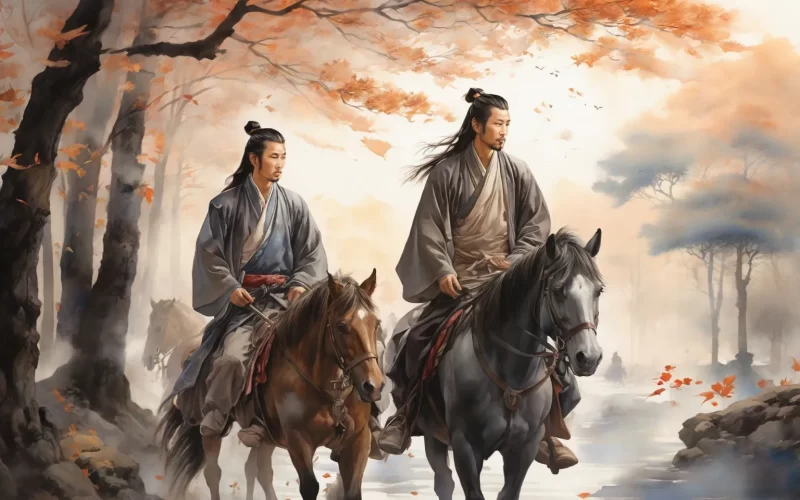
It's a long way home, a long way east.
I am old and my sleeve is wet with tears.
We meet on horseback. I have no means of writing.
Tell them three words: "He is safe."
Original Poem
「逢入京使」
岑参
故园东望路漫漫,双袖龙钟泪不乾。
马上相逢无纸笔,凭君传语报平安。
Interpretation
This poem was composed in the spring of the first year of the Qianyuan era (758 CE), when Cen Can served as Right Remonstrator at court. Jia Zhi, then a Secretariat Drafter, had written a poem on the magnificent scene of the morning audience at Daming Palace, which was answered by a constellation of court luminaries including Wang Wei and Du Fu; Cen Can's piece was among them. This series of responsive poems emerged during the special period when the An Lushan Rebellion had just been initially suppressed and Emperor Suzong had recently returned to Chang'an. The solemn spectacle of the Daming Palace morning audience was imbued with political symbolism as a renewal of dynastic order and a restoration of the golden age.
However, these exchanges were not mere literary games. At that time, the rebellion was not yet fully quelled, the nation faced numerous difficulties, and a hundred tasks awaited renewal. At such a moment requiring earnest governance, the singing of the "morning audience"—the highest state ritual—was itself charged with a longing for the restoration of order and a defense of court authority. Cen Can's responsive poem, written against this complex backdrop, participated in a "ritualistic" reconstruction of the golden age through verse. It had to meet the elegant standards of court occasional poetry and celebrate the court's majesty; it also had to demonstrate individual talent amid a constellation of brilliant poets; and more deeply, it may have concealed the complex sentiments of a poet who had witnessed the hardships of frontier warfare and people's suffering—harboring both sincere hope for a vision of peace and a nuanced awareness of its fragility.
First Couplet: "鸡鸣紫陌曙光寒,莺啭皇州春色阑。"
Jī míng zǐ mò shǔ guāng hán, yīng zhuàn huáng zhōu chūn sè lán.
The rooster crows on the purple avenue, the dawn light cold;
The oriole warbles in the capital, spring's colors fading.
The opening begins from the outskirts beyond the palace, with precise temporal-spatial placement. "The rooster crows" is auditory, marking daybreak; "purple avenue" is visual, referring to the imperial thoroughfare; "the dawn light cold" subtly fuses the visual (dawn light) with the tactile (cold), evoking the particular crispness of a spring morning. The next line, "the oriole warbles in the capital," sets a pleasing sound against the imperial city, while "spring's colors fading" carries a note of regret—fitting the late spring season and perhaps hinting at a subtle awareness that the age's prosperity could not endure. This couplet, with its grand dawn panorama of the capital and its interweaving of warmth and chill, lays a backdrop for the morning court—both magnificent and touched with a hint of quiet solitude.
Second Couplet: "金阙晓钟开万户,玉阶仙仗拥千官。"
Jīn què xiǎo zhōng kāi wàn hù, yù jiē xiān zhàng yōng qiān guān.
The dawn bell of the golden palace opens ten thousand doors;
On the jade steps, the celestial guard surrounds a thousand officials.
The poet's perspective shifts from outside the palace to within the gates, and then to the heart of the assembly. "The dawn bell of the golden palace" is a solemn command, symbolizing the summons of imperial authority and the initiation of order; "opens ten thousand doors" evokes the grandeur of the palace architecture and the magnificent scene of officials streaming in. "The celestial guard on the jade steps" extols the splendor of the imperial retinue and the majesty of the royal house; "surrounds a thousand officials" vividly depicts the gathering of ministers in reverent, orderly assembly. This couplet is perfectly parallel, its images rich and opulent, using the most representative court symbols to construct the classic and central visual tableau of the morning audience, fully displaying the dignity of the imperial center.
Third Couplet: "花迎剑佩星初落,柳拂旌旗露未干。"
Huā yíng jiàn pèi xīng chū luò, liǔ fú jīng qí lù wèi gān.
Flowers greet the sword-adorned officials as the stars just fall;
Willows brush the banners as the dew is not yet dry.
This couplet is a line of immortal fame, shifting the perspective from grand scenes to subtle details. "Flowers greet the sword-adorned officials" and "willows brush the banners" personify the flora, endowing them with an eager attitude of welcome and gentle caress, instantly infusing the solemn court scene with lively charm and resplendent elegance. "As the stars just fall" and "as the dew is not yet dry" are precise temporal captures: the former emphasizes the earliness of the hour, the latter the freshness of the morning; together they evoke the special atmosphere of a spring dawn—fresh, moist, vibrant, and yet supremely solemn. The natural images of flowers, willows, stars, and dew achieve a perfect integration with the human elements of swords, ornaments, and banners, reaching the highest realm of the fusion of scene and emotion in court poetry.
Final Couplet: "独有凤凰池上客,阳春一曲和皆难。"
Dú yǒu fèng huáng chí shàng kè, yáng chūn yī qǔ hè jiē nán.
Only you, honored guest of the Phoenix Pool,
With your "Spring of the Southern Hills" tune, make all replies so hard.
The final couplet deftly returns to the theme of "responsive poem," expressing admiration for Jia Zhi's original. "Honored guest of the Phoenix Pool" is a respectful appellation for Jia Zhi's position as Secretariat Drafter, implying his closeness to the pivot of power. "Spring of the Southern Hills" alludes to the "Spring of the Southern Hills" and "White Snow"—lofty, refined melodies—lavishly praising the exceptional elevation of Jia Zhi's composition. And "make all replies so hard" is both a self-deprecating gesture, showing respect for Jia Zhi, and may also carry a hint of genuine artistic appreciation—before such a brilliant theme and exquisite original, crafting a new response was indeed no easy task. This couplet displays courtesy in praise and grace in modesty, appropriately concluding this piece of imperial occasional verse.
Overall Appreciation
This seven-character regulated verse stands among the finest examples of Tang court exchange poetry, representing the elegant, refined, and magnificently elevated aspect of Cen Can's oeuvre. The entire poem closely adheres to the "morning court" theme, following a rigorous structure of "from distant to near, from grand to subtle, from scene to person," like a masterfully directed court documentary.
Structurally, the poem progresses from outside to inside, from grand to subtle. The first couplet begins with the dawn scene of the capital—"the rooster crows on the purple avenue"—sketching the grand backdrop of the morning court. The second couplet focuses on the palace gates and the heart of the assembly with "the dawn bell of the golden palace" and "the celestial guard on the jade steps," advancing the spatial progression. The third couplet turns to subtle details with "flowers greet the sword-adorned officials" and "willows brush the banners," infusing solemnity with living vitality. The final couplet returns to the responsive theme with "your 'Spring of the Southern Hills' tune, make all replies so hard," concluding with fitting grace. The four couplets move from distant to near, from grand to subtle, from scene to person—layer upon layer, orderly in structure.
In terms of theme, the poem pivots on the personification of "flowers greet" and "willows brush." The "greet" of "flowers greet the sword-adorned officials as the stars just fall" and the "brush" of "willows brush the banners as the dew is not yet dry" transform the inanimate flora into sentient greeters, adding a dimension of vivid charm to the solemn assembly. This technique of enlivening a political scene with natural imagery reaches the highest state of court poetry: "gravity enlivened, majesty infused with freshness," and stands as Cen Can's most distinctive personal mark distinguishing him from other respondents.
Artistically, the most striking qualities of this poem are the precise arrangement of temporal-spatial structure and the naturalization of court imagery. Temporally, the poem moves from "the rooster crows" and "dawn light cold" to "the stars just fall" and "the dew is not yet dry," presenting the full progression from night's end to the morning audience. Spatially, it moves from "purple avenue" and "the capital" to "golden palace" and "jade steps," and then to the specific images of "flowers" and "willows," completing a layered progression from the panoramic capital to the palace core and then to the details before the hall. This interweaving of time and space in an orderly narrative structure creates a perfect isomorphism with the ceremonial rigor of the morning audience itself. And the couplet "flowers greet" and "willows brush" enlivens static scenes with nimble strokes, infusing natural freshness into imperial majesty—a stroke of genius that balances "the grandeur of the court" with "the sensibility of the poet."
Artistic Features
- Precise Arrangement of Temporal-Spatial Structure
Temporally, the poem moves from "the rooster crows" and "dawn light cold" to "the stars just fall" and "the dew is not yet dry," presenting the full progression from night's end to the morning audience. Spatially, it moves from "purple avenue" and "the capital" to "golden palace" and "jade steps," and then to the specific images of "flowers" and "willows," completing a layered progression from the panoramic capital to the palace core and then to the details before the hall. This interweaving of time and space in an orderly narrative structure creates a perfect isomorphism with the ceremonial rigor of the morning audience itself. - Classic Combination and Elevation of Court Imagery
The poem densely deploys iconic court and power imagery: "purple avenue," "golden palace," "jade steps," "celestial guard," "swords and ornaments," "banners," and "Phoenix Pool." Cen Can's genius lies not in mere enumeration but in interweaving these with vivid, vital natural images—"the rooster crows," "the oriole warbles," "flowers greet," "willows brush," "dew moistens"—adding mobility and freshness to the splendid foundation, avoiding the stagnation to which court poetry often succumbs. - The Ultimate Pursuit of Parallelism and Refinement
As a standard seven-character regulated verse, the poem achieves the acme of parallelism and verbal refinement. Lines such as "golden palace" against "jade steps," "dawn bell" against "celestial guard," "opens ten thousand doors" against "surrounds a thousand officials"—all are flawlessly paired. The couplet "flowers greet the sword-adorned officials" and "willows brush the banners" is especially exemplary in its fusion of meaning, image, sound, and color, demonstrating the poet's high skill in pursuing freedom of expression within strict formal constraints. - Balance Between Occasional Duty and Poetic Talent
The entire poem fully satisfies the fundamental requirements of court occasional poetry—celebrating the age and maintaining classical elegance—with frequent depictions of court majesty. Yet through the slight sigh of "spring's colors fading," the brilliant invention of "flowers greet and willows brush," and the appropriate modesty of the final couplet, the poet naturally incorporates personal observation, aesthetic sensibility, and social grace, achieving a delicate balance between the "public" and the "private."
Insights
This splendid and elegant exchange poem offers a refined window into the court culture and scholar-official mentality of the High Tang. It reveals that even in the most formulaic settings that emphasize collectivity—such as imperial occasional poetry—great poets could still find space to display individual artistic talent. Through masterful arrangement of imagery, vivid capture of detail, and rigorous structural organization, Cen Can transformed what could have been a hollow ritual of praise into a work of independent aesthetic value, where scene and emotion are perfectly fused.
At the same time, this poem shows how literature participated in a "ritualistic" national narrative during the period of imperial restoration. The repeated singing of the "morning audience"—a ritual symbolizing order, authority, and unity—was itself a kind of cultural "groundbreaking ceremony." The exchange among Cen Can and his contemporaries was not merely a literary competition but a participation, through poetry, in the shaping and consolidation of the empire's legitimacy and orthodoxy after war.
Ultimately, this poem leaves us with a reflection on the relationship between "constraint" and "creation." Under multiple constraints—theme, genre, occasion, and political atmosphere—Cen Can still produced such immortal lines as "flowers greet the sword-adorned officials as the stars just fall, willows brush the banners as the dew is not yet dry." This reminds all creators that true artistic creativity often lies not in throwing off all constraints, but in recognizing and respecting necessary boundaries, and within those limits, opening up infinite poetic possibilities.e.
Poem translator
Kiang Kanghu
About the poet
Cén Cān(岑参), 715 - 770 AD, was a native of Jingzhou, Hubei Province. He studied at Mt. Songshan when he was young, and later traveled to Beijing, Luoyang and Shuohe. Cén Cān was famous for his border poems, in which he wrote about the border scenery and the life of generals in a majestic and unrestrained manner, and together with Gao Shi, he was an outstanding representative of the border poetry school of the Sheng Tang Dynasty.