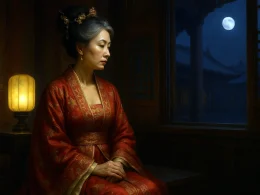

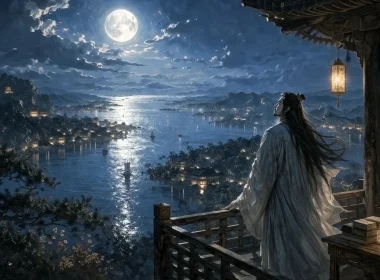
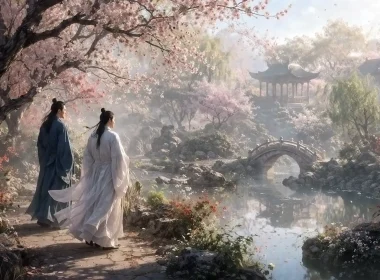
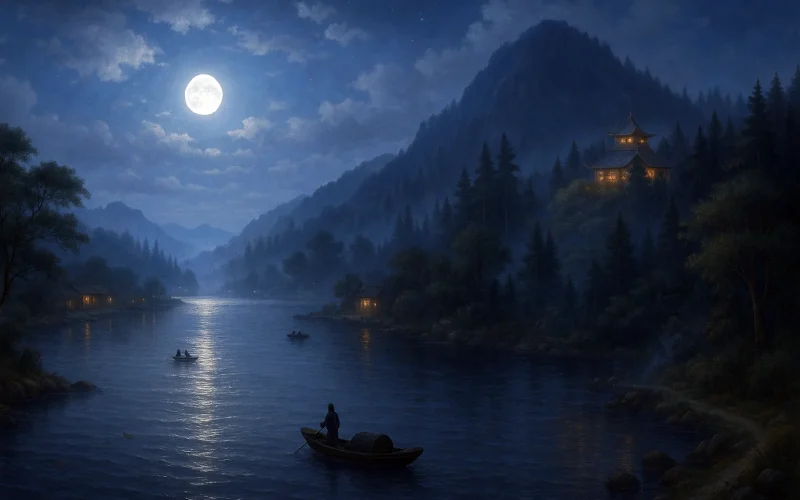
A bell in the mountain-temple sounds the coming of night.
I hear people at the fishing-town stumble aboard the ferry,
While others follow the sand-bank to their homes along the river.
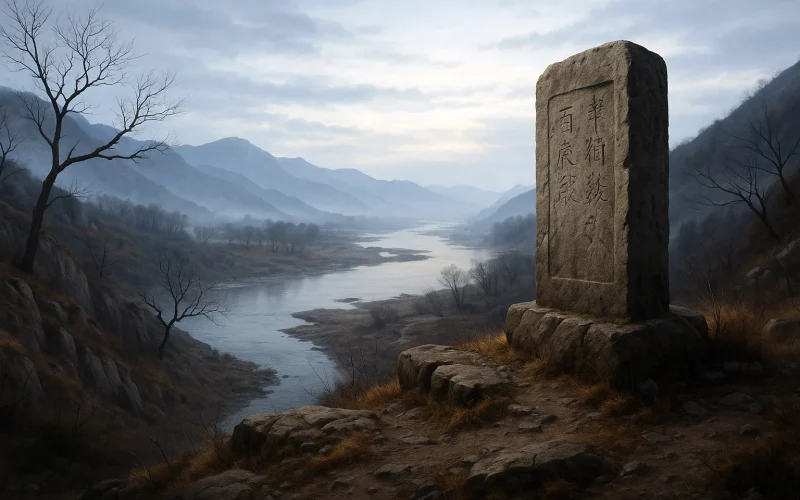
...I also take a boat and am bound for Lumen Mountain --

And soon the Lumen moonlight is piercing misty trees.
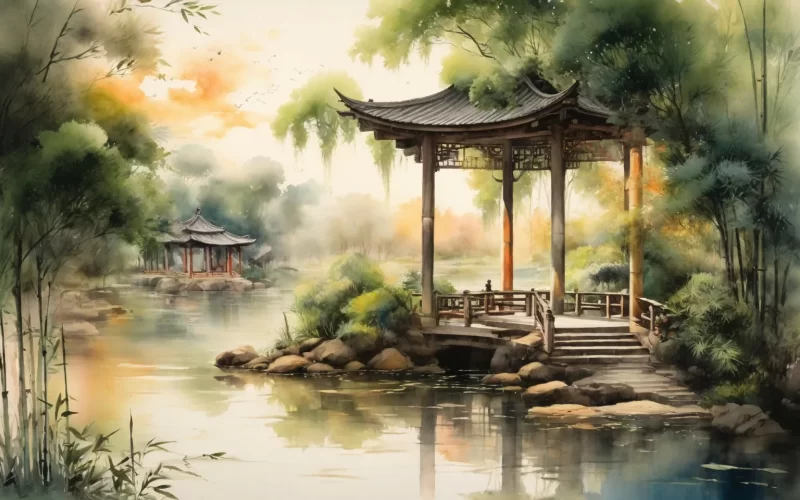
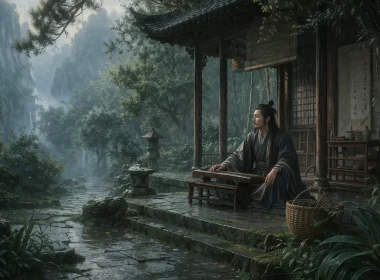
I have come, before I know it, upon an ancient hermitage,
The thatch door, the piney path, the solitude, the quiet,
Where a hermit lives and moves, never needing a companion.
Original Poem
「夜归鹿门歌」
孟浩然
山寺钟鸣昼已昏,渔梁渡头争渡喧。
人随沙路向江村,余亦乘舟归鹿门。
鹿门月照开烟树,忽到庞公栖隐处。
岩扉松径长寂寥,惟有幽人自来去。
Interpretation
This poem was composed after the 21st year of the Kaiyuan era (733 AD), during the period when Meng Haoran had returned to his hometown of Xiangyang after abandoning his official ambitions in Chang'an. The wandering and petitioning of his thirties and early forties had yielded nothing but the quiet desolation of "waiting in vain, returning empty each morning." When he finally let go of his attachment to fame and came back to where he was born, Deer-Gate Mountain ceased to be merely a geographic refuge for reclusion—it became the symbol of a spiritual rebirth.
Deer-Gate Mountain lies to the southeast of Xiangyang. In the late Han Dynasty, the renowned scholar-recluse Pang De'gong refused the official summons and lavish courtesies offered by the warlord Liu Biao, and took his wife up into the Deer-Gate peaks, disappearing among the herbs, never to return—a celebrated tale of the lofty-hearted. Meng Haoran "built himself a dwelling" there, a gesture that was in truth his own act of spiritual emulation—the turning of his life from "seeking employment in the world" to "sufficiency within the heart." The "returning at night" in the title is not a casual record of movement; it is a carefully framed spiritual rite: in the gathering dark he bids farewell to the daylight world, on the homeward journey he leaves the dusty world behind, and in the moon-shadowed pines and wind of Deer-Gate, he reclaims his own soul.
Two groups of "homecomers" appear in this poem: the crowd at the ferry scrambling "toward the riverside village," while the poet alone "returns to Deer-Gate." The direction is the same; the destinations are worlds apart. The village is the secular home; Deer-Gate is the native soil of the heart. This one stroke of contrast, rendered as lightly as a casual observation, already contains the entire tension between the hidden and the prominent, the many and the one, the dusty and the transcendent.
First Couplet: 山寺钟鸣昼已昏,渔梁渡头争渡喧。
Shān sì zhōng míng zhòu yǐ hūn, yú liáng dù tóu zhēng dù xuān.
From the hill temple sounds the evening bell;
The ferry bustles as night begins to fall.
Explication: The poem opens with an auditory rendering of dusk: the bell sound, arriving from the mountain temple, is distant and serene; the clamor, rising from the ferry crossing, is urgent and chaotic. One is still, the other active; one distant, the other near—they are juxtaposed within the same twilight moment, yet do not disturb each other. This is Meng Haoran's unique style: he never deliberately criticizes the mundane world; he simply and calmly presents two states of existence side by side, letting the reader discern the direction of their own heart. The phrase "The ferry bustles" is particularly masterful. The word "bustles" captures the anxious haste of people hurrying home at dusk, while also hinting at the poet's own state of mind, already distant from such urgency. He hears the clamor, sees the bustle, but already stands apart. His body is at the ferry, but his heart has already boarded the boat—bound for a different direction.
Second Couplet: 人随沙路向江村,余亦乘舟归鹿门。
Rén suí shā lù xiàng jiāng cūn, yú yì chéng zhōu guī lù mén.
Along the sandy path they go to riverside homes;
I also take a boat, returning to Deer-Gate's glooms.
Explication: This couplet is the pivotal hinge and the first appearance of the "I" in the poem. The first two lines are a panoramic sketch of dusk; here, the focus abruptly narrows, placing the poet at the center of the frame. Syntactically, it forms a parallel contrast: people return to riverside villages, I return to Deer-Gate; the paths differ, the destinations are distinct, yet both involve "returning." The word "also" is deeply meaningful. It neither negates the return of others nor elevates his own choice; it merely states a factual distinction. Yet it is precisely this gentle, non-judgmental tone that makes the resoluteness of his reclusion all the more firm—true detachment does not need to belittle the world to prove itself. "I also take a boat" is a literal account of the journey, yet it also figuratively charts the path of the heart. The boat travels on water; the man heads toward the mountain. This water route, from the clamorous ferry to the silent forest, externalizes the poet's entire spiritual trajectory—from seeking office to reclusion, from agitation to stillness, from the crowd to solitude.
Third Couplet: 鹿门月照开烟树,忽到庞公栖隐处。
Lù mén yuè zhào kāi yān shù, hū dào Páng gōng qī yǐn chù.
The Deer-Gate moonlight parts the misty trees;
I find myself where Master Pang lived at ease.
Explication: This couplet marks a dual entry into both space and state of mind. The boat reaches the mountain's foot; the man enters the woods; night deepens; moonlight brightens. The phrase "parts the misty trees" is exceptionally beautiful—moonlight, like water, gradually washes away layers of mountain mist and tree shadows, revealing, deep within, the traces of that lofty scholar from centuries past. The most moving part is "find myself" (hū dào—suddenly arrive). It is not "seek and find" or "visit and find," but a sudden, unanticipated arrival. This indicates the poet's journey is not a deliberate pilgrimage, but rather that his body and mind have already merged with this mountain forest. The journey is the destination; arrival needs no sudden realization. Pang Gong's hermitage lies deep in the mountain, yet arrives unexpectedly amidst the poet's boating and the moonlight—a true meeting of spirits never requires deliberate seeking. In this moment, across five hundred years, Meng Haoran and Pang De'gong arrive at the same silence under the same Deer-Gate moon.
Fourth Couplet: 岩扉松径长寂寥,惟有幽人自来去。
Yán fēi sōng jìng zhǎng jì liáo, wéi yǒu yōu rén zì lái qù.
The rocky gate, the pine-shrouded path, in solitude dwell;
Here only the recluse comes and goes of his own will.
Explication: The poem's ultimate realm unfolds here. "The rocky gate, the pine-shrouded path" refers to Pang Gong's former dwelling and also to Meng Haoran's present abode. "In solitude dwell" is not regret, but fulfillment—this solitude is the very barrier that allows the recluse to preserve his true self. A place seen as desolate and forlorn in the eyes of the world is, under the poet's brush, a realm of self-sufficient completion. The final line, "Here only the recluse comes and goes of his own will," is the poetic eye of the entire poem and its most serene self-declaration. The "recluse" is Pang De'gong, and also Meng Haoran himself; it is the portrait of a lofty scholar across the ages, and also the poet's present self-identification. "Comes and goes of his own will" encapsulates the essence of the eremitic life: no welcomes, no farewells, no entanglements, coming and going according to one's heart, at peace with the world.
The poem begins with "clamor" and ends in "solitude"; it opens with the crowd and closes with the recluse; it moves from the bustle of the ferry to the solitary journey into the mountain. This trajectory from movement to stillness, from outward to inward, from crowd to solitude, is precisely the complete ritual of the poet's spiritual reclusion.
Holistic Appreciation
This is the pinnacle of Meng Haoran's reclusive poetry and the spiritual autobiography he wrote for himself. Using a single night journey home as its narrative thread, it accomplishes a transcendent writing of the soul in every detail.
Structurally, the poem simultaneously unfolds two layers of space: the geographical journey home from the ferry to the mountain forest, and the spiritual transformation from the mundane to the transcendent. These two layers mirror and reflect each other, elevating an ordinary night return into an eternal ritual of the soul's homecoming. The first couplet juxtaposes the temple bell and the ferry clamor, depicting the directions of two kinds of life at dusk. The second couplet contrasts "people returning to riverside homes" with "I return to Deer-Gate," completing the first development of the spiritual divergence. The third couplet uses the hazy moonlit mist parting the trees and the sudden "find myself" to describe the poet's encounter with Pang De'gong across time and space. The fourth couplet solidifies the realm of reclusion into permanence with the solitude of "the rocky gate, the pine-shrouded path" and the ease of "the recluse comes and goes of his own will."
Thematically, the core lies in those three words: "comes and goes of his own will." The "bustles" at the ferry is the busyness and calculation of ordinary people; the "own will" of the recluse is the freedom to breathe with heaven and earth. Between this "bustles" and this "own will" lies the poet's complete understanding of two states of being. Deer-Gate in the poem is no longer a geographical peak, but the spiritual home Meng Haoran constructs for himself. Pang De'gong accomplished his refusal of worldly power here; Meng Haoran accomplishes his release from the illusion of fame here. Two generations of recluses, the same mountain forest, meeting across five centuries in this poem—this is no coincidence, but a tender continuity of cultural memory.
Artistically, its most moving quality is the technique of "using a journey to trace the heart's path, using nightfall to write clarity." The poet turns a night return into the soul's homecoming, turning the ferry's clamor and the mountain's silence into metaphors for two possible lives. That sudden "find myself" and the ease of "comes and goes of his own will" attain immense spiritual tension within the simplest language.
Artistic Merits
- Juxtaposition and Progression of Spatial Structure: The poem unfolds two spatial threads in parallel: "ferry → sandy path → riverside village" and "in the boat → Deer-Gate → rocky gate." The former is the crowd's path home; the latter is the poet's. The two threads move from juxtaposition to divergence, ultimately separating completely, forming a clear spiritual altitude difference.
- Implicit Writing of Temporal Consciousness: Not a single word explicitly names past or present, yet through the sudden arrival at "where Master Pang lived," it compresses five centuries into a single moment of epiphany. This implicit allusion makes the sense of history fall as naturally as moonlight, with no trace of artifice.
- Subtle Use of Personal Pronouns: From the impersonal panoramic description of the first couplet, to the first appearance of "I" (余) in the second, to the self-confirmation as "the recluse" (幽人) in the final couplet, the poet completes a process of self-identification from concealment, to manifestation, to sublimation.
- Suspended Conclusion and Lingering Resonance: The poem ends on "comes and goes of his own will," with no sequel and no commentary. This open-ended closure lets the poetic realm extend boundlessly outward—we are not told where the recluse will go next, just as we need not ask whether Meng Haoran attained ultimate peace. The answer lies in what is left unsaid.
Insights
Deer-Gate Mountain is not particularly lofty, and the traces of Pang De'gong have long faded. But Meng Haoran grants this mountain eternal life in his poem. Every era has its own "ferry" and its own "Deer-Gate"—the former is where we must go for our livelihood; the latter is the shore our souls truly yearn to reach. Meng Haoran tells us: true reclusion need not mean fleeing into some unreachable deep mountain. It can be accomplished on a night journey home; it can be realized in the moment moonlight parts the misty trees; it can even begin quietly at the very moment we read this poem.
"Here only the recluse comes and goes of his own will"—these words are the recluse's self-portrait, and also an invitation to all who yearn for spiritual freedom. It invites us, amid the world's busy demands, to preserve for ourselves a secluded path leading to the Deer-Gate within; to listen, while answering countless external calls, to that most authentic voice of the soul which "comes and goes of its own will."
The Deer-Gate moon of a thousand years ago still shines on every night traveler willing to board the boat and return. The true place of return is never somewhere far away, but in the moment we finally understand ourselves. This is the vitality of poetry: it writes of Meng Haoran's single night return, yet speaks to all people, in all times, who seek silence within clamor and guard their original heart within the mundane world.
Poem translator
Kiang Kanghu
About the poet
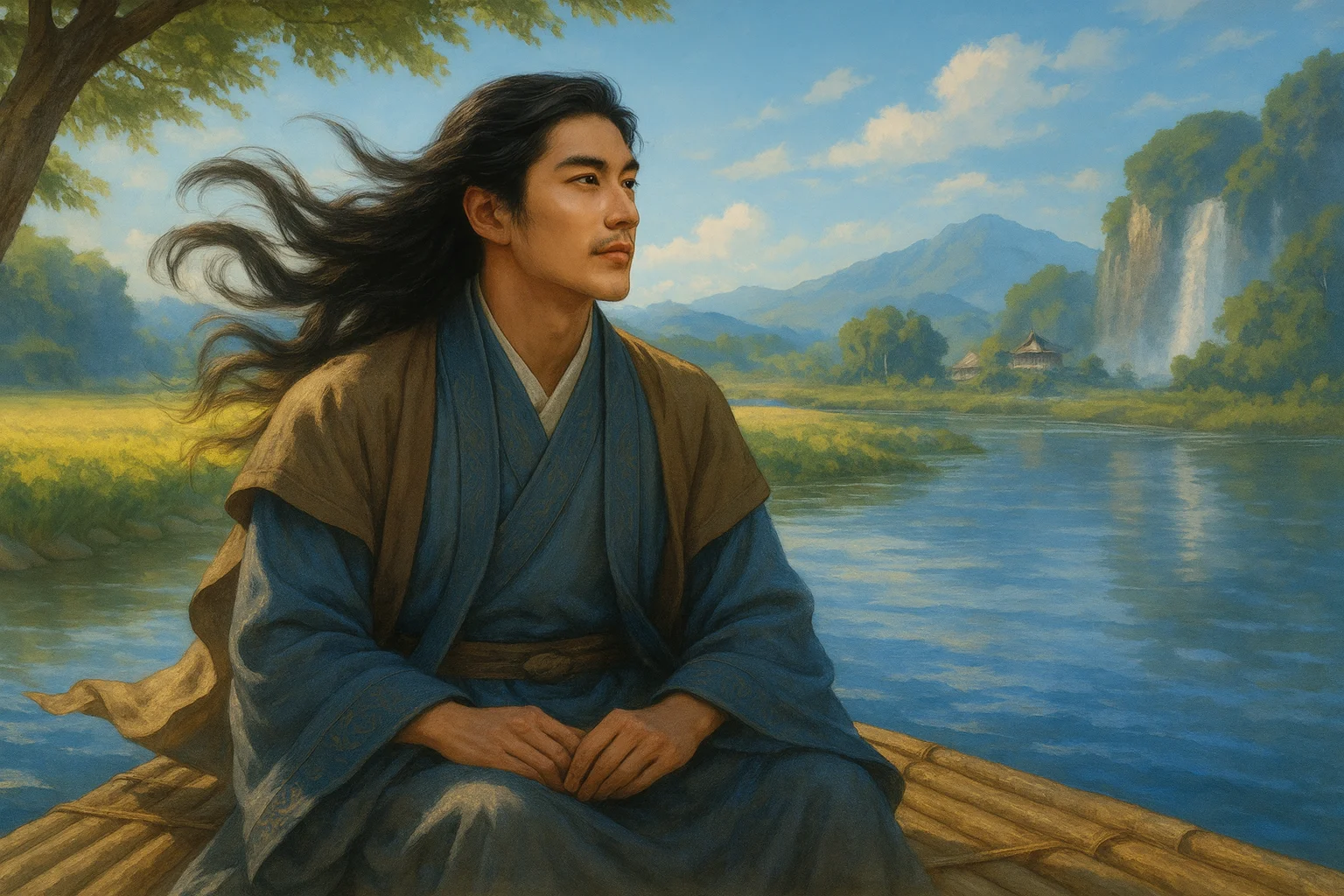
Meng Haoran (孟浩然 689 - 740), a native of Xiangyang, Hubei Province, was a renowned landscape and pastoral poet of the Tang Dynasty. In his early years, he lived in seclusion on Mount Lumen, reading for his own pleasure. At the age of forty, he traveled to the capital to take the jinshi examination but failed. Thereafter, he remained a commoner for the rest of his life, roaming the Wu and Yue regions and finding contentment in poetry and wine. He excelled in five-character verse, with a style that is light and natural, often depicting the pleasures of landscapes and reclusion. He is regarded as a representative of the High Tang landscape and pastoral poetry school. His collected works, Meng Haoran Ji, have been handed down, and his poetry exerted a profound influence on later hermitic poetic traditions.