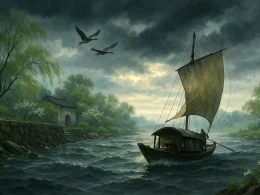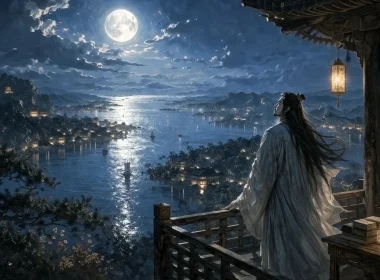
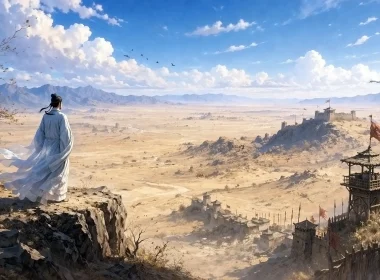
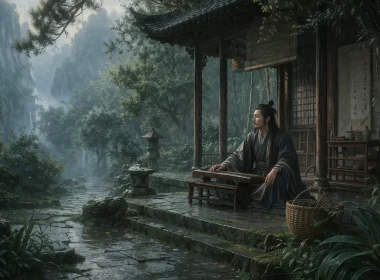
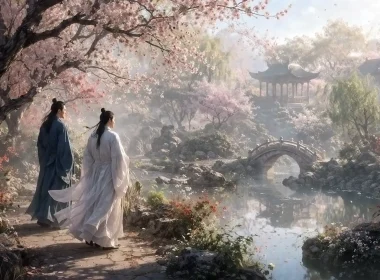
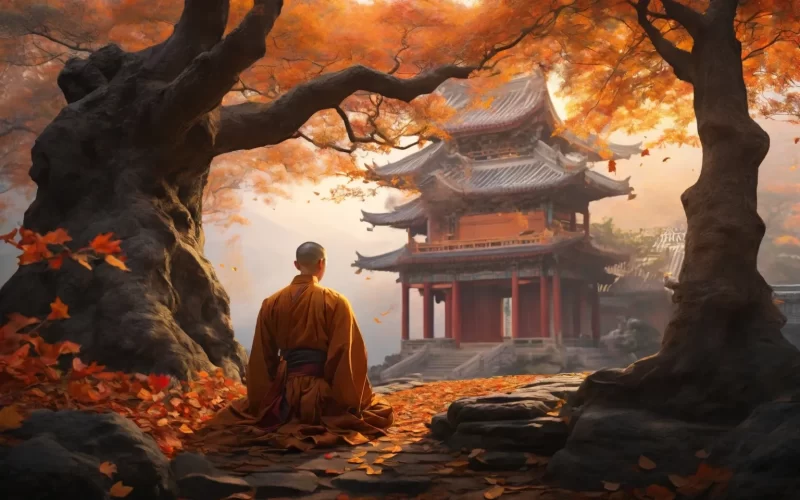
How gladly I would seek a mountain
If I had enough means to live as a recluse!
For I turn at last from serving the State
To the Eastern Woods Temple and to you, my master.

...Like ashes of gold in a cinnamon-flame,
My youthful desires have been burnt with the years-
And tonight in the chilling sunset-wind
A cicada, singing, weighs on my heart.
Original Poem
「秦中感寄远上人」
孟浩然
一丘尝欲卧,三径苦无资。
北土非吾愿,东林怀我师。
黄金燃桂尽,壮志逐年衰。
日夕凉风至,闻蝉但益悲。
Interpretation
This poem was composed in the sixteenth to seventeenth years of the Kaiyuan era (728–729 CE), when Meng Haoran was just over forty and trapped in the capital Chang'an. That year he failed the imperial examination, yet he did not immediately return south but lingered in the capital, still seeking a path to advancement. However, reality proved far more cruel than he had imagined: rice in Chang'an was expensive, life was hard, and his former poetic fame and social connections brought him no actual patronage. In another poem he wrote, "寂寂竟何待,朝朝空自归" —"In stillness and silence, what am I waiting for? Day after day I return empty-handed"—a true portrait of these straitened days.
The "远上人" (Master Yuan) in the title is a monk whose dharma name is "Yuan," a friend of Meng Haoran's from beyond the mundane world. In the Eastern Jin, Huiyuan founded the White Lotus Society on Mount Lu, establishing the Pure Land school and becoming a spiritual icon for later monk-recluses. Meng Haoran uses "东林" (Eastern Forest) to refer to Master Yuan's dwelling—both as an honorific and as a covert allusion, likening his friend to Huiyuan and himself to a follower of the Lotus Society. At this time, he was physically in the "northern soil" of Chang'an, yet his heart was set on the "Eastern Forest" of Mount Lu—these two geographical poles corresponded to the two extremes of his life's choices.
What is most remarkable about this poem is that it lays bare, without any veil, the poverty and embarrassment of a man seeking office. Chinese literati writing about disappointment usually dwell on unrecognized talent, unfulfilled ambitions, or the scarcity of kindred spirits—rarely do they, like Meng Haoran, write so directly about "having no money." "三径苦无资" and "黄金燃桂尽"—this is the utter destitution of not even having the travel expenses to return to a life of seclusion. It is not that he does not want to leave; it is that he cannot. This thoroughgoing straits make this poem particularly candid and especially poignant within Meng Haoran's collected works.
First Couplet: "一丘尝欲卧,三径苦无资。"
Yī qiū cháng yù wò, sān jìng kǔ wú zī.
I have long wished to retire to a mound and rest,
Yet bitterly lack the means to tend the three paths.
The opening line directly states his long-cherished aspiration, only to immediately crash into the mire of reality. "一丘" (a mound) alludes to the History of the Han passage "to lodge in a single hill," and "三径" (three paths) borrows from Tao Yuanming's Returning Home: "The three paths are overgrown"—both are core symbols of the recluse's discourse. By using these two allusions in succession, the poet stresses: this wish for reclusion is not a fleeting impulse, but a lifelong desire. Yet all such desires are blocked by the same character—"苦" (bitterly). It is not that no one recommends him, nor that the ruler is unenlightened; the bitterness is simply—having no money. This word "bitter" is so plain as to be almost coarse, yet it carries a destructive force greater than any outrage. When an ideal is converted into travel expenses, when a spiritual home is barred by a material threshold, reclusion ceases to be a noble choice and becomes a luxury one cannot afford.
Second Couplet: "北土非吾愿,东林怀我师。"
Běi tǔ fēi wú yuàn, dōng lín huái wǒ shī.
The northern soil was never my wish;
The Eastern Forest—there I cherish my master.
This couplet marks a total reversal of values. "北土" (northern soil) refers to Chang'an, the heart of the empire, the direction toward which countless scholars devoted their lives—yet Meng Haoran says: never my wish. It is not that he failed to obtain office; it is that he did not wish it, yet was compelled to seek it. This torn feeling of being forced into something against his will is even more suffocating than mere failure in the exam. "东林" (Eastern Forest) is the temple on Mount Lu where Master Huiyuan gathered his society for chanting—the spiritual homeland of Buddhist reclusion in China. By addressing Master Yuan as "my master," Meng Haoran shows both respect for a specific friend and his allegiance to the entire world beyond the dusty realm. From "northern soil" to "Eastern Forest," from "never my wish" to "cherish my master," the poet completes his spiritual rejection of Chang'an and his spiritual conversion to Mount Lu. Yet this conversion remains suspended—he can only "cherish," not "go to."
Third Couplet: "黄金燃桂尽,壮志逐年衰。"
Huáng jīn rán guì jìn, zhuàng zhì zhú nián shuāi.
My gold, like firewood, has all burned away;
My lofty aspirations have withered with the years.
This couplet is the most painful in the entire poem, capturing the dual depletion of material and spirit. The allusion "燃桂" (burning cassia) comes from the Stratagems of the Warring States: "Food in Chu is more precious than jade, firewood more precious than cassia," describing the exorbitant cost of living in Chang'an. Meng Haoran does not say "gold is exhausted," but "gold is burned like cassia"—the money was not spent, but burned up like firewood. The character "燃" (burn) carries warmth, process, and embers. He watched his savings turn to smoke, just as he watched his ambitions fade into the twilight of his spirit. The word "衰" (wither) in "壮志逐年衰" is not "disappear" nor "exhaust," but a gradual withering, a slow decline. It is not a collapse overnight, but years of cumulative wear. At barely over forty, Meng Haoran already speaks of himself as "withered." This is not physical aging—it is the aging of hope.
Fourth Couplet: "日夕凉风至,闻蝉但益悲。"
Rì xī liáng fēng zhì, wén chán dàn yì bēi.
At dusk the cool wind arrives;
Hearing the cicadas only deepens my grief.
Closing the scene with a landscape, this is Meng Haoran's finest craft. "凉风" (cool wind) is the herald of autumn; "蝉" (cicada) is a symbol of purity and brevity. Yet here there is neither the serene clarity of "松月生夜凉" (pine and moon bring night's coolness) nor the pleasantness of "荷风送香气" (lotus breeze wafts fragrance). The cool wind is merely cool; the cicada's song is merely mournful. The three characters "但益悲" (only deepens grief) form the emotional terminus of the poem. "益" means addition, accumulation, a road of no return. The poet finds no release in the wind and cicadas, no comfort in the dusk. He is only sadder, colder, older.
Overall Appreciation
This is the most unadorned poem in Meng Haoran's collection. It is unadorned in its direct depiction of poverty—"三径苦无资" and "黄金燃桂尽"—a distress never so explicitly expressed in his other works. It is unadorned in its direct confession of inner contradiction—"北土非吾愿"—a thorough negation of Chang'an, of office-seeking, of the choices of his first half-life. It is unadorned in its direct admission of aging—"壮志逐年衰"—a forty-year-old man already accepting the verdict of old age.
Structurally, the four couplets form a linear descent of emotion: the first couplet is the stranding of an ideal; the second, the reversal of values; the third, the exhaustion of body and mind; the fourth, the sinking of mood. The poet leaves himself no exit, no concluding sliver of moonlight, no lotus-scented breeze, no temple bell. He simply lets himself sink into that cool wind and that chorus of cicadas.
In terms of theme, the poem pivots on the tension between the character "资" (means) and "怀" (cherish). The "三径苦无资" is the material threshold, the reality that blocks the way home; the "东林怀我师" is the spiritual home, the longing that material lack cannot erase. Poverty can trap his body and bar his return, but it cannot trap the master in his heart, nor the Eastern Forest in his soul.
Artistically, the most striking quality of this poem is its plain style that brings the discourse of reclusion back down to earth. Meng Haoran wraps the noble allusions of "一丘," "三径," and "东林" around the raw realities of "无资" and "燃桂尽." Between the elegant ideal of reclusion and the harshness of survival, a chasm opens—and it is precisely this chasm that gives the poem its astonishing power.
Artistic Features
- A Rare "Writing of Poverty" in Classical Poetry: Chinese literati writing of disappointment usually dwell on unrecognized talent or thwarted ambition; rarely do they write so directly about "having no money." "三径苦无资" and "黄金燃桂尽" place spiritual plight and material plight side by side, creating an unbridgeable gap between the ideal of reclusion and the reality of survival.
- Value Encoding Through Spatial Imagery: "北土" and "东林" form the poem's coordinate system of values. The former is Chang'an, officialdom, "never my wish"; the latter is Mount Lu, the transcendent realm, "cherish my master." Geographical orientation is imbued with moral hierarchy; spatial choice is life choice.
- Sorrowful Use of Allusion: "一丘," "三径," "东林," "燃桂"—Meng Haoran deploys four allusions without pedantry, because they are no longer mere rhetoric but the cognitive framework through which he understands his own fate. He places himself in the lineage of Tao Yuanming and Huiyuan, recognizing his own distress in the figures of antiquity.
- The Cruel Internalization of Time Consciousness: "逐年衰" is the most brutal phrase in the poem. It does not describe a single moment, but the recognition of a long process. Meng Haoran did not collapse at the moment of his examination failure; he was worn down, day after day, in the countless days of "朝朝空自归" (returning empty-handed each morning).
- The Reversed Closure of the Final Line: The closing line "闻蝉但益悲" refuses all consolation. The cool wind does not soothe, the cicadas do not accompany, the dusk is not gentle. This is one of the rare nights without light in Meng Haoran's poetic landscape.
Insights
This poem teaches us: the cruelest enemy of idealism is often not political suppression, but the grinding erosion of poverty. Meng Haoran did not lack the will to retire—he had "a mound," "three paths," "the Eastern Forest," "my master." He merely lacked the travel expenses. This fact is so simple, yet so devastating. It reduces reclusion from an elevated spiritual choice to a luxury beyond one's means.
In contemporary society, countless people are similarly trapped between "northern soil" and "Eastern Forest": they long for a simpler, more authentic life, yet are pinned in place by mortgages, medical bills, and children's education. Meng Haoran's "苦无资" is not a plight unique to the Tang dynasty—it is a chronic ailment of human civilization: making spiritual exits into material thresholds. Yet this poem does not teach us to abandon our ideals. On the contrary, at his most destitute, Meng Haoran still wrote "东林怀我师." He never forgot that direction, nor denied that it had been, and still was, his true wish.
A thousand years ago, on an autumn day in Chang'an, a poet in plain clothes, his funds exhausted, wrote this poem to his monk friend far away. He had nothing to send—no scrolls, no gifts, not even the fare to return home. All he could send was his distress, his age, his sorrow, and an unwavering yearning. This is perhaps the purest form of human friendship: when I have nothing left, I can still send you myself.
Poem translator
Kiang Kanghu
About the poet
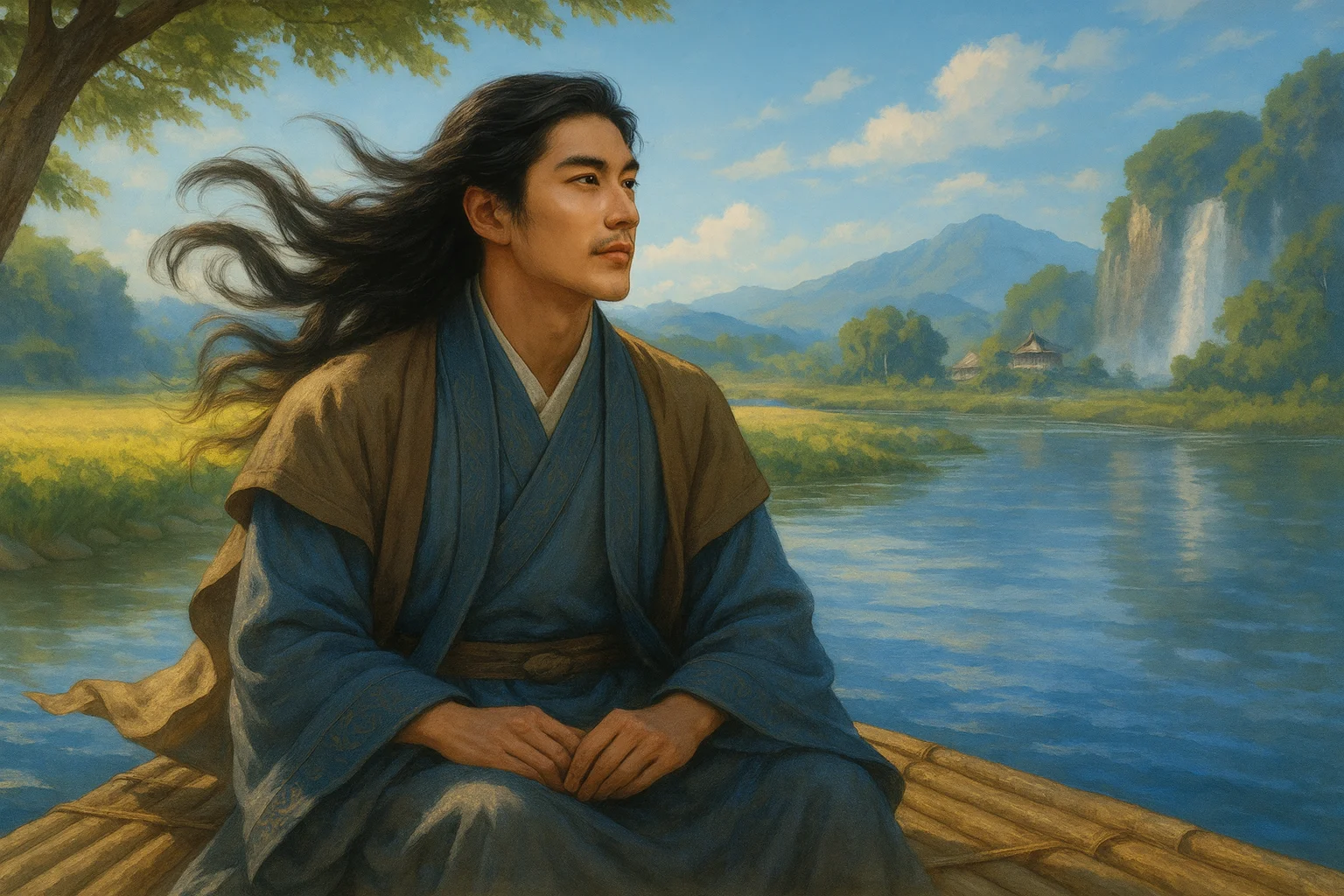
Meng Haoran (孟浩然 689 - 740), a native of Xiangyang, Hubei Province, was a renowned landscape and pastoral poet of the Tang Dynasty. In his early years, he lived in seclusion on Mount Lumen, reading for his own pleasure. At the age of forty, he traveled to the capital to take the jinshi examination but failed. Thereafter, he remained a commoner for the rest of his life, roaming the Wu and Yue regions and finding contentment in poetry and wine. He excelled in five-character verse, with a style that is light and natural, often depicting the pleasures of landscapes and reclusion. He is regarded as a representative of the High Tang landscape and pastoral poetry school. His collected works, Meng Haoran Ji, have been handed down, and his poetry exerted a profound influence on later hermitic poetic traditions.