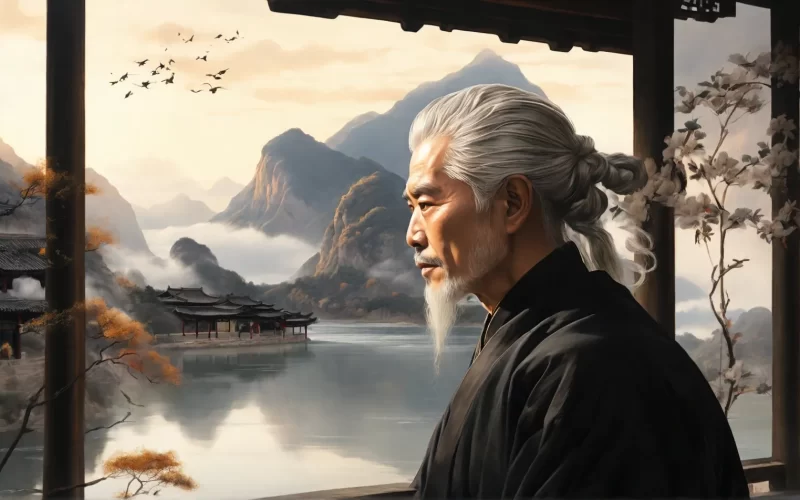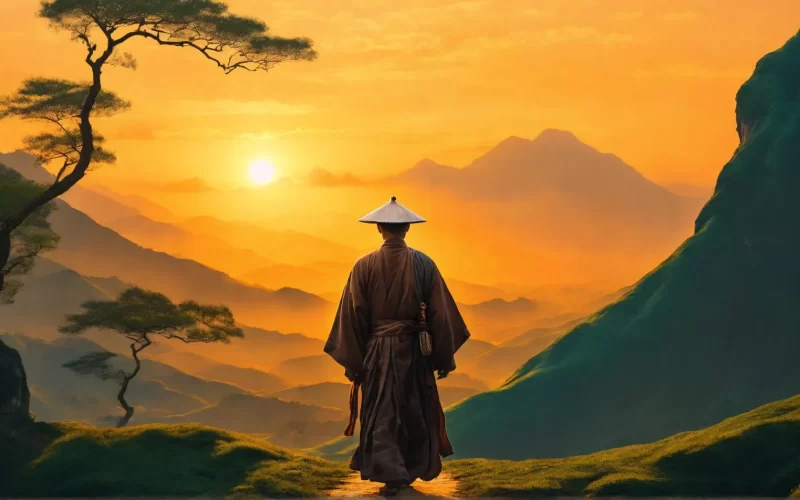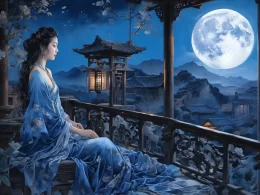

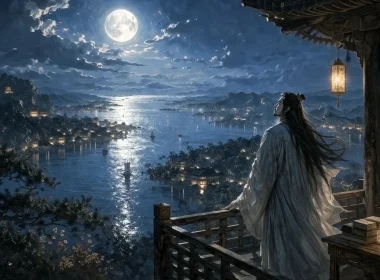
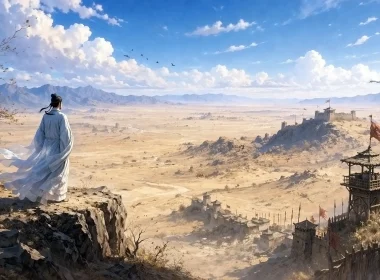
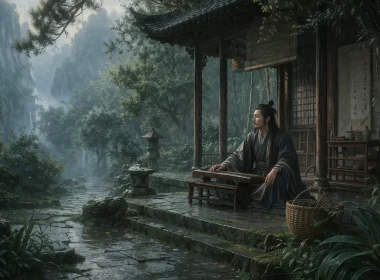
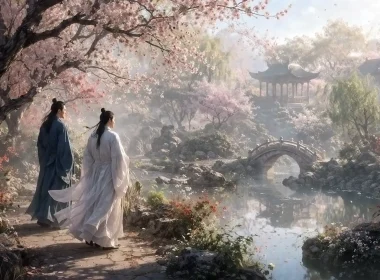
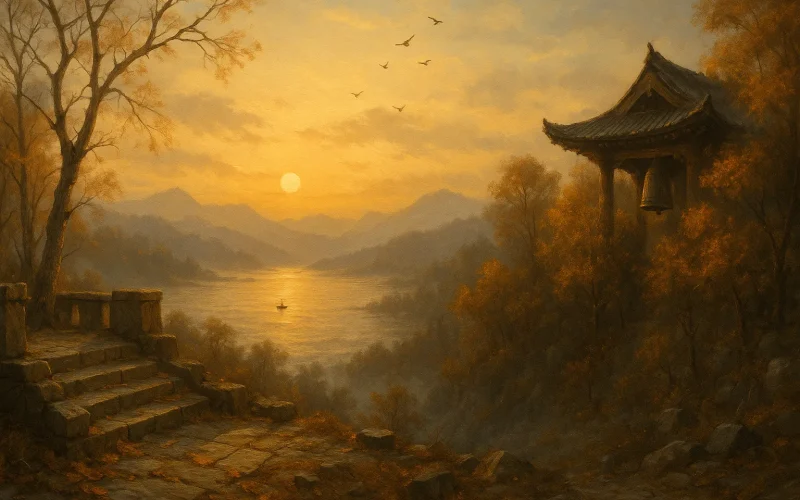
So autumn breaks my homesick heart...
Few pilgrims venture climbing to a temple so wild,
Up from the lake, in the mountain clouds.
...Sunset clings in the old defences,
A stone gong shivers through the empty woods.
...Of the Southern Dynasty, what remains?
Nothing but the great River.
Original Poem
「秋日登吴公台上寺远眺」
刘长卿
古台摇落后, 秋日望乡心。
野寺人来少, 云峰水隔深。
夕阳依旧垒, 寒磬满空林。
惆怅南朝事, 长江独至今。
Interpretation
This poem was composed by Liu Changqing during his travels in Yangzhou, written in autumn while ascending the Wu Gong Terrace. Wu Gong Terrace was located northwest of Jiangdu (modern Yangzhou, Jiangsu). Originally, it was a crossbow platform built by Shen Qingzhi of the Liu Song dynasty during the Southern Dynasties for his attack on Prince Liu Dan of Jingling. It was later fortified by the Chen dynasty general Wu Mingche during his campaign against Northern Qi, hence the name "Wu Gong Terrace." This is an ancient battlefield steeped in the blood and fire of history, witnessing the tumultuous changes of successive regimes and incessant warfare over several decades of the Southern Dynasties.
Throughout his life, Liu Changqing was "unyielding and offending superiors, twice demoted." At this time, although he had been transferred from his place of exile, he was still not entrusted with important positions. Stranded in the Jianghuai region, he was caught in a dilemma. Ascending the ancient terrace in autumn, as all things wither and fall, the scene is one of desolation. Standing alone on the terrace, the poet sees before him a wild temple, a desolate terrace, the setting sun, and crumbling fortifications; in his ears, the cold chime of a temple bell echoes in the empty woods. The rise and fall of the Southern Dynasties seems to come alive in the autumn wind; yet the river below the ancient terrace still surges eastward, unmoved by any human affairs. At this moment, the sorrows of his personal life and the sighs for the vicissitudes of history resonate within the poet's heart—his own half-life of hardship mirrors the experiences of countless talented individuals of the Southern Dynasties; the ancient terrace remains, but human affairs have changed; only the Long River flows on, day and night.
The line in the poem, "惆怅南朝事" (I grieve o'er Southern Dynasty's deeds), is precisely the focal point of the poem's emotion. What the poet laments is not only those bygone events of the Southern Dynasties, but all lives and destinies that, like meteors, streak across the long river of history only to be forgotten. And the five characters, "长江独至今" (Only the Long River still flows east to the sea), use the eternity of nature to contrast the brevity of human affairs, elevating personal melancholy into a profound inquiry into history and existence.
First Couplet: "古台摇落后,秋日望乡心。"
Gǔ tái yáo luò hòu, qiū rì wàng xiāng xīn.
When leaves fall from the trees, I mount the terrace high
And long for my far native land in autumn sky.
The poem opens with "ancient terrace" and "withering and falling," establishing the desolate tone. "古台" (gǔ tái, ancient terrace) is a historical relic bearing the memories of the Southern Dynasties' rise and fall. "摇落" (yáo luò, to wither and fall) is an autumnal scene, implying the bleakness of all things decaying. Placed side by side, they present two dimensions of time simultaneously before the reader: the depth of history and the change of seasons. The next line, "秋日望乡心" (qiū rì wàng xiāng xīn, autumn day, heart longing for home), moves from scene to emotion, pinpointing the core feeling of the ascent. The three characters "望乡心" (heart longing for home) express both longing for his native place and a yearning for a spiritual home. At this moment, the poet is in a strange land, disappointed in his career. Looking out from the terrace, all he sees is desolation, and homesickness arises spontaneously amidst the autumn colors.
Second Couplet: "野寺人来少,云峰水隔深。"
Yě sì rén lái shǎo, yún fēng shuǐ gé shēn.
The lonely temple stands buried where few people pass;
Cloud-veiled peaks are severed by water stretching far.
This couplet describes the scene from the terrace, creating a vast, remote意境 (yìjìng, artistic conception). "野寺人来少" (yě sì rén lái shǎo, wild temple, people come rarely) depicts the desolation nearby—a temple in the wilderness, originally seldom visited; the word "少" (shǎo, few) emphasizes its cold, lonely stillness. "云峰水隔深" (yún fēng shuǐ gé shēn, cloud-veiled peaks are severed by water deep) depicts the remote depth—peaks shrouded in mist, severed by the river, seeming like another world, visible but unreachable. This word "深" (shēn, deep) is both the depth of landscape and the depth of the poet's state of mind. Standing alone on the terrace, looking around at the vastness, with no one to speak to, no path to follow, only this wild temple, cloud-veiled peaks, and river face him in silence.
Third Couplet: "夕阳依旧垒,寒磬满空林。"
Xī yáng yī jiù lěi, hán qìng mǎn kōng lín.
The setting sun still lingers on the ancient wall;
The temple's chilly chime fills woods sad and tall.
This couplet, combining movement and stillness, depicts the bleak scene of interwoven time and space; it is the stroke of genius in the entire poem. "夕阳依旧垒" (xī yáng yī jiù lěi, the setting sun still lingers on the ancient wall) describes vision—the setting sun is an inanimate thing, but with the word "依" (yī, to lean on, linger), it gains a sense of reluctant attachment, as if it too cannot bear to leave this ancient fortification, lingering before setting. "寒磬满空林" (hán qìng mǎn kōng lín, the temple's chilly chime fills woods sad and tall) describes hearing—the chime originates in the temple, but with the word "满" (mǎn, to fill), it diffuses, filling the entire empty woods. This chime is "寒" (hán, cold)—both the chill of autumn and the chill of the heart; these woods are "空" (kōng, empty)—both the emptiness of the mountain woods and the emptiness of the inner self. The setting sun lingers on the old fortifications; the chilly chime fills the empty woods—one warm, one cold; one still, one moving—together constructing an artistic world both desolate and ethereal.
Fourth Couplet: "惆怅南朝事,长江独至今。"
Chóu chàng nán cháo shì, Cháng Jiāng dú zhì jīn.
I grieve o'er Southern Dynasty's deeds long past alone;
Only the Long River still flows east to the sea.
The final couplet shifts from scene to history, from history to reflection, concluding the poem. "惆怅南朝事" (chóu chàng nán cháo shì, I grieve o'er Southern Dynasty's deeds) uses five characters to fully express sorrow for the rise and fall of history—where are the heroic feats, the beacon fires of war, the talented scholars and beauties of the Southern Dynasties now? Only this ancient terrace and wild temple remain, standing silently in the autumn wind. The next line, "长江独至今" (Cháng Jiāng dú zhì jīn, Only the Long River still flows east to the sea), uses the eternity of nature to contrast the brevity of human affairs. This word "独" (dú, alone, only) carries immense weight: the Long River flows on alone, the ancient terrace stands alone, the poet ascends alone, history has passed alone—all things are "alone," and within this "aloneness," the most difficult to bear is the clarity and helplessness of the human heart. Facing the Long River, the poet thinks: for thousands of years, how many heroes have surged forth and receded like this river's water, yet the Long River still flows east day and night, pausing for no one, unchanged by any event. This line is both a sigh for history and a sudden insight into life.
Holistic Appreciation
This is a powerful work among Liu Changqing's poems of ascending a height to reflect on the past. The entire poem consists of eight lines and forty characters. Using an autumn ascent as its entry point, it merges the desolation of the historic site, the bleakness of autumn scenery, the rise and fall of history, and the poet's personal circumstances, revealing the poet's deep and complex inner world while drifting in a strange land.
Structurally, the poem presents a progressive layering from near to far, from scene to emotion, from past to present. The first couplet introduces the theme with "ancient terrace" and "withering and falling," leading from the ascent to homesickness, establishing the poem's desolate tone. The second couplet describes the desolation of the nearby wild temple and the depth of the distant cloud-veiled peaks, using spatial distance to express the solitude of the heart. The third couplet uses the setting sun and chilly chime to sketch a bleak picture at dusk, using intertwined sight and sound to create atmosphere. The final couplet shifts from scene to history, concluding the emotion accumulated in the first six lines with "I grieve o'er Southern Dynasty's deeds," and ending with "Only the Long River still flows east to the sea," elevating personal melancholy into an inquiry into history and existence. Between the four couplets, moving from near to far, scene to emotion, past to present, the poem deepens layer by layer, forming a seamless whole.
Thematically, the core of this poem lies in the words "独" (alone) and "空" (empty). The first couplet: "独" ascends the ancient terrace; the second: "独" faces the wild temple; the third: "独" hears the chilly chime; the fourth: "独" faces the Long River—this word "独" runs through the entire poem, representing both the poet's solitary situation while ascending and the isolated feeling of the individual life facing the long river of history. And the "empty" of "The lonely temple... where few people pass," the "empty" of "The temple's chilly chime fills woods," and the "empty" implied in "Only the Long River still flows" together construct a spiritual world both desolate and ethereal. In the interweaving of this "empty" and "alone," the sorrows of the poet's personal life gain the weight of history, and momentary melancholy is elevated into an eternal inquiry.
Artistically, the poem's most moving aspect lies in the double reflection of "interweaving past and present, using scenery to write history." Writing of the ancient terrace, the poet's brush contains the blood and fire of the Southern Dynasties; writing of the setting sun, it contains the vicissitudes of the old fortifications; writing of the chilly chime, it contains echoes of history; writing of the Long River, it contains the rise and fall of the ages. Every scene before his eyes is not merely scenery, but a witness to history, a vessel of time. This technique of integrating personal ascent with historical contemplation is precisely the highest realm of classical Chinese poetry's "ascending a height to reflect on the past."
Artistic Merits
- Scene and Emotion Fused, Past and Present Interwoven: The entire poem merges autumnal scenery with historical reflection. Every stroke describes a scene, yet every stroke describes history; every stroke describes what is seen, yet every stroke describes what is felt.
- Sight and Sound Combined, Conception Vast and Desolate: The third couplet's "The setting sun still lingers on the ancient wall" describes sight; "The temple's chilly chime fills woods" describes hearing. One warm, one cold; one still, one moving—together constructing an artistic world both desolate and ethereal.
- Language Concise, Resonance Lingering: The entire poem has no superfluous words, especially concluding with the five characters, "Only the Long River still flows east to the sea." Using the eternity of nature to contrast the brevity of human affairs, the words end but the meaning is endless.
- Structure Rigorous, Progressing Layer by Layer: From ascent to longing for home, from longing to describing scenery, from describing scenery to reflecting on the past, from reflecting to realizing a truth. The four couplets are interlocked, seamless and natural.
Insights
Using an autumn ascent as its thread, this poem speaks to an eternal theme—Humans between heaven and earth are but passing travelers; only the landscape remains, while human affairs have changed.
It first allows us to see the "weight of time." That ancient terrace was once a place of raging battle during the Southern Dynasties; now only a desolate terrace and wild temple remain. Where are those heroic feats, those talented scholars and beauties now? Only the setting sun lingers, the chilly chime remains, the Long River flows on. The poet tells us: Time is the most ruthless sculptor, grinding all glory into dust, transforming all prosperity into smoke and clouds. Standing by the long river of time, an individual life is as small as an ant, fleeting.
On a deeper level, this poem prompts us to contemplate the relationship between "eternity and transience." The Long River "still flows east to the sea" is a symbol of eternity; yet the events of the Southern Dynasties have long vanished without a trace. Facing this eternal river, what arises in the poet's heart is not only emotion for history, but also a sudden insight into his own fate: What are the hardships, disappointments, joys and sorrows of my own life within the long river of history? This insight brings both relief and melancholy—relief that personal gain and loss are so insignificant; melancholy that life is so brief and uncertain.
And most moving is the poem's consciousness of that "alone." The poet ascends the ancient terrace alone, faces the setting sun alone, hears the chilly chime alone, watches the Long River alone. Within this word "alone" lies loneliness, but also clarity; helplessness, but also transcendence. True clarity is often lonely; true depth often requires facing alone. The "alone" in "Only the Long River still flows" is both the loneliness of the river and the loneliness of the poet, and indeed the fate of every clear-sighted individual in the long river of history.
This poem writes of a Tang dynasty ascent, yet allows everyone who pauses in contemplation by the river of time to find resonance within it. The figure on the ancient terrace is the figure of everyone contemplating history; the empty woods within the sound of the chilly chime reflect every lonely soul; the eastward flow of the Long River is where the gaze of everyone questioning eternity is directed. This is the vitality of poetry: it writes of one person's feelings, but reads as the heart's concern of all.
Poem Translator
Kiang Kanghu
About the Poet
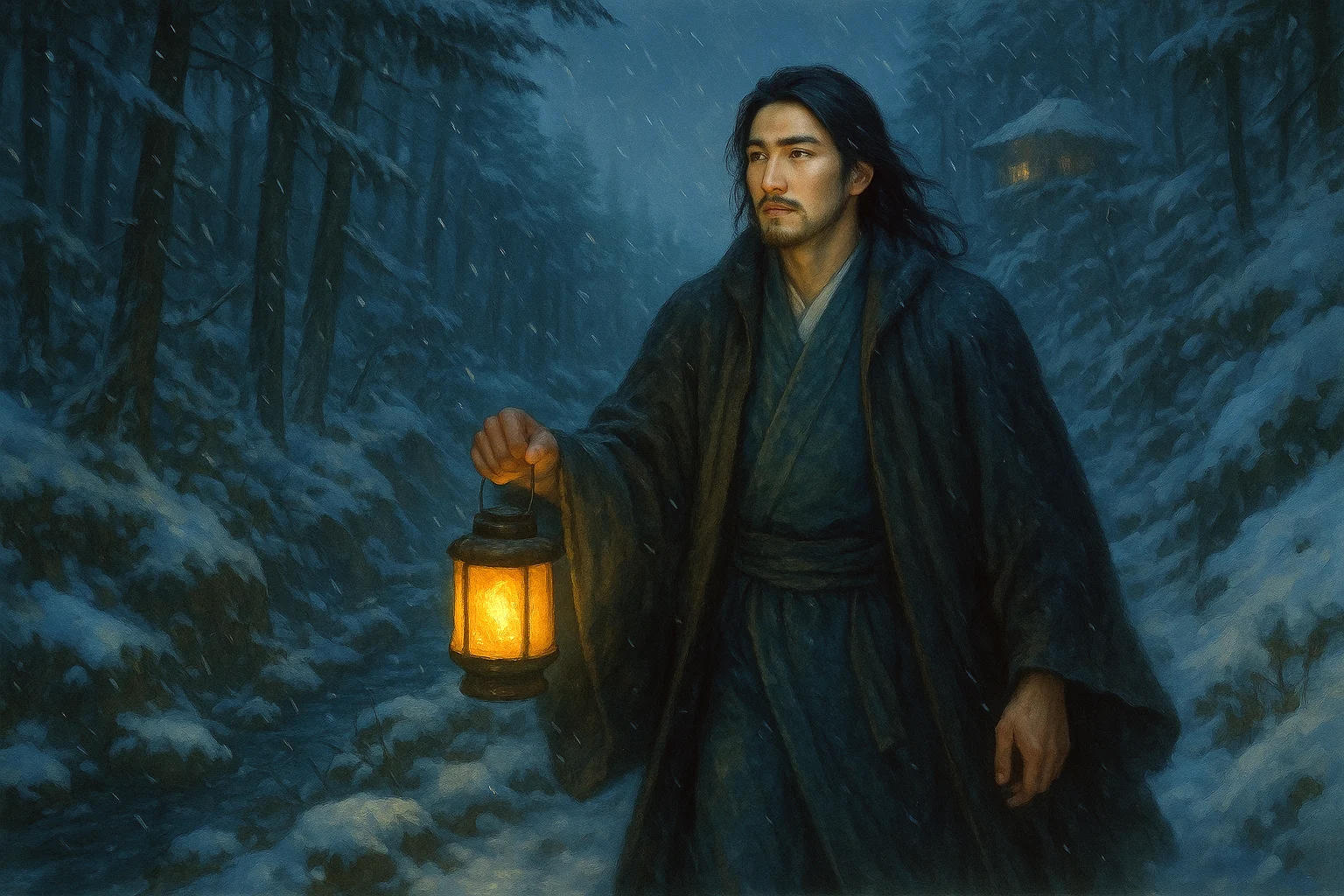
Liu Zhangqing (刘长卿 c. 726 – c. 786), a native of Xuancheng, Anhui Province, was a poet of the Mid-Tang Dynasty. He obtained the jinshi degree (presented scholar) in the late Tianbao era and successively held official posts such as Sheriff of Changzhou and Investigating Censor. Due to his upright and unyielding character, he was exiled twice. His poetry, particularly his five-character verses, achieved the highest distinction, often depicting the melancholy of exile and the joys of reclusion in landscapes. His poetic style is refined, elegant, and ethereal, blending a desolate undertone with the meticulousness characteristic of the Ten Talented Poets of the Dali era. He excelled in using plain sketching to create an atmosphere of tranquil emptiness and profound remoteness. As a pivotal poet bridging the High Tang and Mid-Tang periods, his work inherits the idyllic charm of Wang Wei and Meng Haoran while foreshadowing the bleak and cool elegance of Dali poetry. He exerted a certain influence on late Tang poets such as Yao He and Jia Dao, who belonged to the "painstaking school."