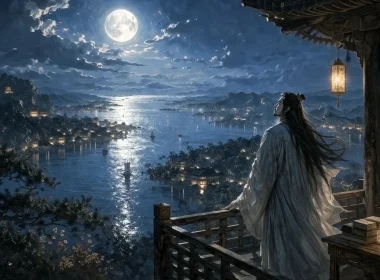
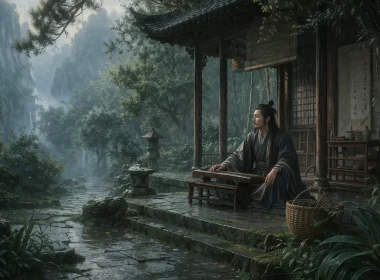

You are gone. The river is high at my door.
Cicadas are mute on dew-laden boughs.
This is a moment when thoughts enter deep.
I stand alone for a long while.

...The North Star is nearer to me now than spring,
And couriers from your southland never arrive -
Yet I doubt my dream on the far horizon
That you have found another friend.
Original Poem
「凉思」
李商隐
客去波平槛,蝉休露满枝。
永怀当此节,倚立自移时。
北斗兼春远,南陵寓使迟。
天涯占梦数,疑误有新知。
Interpretation
This poem was composed by Li Shangyin in his later years while serving in the Xuanchou administrative headquarters, around the autumn of 854 AD. By this time, the poet had moved between various regional posts for many years, personally witnessing countless scenes of "guests departing" and "temporary lodging." The "chill" in the title refers not only to the physical coolness of an autumn night but more profoundly to the psychological chill of interpersonal estrangement and interrupted communication. The title precisely captures a state of mind common among Tang Dynasty scholar-officials living itinerant lives—as the body moves constantly, emotions gradually lose their stable anchor, and longing itself takes on a "chilled" quality.
At this stage, Li Shangyin possessed a deep understanding of the relationship between friendship and communication. In an era of difficult correspondence, connections among intellectuals relied heavily on letters and oral messengers, yet transfers between posts and political shifts often severed these links. While "Chilled Longing" ostensibly expresses longing for a friend, it actually touches upon a fundamental dilemma of interpersonal relationships in pre-modern society: when physical distance exceeds a certain threshold, how can emotion substantiate its own existence? The line "fearing new friends cause this neglect" is a natural product of this predicament—not mere jealousy, but the mind's necessary deduction to fill the void created by an informational vacuum.
First Couplet: 客去波平槛,蝉休露满枝。
Kè qù bō píng kǎn, chán xiū lù mǎn zhī.
After parting, waves lie calm against the balustrade;
Cicadas hushed, on laden boughs the dew is laid.
Explication: This couplet conveys the depth of time through a contrast of refined perceptions. "After parting" and "waves lie calm" mark a shift from motion to stillness, hinting at the emptiness that follows sociability. More exquisite is "Cicadas hushed, on laden boughs the dew is laid": the "hushing" of cicadas is the cessation of sound, while the "laying" of dew is the emergence of visual detail. The poet captures a perceptual phenomenon wherein visual details become pronounced precisely as sound recedes. Dew, as a nocturnal condensation, suggests the transition from day to deep night and metaphors longing accumulating quietly within silence.
Second Couplet: 永怀当此节,倚立自移时。
Yǒng huái dāng cǐ jié, yǐ lì zì yí shí.
In this late season, constant thoughts remain;
Leaning on the rail, I watch hours wax and wane.
Explication: "Constant thoughts" and "leaning on the rail" form a pair of existential postures: the former is an inner, sustained state; the latter is a bodily, static form. The phrase "watch hours wax and wane" is telling—time seems to possess its own agency, passing unnoticed. These words articulate the altered sense of time peculiar to deep contemplation: when immersed in feeling, objective time (the waxing and waning) and subjective time (a felt stillness) become disjointed. This very dislocation serves as proof of longing's depth.
Third Couplet: 北斗兼春远,南陵寓使迟。
Běi dǒu jiān chūn yuǎn, Nánlíng yù shǐ chí.
The Plough-star shares spring's far, departed glow;
From Southern Mounds, the courier's answers slow.
Explication: This couplet constructs a coordinate system for longing through a dual stretching of space and time. "The Plough-star shares spring's far, departed glow" suggests an upward, cosmic remoteness: stars are spatially distant, yet the poet says the constellation "shares spring's… glow," transforming spatial into temporal distance (the remoteness of a departed spring). "From Southern Mounds, the courier's answers slow" expresses a forward, interpersonal waiting: "the courier's answers" refer to messages from an envoy residing afar; the word "slow" conveys the inevitable attenuation and delay information suffers during physical transmission. Together, these lines reveal the nature of pre-modern longing: it is always navigating multiple layers of distance.
Fourth Couplet: 天涯占梦数,疑误有新知。
Tiānyá zhān mèng shuò, yí wù yǒu xīn zhī.
Here at earth's edge, I seek signs in dreams, time and again,
Fearing new friends cause this neglect, this unexplained disdain.
Explication: The final coupleet ventures into psychological depths. "Seek signs in dreams" is a substitute strategy for communication when real channels close; with no news, one turns to dreams for clues. The subtlety of "fearing new friends cause this neglect" lies here: the poet's fear is not of a friend's betrayal but of a misunderstanding born from informational error—the phrasing preserves the possibility of a benign explanation. This psychology, both anxious and restrained, displays the particular tact of scholarly friendship: even in deepest private worry, an effort persists to maintain trust in the other's character.
Holistic Appreciation
This is a poetic experiment concerning "interruption." The poem presents various potential fractures in human connection: interruption of sound (cicadas hushed), interruption of company (parting), interruption of information (courier slow), interruption of trust (fearing error). Li Shangyin's brilliance lies not in attempting to mend these breaks but in transforming interruption itself into a wellspring of poetry.
The poem's structure forms a near-perfect symmetry: the first couplet describes external silence after "parting"; the final couplet describes inner turmoil after "fearing." The second couplet explores the temporal depth of "constant thoughts"; the third explores the spatial breadth of "the Plough-star." This structure implies the complete shape of longing: it delves inward (temporal depth) and reaches outward (spatial expanse); it manifests in changes to the external world (dew-laden boughs) and unfolds in internal psychological shifts (seeking dream signs).
Particularly noteworthy is the use of water imagery. The water in "waves lie calm" is a still mirror-surface. Though not directly mentioned in the final couplet, "earth's edge" implies great distances, often across waters, and "seek signs in dreams" subtly connects to the dream tradition found in ancient poetry. This movement from literal to metaphorical water completes the sublimation of longing from a concrete scene to an abstract state of being.
Artistic Merits
- Depicting the "Negative Space" of Perception: The poet does not directly describe longing's intensity but writes of the silence after "cicadas hushed," the emptiness after "waves lie calm," the desolation of "laden boughs." By portraying the vacant state of perception, the invisible longing acquires a tangible form.
- The Art of Layering Time: "Spring's far, departed glow" spatializes past time (spring); "watch hours wax and wane" reifies present time; "seek signs in dreams" mystifies future time. These three treatments allow eight short lines to encompass the full temporal spectrum of past, present, and future.
- A Poetic Forerunner to Information Theory: The entire poem can be read as a subtle analysis of an interpersonal communication system, complete with source (friend), channel (courier), receiver (poet), noise (distance, time), and feedback (dream signs). In poetic language, Li Shangyin touches upon core issues of attenuation, delay, and misinterpretation in the transmission of meaning.
Insights
The work's brilliance lies in capturing one of the most classical yet fundamental human dilemmas: how trust coexists with doubt in the silence of broken communication. It traces a complete psychological process. Its soul resides in the final couplet: "Fearing new friends cause this neglect…" The weight of "fearing… cause this neglect" is immense. The poet's fear points not to the friend's character but to a more unsettling possibility: could the cherished, deeply trusted bond itself be a misunderstanding? The existence of "new friends" becomes secondary; what truly unsettles is the idea of "error"—it undermines one's certainty in personal memory, judgment, and feeling itself. When external information fails, the inner self becomes a court of self-interrogation, and "seeking signs in dreams," this ultimately unreliable act, becomes the only available evidence. This is the cold logic derived from solitude, a logic that attacks its own foundation.
The poem's timeless resonance stems from its profound engagement with an emotional structure common to all ages: when the reliable anticipation of connection is severed, the mind inevitably begins to consume itself within a void of meaning. Li Shangyin immortalizes this psychological process through his verse, revealing that the most profound chill arises not from the autumn dew, but from that quiet, creeping doubt concerning the veracity of once-cherished warmth. This vulnerability is ancient, deeply and universally human.
Poem translator
Kiang Kanghu
About the poet
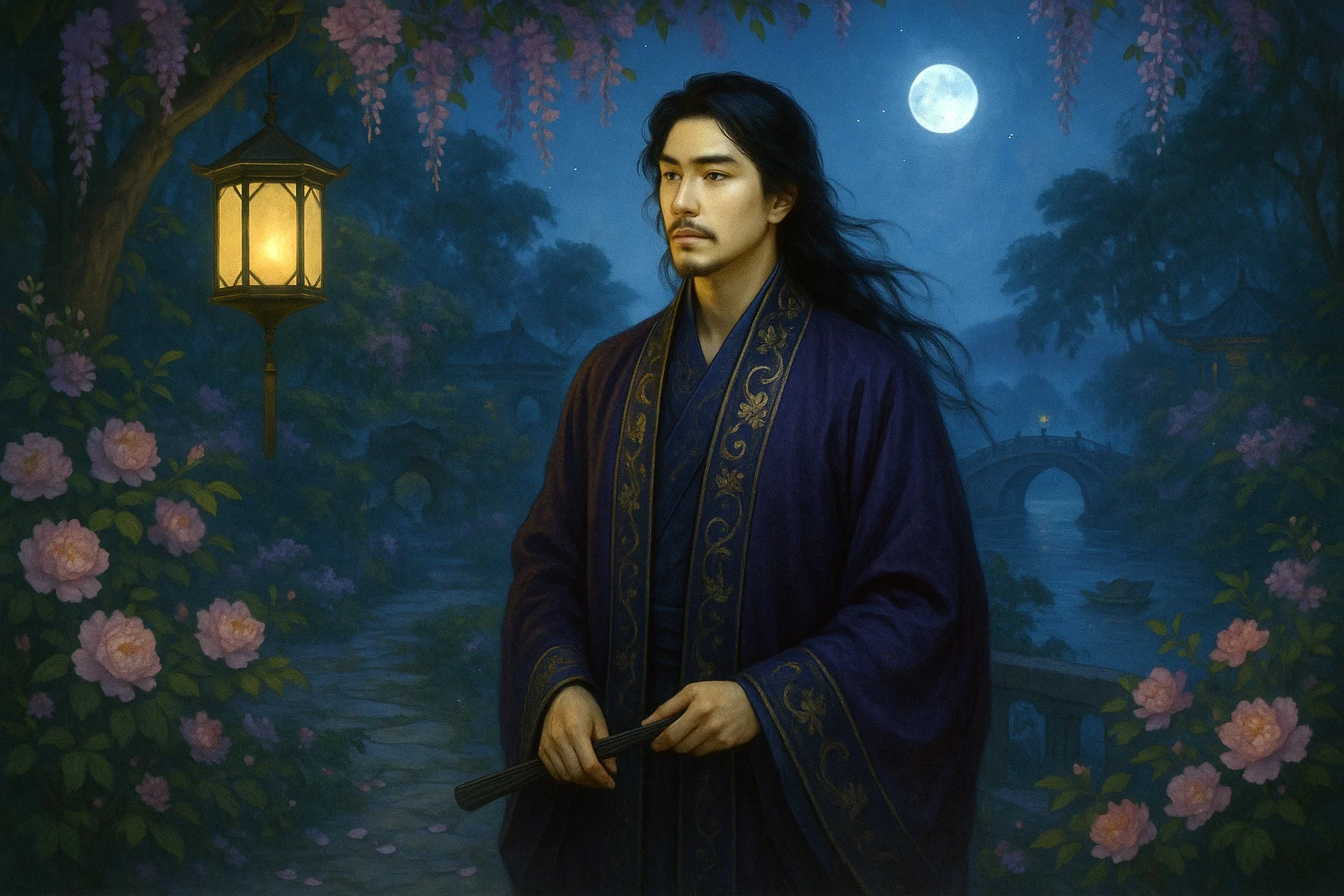
Li Shangyin (李商隐), 813 - 858 AD, was a great poet of the late Tang Dynasty. His poems were on a par with those of Du Mu, and he was known as "Little Li Du". Li Shangyin was a native of Qinyang, Jiaozuo City, Henan Province. When he was a teenager, he lost his father at the age of nine, and was called "Zheshui East and West, half a century of wandering".