
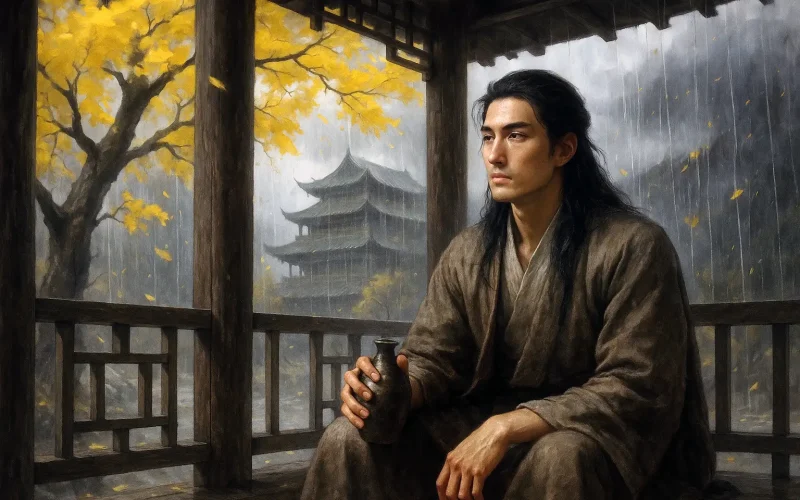
I ponder on the poem of The Precious Dagger.
My road has wound through many years.
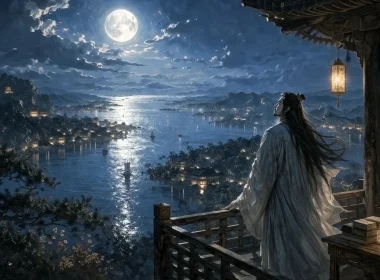
...Now yellow leaves are shaken with a gale;
Yet piping and fiddling keep the Blue Houses merry.

On the surface, I seem to be glad of new people;
But doomed to leave old friends behind me,
I cry out from my heart for Xinfeng wine
To melt away my thousand woes.
Original Poem
「风雨」
李商隐
凄凉宝剑篇,羁泊欲穷年。
黄叶仍风雨,青楼自管弦。
新知遭薄俗,旧好隔良缘。
心断新丰酒,销愁斗几千。
Interpretation
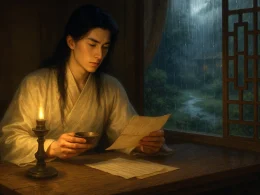
This poem stands as a defining work from Li Shangyin's period of rootless wandering during his middle years, likely composed in the autumn of 848 AD. At this time, the poet was adrift between various provincial posts. Having endured the death of his father-in-law, Wang Maoyuan—which shattered his political support—and finding himself trapped within the factional conflict between the Niu and Li parties, he descended fully into an existence defined by "drifting, meant to use up all my years." The poem presents the poet's lucid understanding of his own destiny: the eternal mismatch between talent and circumstance, the acute conflict between the individual and his age. The self-referential "desolate 'Song of the Precious Sword'" does more than recall the historical precedent of Guo Zhen, whose poem of that name earned him imperial favor in the early Tang. It serves, more pointedly, as a sorrowful indictment of the failure of the mechanisms for recognizing talent in his own era.
The Tang state was in its late decline, riddled with intertwined crises of political decay, regional militarism, and eunuch dominance. Paths to advancement for scholars were narrowing. Li Shangyin's wandering was not merely geographical but a form of existential suspension—"new friends meet with vulgar fashion" exposes the difficulty for principled men to find footing in a corrupt milieu, while "old bonds are cut off by circumstance" reveals the fragility of human connections amid political strife. This double isolation rendered the poet a "sere leaf" of his time, adrift alone in the wind and rain.
First Couplet: 凄凉宝剑篇,羁泊欲穷年。
Qīliáng bǎojiàn piān, jī bó yù qióng nián.
How desolate, the "Song of the Precious Sword"!
This drifting life will use up all my years, bound.
Explication: The "Song of the Precious Sword" alludes to the poem by that name by Guo Zhen, which won the admiration of Empress Wu Zetian and became emblematic of a scholar finding his destined ruler. By modifying it with "How desolate," Li Shangyin executes a potent reversal of the allusion's meaning: a historical text symbolizing opportunity is transformed into an expression of present-day frustration. The word "bound" (yu) in the second line is crucial; it conveys not desire but a resigned prediction of an inescapable fate—not the possibility, but the certainty of a life spent wandering. This clear-eyed despair carries a weight beyond simple lament.
Second Couplet: 黄叶仍风雨,青楼自管弦。
Huáng yè réng fēngyǔ, qīnglóu zì guǎnxián.
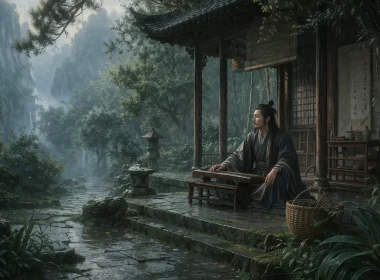
Sere leaves endure the wind and rain;
The blue towers keep their own flutes and strings.
Explication: This couplet juxtaposes two parallel realities through cinematic contrast. "Sere leaves endure the wind and rain": the word "endure" speaks to the repetitive, inescapable nature of hardship—the storm is not an incident but a constant condition. Set against this is "The blue towers keep their own flutes and strings." The phrase "keep their own" delineates a self-contained world of pleasure, utterly indifferent to the suffering outside. These worlds exist side-by-side yet are separated by a chasm of values. The poet, situated in the first, observes the second, evoking a powerful sense of alienation from realms of comfort and ease, introducing a note of social critique rare in his poetry.
Third Couplet: 新知遭薄俗,旧好隔良缘。
Xīnzhī zāo bó sú, jiù hǎo gé liángyuán.
New friends meet with a vulgar, shallow fashion;
Old bonds are cut off by circumstance, by passion.
Explication: This couplet reveals the dual collapse of human connection in a hostile environment. "New friends meet with… vulgar fashion" describes the failure of lateral connection: in a corrupt and petty social climate, genuine new relationships cannot take root. "Old bonds are cut off by circumstance" describes the rupture of longitudinal ties: past affections are severed by the demands of changing situations ("circumstance" implying both opportunity and fate). The poet finds himself in a relational void, unable to forge new paths forward and having lost the connections of the past. For a scholar's spirit that thrives on mutual understanding, this constitutes a profound form of isolation.
Fourth Couplet: 心断新丰酒,销愁斗几千。
Xīn duàn xīnfēng jiǔ, xiāo chóu dòu jǐ qiān.
My heart severs hope in Xinfeng wine's cheer.
To drown this sorrow—how many thousand cups here?
Explication: The final couplet invokes a classical allusion only to dismantle it, negating even this traditional solace. "Xinfeng wine" alludes to Ma Zhou, who drank alone at Xinfeng in obscurity before later rising to prominence under Emperor Taizong—a classic narrative of scholar-official resilience. "My heart severs hope" utterly crushes this narrative; it is not anxious waiting but the cutting off of hope itself. The rhetorical question "how many thousand cups?" subjects the cliché of "drowning sorrow in drink" to cold scrutiny: if sorrow is an ocean, how can it be measured by wine? This skeptical turn elevates the poem from personal complaint to a philosophical questioning of the very possibility of solace for the scholar in adversity.
Holistic Appreciation
This is a poem that systematically deconstructs hope. Li Shangyin dismantles, layer by layer, the pillars supporting a scholar's spirit: the first couplet dismantles the myth of replicable historical opportunity; the second, the illusion of a just or caring social order; the third, the reliability of human bonds; the fourth, the efficacy of traditional comforts. This progression gives the poem a surgical, analytical sharpness.
Structurally, it achieves a symmetry of despair: the outer couplets concern the individual's relationship to history and self (the Sword, the Wine), while the inner couplets concern his relationship to society and others (Leaves/Towers, New/Old friends). This implies the poet's predicament is total and inescapable—he finds no place in the world and no internal exit.
The imagery of "wind and rain" is particularly potent. It transcends weather to become the embodiment of the era's hostile climate and the tangible pressure of fate. The sere leaf drifts not merely in but as part of the storm—the environment and the fate are one. This complete immersion of the individual within the temper of the times makes the poem a condensed specimen of the late Tang scholarly psyche.
Artistic Merits
- The Critical Deployment of Allusion: Allusions like Guo Zhen's success or Ma Zhou's perseverance, traditionally symbols of hope, are inverted to highlight the harshness of the poet's reality. This is allusion as critique, not ornament.
- Value Systems in Juxtaposition: The contrast between "sere leaves" and "blue towers" is not merely rich versus poor, but the coexistence of incommensurate realities. The poet's restraint—simply noting the towers' self-absorption—makes the critique more damning.
- Emotion Channeled Through Reason: The poem avoids lyrical outbursts. Instead, emotion is conveyed through controlled, almost fatalistic statements ("will use up," "endure," "meet with," "cut off," "how many") that allow reason to articulate despair, a hallmark of Li Shangyin's mature style.
Insights
The work exposes a harsh truth: personal excellence is no guarantee of recognition, let alone integration, by its historical moment. Li Shangyin's tragedy lies not just in unmet talent, but in his lucid awareness that this failure was systemic—a sign of an age where "vulgar fashion" blocked "circumstance," rendering the social machinery incapable of valuing true worth.
The stark juxtaposition of "Sere leaves endure the wind and rain; / The blue towers keep their own flutes and strings" raises an enduring ethical question: What is the legitimacy of one segment's revelry when another endures relentless hardship? Li Shangyin offers no easy answer, but the juxtaposition itself is a silent indictment. The lesson for any society is that it cannot remain healthy if its systems of value (the music in the towers) are completely divorced from the lived experience of its members (the leaves in the storm).
Ultimately, the poem offers not consolation but a courage of unflinching clarity—to face the likely fate of "drifting to use up all my years," to still invoke the "Song of the Precious Sword" even with a "heart severed" from hope. The act of writing this precise lament itself becomes the final resistance: one may be cast aside by the age, but one need not erase oneself; one's years may be spent in drift, but meaning need not dissolve in silence. In this light, "In the Wind and Rain" is less a lament than a spiritual manifesto, a declaration of creative integrity upheld in a landscape of devalued meaning.
Poem translator
Kiang Kanghu
About the poet
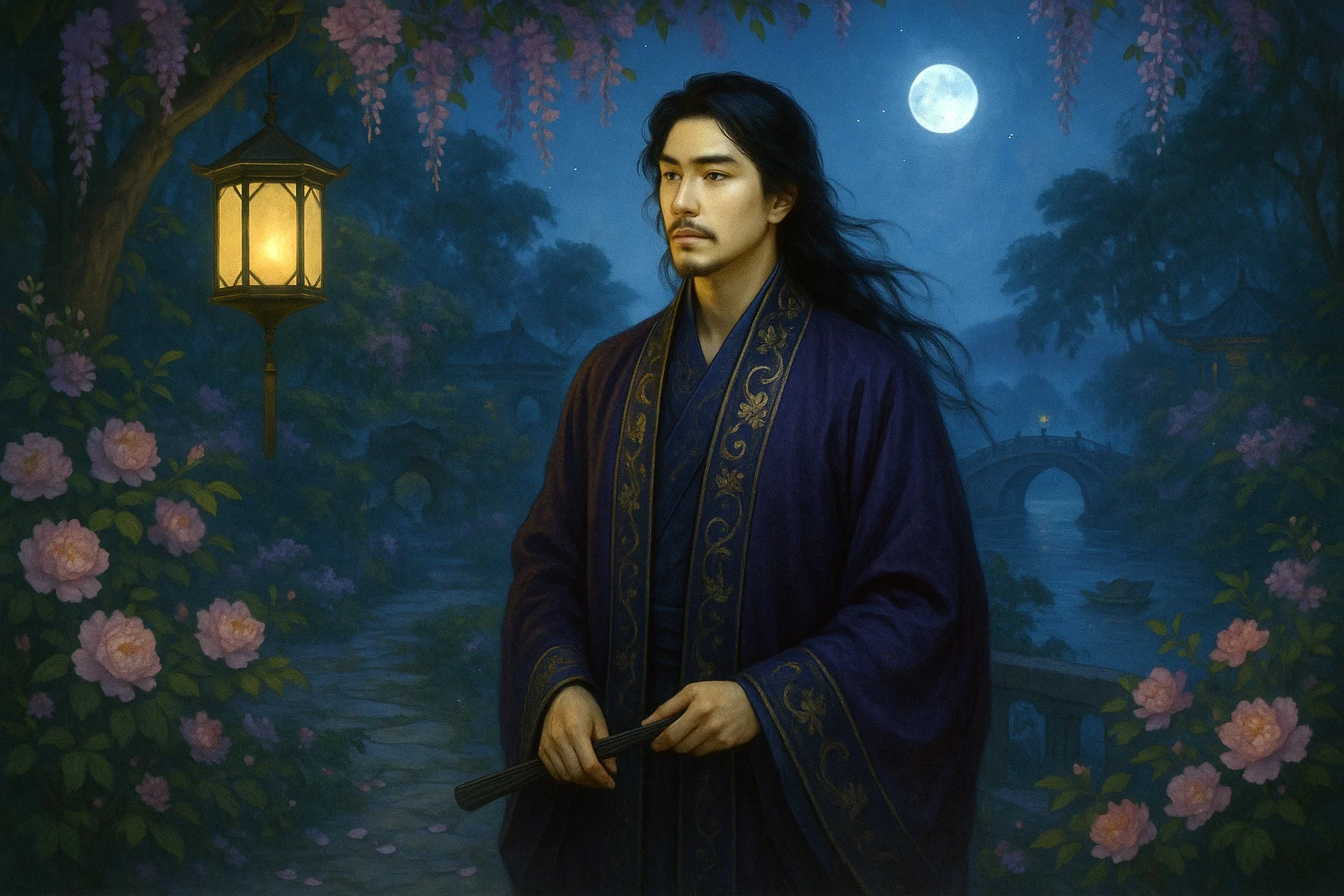
Li Shangyin (李商隐), 813 - 858 AD, was a great poet of the late Tang Dynasty. His poems were on a par with those of Du Mu, and he was known as "Little Li Du". Li Shangyin was a native of Qinyang, Jiaozuo City, Henan Province. When he was a teenager, he lost his father at the age of nine, and was called "Zheshui East and West, half a century of wandering".