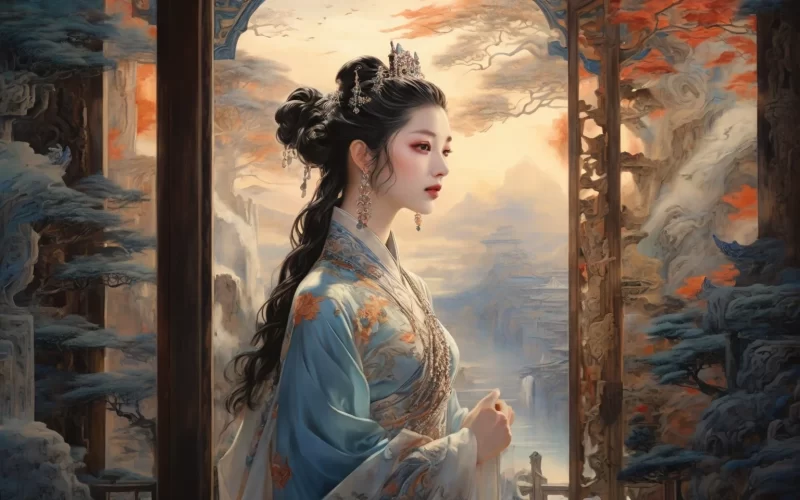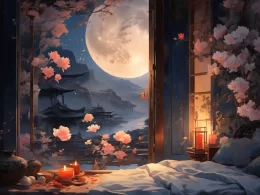

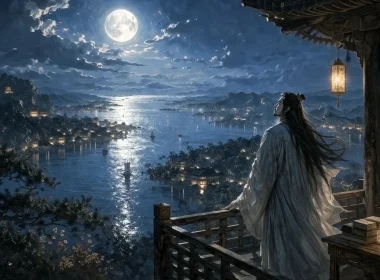
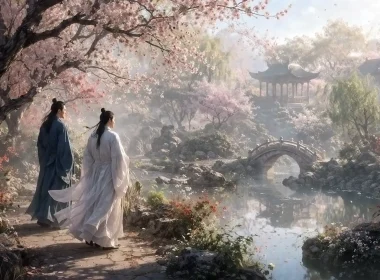
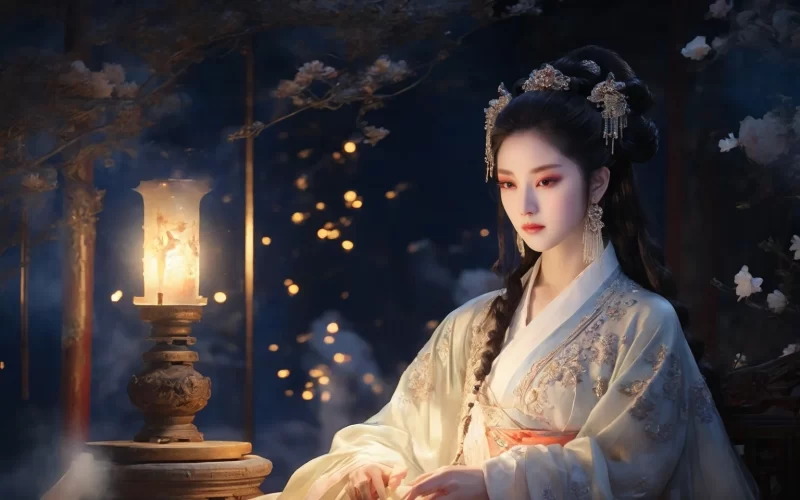
The candle’s shadow deepens on the mica screen;
The River of Stars sinks low, morning stars unseen.
Chang'e must regret having stolen the elixir of grace —
Facing the blue sea and azure sky, night after night, alone in space.
Original Poem
「嫦娥」
李商隐
云母屏风烛影深,长河渐落晓星沉。
嫦娥应悔偷灵药,碧海青天夜夜心。
Interpretation
This poem is believed to have been composed between 851 and 855 AD, representing a masterpiece from Li Shangyin's late period, a time when his poetic craft reached a state of sublime perfection. During these years, the poet suffered multiple blows: the death of his wife (née Wang), the complete shattering of his political ideals, and his own deteriorating health. His experience of "solitude" had evolved from a specific circumstance into a fundamental, existential awareness. While ostensibly a poetic reflection on a mythological figure, the poem is, in essence, a profound meditation by the poet on his own spiritual condition.
The religious and cultural context of the late Tang is noteworthy. With the prevalence of Daoist alchemical practices and the spread of Pure Land Buddhist beliefs, notions of "ascension" and "eternal life" permeated the zeitgeist. Through the story of Chang'e, however, Li Shangyin offers a sobering deconstruction of this collective fantasy of "achieving immortality." He reveals the cruel essence of the ascension promised by the "elixir" by showing how the "sapphire sea and blue sky," objects of worldly longing, become an eternal prison. The creation of this poem can thus be seen as the poet's poetic response to the spiritual predicament of his era.
First Couplet: 云母屏风烛影深,长河渐落晓星沉。
Yúnmǔ píngfēng zhú yǐng shēn, cháng hé jiàn luò xiǎo xīng chén.
On the mica screen, candle-shadows gather, dense and deep;
The Silver River fades, the morning stars sink into sleep.
Explication: This couplet constructs a doubly confined space through two sets of imagery. The "mica screen" is an ornate, semi-transparent barrier within the chamber. The deepening candle-shadows upon it suggest time congealing within absolute stillness. "The Silver River fades" and "the morning stars sink" depict the celestial progression outside. While the movement of heavenly bodies should imply vastness, the verbs "fades" and "sink" impart a sense of heavy, irrevocable descent. The interior and exterior spaces mirror each other: the shifting play of light on the screen and the slow turn of the cosmos together outline a vessel of time and space that is closing in upon itself.
Final Couplet: 嫦娥应悔偷灵药,碧海青天夜夜心。
Cháng'é yīng huǐ tōu líng yào, bì hǎi qīng tiān yè yè xīn.
Chang'e must regret the stolen pill that set her free,
Over sapphire seas, under blue skies, her heart night's captive be.
Explication: "Must regret" acts as the poem's emotional pivot, using a tone of speculation to shift from description to judgment. The compound image "sapphire seas, blue skies" warrants deep reflection: the boundless sea is impassable; the immense sky offers no support. Together, they form a magnificent yet utterly desolate void. The phrase "night after night" uses temporal repetition ("night's captive") to stretch a moment of feeling into an eternal condition. Most profound is the word "stolen"—Chang'e's ascent was not a gift but a conscious theft. This renders her solitude not a fate imposed from without, but the inescapable consequence of her own choice.
Holistic Appreciation
This is a philosophical poem concerning the price of freedom and the dilemma of existence. Through his reimagining of the myth, Li Shangyin reveals a cruel paradox: the transcendence humans most desire (ascending to immortality) may lead to the most extreme form of confinement (eternal solitude). The figure of Chang'e serves as a metaphor for all who seek absolute freedom—in casting off all earthly bonds (by stealing the elixir), one loses all connection and anchor, left to face the infinite alone.
The poem exhibits a precise spatiotemporal structure. It moves from the indoor scene of the mica screen and candlelight (close-up, artificial, finite), to the fading stars outside the window (middle-ground, natural, transitional), finally arriving at the lunar vista of sapphire seas and blue skies (distant, cosmic, infinite). This layered expansion of physical space inversely highlights the increasing constriction of psychological space—the vaster the external world, the more profound the inner isolation. Temporally, the progression from the deep night of "gathering shadows" to the dawn of "sinking stars" should mark a transition from dark to light. Yet, the imagery of fading and sinking makes this dawn feel like another form of darkness falling.
The poem's deepest tension lies in the complex psychology of "must regret." Regret implies a negation of one's choice, yet the speculative "must" leaves room for the possibility that Chang'e does not regret. This uncertainty reflects a universal human state after momentous decisions—we can never truly know if the path not taken would have been better. Thus, Chang'e's "heart night's captive" becomes the eternal, silent question haunting the soul of every individual who has made a definitive, life-altering choice.
Artistic Merits
- Superimposition of Translucent Imagery: The semi-translucent mica screen, the penetrating candlelight, the fading glow of stars, the clarity of the blue sky—all images possess a quality of translucency. This layered superimposition of translucent elements does not create clarity but produces visual ambiguity and a dreamlike disorientation, perfectly mirroring Chang'e's nebulous state between myth and psychological reality.
- The Aesthetics of Slowness: Verbs and adjectives like "gather deep," "fades," "sink," and "night after night" collectively create a viscous, heavy sense of time's passage. The character for "gradually" (jian), in particular, breaks down the grand motion of the Milky Way into near-static increments, demonstrating Li Shangyin's exceptional ability to capture the microscopic texture of time.
- Psychological Reconstruction of Myth: The poet entirely bypasses the narrative of the flight to the moon, focusing solely on the psychological aftermath of ascension. This result-oriented reinterpretation of myth injects ancient lore with modern psychological depth. The crucial question becomes not how one achieves immortality, but what remains of the essential human experience after achieving it.
Insights
This work lays bare a timeless human paradox: the pursuit of absolute freedom may culminate in absolute isolation. By stealing the elixir, Chang'e broke free from mortal confines but also severed all ties to mortal warmth and resonance. The breathtaking beauty of the sapphire seas and blue skies only throws the desolation of her "heart night's captive" into sharper relief. The lesson for any age is this: true freedom may reside not in escaping all bonds, but in maintaining one's spiritual sovereignty within a necessary web of connections.
The speculation of "must regret" touches upon the ultimate dilemma of choice: we can never conclusively know the condition of our unrealized "possible selves." The space between Chang'e's potential regret and her potential lack of it is the very space of eternal human vacillation following a definitive act. This reminds us: what may be most important is not making the perfectly "correct" choice, but fully embracing and enduring all consequences of the choice we make, including those hours of silent self-interrogation in the depth of night.
Ultimately, the poem compels us to re-examine the meaning of "ascension." Amidst any era's prevailing currents that prize transcendence and liberation, Li Shangyin uses Chang'e's fate—"her heart night's captive" before the eternal "sapphire seas and blue skies"—to sound a warning for all souls yearning for the heights: some summits are, in truth, solitudes; some forms of forever are, in essence, prisons. In this sense, the poem is far more than a lyrical plaint or historical reflection; it is an enduring diagnosis of the human spiritual condition. It tells us that the profoundest loneliness is found not in the absence of company, but in possession of the entire cosmos with no one who can comprehend the language of one's heart.
About the poet
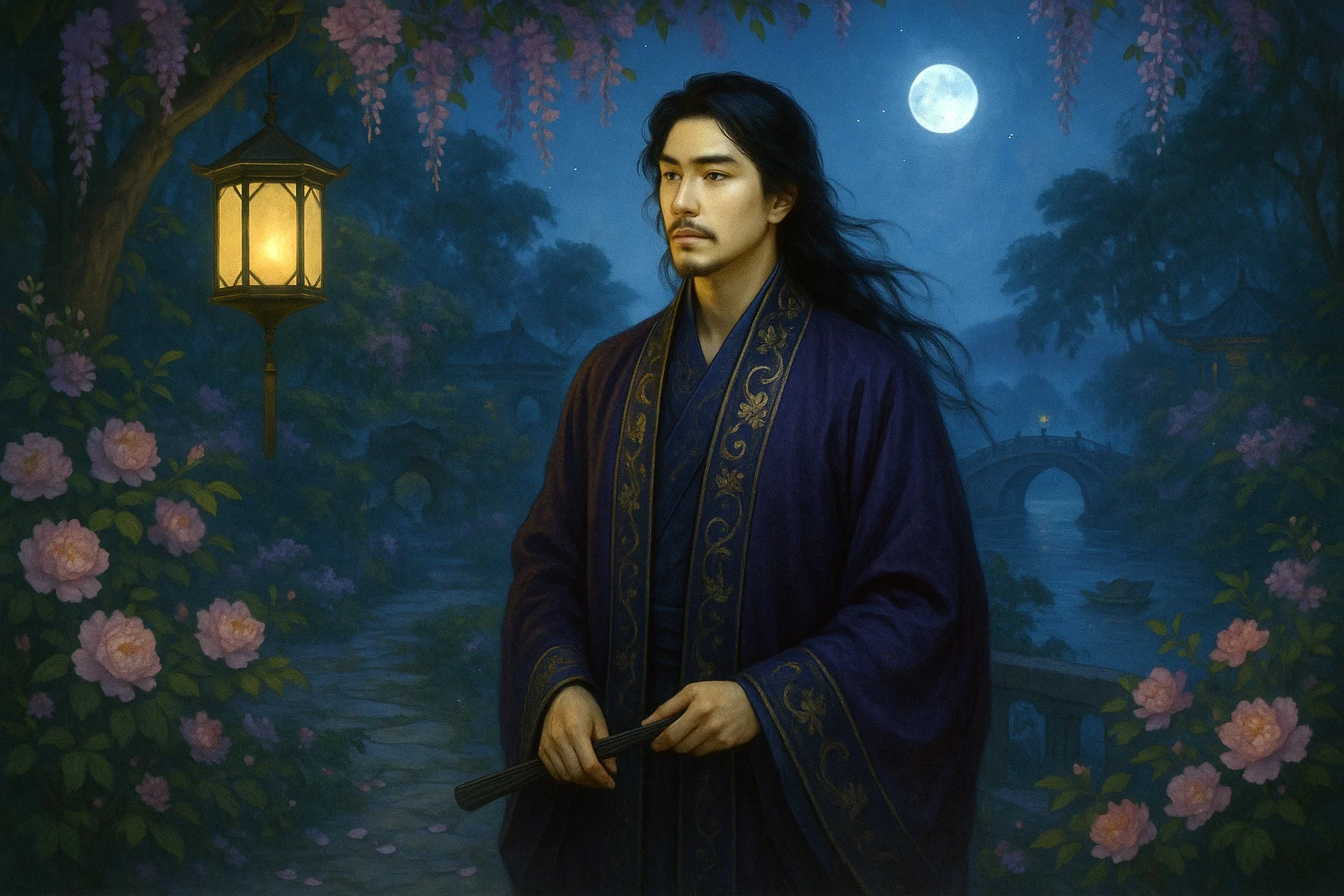
Li Shangyin (李商隐), 813 - 858 AD, was a great poet of the late Tang Dynasty. His poems were on a par with those of Du Mu, and he was known as "Little Li Du". Li Shangyin was a native of Qinyang, Jiaozuo City, Henan Province. When he was a teenager, he lost his father at the age of nine, and was called "Zheshui East and West, half a century of wandering".