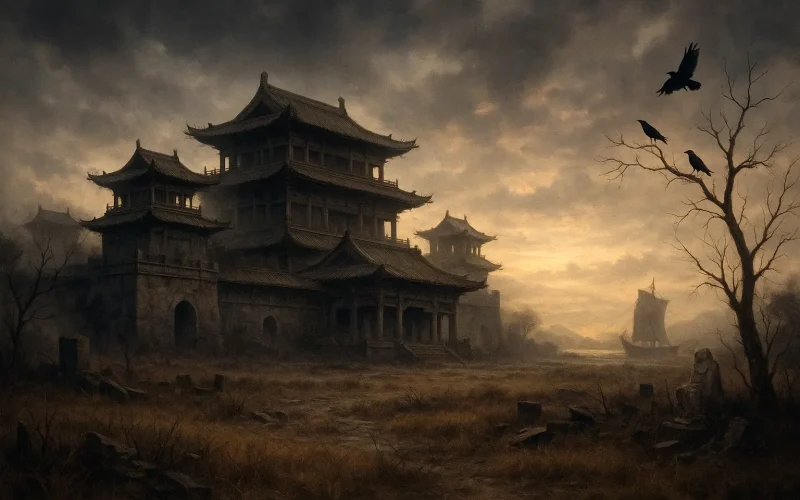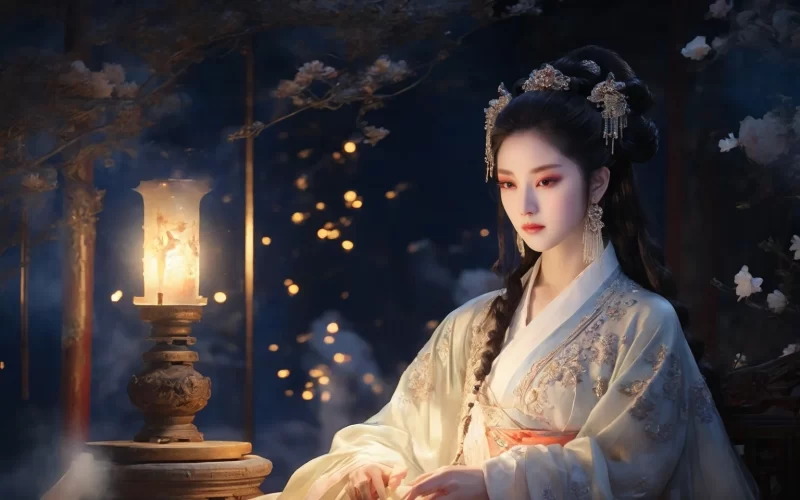

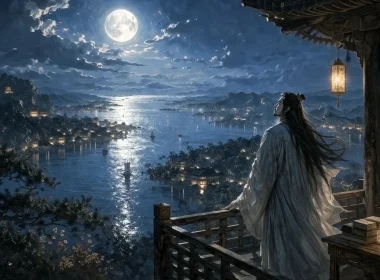
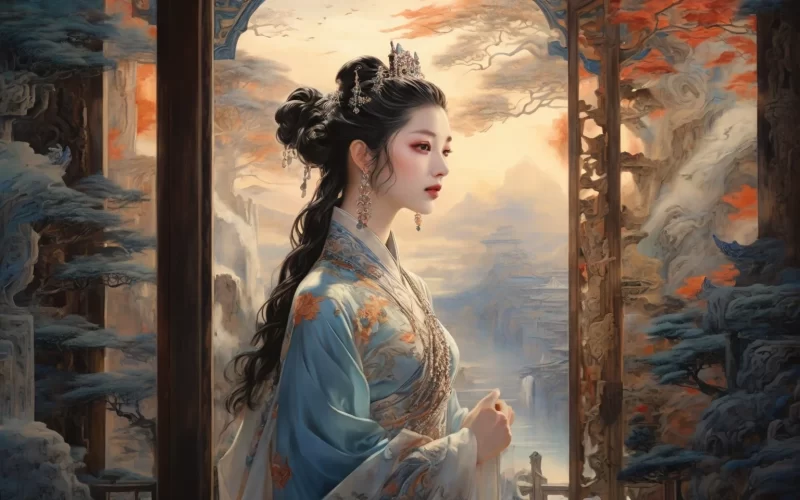
The Mother of Heaven, in her window b y the Jade Pool,
Hears The Yellow Bamboo Song shaking the whole earth
Where is Emperor Mu, with his eight horses running
Ten thousand miles a day ? Why has he never come back?
Original Poem
「瑶池」
李商隐
瑶池阿母绮窗开,黄竹歌声动地哀。
八骏日行三万里,穆王何事不重来?
Interpretation
This poem is believed to have been composed around 852 AD, a time when Emperor Xuanzong, in his later years, was obsessively pursuing longevity, widely summoning alchemists and seeking immortality through elixirs. Li Shangyin draws upon the story from The Biography of King Mu concerning King Mu of Zhou's meeting with the Queen Mother of the West at the Jasper Lake and their promise to meet again in three years—a promise ultimately unfulfilled. On the surface, the poem describes the anticipation and disillusionment within the divine realm, but it actually constructs a two-tier allegorical system aimed at the rulers of his own time: it satirizes the futility of an emperor's quest for immortality while, on a deeper level, exposes the structural self-deception of power in the face of death.
The Tang state was in decline, plagued by separatist military governors, dominant eunuchs, and a suffering populace. Yet, Emperor Xuanzong poured his energy into Daoist occultism. Li Shangyin keenly captures the symbiotic relationship between political escapism and the anxiety of mortality—the more intractable the real-world problems appear, the more power tends to seek solace in the supernatural. The profundity of this poem lies not merely in its critique of the pursuit of immortality, but in its revelation of how those at the pinnacle of power employ the fabrication of an "illusion of immortality" to resist the fundamental terror of life's finitude.
First Couplet: 瑶池阿母绮窗开,黄竹歌声动地哀。
Yáochí ā mǔ qǐ chuāng kāi, Huángzhú gēshēng dòng dì āi.
At Jasper Lake, the Queen Mother opens her latticed window bright;
The "Song of the Yellow Bamboo" rises—shaking the earth with mournful might.
Explication: This couplet constructs a vertical dialogue between myth and reality. "Opens her latticed window" is the elegant gesture of the celestial realm, symbolizing the eternal, timeless existence actively turning its attention to mortal time. The "Song of the Yellow Bamboo," composed by King Mu long ago to lament the people's suffering, now echoes as a sorrowful cry piercing through time. The key lies in "shaking the earth with mournful might"—the lament does not drift up faintly but "shakes the earth," granting human suffering a kind of seismic force that compels even the lofty Jasper Lake to tremble. Thus, the Queen Mother's act of opening her window is not a leisurely gaze but a response startled by this dirge that has crossed the boundary between the immortal and mortal worlds.
Final Couplet: 八骏日行三万里,穆王何事不重来?
Bā jùn rì xíng sān wàn lǐ, Mù wáng hé shì bù chóng lái?
His eight chargers could run thirty thousand leagues before the day was done;
What matter, then, could keep King Mu from coming once again?
Explication: This couplet employs a logical inquiry to achieve the ultimate deconstruction of the fantasy of eternal life. "His eight chargers could run thirty thousand leagues" represents the infinite capacity for action within mythic logic, the perfect image of transcending physical limits. However, "what matter… could keep King Mu" subjects this perfect system to the test of reality. The poet provides no direct answer, yet every reader understands: the obstacle for King Mu is not spatial distance, but the endpoint of time—death. This "answer without answering" creates intense ironic tension: when the premise of the myth (running thirty thousand leagues a day) is juxtaposed with the reality of the outcome (never returning), the emptiness of the promise of immortality is laid bare. More profoundly, this is the Queen Mother's question—even the sovereign of the immortal realm is left asking after the whereabouts of death; how, then, can mortal seekers of immortality avoid the same question?
Holistic Appreciation
This is a masterpiece that employs mythic narrative to explore the philosophy of death. Li Shangyin's brilliance lies in not directly critiquing the folly of seeking immortality. Instead, by presenting the immortal realm's own perplexity (the Queen Mother's question), he allows the fantasy of eternal life to reveal its own flaws through its internal logic. The poem constructs a precise cognitive misalignment: the immortals assume the constraint is space (hence emphasizing the supernatural speed of the steeds), while reality dictates it is time (King Mu is dead); mortal emperors pursue the immortality of the divine realm, while the divine realm awaits the fulfillment of a mortal's promise. This two-way misunderstanding lays bare the absoluteness of the boundary between life and death.
The poem unfolds as a gradually deepening auditory event: from the visual anticipation of "opens her latticed window," to the auditory intrusion of the "Song of the Yellow Bamboo," to the sensory shock of "shaking the earth," finally resolving into the silent interrogation of "what matter… could keep." In this process, the Queen Mother transforms from an active expectant (opening the window) to a passive, shaken listener (hearing the lament), and finally to a perplexed questioner (posing the query), completing a subtle descent from the divine to the human. Her humanization is achieved precisely through her inability to answer the riddle of death.
The poem's most tension-filled design lies in this: the source of the lament (the "Song of the Yellow Bamboo") is none other than the absent one himself (King Mu). This creates a strange loop of self-mourning—King Mu composed his own elegy (lamenting the people's hardship, itself a metaphor for life's brevity) while alive, and after death, this song continues to traverse time, interrogating the promise of immortality. In this design, death is no longer a silent end but gains a persistent voice, continually disturbing the tranquility of the fantasy of everlasting life.
Artistic Merits
- Recoding Mythic Symbols: The Queen Mother of the West, traditionally the bestower of immortality in myth, is transformed here into the bearer and poser of the riddle of death. This role reversal grants the mythic narrative a dimension of philosophical critique.
- Paradoxical Construction of Time and Space: The interweaving of immortal time (eternal) and mortal time (finite) is presented through the collision of "opens her latticed window" (a moment within eternity) and the "Song of the Yellow Bamboo" (the echo of the finite within eternity), constructing an ontological meditation on time.
- The Cognitive Explosiveness of the Rhetorical Question: The final line, "What matter… could keep King Mu," uses a seemingly childlike, simple question to shatter the entire defensive logic of the myth. This technique of using a naïve question to dismantle a complex illusion exemplifies the "using-simple-inquiry-to-shatter-profound-speculation" intellectual artistry of Li Shangyin's later poetry.
Insights
This work reveals a classic coping mechanism humans employ in the face of death: using the imagination of infinite space (running thirty thousand leagues a day) to evade the finite reality of time (what keeps him from coming). King Mu's eight chargers symbolize the conquest of physical limits, a conquest rendered meaningless before death. The lesson for any era is this: we may extend our dominion over space through technology, power, or faith, but the fundamental dilemma of temporality—life's finitude and mortality—cannot be truly overcome.
The Queen Mother's act of "open[ing] her latticed window" symbolizes the gaze of the eternal upon the ephemeral. Ironically, this gaze ends up generating perplexity in the eternal one. This reminds us: the pursuit of eternity may, in fact, make us feel the sting of transience more acutely. The more an emperor like Xuanzong becomes immersed in the quest for longevity, the more the anxiety of death might churn in his subconscious; the more he builds paradisiacal realms like the Jasper Lake, the more likely he is, one day, to hear the "Song of the Yellow Bamboo" piercing through his palace walls.
Ultimately, the poem offers not a denial of immortality, but a sober recognition of life's limits. Through its deconstruction of myth, it tells us: true transcendence lies perhaps not in denying death, but in accomplishing, within our finite lives, deeds worthy of being remembered by the "Song of the Yellow Bamboo." In this sense, this is not merely a poem satirizing the pursuit of immortality; it is a poem of existence about how to face life's finitude. It suggests that what is more important than seeking to "come again" is how to ensure that our one, singular life journey maintains necessary clarity and compassion in the presence of the "earth-shaking" sorrows of the human world.
Poem translator
Kiang Kanghu
About the poet
Li Shangyin (李商隐), 813 - 858 AD, was a great poet of the late Tang Dynasty. His poems were on a par with those of Du Mu, and he was known as "Little Li Du". Li Shangyin was a native of Qinyang, Jiaozuo City, Henan Province. When he was a teenager, he lost his father at the age of nine, and was called "Zheshui East and West, half a century of wandering".