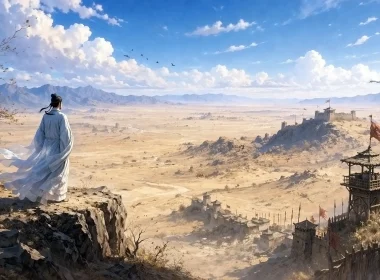
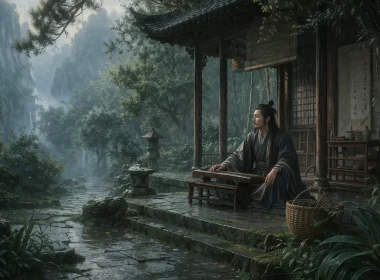
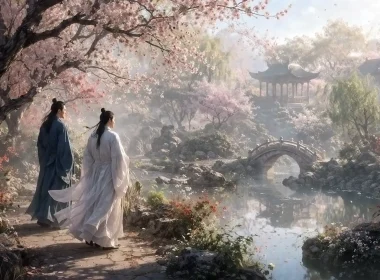
At dusk I’m sad; my heart’s in gloom.
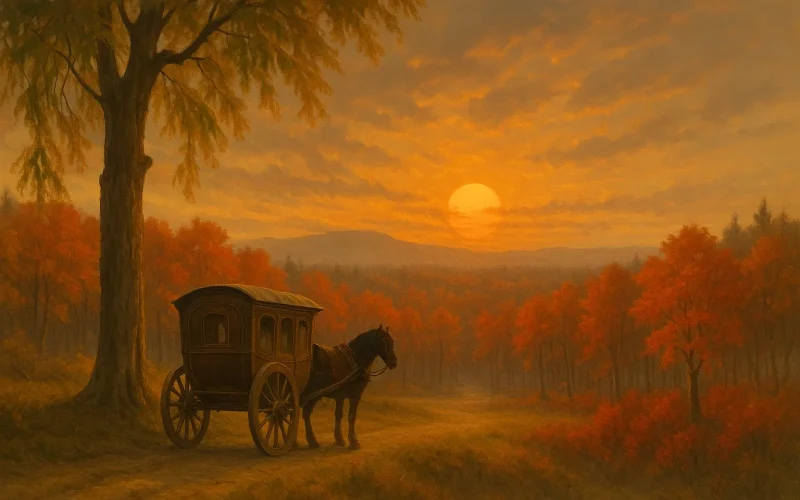
I ride to see the ancient tomb.
The setting sun is fine beyond compare,
But it will soon be swallowed by the dark air.
Original Poem
「乐游原」
李商隐
向晚意不适,驱车登古原。
夕阳无限好,只是近黄昏。
Interpretation
This poem was likely composed between 845 and 848 AD, representing a hallmark of Li Shangyin's late style where his poetic artistry returned to a state of refined simplicity. It is also one of the most widely disseminated and frequently adapted works in all of classical Chinese poetry. By this period, the poet had endured career setbacks, personal tragedy (the death of his wife, née Wang), and declining health, developing an exceptionally keen sensitivity to life's passage. The Plain of Tombs (Leyou Yuan), located southeast of Chang'an, was a famous scenic spot where Tang people lingered for feasts and outings. Li Shangyin's choice to unfold his contemplation of the "dusk" moment here serves as a dual metaphor for both his own life stage and the prevailing mood of his era.
The poem's creation coincided roughly with the "Huichang Persecution of Buddhism," a time when society was permeated by a premonition of a glorious age nearing its end. The sigh within the lines, "The setting sun has boundless beauty; / Only the dusk is near," is both an individual's recognition of life's evening and a reflection of the common temporal sensibility among late Tang scholar-officials. Its ability to resonate across time and space lies precisely in its distillation of a personal, momentary experience into a universal human condition—every era, every individual faces their own "dusk moment," and Li Shangyin gave this universal experience its perfect poetic form in just twenty characters.
First Couplet: 向晚意不适,驱车登古原。
Xiàng wǎn yì bùshì, qū chē dēng gǔ yuán.
At dusk, my spirit is disquieted; I drive my carriage up the ancient plain.
Explication: "At dusk" is not merely a temporal marker but a metaphor for psychological state—life approaching its evening, the light gradually dimming. The three words "my spirit is disquieted" are supremely concise yet rich with layers: they contain physical weariness (from illness in later years), mental frustration (from career difficulties), and existential anxiety (a keen awareness of life's fleetingness). "I drive my carriage up the ancient plain" presents a classic response to this "disquiet": when the heart is troubled, seek release by moving upward, toward open space. This is both a physical movement and a gesture of the spirit seeking transcendence. The word "ancient" in "ancient plain" foreshadows the temporal meditation about to unfold.
Final Couplet: 夕阳无限好,只是近黄昏。
Xīyáng wúxiàn hǎo, zhǐshì jìn huánghūn.
The setting sun has boundless beauty; Only the dusk is near.
Explication: This couplet constitutes one of the most famous paradoxes in Chinese poetic history. "Has boundless beauty" is the ultimate expression of an aesthetic judgment, while "Only" introduces a sudden turn in valuation. The key lies in the word "near" in "the dusk is near"—it is not "is dusk," but "is near dusk." This capturing of a liminal state exemplifies Li Shangyin's most exquisite temporal perception: the most beautiful moment lies precisely in the cusp before ending; the deepest poignancy arises from knowing inevitable fading even while witnessing radiance. The setting sun here becomes a multi-layered symbol: the evening of an individual life, the afterglow of the Tang's glorious age, and the inevitable "approaching-end" state of all beautiful things. The complex emotions contained within "Only"—admiration, regret, acceptance, resistance—have rendered these lines a timeless cipher for time within the collective unconscious of the culture.
Holistic Appreciation
This is a philosophical poem about the "liminal moment." The entire poem traces a complete spiritual movement: from the inward contraction of "disquiet," to the spatial expansion of "ascending the height," to the visual shock of "seeing the setting sun," finally resolving into the spatiotemporal insight of "the dusk is near." In this process, the poet accomplishes a sublimation from personal mood to cosmic awareness—the initial "disquiet" is specific and private, while the final "dusk is near" touches upon the universal human condition.
The poem's structure possesses a mathematical elegance. The first two lines describe "motion" (driving, ascending); the last two describe "stillness" (standing, observing). The subject of the first two lines is the "I" (disquieted, driving); the subject of the last two is the "scene" (sunset's beauty, dusk's nearness). This shift from subjective action to objective presentation suggests that before a grand natural spectacle, personal cares are temporarily suspended and transformed into a recognition of a higher order. The poet does not resolve the "disquiet"; instead, he allows it to acquire a new dimension of meaning within the sunset's splendor.
Particularly noteworthy is the originality of the poem's handling of time. "Dusk" is physical time; "the dusk" is also physical time. But the word "near" in "the dusk is near" opens up a field of psychological time between these two points—a duration not measurable by clocks but a keen awareness of the "not-yet-gone" state. Here, Li Shangyin creates a unique temporal aesthetic: true profundity lies not in possession, but in the awareness of imminent loss. This temporal consciousness allows the brief twenty-character poem to bear the weight of eternal contemplation on existence, beauty, and passing.
Artistic Merits
- The Precise Dynamics of Verbs: The word "drive" conveys both a sense of speed and urgency. Combined with the upward movement of "ascend," it sketches a spatial breakout undertaken to escape spiritual unrest. Conversely, "near" transforms spatial proximity (to dusk) into a feeling of temporal imminence, achieving a double meaning with seemingly effortless grace.
- The Poetic Revolution of a Negative Conjunction: "Only," in everyday usage, expresses a restrictive contrast. Here, it becomes the pivotal point of emotional complexity. It simultaneously acknowledges the absoluteness of "beauty" and implies its temporariness. This dialectical unity of affirmation and negation pioneered a new dimension of emotional expression in classical poetry.
- Extreme Concentration of Scene: Driving, ascending the plain, viewing the sunset, reflecting—a potentially elaborate process is compressed into twenty characters. This conciseness does not feel cramped; rather, the resulting negative space expands the imaginative realm. Every action, every image becomes a springboard to deeper contemplation, not an end in itself.
Insights
This work reveals a profound wisdom about life: humanity's keen perception of "passing" is precisely the strongest proof of our consciousness of "being." The poet sighs because "the dusk is near" precisely because he fully apprehends the "boundless beauty." We grieve for the brevity of beautiful things precisely because we have genuinely experienced their beauty. For modern readers, the lesson is this: in cultures that pursue permanence and stability, acknowledging and cherishing "the beauty of the approaching end" may bring us closer to the truth of existence than fantasizing about "everlasting perfection."
The complex emotional structure contained within the two words "Only" holds particular contemporary significance. It is not simple negation but contains multiple voices: a clear-eyed recognition of inevitable fading, a wholehearted admiration for present glory, a resigned acceptance of time's flow, and a deep-seated attachment to existence itself. This capacity to hold contradictory emotions within a single phrase reminds us, in an age of fragmented expression, how to preserve emotional complexity and dialectical thought.
Ultimately, what this poem offers is not pessimism but a kind of lucid affection. Li Shangyin does not negate the "boundless beauty" because "the dusk is near." On the contrary, it is precisely because "the dusk is near" that the "boundless beauty" appears so breathtaking. This attitude of finding intensity within limits and experiencing depth within brevity is perhaps the best strategy for confronting the desolation of time. In this sense, this is not merely a poem of old age but a poem of life that teaches us how, at all "dusk moments"—personal, epochal, civilizational—to retain the courage to gaze and to marvel.
About the poet
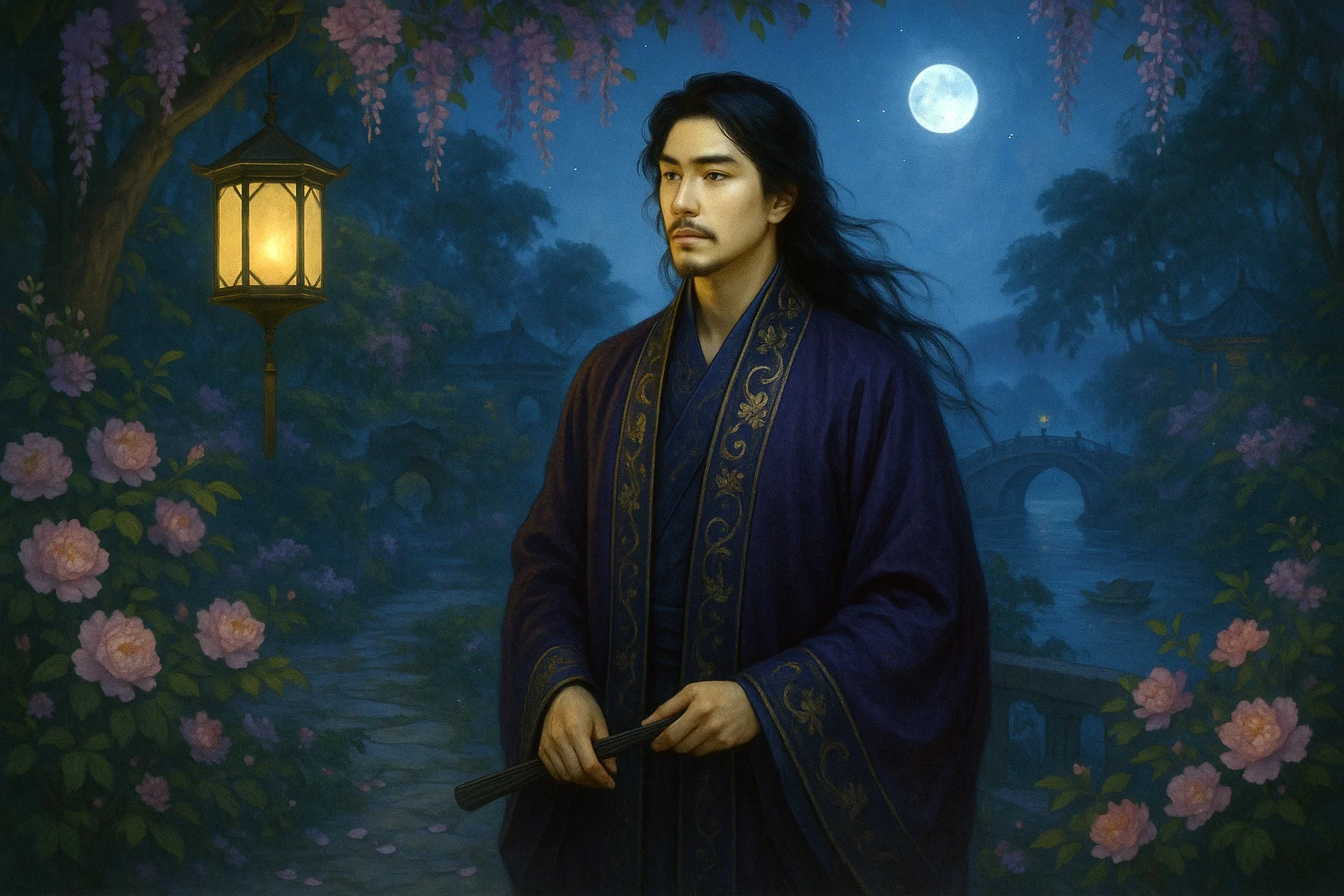
Li Shangyin (李商隐), 813 - 858 AD, was a great poet of the late Tang Dynasty. His poems were on a par with those of Du Mu, and he was known as "Little Li Du". Li Shangyin was a native of Qinyang, Jiaozuo City, Henan Province. When he was a teenager, he lost his father at the age of nine, and was called "Zheshui East and West, half a century of wandering".