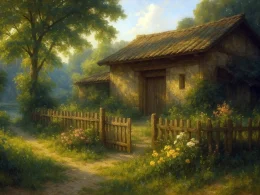



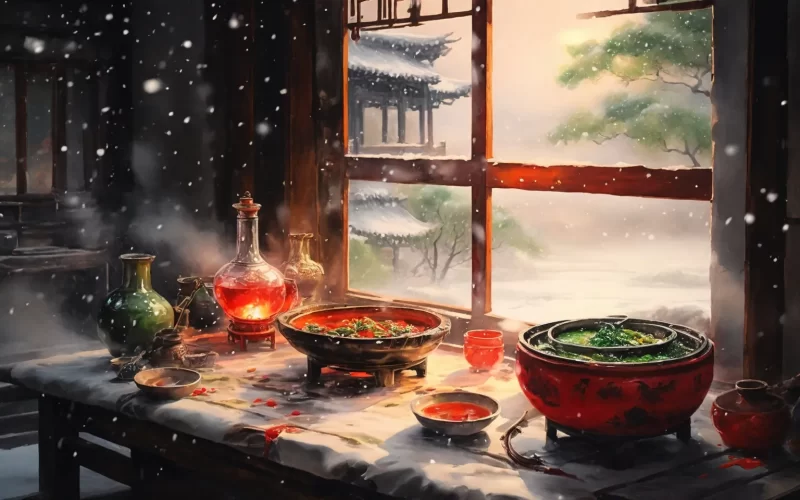
Vino reciente con espuma verde.
Un pequeño horno de arcilla roja.
Cae la noche. Caerá la nieve.
¿Quieres venir a tomar una copa?
Texto original
「问刘十九」
白居易
绿蚁新醅酒,红泥小火炉。
晚来天欲雪,能饮一杯无?
Antigua práctica
This poem was composed during the Yuanhe era of Emperor Xianzong of Tang, while Bai Juyi held the post of Marshal of Jiangzhou. By this time, the poet had weathered the storms of official life, and his state of mind was gradually becoming more detached and tranquil, turning his gaze more towards the warmth and interest of daily life. This short poem is like a sketch with simple yet evocative brushstrokes, capturing and conveying a warm, sincere invitation within the dusk of a cold, snow-threatened sky. It is not merely a summons of friendship; it also reflects the poet's wisdom and warmth in actively creating poetic moments in life and seeking solace for the soul amidst difficult circumstances.
First Couplet: 绿蚁新醅酒,红泥小火炉。
Lǜ yǐ xīn pēi jiǔ, hóng ní xiǎo huǒ lú.
Newly brewed wine, with its green-foam ants; / A small red-clay stove, with a little fire's glow.
(绿蚁 lǜ yǐ, lit. "green ants": a poetic term for the fine, greenish froth on the surface of newly fermented wine.)*
The opening lines meticulously outline the indoor scene, selecting the two most emblematic objects of winter domesticity. "Green-foam" (绿蚁) refers to the froth on the wine's surface; comparing it to "ants" (蚁) vividly evokes its fineness, while "green" (绿) describes its fresh, appealing look, bringing a visual and gustatory freshness immediately to mind. The words "newly brewed" (新醅) further emphasize the wine's immediacy and the sincerity of the host's intent. "Small red-clay stove" (红泥小火炉) uses color (red), material (clay), form (small), and state (fire) to jointly create a warm, simple, intimate focal point for both touch and sight. The interplay of colors—green and red—and sensations—the initial coolness of the fermenting wine and the warmth of the glowing fire—constructs, in just ten characters, a cozy space brimming with the texture of life and the warmth of hospitality.
Second Couplet: 晚来天欲雪,能饮一杯无?
Wǎn lái tiān yù xuě, néng yǐn yī bēi wú?
Evening comes, the sky threatens snow; / Could you, my friend, come drink a cup or so?
This couplet shifts the perspective from indoors to outdoors, from objects to people, completing the final projection of emotion. "Evening comes, the sky threatens snow" (晚来天欲雪) is a masterful setting of the scene: dusk adds a sense of lateness to time, while "threatens snow" intensifies the bitter cold and the enclosed feeling of space, which in turn makes the "wine" and "stove" of the previous lines seem even more precious and inviting. On this foundation, the concluding line, "Could you, my friend, come drink a cup or so?" (能饮一杯无), flows out as naturally as colloquial speech, yet holds boundless feeling. This query carries an intimate summons for the friend, an anticipation of sharing the evening, and also a subtle hint of dispelling loneliness. It lacks fervent emotional outpouring, yet reveals deep sincerity within its plainness; it is phrased as a question but implies an affirmative wish, pushing the Tang poetry art of "entrusting deep feeling with simple words" to its extreme.
Overall Appreciation
The charm of this five-character quatrain lies in its perfect fusion of "scene," "object-interest," and "human sentiment." The poem's structure is exquisite: the first two lines present a static "realm of objects," establishing a warm tone through precise close-ups of the "wine" and the "stove"; the last two lines are a dynamic extension of the "scene" and an infusion of "human sentiment," creating tension between the indoor warmth and the outdoor cold through the weather change of the "threatening snow," finally crystallizing in an inquiry full of anticipation and warmth. The four lines resemble a complete slice of life, from preparation to invitation, full of pictorial flow and emotional appeal. With the most economical brushstrokes, the poet melds the chill of a winter night, the warmth of a room, the richness of wine's aroma, and the depth of friendship into a single crucible, creating one of the most classic scenes of life aesthetics and human warmth in the history of Chinese poetry.
Stylistic Features
- Typicality and Emotional Resonance of Imagery: "Newly brewed wine" and "small stove" are not merely winter objects; they are cultural symbols of warmth, leisure, friendship, and poetic sentiment. Once juxtaposed, they naturally evoke the classic humanistic picture of gathering around the stove for conversation, fending off the cold night.
- Contrast and Fusion of Color and Sensation: The fresh vibrancy of "green-foam" and the warm simplicity of "red-clay" form a subtle contrast in color and texture, both serving the theme of "warm hospitality." The gray-white cold of the "sky threatens snow" and the red-green warmth indoors create a larger environmental contrast, enhancing the appeal of the invitation.
- Colloquial Language in Poetry and the Art of Suggestion: The closing line, "Could you… come drink a cup or so?" uses pure colloquial language, as intimate as a face-to-face chat, greatly shortening the distance with the reader. Simultaneously, this question is a profound suggestion: Will Liu the Nineteenth come? What will they talk about afterwards? Nothing is stated, leaving infinite space for the reader's imagination and aftertaste, creating a lingering charm.
- Highly Condensed Scene Narration: Twenty characters contain time (evening), weather (threatening snow), place (indoors), characters (host and potential guest), event (preparing wine and inviting), and emotion (anticipation). The narrative density is extremely high, yet it feels utterly unconstrained, demonstrating the poet's extraordinary mastery of language.
Reflection
This poem transcends ordinary friendship poetry; it reveals a life-art of actively creating beauty and maintaining emotional connections amidst the mundane or even in adversity. The poet does not passively endure the loneliness and chill of his place of exile. Instead, he constructs a warm corner of the world with "newly brewed wine" and a "small stove," extending a sincere invitation to a friend. This reflects his philosophical openness of "where the heart finds peace, there is home" and the wisdom of "discovering vitality in the minute details."
In the modern world where human connections grow increasingly distant and life's pace is tense, this poem is like a clear reminder. It tells us that true warmth and solace often stem from the simplest, most unadorned shared moments. Perhaps a grand feast is not needed—just a cup of wine, a stove's fire, an evening when snow threatens, and a sincere "Could you come drink a cup or so?" It encourages us, amidst busyness and pressure, to actively create small, warm rituals for ourselves and others, to settle our hearts and minds, and to resist the world's chill through emotional connection and savoring the present moment. This ability to discover poetry in ordinary life and transmit warmth is the precious spiritual legacy Bai Juyi bequeaths to later generations.
Traductor
Chen Guojian(陈国坚)
Sobre el poeta

Bai Ju-yi (白居易), 772 - 846 d.C., era natural de Taiyuan, Shanxi, y más tarde emigró a Weinan, Shaanxi. Bai Juyi fue el poeta más prolífico de la dinastía Tang, con poemas en las categorías de oráculos satíricos, ociosidad, sentimentalismo y ritmos misceláneos, y el poeta más influyente después de Li Bai y Du Fu.