


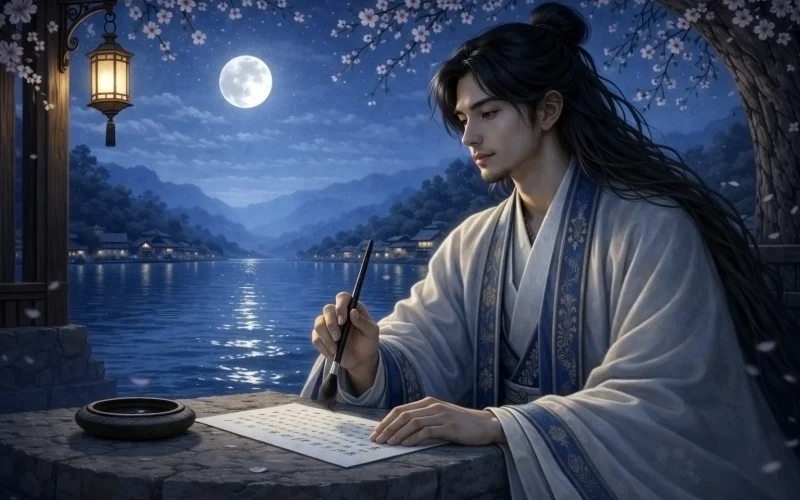
Zhu Qingyu (朱庆馀 dates of birth and death unknown), also known by his given name Kejiu, was a poet of the Mid-Tang period, a native of Yuezhou (present-day Shaoxing, Zhejiang Province). He passed the jinshi examination in the second year of the Baoli era (826 AD) and held the position of Collator in the Imperial Library. His poetry excelled in the five-character regulated verse style, characterized by a refined and subtle elegance, with particular skill in depicting the emotions of boudoir women and palace maidens. In the Complete Tang Poems, two volumes containing 177 of his works are preserved. He was adept at using allegorical and metaphorical techniques, blending everyday emotions with political aspirations. Although not many of his poems survive, his exquisite craftsmanship secures him a unique place in the history of Tang poetry, with his poem Boudoir Sentiments becoming a quintessential example of the fusion of examination-themed and boudoir poetry in later generations.
Major Works

Life
There are two main theories regarding Zhu Qingyu's birthplace: one holds that he was from Yuezhou (present-day Shaoxing, Zhejiang), while the other suggests he was from Minzhong (present-day Fujian). Through scholarly research, it has been conclusively determined that he was undoubtedly from Yuezhou. He was born into a relatively affluent family in Yuezhou, as can be seen from his description in the poem "Returning to My Old Garden" (归故园): "桑柘骈阗数亩间,门前五柳正堪攀。尊中美酒长须满,身外浮名总是闲." The poem depicts a leisurely and comfortable life in his old home; had he not pursued fame and fortune, he could have spent his days in this manner. However, Zhu Qingyu was not content with this. Possessing talent and ambition, he aspired to achieve great things, so he left his hometown and embarked on the path to the capital to take the imperial examinations.
Zhu Qingyu entered the examination arena around the early Yuanhe era of Emperor Xianzong (806–810 AD). In his poem "Presented to Hanlin Academician Jiang Fang" (上翰林蒋防舍人), he wrote, "应怜独在文场久,十有馀年浪过春," indicating that by the end of the Changqing era, he had already spent more than ten years struggling in the examination system. During his time in the capital, he traveled extensively seeking recognition, his heart filled with loneliness and solitude. In "To a Friend" (寄友人), he wrote: "当代知音少,相思在此身。一分南北路,长问往来人." The term "知音" in the context of the Tang dynasty referred specifically to officials who recognized and supported talented individuals. He confided in his friend the hardships of traveling north and south, constantly being a guest in unfamiliar places, lamenting his inability to find a way into officialdom.
The turning point in Zhu Qingyu's life came through his association with Zhang Ji. Around the Changqing era, Zhu Qingyu went to the capital to take the examinations and presented his poems to Zhang Ji, who was then serving as Vice Director of the Waterworks Bureau. He carefully selected twenty-six of his poems to present to Zhang Ji. After reading them, Zhang Ji was greatly impressed, "placing them in his sleeve and praising them," enthusiastically promoting him among his colleagues. Because Zhang Ji held a high reputation in the literary world at the time, his endorsement quickly spread Zhu Qingyu's name among the scholars of Chang'an. However, as the examination approached, Zhu Qingyu remained anxious, uncertain whether his writing would meet the examiners' standards. Driven by this subtle apprehension, he wrote his famous masterpiece "A Bride's Thoughts, Offered to Vice Director Zhang" (闺意献张水部), also known as "On the Eve of the Examination, Sent to Vice Director Zhang" (近试上张水部), using the persona of a new bride to cleverly sound out Zhang Ji. Understanding the subtext, Zhang Ji responded with "In Reply to Zhu Qingyu" (酬朱庆馀), using the line "越女新妆出镜心" to offer clear affirmation and encouragement. This literary anecdote, "Zhu Qingyu presenting his poems and Zhang Ji praising them," vividly reflects the Tang dynasty examination practice of "presenting one's compositions" (行卷) and has become a model of mentorship in Chinese literary history.
With Zhang Ji's advocacy, Zhu Qingyu finally passed the Jinshi examination in the second year of the Baoli era of Emperor Jingzong (826 AD), by which time he was nearly thirty years old. After passing, he was appointed Collator in the Palace Library, a low-ranking but respectable post responsible for collating books. Subsequently, he may have been sent on a mission to the frontier, experiencing a brief period of life in the border regions. His poems include works such as "The Great Wall" (长城) and "Seeing Off Collator Wei to the Lingzhou Military Headquarters" (送韦校书佐灵州幕), indicating that he did indeed travel to the northern frontier. In his official career, he never held prominent office, spending his life unfulfilled in officialdom.
Zhu Qingyu had a wide circle of acquaintances and interacted with many literary figures of his time. His closest relationship was with Zhang Ji, from whom he deeply absorbed the essence of regulated verse. He also exchanged poems with Jia Dao, Yao He, Gu Feixiong, Wuke, Zhang Xiaobiao, and others, and his poetry was profoundly influenced by Jia Dao's "painstaking intoning" style. He also had interactions with senior poets such as Bai Juyi, Wang Jian, Linghu Chu, and Jiang Fang. While in Ezhou, he happened to meet Bai Juyi, who was on his way to take up his post as Prefect of Hangzhou, and composed the poem "Seeing Off Bai Juyi to Hangzhou at Ezhu" (鄂渚送白舍人赴杭州) to bid him farewell.
Around the second year of the Kaicheng era (837 AD), Zhu Qingyu died of illness at approximately forty years of age. Before his death, he compiled his poems into a collection. The New Book of Tang · Treatise on Literature records the Collected Poems of Zhu Qingyu in one volume. The Southern Song Shupeng edition of the Collected Poems of Zhu Qingyu in one volume survives, containing 165 of his poems. The Complete Tang Poems includes two volumes of his poetry, totaling 177 pieces.
Stylistic Characteristics
Zhu Qingyu's poetry excels in regulated verse, particularly in five-character regulated verse and seven-character quatrains. His poetic style was deeply influenced by Zhang Ji and Jia Dao. He absorbed both the "fresh, elegant, simple, and ingeniously moving" qualities of Zhang Ji's regulated verse and the "painstaking craftsmanship" attitude of Jia Dao, forming his own unique artistic style. Overall, his poetry is characterized by fresh elegance, simplicity, and meticulous subtlety, establishing a distinctive presence in the Mid-to-Late Tang poetic landscape.
Poetic Origins
Zhu Qingyu's poetic origins are fundamentally rooted in Zhang Ji. Zhang Ji of the Song dynasty, in his "Preface to the Collected Poems of Xiang Si" (项斯诗集序), clearly stated: "During the Yuanhe era, Zhang of the Waterworks Bureau established a style of regulated verse that was fresh, elegant, simple, and ingeniously moving, with clear language and far-reaching meaning. Only Zhu Qingyu personally received his teachings." This passage reveals Zhu Qingyu's central position in the transmission of Zhang Ji's poetics—he was the only direct disciple who "personally received his teachings," and his poetic style formed a continuous lineage with Zhang Ji's. The Qing dynasty Revised Chart of Masters and Disciples in Mid-to-Late Tang Poetry (重订中晚唐诗主客图) further classified Zhu Qingyu as a "master disciple of the highest rank" in Zhang Ji's poetic school, stating, "His regulated verse specifically studied Zhang of the Waterworks Bureau, integrating it so thoroughly that few others could match him."
At the same time, Zhu Qingyu also had close interactions with Jia Dao, and his poetry was influenced by Jia Dao's "painstaking intoning" style. Like Jia Dao, he adopted an attitude of painstaking craftsmanship, emphasizing the refinement of language and the construction of imagery. The Qing dynasty Tangshi Gui Zhezhong (唐诗归折衷) commented that "Zhu Qingyu received his education from Zhang Ji, yet also associated with Jia Dao. Thus, in his choice of words, he combined the depth of Jia Dao with the elegance of Zhang Ji," accurately pointing out the fusion of Zhang Ji's "elegance" and Jia Dao's "depth" in his poetic style.
Thematic Content
According to scholarly research, Zhu Qingyu's poetry can be divided into five main categories by content:
Poems of Social Interaction and Exchange: This category is the most numerous, reflecting his interactions with Zhang Ji, Jia Dao, Yao He, and others. For example, "Presented to Governor Li of Jiangzhou" (上江州李使君) describes his association with Li Bo, while "Presented to Hanlin Academician Jiang Fang" (上翰林蒋防舍人) and "Presented to Hanlin Academician Li" (上翰林李舍人) were compositions presented to high-ranking officials, expressing both his desire for their support and his helplessness after long years of frustration in the examination system.
Farewell Poems with Deep Emotion in Simple Language: Examples include "Seeing Off Chen Biao" (送陈摽) and "Seeing Off Collator Wei to the Lingzhou Military Headquarters" (送韦校书佐灵州幕). These poems convey sincere emotion through subtle expression, often revealing deep feelings within seemingly plain narration. In "Seeing Off Magistrate Ming of Huaiyin" (送淮阴丁明府), he wrote: "之官未入境,已有爱人心。遣吏回中路,停舟对远林." The language is simple and understated, yet the emotional resonance is profound.
Travel Poems with Varied Charm: Zhu Qingyu traveled extensively throughout his life, visiting Chang'an, Fengxiang, Wuhan, Anhui, and many other places. Travel poems constitute an important part of his oeuvre. For example, in "Passing by Yexi" (过耶溪), he wrote: "春溪缭绕出无穷,两岸桃花正好风。恰是扁舟堪入处,鸳鸯飞起碧流中." With fresh, elegant brushstrokes, he depicts the scenery of the Jiangnan water country, creating a beautiful artistic conception. In "Passing the Double Ninth Festival While Traveling" (旅中过重阳), he wrote: "登高思旧友,满目是穷荒。草际飞云片,天涯落雁行." Here, he reveals his homesickness during his travels, with deep and poignant emotion.
Meticulously Detailed Poems on Objects: His object poems excel at capturing subtle characteristics of things, conveying their essence with refined language. In "Drifting on the Stream" (泛溪), the couplet "鸟飞溪色里,人语棹声中" combines visual and auditory elements to depict the leisurely pleasure of boating on the stream—natural and vivid.
Chan Poems with Quiet Tranquility: Zhu Qingyu had a fondness for the teachings of Laozi and Zhuangzi, and his poems often describe visits to monks and inquiries into Chan Buddhism. Works such as "Visiting the Puzhao Temple with Scholar Shi Zhou" (与石昼秀才过普照寺) and "Inscription on the Qinglong Temple" (题青龙寺) depict the quiet surroundings of temples, revealing a transcendent, reclusive state of mind. In "Staying at the Study of Scholar Chen" (宿陈处士书斋), the lines "向炉新茗色,隔雪远钟声" use the color of freshly brewed tea and the sound of distant bells to convey the quiet solitude of mountain life, creating an ethereal conception.
Choice of Imagery
Zhu Qingyu's poetry displays distinctive patterns in its choice of imagery. According to research, he selected different types of imagery for different thematic categories: when expressing aspirations for officialdom, he often used images such as "city walls," "court," and "sword"; when expressing life's hardships, he used images such as "clouds," "grass," and "moon"; when expressing a reclusive state of mind, he used images such as "bamboo," "pine," and "crane." These images are often combined to create a quiet, distant, and subtle artistic conception.
For example, in "Staying at a Riverside Inn" (宿江馆), he wrote: "夜深乡梦觉,窗下月明斜。起雁看荒草,惊波尚白沙." Using images such as "bright moon," "wild grass," and "white sand," he creates a solitary atmosphere of staying overnight at a riverside inn. In "Seeking Jia Dao's Dwelling" (寻贾岛所居), he wrote: "独在钟声外,相逢树色中。谁言人渐老,所向意皆同." Using "bell sounds" and "tree colors" to depict the deep quiet of mountain living, and "people gradually aging" and "shared aspirations" to express the common bond he shared with Jia Dao, merging scene and sentiment.
Language Style
Zhu Qingyu's poetic language exhibits two distinctive characteristics. On one hand, he favored simplicity, rarely using ornate diction; his language is naturally bright and clear, giving a fresh, elegant impression. Zhang Ji's evaluation of Zhang Ji's poetry as having "clear language and far-reaching meaning" applies equally to Zhu Qingyu, who deeply absorbed his master's teachings; his poetic language is similarly fresh, elegant, and simple, avoiding artificial ornamentation. On the other hand, he also emphasized objective, meticulous depiction of real objects, with precise, realistic, and exquisitely detailed brushstrokes—clearly influenced by Jia Dao's "painstaking intoning" style.
Preferred Verse Forms
Zhu Qingyu specialized in regulated verse and quatrains, achieving great distinction in both forms. His five-character regulated verse is characterized by "original craftsmanship, skillful use of parallelism and syntax, and particular attention to exquisite concluding lines." For example, the couplet "曲渚回花舫,生衣卧向风。鸟飞溪色里,人语棹声中" from "Drifting on the Stream" (泛溪) displays balanced parallelism and a natural conception. His seven-character quatrains are "subtle and natural, with implied meaning, flowing rhythm, and a style that is both evocative and relaxed." "A Bride's Thoughts, Offered to Vice Director Zhang" (闺意献张水部) and "Palace Song" (宫中词) are representative works of his seven-character quatrains.
Literary Influence
Zhu Qingyu occupies a certain place in the history of Mid-to-Late Tang poetry. Although not a first-rank master, through his unique artistic achievements and the famous literary anecdote associated with him, he left an indelible mark on Chinese literary history.
The Cultural Symbol of the "Zhang-Zhu Anecdote"
The story of the poetic exchange between Zhu Qingyu and Zhang Ji—"presenting a poem to sound out the path, receiving a poem in reply as affirmation"—has long transcended their personal interaction to become a classic symbol of Tang dynasty examination culture and literati exchange in ancient China. Literary sources such as the Tangshi Jishi (唐诗纪事) and Tang Caizi Zhuan (唐才子传) all record this event, and later literati often alluded to this典故, giving it profound cultural significance. This anecdote vividly reveals the mentality of scholars under the examination system and the role of mentorship, serving as an exemplary model of recognizing and cultivating talent for later generations.
Direct Disciple of Zhang Ji's Poetics
Zhu Qingyu held a central position in the transmission of Zhang Ji's poetics. Zhang Ji of the Song dynasty explicitly stated that Zhang Ji's poetic style—"fresh, elegant, simple, and ingeniously moving, with clear language and far-reaching meaning"—was "personally received by Zhu Qingyu alone." This means that Zhu Qingyu was not only Zhang Ji's student but the sole direct inheritor of his poetics. Under Zhang Ji's influence, Zhu Qingyu developed a poetic style of fresh elegance, simplicity, and ingenious subtlety, becoming an important representative of Zhang Ji's poetic school during the Mid-to-Late Tang transition.
A Unique Style Combining Zhang Ji and Jia Dao
Zhu Qingyu's poetry successfully combined the "elegance" of Zhang Ji with the "depth" of Jia Dao, forming his own unique artistic character. The Qing dynasty Revised Chart of Masters and Disciples in Mid-to-Late Tang Poetry classified him as a "master disciple of the highest rank" in Zhang Ji's school, commenting, "His regulated verse specifically studied Zhang of the Waterworks Bureau, integrating it so thoroughly that few others could match him." The Tangshipin (唐诗品) praised him, saying, "His writing contains refined thought, his words flow with rhythm, and wherever his conception leads, he achieves mastery," fully affirming his artistic achievements.
Later Critical Reception
Throughout history, evaluations of Zhu Qingyu have largely been framed within the context of his inheritance of Zhang Ji's poetics. Liu Kezhuang of the Song dynasty, in his Houcun Shihua (后村诗话), commented that his quatrains "were praised by the world," but also noted that "his other works are not as accomplished." The Tangyin Guiqian (唐音癸签) commented that he "studied poetry under Zhang Ji, capturing the essence in miniature," acknowledging that he inherited Zhang Ji's true legacy while noting that his scale and scope were somewhat smaller than Zhang Ji's. The Shixue Yuanyuan (诗学渊源) noted that he "studied Du Fu, closely following the style of the Dali era, a rare phenomenon among Late Tang poets." The Ming dynasty Tangshipin offered a more comprehensive assessment: "He personally received the teachings of Zhang of the Waterworks Bureau, thus gaining fame in the literary arena, yet he could not further elevate his aspirations to approach the 'Great Elegance'—is this not a case of holding jade and pearls yet still lamenting his circumstances?"
Survival and Transmission of His Poetry
Zhu Qingyu's poetry collection circulated in multiple editions during the Song dynasty. The New Book of Tang · Treatise on Literature records the Collected Poems of Zhu Qingyu in one volume. The National Library of China holds a Southern Song Shupeng edition of the Collected Poems of Zhu Qingyu in one volume, containing 165 of his poems, which is an important source for studying his work. The Complete Tang Poems includes two volumes of his poetry, totaling 177 pieces.
Zhu Qingyu was a poet with a distinctive style during the Mid-to-Late Tang transition. His famous lines such as "画眉深浅入时无" from "A Bride's Thoughts, Offered to Vice Director Zhang" and "鹦鹉前头不敢言" from "Palace Song" have been recited through the ages, and the literary anecdote he shared with Zhang Ji has become a classic symbol in examination culture. His poetry, rooted in Zhang Ji's tradition while incorporating elements of Jia Dao's style, developed a unique character of fresh elegance, simplicity, and meticulous subtlety, occupying a central position in the transmission of Zhang Ji's poetics. Although his poetic achievements did not reach the heights of Zhang Ji or Jia Dao, his place in the history of Tang poetry cannot be overlooked. His character and his poetry, even after a thousand years, continue to resonate with readers.