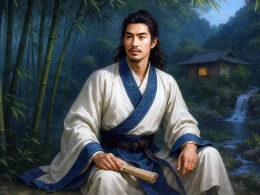



Zhang Zhongsu (张仲素 c. 769 - c. 819), a native of Hejian City, Hebei Province, was a renowned poet of the Mid-Tang period. He passed the jinshi examination in the fourteenth year of the Zhenyuan era (798 AD) and also succeeded in the Boxue Hongci (Erudite Scholar) examination. He held official positions including Hanlin Academician and Drafter of the Central Secretariat. His poetry excelled in the yuefu (Music Bureau) style, particularly in depicting the sentiments of women longing for their absent husbands. His poetic style is characterized by a delicate, refreshing clarity combined with a touch of heroic vigor. Together with Linghu Chu and Wang Ya, both also Drafter of the Central Secretariat, he engaged in poetic exchanges, forming a triumvirate that stood alongside Bai Juyi’s popular school and Han Yu’s unconventional school in the literary landscape of the time.
Major Works

Life
Zhang Zhongsu was born into a family of officials. His great-grandfather, Zhang Qizhen, served as Prefect of Ruzhou; his grandfather, Zhang Shiheng, held the post of Merit Official in the Jingzhao Prefecture; his father, Zhang Ying, served as Protector General of Annan. His family's scholarly heritage laid a solid foundation for his later literary achievements.
In the fourteenth year of the Zhenyuan era of Emperor Dezong (798 AD), Zhang Zhongsu passed the Jinshi examination, achieving the degree in the same year as Li Ao and Lü Wen. After passing the examination, due to a lack of connections at court, he was unable to obtain an official post and remained in obscurity for several years. Later, he took the Boxue Hongci (Extensive Learning and Great Literary Talent) examination, passed it, and was finally appointed to an official position, serving as a staff member in the Wuning Army (according to some sources, the Wukang Army) under the military governor of Xuzhou, Zhang Yin.
In the twentieth year of the Zhenyuan era (804 AD), Zhang Zhongsu entered the court as Collator in the Imperial Library. During the Yuanhe era of Emperor Xianzong, his official career gradually progressed: in the seventh year of the Yuanhe era (812 AD), he served as Vice Director of the Bureau of State Lands, concurrently serving as an examination judge; the same year, he was transferred to Vice Director of the Ministry of Rites; in the ninth year of the Yuanhe era (814 AD), he was appointed Vice Director of the Bureau of Merit Titles; in the eleventh year of the Yuanhe era (816 AD), he served as Director of the Ministry of Rites and concurrently Academician of the Hanlin Academy.
As a Hanlin Academician, Zhang Zhongsu enjoyed the deep trust of Emperor Xianzong. In the thirteenth year of the Yuanhe era (818 AD), he was appointed Director of the Bureau of Titles and Drafting Official, and soon after was promoted to Chief Hanlin Academician. He was ordered by Emperor Xianzong to compile the collected works of the deceased poet Lu Lun and present them to the court. In the fourteenth year of the Yuanhe era (819 AD), he was promoted to Drafter of the Secretariat, and died of illness in the winter of that year. Posthumously, he was honored as Vice Minister of Rites.
During his time at court, Zhang Zhongsu had close associations with Wang Ya and Linghu Chu, who were also serving in the Hanlin Academy. They exchanged poems frequently, and their works were compiled together as the Collection of the Three Academicians of the Yuanhe Era (元和三舍人集), which has been passed down through the ages. Zhang Zhongsu also authored The Pivot of Fu (赋枢) in three volumes and The Garden of Ci (词圃) in ten volumes, both of which have been lost. The Complete Tang Poems (全唐诗) preserves one volume of his poetry, totaling thirty-nine pieces.
Stylistic Characteristics
Zhang Zhongsu's poetic achievements are most outstanding in his Music Bureau poems, particularly in the genres of boudoir lament and frontier poetry. His poetic style combines fresh elegance and refined clarity with robust vigor. His language is ethereal and elegant, his conception delicate and ingenious, establishing a unique presence in the Mid-Tang poetic scene. Hu Yinglin of the Ming dynasty commented in his Sousou (Poetic Depths): "After Wang Changling of Jiangning, Zhang Zhongsu carried on his legacy; his 'Autumn Boudoir' and 'Frontier' poems are all masterfully crafted."
Boudoir Lament Poems
Zhang Zhongsu excelled at portraying the emotions of women yearning for their absent husbands. The figures he depicted are vivid and expressive, with emotions conveyed subtly and implicitly, often through detailed descriptions and indirect contrast, fully expressing the depth of longing.
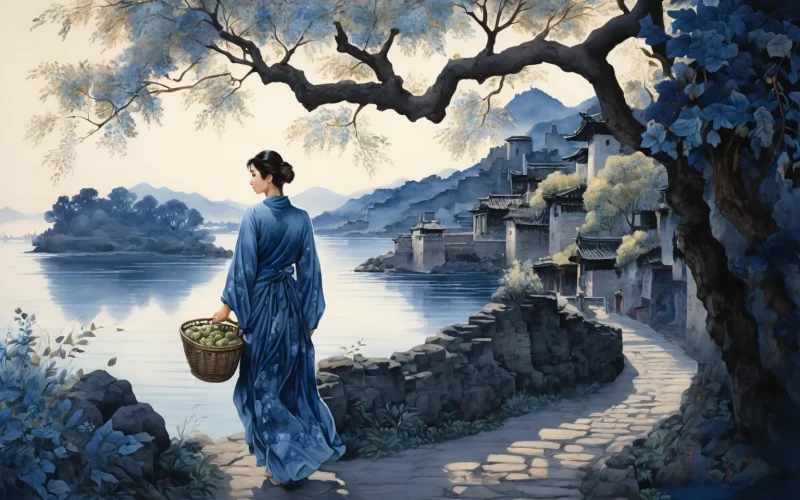
"Spring Boudoir Thoughts" (春闺思) is a representative work of his boudoir lament poetry: "袅袅城边柳,青青陌上桑。提笼忘采叶,昨夜梦渔阳." The poem depicts a mulberry-picking woman who, because she dreamed the previous night of her husband garrisoned at Yuyang, is so distracted that she forgets to pick mulberry leaves while holding her basket. The first two lines, "袅袅城边柳,青青陌上桑," establish the season and setting, contrasting the vibrant spring scene with the woman's loneliness. The latter two lines, through the subtle action of "提笼忘采叶," reveal the depth of her longing. The entire poem conveys longing without directly stating it—subtle and evocative, with an enduring aftertaste.
"Autumn Night Song" (秋夜曲) also depicts a woman yearning for her distant husband: "丁丁漏水夜何长,漫漫轻云露月光。秋逼暗虫通夕响,征衣未寄莫飞霜." Through the repetition of "丁丁" and "漫漫," the poem evokes the length and solitude of an autumn night. The final line, "征衣未寄莫飞霜," expresses the woman's heartfelt concern for her distant husband in the form of a prayer to heaven—simple in expression yet deeply moving.
"Autumn Boudoir Thoughts" (秋闺思) is also an excellent work of this type: "梦里分明见关塞,不知何路向金微." Using a dream to convey longing, it expresses the helplessness of a woman who longs to reunite with her husband but cannot, with a poignant and moving effect.
Frontier Poetry
Zhang Zhongsu's frontier poetry stands in sharp contrast to his boudoir lament poems. This category of work features impassioned language and heroic spirit, celebrating the fighting spirit of frontier soldiers and evoking the legacy of High Tang frontier poetry.
"Five Poems Under the Frontier Pass" (塞下曲五首) are representative of his frontier poetry. The first reads: "三戍渔阳再渡辽,騂弓在臂剑横腰。匈奴似若知名姓,休傍阴山更射雕." This poem depicts a seasoned frontier general. "騂弓在臂剑横腰" portrays his martial bearing, while "匈奴似若知名姓" conveys his far-reaching reputation. The writing is vigorous, the spirit heroic.
The third poem: "朔雪飘飘开雁门,平沙历乱卷蓬根。功名耻计擒生数,直斩楼兰报国恩." With the bold declaration "直斩楼兰," it expresses the soldiers' heroic determination to repay their country's grace with their lives—impassioned and inspiring.
The fifth poem: "阴碛茫茫塞草肥,桔槔烽上暮云飞。交河北望天连海,苏武曾将汉节归." Using the allusion of Su Wu returning to Han with his envoy's staff, it praises the loyalty and integrity of frontier generals, imbuing the poem with profound historical reflection.
Court Poetry and Poems on Objects
As a Hanlin Academician, Zhang Zhongsu also composed a number of court poems and poems on objects. These works feature ornate diction and balanced parallelism, demonstrating his mastery of language. For example, "Five Poems on Joys in the Palace" (宫中乐五首) depict life in the palace: "网户交如绮,纱窗薄似烟。乐吹天上曲,人是月中仙." With richly colored brushstrokes, he portrays the magnificence of the palace and the ethereal beauty of its ladies.
"Altair Lowering over Jianzhang Palace" (玉绳低建章) depicts the stars of the Big Dipper in the night sky: "迢迢玉绳下,芒彩正阑干。稍复临鳷鹊,方疑近露寒." The observation is meticulous, the depiction refined, showcasing the poet's keen sensitivity to natural scenes.
"Immortal Crane on Mount Gou" (缑山鹤) and "Hearing a Reed Pipe on the Banks of the Luo River at Night" (夜闻洛滨吹笙) use allusions to the immortal Prince Qiao to express a longing for a transcendent realm. The poetic style is ethereal and elegant, contrasting with his boudoir lament and frontier works.
Stylistic Characteristics and Artistic Achievements
Zhang Zhongsu's poetic creation exhibits a diversity of styles. His boudoir lament poems are graceful and delicate, excelling at conveying emotion through detail; his frontier poems are impassioned and heroic, with vigorous momentum; his court poems are elegant, refined, and beautifully ornate. This stylistic diversity reflects his remarkable ability to handle different themes.
His poetic language is fresh, elegant, and refined, with an ethereal quality, rarely producing mediocre work. He excelled particularly in Music Bureau poetry, often achieving harmonious musicality. Xin Wenfang, in his Tang Cai Zi Zhuan (Biographies of Tang Talents), commented: "He excelled in poetry, with many striking lines. He was especially skilled in Music Bureau poetry, often achieving harmony in musical tone, surpassing even the ancients in ways they had not anticipated." This fully affirms his achievements in Music Bureau poetry.
In terms of artistic technique, Zhang Zhongsu excelled in using detailed description and indirect contrast, conveying deep emotion through seemingly ordinary daily actions or natural scenes. For example, in "Spring Boudoir Thoughts," the subtle action of "提笼忘采叶" vividly portrays the woman's distraction and longing. He also skillfully used reduplicative words to create atmosphere; in "Autumn Night Song," "丁丁" and "漫漫" not only mimic sound and depict scenes but also imply the passage of long hours and the extension of emotional state.
Literary Influence
Zhang Zhongsu occupies an important position in the Mid-Tang poetic world, and his influence is mainly reflected in the following aspects.
The "Three Academicians of the Yuanhe Era" and the Elegant and Orthodox School
Zhang Zhongsu, together with Wang Ya and Linghu Chu, served as Hanlin Academicians during the reign of Emperor Xianzong. They exchanged poems frequently, and their poetic styles were similar. Their contemporaries referred to them as the "Three Academicians of the Yuanhe Era," and their works were compiled together as the Collection of the Three Academicians (三舍人集), which has been passed down through the ages. Their poetry championed the beauty of elegance and balance, contrasting with the aesthetic orientations of the schools of Bai Juyi and Han Yu, representing an important pole in the late Mid-Tang poetic scene.
Modern scholars have pointed out that the poetry of Zhang Zhongsu, Linghu Chu, Wang Ya, and others shared common characteristics with poets such as Quan Deyu, Wu Yuanheng, and Pei Du, and can be referred to as the "Elegant and Orthodox School." Alongside the popular school led by Bai Juyi and the unconventional school led by Han Yu, they stood as three major forces in the literary world of the late Mid-Tang.
Successor to Wang Changling in Boudoir Lament Poetry
Hu Yinglin of the Ming dynasty, in his Sousou, commented on Zhang Zhongsu: "After Wang Changling of Jiangning, Zhang Zhongsu carried on his legacy; his 'Autumn Boudoir' and 'Frontier' poems are all masterfully crafted." This evaluation accurately points to Zhang Zhongsu's position in the creation of boudoir lament poetry—he inherited the tradition of Wang Changling from the High Tang and advanced the genre to new heights.
Zhang Zhongsu's boudoir lament poetry achieved a very high level of artistry. Works such as "Spring Boudoir Thoughts," "Autumn Night Song," and "Autumn Boudoir Thoughts," with their delicate emotional portrayal and exquisite artistic conception, became exemplary works of Tang boudoir lament poetry, recited throughout the ages.
Friendship with Bai Juyi and Its Influence
Zhang Zhongsu had direct friendly exchanges with Bai Juyi. His "Three Poems on the Swallow Pavilion" (燕子楼诗三首), written about the story of Guan Panpan, were greatly admired by Bai Juyi for their "extremely graceful and beautiful language," leading Bai to compose three poems in response. This literary exchange became a celebrated story in literary circles and attests to the mutual respect between the two poets.
In summary, Zhang Zhongsu was an outstanding poet of the Mid-Tang dynasty, excelling in Music Bureau poetry and achieving great distinction in both boudoir lament and frontier poetry. He carried on the legacy of Wang Changling, advancing boudoir lament poetry to new heights. His frontier poetry is impassioned and heroic, full of vigor, evoking the spirit of the High Tang. Together with Wang Ya and Linghu Chu, he was known as one of the "Three Academicians of the Yuanhe Era," representing the Elegant and Orthodox School of the Mid-Tang, standing alongside the schools of Bai Juyi and Han Yu. His representative works, such as "Spring Boudoir Thoughts," "Autumn Night Song," and "Under the Frontier Pass," with their fresh and elegant language and delicate, ingenious conception, have become gems in the treasury of Tang poetry, capable of moving the hearts of readers even after a thousand years.