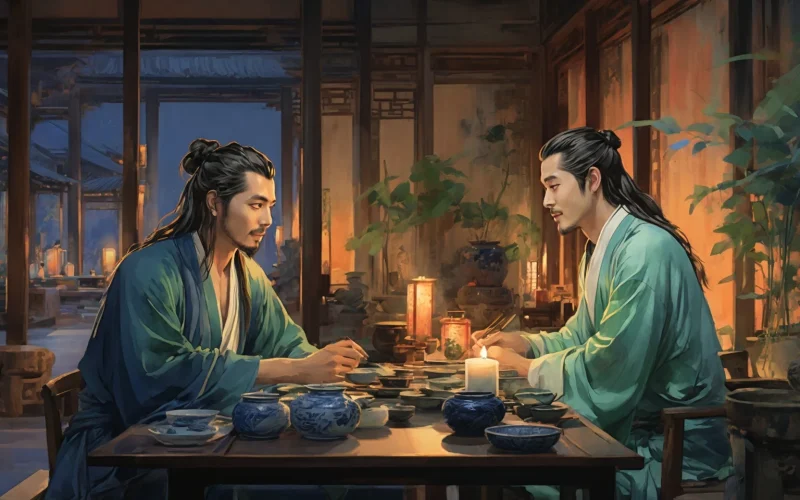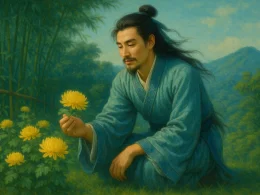



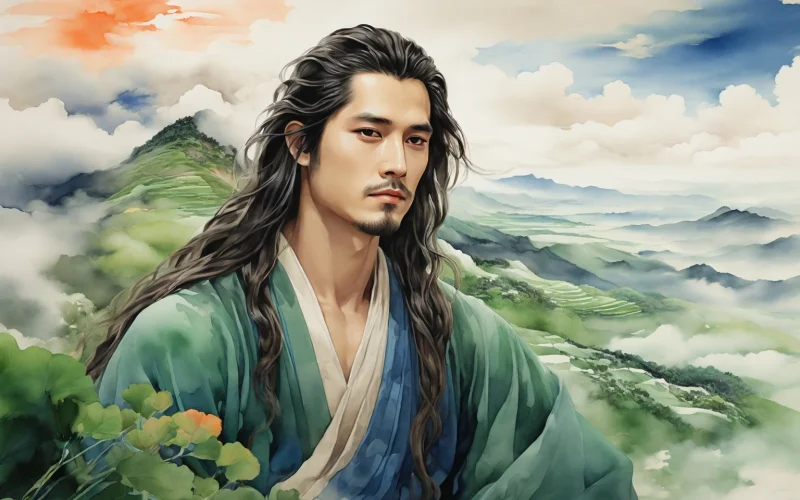
Xu Hun (许浑 c. 788 - c. 858), a native of Danyang, Jiangsu Province, was a renowned poet of the late Tang Dynasty. His ancestor was Xu Yushi, a chancellor during the reign of Empress Wu Zetian, and his family once held prominent status but had declined by Xu Hun's time. He obtained the jinshi degree in the sixth year of the Taihe era (832 AD) and successively served as magistrate of Dangtu and Taiping counties, eventually rising to the position of Vice Director of the Forestry and Crafts Bureau. As an important representative of the late Tang poetic circle, Xu Hun was celebrated for his mastery in depicting water and rain. His poetry often features nostalgic reflections on history, characterized by a desolate and solemn style. He excelled particularly in seven-character regulated verse, with language that is concise, refined, and harmonious in rhythm. Standing apart from Du Mu and Li Shangyin, he established his own distinctive school, exerting a profound influence on later poets such as Wei Zhuang and Luo Yin.
许浑
xǔ hún
Major Works




Life
Xu Hun, courtesy name Yonghui, also styled Zhonghui, was a native of Danyang, Runzhou (present-day Danyang City, Jiangsu Province). He was born around the seventh year of the Zhenyuan era of Emperor Dezong of the Tang dynasty (c. 791 AD) and died around the twelfth year of the Dazhong era of Emperor Xuanzong (c. 858 AD), living approximately sixty-eight years. He was a renowned poet of the Late Tang dynasty, excelling particularly in regulated verse, especially the seven-character regulated form, occupying an important position in the Late Tang poetic world. He was a contemporary of and equally famous with Du Mu, Li Shangyin, and Wen Tingyun.
Xu Hun was born into a family of officials. His distant ancestor was Xu Yushi, a chancellor during the reign of Emperor Gaozong of the Tang dynasty, and the family was quite prominent during the time of Gaozong and Empress Wu. However, by the time Xu Hun was born, the family fortunes had declined. His father, Xu Xian, served as Prefect of Yuanzhou. From a young age, Xu Hun was intelligent and studious, reading widely and devoting himself especially to poetic composition. However, his path through the imperial examinations was not smooth; in his early years he failed repeatedly and spent many difficult years in Chang'an.
Regarding Xu Hun's life, the most legendary aspect is his appellation "Dingmao Bridge." According to the Tangshi Jishi (Records of Tang Poetry), Xu Hun once "dreamt of climbing Mount Kunlun, where he saw a man who gave him a square bamboo staff, saying, 'This staff can be made into a flute.' Upon waking, he composed a poem containing the line 'Kunlun Mountain lies west of Jade Gate.'" Although this legend is not reliable, it reflects from one perspective the deification of Xu Hun's poetic talent by his contemporaries.
In the sixth year of the Dahe era of Emperor Wenzong (832 AD), Xu Hun finally passed the Jinshi examination, by which time he was already over forty. After obtaining his degree, he was appointed Magistrate of Dangtu County (present-day Dangtu County, Anhui Province), and later transferred to be Magistrate of Taiping County. In his local official positions, he was diligent in government affairs, showed concern for the people's condition, and achieved considerable results. At the same time, he never ceased his poetic chanting, writing a large number of poems depicting the landscapes of Jiangnan and the hardships of the people's lives.
From the end of the Dahe era to the beginning of the Kaicheng era (835–838 AD), Xu Hun entered the court as a Censor, later moving to the position of Palace Censor. During his time at court, he had the opportunity to become acquainted with many important figures of the literary world, interacting and exchanging poems with Du Mu, Li Shangyin, Wen Tingyun, and others. Du Mu held his poetic talent in the highest esteem, composing a long poem titled "Presented to Censor Xu the Seventh, Who Has Resigned from Office and Returned East to the Freedom of Jiangnan, on Hearing of His Contentment, I Gaze into the Distance and Send This Poem in Ten Couplets."
However, Xu Hun had a tranquil nature and did not enjoy official social engagements. Moreover, witnessing the increasing corruption of court politics and the intensifying factional strife, he conceived the idea of retirement. Around the third year of the Kaicheng era (838 AD), he resigned from his official post, returned east to Danyang in Runzhou, and lived in reclusion at his villa by Dingmao Bridge on the eastern outskirts of the city. For the next twenty years, he lived a life of "seclusion to pursue his aspirations," finding solace in landscapes, devoting himself to poetic art, and writing a large number of poems depicting the scenery of Jiangnan and the life of reclusion. His poetry collection was named the Dingmao Ji (Dingmao Collection), and later generations referred to him as "Xu Dingmao."
During his seclusion, Xu Hun was not completely cut off from the world. He maintained correspondence and occasional poetic exchanges with poets such as Du Mu, Wen Tingyun, and Li Pin. During the Dazhong era of Emperor Xuanzong, he briefly came out of retirement to serve as Adjutant in Runzhou, but soon resigned again. Around the twelfth year of the Dazhong era (858 AD), Xu Hun died of illness at his Dingmao Bridge villa, ending his life of tranquil self-preservation.
Looking at his life as a whole, Xu Hun lived through the reigns of six emperors—Xianzong, Muzong, Jingzong, Wenzong, Wuzong, and Xuanzong—witnessing the increasing corruption of politics and the turmoil of society in the Mid-to-Late Tang. His choice to retire to the forests and find pleasure in poetry was partly due to his personal nature, and also reflected the disappointment and escapism of Late Tang scholars facing reality.
Stylistic Characteristics
Xu Hun's poetry achieved its highest distinction in five-character regulated verse and seven-character regulated verse, especially the latter, establishing a unique place for him in the Late Tang. His poetry primarily focuses on themes of landscape depiction, nostalgia for the past, travel, and farewells. Stylistically, it is characterized by meticulous craftsmanship, balanced elegance, fresh beauty, and plaintive grace, earning him the posthumous praise as the "Crown of the Late Tang."
"A Thousand Poems of Xu Hun are Wet"
A remarkably distinctive feature of Xu Hun's poetry is the frequent appearance of imagery related to water, rain, rivers, and lakes. According to later statistics, the character for "water" appears nearly three hundred times in his poems, and the character for "rain" appears over a hundred times, leading to the playful comment that "a thousand poems of Xu Hun are wet." This characteristic is closely related to his long-term residence in the Jiangnan water country, and also corresponds to the fresh, moist, and lustrous quality of his poetic style.
For example, in "At the East Tower of Xianyang City" (咸阳城东楼), the lines "溪云初起日沉阁,山雨欲来风满楼" depict the scene of clouds rising over the stream and the sun setting behind the pavilion, with wind filling the tower as mountain rain approaches, creating a vast and tense atmosphere. This couplet has become eternally famous. Similarly, in "Early Autumn" (早秋), the lines "遥夜泛清瑟,西风生翠萝。残萤栖玉露,早雁拂金河" use images of clear zithers, green vines, dewdrops like jade, and the Silver River to sketch the coolness and moisture of early autumn.
This preference for water and rain imagery gives Xu Hun's poetry a unique sense of "moisture," forming a distinct contrast with the rich splendor of Li Shangyin and the handsome vigor of Du Mu among other Late Tang poets.
Poems on Ancient Sites
Xu Hun's poems on ancient sites represent the most accomplished part of his oeuvre. He excels at selecting historical relics as subjects for chanting, blending the scenes before his eyes with historical events to express deep reflections on the rise and fall of dynasties. His historical poems often feature broad vision and profound sentiment, occupying an important place among Late Tang poems on ancient themes.
For instance, in "Meditation on Jinling" (金陵怀古), the lines "玉树歌残王气终,景阳兵合戍楼空" use the fading song of Chen Houzhu's "Jade Trees and Flowers of the Inner Court" to symbolize the end of the Six Dynasties' royal aura, setting the tone for the entire poem from the very beginning. Then, with the actual scene before his eyes—"松楸远近千官冢,禾黍高低六代宫" (Pines and oaks, far and near, mark the tombs of officials; millet, high and low, covers the Six Dynasties' palaces)—he depicts the vicissitudes of history, with imagery vast and desolate, and sentiment profound.
Similarly, in "The Ancient City of Luo" (故洛城), the lines "禾黍离离半野蒿,昔人城此岂知劳" use the desolate scene of millet and wild herbs to write of the decline of the ancient capital Luoyang. The concluding lines "水声东去市朝变,山势北来宫殿高" contrast the eternal flow of water and the enduring mountain ranges with the changing human world, capturing the spirit of Liu Yuxi's historical poems.
Travel and Farewell Poems
Xu Hun traveled extensively throughout his life, his footprints covering vast areas north and south of the Yangtze, and thus he wrote numerous travel poems and farewell poems. These works are characterized by sincere emotion and subtle implication, often revealing deep feeling within plain narrative.
For example, in "On an Autumn Day, En Route to the Capital, Inscribed at the Post Station of Tong Pass" (秋日赴阙题潼关驿楼), the lines "红叶晚萧萧,长亭酒一瓢" use images of red leaves in the evening rustle, a long pavilion, and a gourd of wine to sketch the scene of an autumn departure. The language is concise, yet the conception is profound. Similarly, in "Farewell at Xie Pavilion" (谢亭送别), the lines "劳歌一曲解行舟,红叶青山水急流" use the bright scenery of red leaves and green mountains as a contrast to the sorrow of parting, and the image of the swift-flowing water conveys the departing boat and the reluctant feelings, blending scene and sentiment with endless aftertaste.
The Culmination of Regulated Verse Art
Xu Hun was one of the most outstanding writers of regulated verse in the Late Tang, especially achieving the highest distinction in seven-character regulated verse. His regulated verses feature meticulous prosody, balanced parallelism, apt use of allusions, and harmonious tonal patterns, reaching a very high artistic level. Fan Xiwen of the Song dynasty, in his Duichuang Yeyu (Night Talks by the Bed), stated: "Seven-character regulated verse is extremely difficult. Among the Tang poets famous for their poetry, only one or two out of ten in their collections are truly remarkable, and even these are not always worth transmitting. For when the language is long and the spirit weak, it easily descends into vulgarity; and when the facts are solid but the meaning empty, it nearly becomes blocked. Only Xu Hun, Du Mu, Li Shangyin, and Wen Tingyun achieve sonorous rhythm and profound charm."
Xu Hun's regulated verses excel in pursuing natural and fluent expression within strict prosodic forms. For example, in "Early Autumn," the lines "高树晓还密,远山晴更多" exhibit balanced parallelism and a natural conception. In "At the East Tower of Xianyang City," the lines "溪云初起日沉阁,山雨欲来风满楼" are not only a model of parallelism but also an eternally famous couplet due to their symbolic significance.
Influence
Xu Hun occupies an important position in the Late Tang poetic world, and his influence spans the Tang, Song, Yuan, Ming, and Qing dynasties, leaving a profound mark on the history of Chinese poetry.
The Culmination of Late Tang Regulated Verse
Xu Hun was one of the most outstanding writers of regulated verse in the Late Tang. His regulated verses, with their meticulous prosody, balanced parallelism, apt allusions, and harmonious tonal patterns, represent the highest achievement of Late Tang regulated verse. Fan Xiwen of the Song dynasty, in his Duichuang Yeyu, ranked him alongside Du Mu, Li Shangyin, and Wen Tingyun as one of the four great masters of Late Tang seven-character regulated verse, fully affirming his position in the composition of regulated verse. Hu Yinglin of the Ming dynasty, in his Sousou (Poetic Depths), stated: "Among Late Tang regulated verse, Xu Hun is the crown." Although this evaluation may be somewhat excessive, it reflects Xu Hun's status in the eyes of Ming critics.
The Formation and Influence of the "Xu Hun Style"
Xu Hun's poetic style was unique in the Late Tang, and later generations referred to it as the "Xu Hun Style." The main characteristics of this style are: excelling in regulated verse, especially the seven-character form; skill in depicting landscapes, particularly water and rain imagery; a style of fresh beauty and plaintive grace, meticulously crafted and balanced; emotional expression that is subtle and implicit, with natural charm rather than artificial ornamentation.
The "Xu Hun Style" exerted a profound influence on later generations. The Late Tang poet Li Pin studied under Xu Hun and received his true legacy. Early Song poets of the "Late Tang Style," such as Lin Bu and Wei Ye, largely imitated Xu Hun's fresh and beautiful poetic style. The "Four Lings of Yongjia" in the Southern Song also championed Xu Hun, using his clear, light, and lively style to counter the stiffness and obscurity of the Jiangxi School of Poetry. Even through the Ming and Qing dynasties, many poets continued to study Xu Hun, his influence extending unbroken.
"山雨欲来风满楼" as a Cultural Symbol
The couplet from "At the East Tower of Xianyang City"—"溪云初起日沉阁,山雨欲来风满楼"—with its profound historical insight and powerful artistic appeal, has become an immortal famous line in the history of Chinese literature. The phrase "山雨欲来风满楼" (The wind fills the tower as mountain rain approaches) has become a common idiom in Chinese, used to describe the tense atmosphere before a major event. On the strength of this single couplet alone, Xu Hun's place in history is assured.
Controversy and Established Judgment in Critical Reception
Throughout history, evaluations of Xu Hun have been somewhat controversial. Chen Shidao of the Song dynasty, in his Houshan Shihua (Houshan's Poetry Talks), criticized Xu Hun's poems as "a thousand poems like one," meaning that his themes were repetitive and his style monotonous. This criticism has some validity; Xu Hun's poetry indeed tends toward concentrated themes and fixed techniques. However, in terms of his mastery of regulated verse art, Xu Hun's position cannot be overlooked.
Hu Yinglin of the Ming dynasty offered a more balanced evaluation in his Sousou: "Xu Hun's poetry excels in depicting scenery and is skilled in nostalgic themes. It is a pity that his structural framework is somewhat low and his rhythmic vitality somewhat weak. However, lines such as '溪云初起日沉阁,山雨欲来风满楼' and '石燕拂云晴亦雨,江豚吹浪夜还风' are truly masterpieces that cannot be discarded." This evaluation acknowledges both his artistic achievements and his limitations, presenting a relatively fair assessment.
The Transmission and Influence of the Dingmao Ji
Xu Hun's poetry collection, the Dingmao Ji, named after his reclusive residence at Dingmao Bridge, contains over five hundred of his poems. This collection circulated in multiple editions during the Song dynasty, with Lu You of the Southern Song composing a preface for it. In the preface, Lu You stated: "Xu Yonghui's poetry, though somewhat weak in structural strength, features harmonious and pleasing rhythms and a plaintive, graceful emotional tone. Reading it inspires thoughts of mist and clouds among the mountains." This evaluation accurately identifies the stylistic characteristics of Xu Hun's poetry. The Dingmao Ji circulated widely in later generations, exerting a profound influence on poets throughout the ages. The Qing dynasty compilation Quan Tangshi (Complete Tang Poems) includes eleven volumes of Xu Hun's poetry, a relatively large number among Late Tang poets.
In summary, Xu Hun was one of the most outstanding writers of regulated verse in the Late Tang dynasty, distinguished by his meticulously crafted, balanced, fresh, beautiful, and plaintive poetic style. His historical poems are profound in sentiment, his landscape poems fresh and moist, his farewell poems subtle and enduring. The line "山雨欲来风满楼" from "At the East Tower of Xianyang City" has become an eternal famous line and a cultural symbol. Although his poetry has limitations in terms of repetitive themes and relatively narrow scope, in terms of regulated verse art, he represents one of the highest achievements of the Late Tang. His Dingmao Ji has been transmitted for a thousand years, exerting a profound influence on later generations. Xu Hun himself and his poetry are a typical reflection of Late Tang scholars seeking solace in landscapes and finding pleasure in poetry amidst an age of decline.