
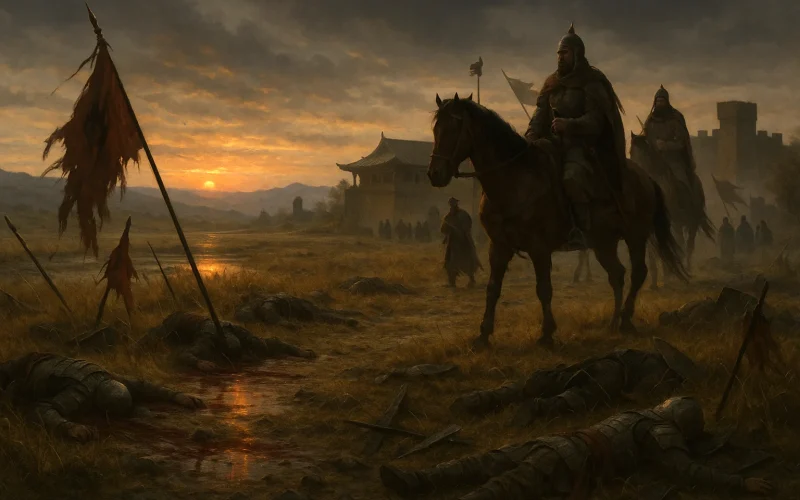
In early winter noble sons of household good
Blended with water in Chentao mires their pure blood.
No more war cry under the sky on the vast plain,
In one day forty thousand loyal warriors slain.

The enemy came back with blood-stained arrows long;
They drank in market place and shouted barbarous song.
Our countrymen turned north their faces bathed in tears;
Day and night they expect the royal cavaliers.
Original Poem
「悲陈陶」
杜甫
孟冬十郡良家子,血作陈陶泽中水。
野旷天清无战声,四万义军同日死。
群胡归来血洗箭,仍唱胡歌饮都市。
都人回面向北啼,日夜更望官军至。
Interpretation
This poem was composed in the winter of 756 CE, the first year of the Zhide era under Emperor Suzong, while Du Fu was trapped in Chang'an, then occupied by the rebel forces of An Lushan and Shi Siming. In October of that year, the Tang chancellor Fang Guan led imperial troops in a fierce battle against the rebels at Chentaoxie (east of present-day Xianyang, Shaanxi). Employing ancient chariot tactics, the Tang army was devastated by enemy fire attacks, resulting in the catastrophic loss of over forty thousand soldiers in a single day. When news of the disaster reached Chang'an, Du Fu, overwhelmed with grief and indignation, used his poetry as a historical record to document this calamity and the reaction within the occupied capital. The poem is also known by the title Lament for Chentaoxie.
First Couplet: “孟冬十郡良家子,血作陈陶泽中水。”
Mèng dōng shí jùn liángjiā zǐ, xuè zuò Chéntáo zé zhōng shuǐ.
In early winter, sons from honest homes in ten western towns / Found their blood become the water in Chentao's marshy grounds.
The opening line reads like an entry from a historical chronicle, stating the time (early winter), the identity of the soldiers ("sons from honest homes"), and their grim fate ("blood become the water"). "Ten towns" broadly refers to the Longyou region, emphasizing the wide geographical reach of the conscription. "Sons from honest homes" stresses that these soldiers were originally simple, law-abiding civilians, rendering their sacrifice even more innocent and tragic. The subsequent line employs a harrowing metaphor, transforming abstract bloodshed into a concrete, visceral image—blood literally forming the waters of the marsh. This not only conveys the massive scale of death but also imbues the very landscape with a tone of profound sorrow, establishing the poem's bleeding, lament-filled foundation.
Second Couplet: “野旷天清无战声,四万义军同日死。”
Yě kuàng tiān qīng wú zhàn shēng, sì wàn yì jūn tóng rì sǐ.
The fields lie vast, the sky is clear, no sound of battle cries; / Forty thousand loyal troops all met their death on that same day, before their eyes.
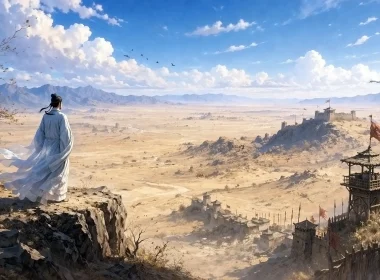
This couplet uses a scene of extreme stillness to underscore an event of extreme carnage. After the slaughter, the battlefield sinks into a deathly silence. The three words "no sound of battle cries" are startling and chilling, implying no life remains to fight. The latter line, with the precise numeral "forty thousand" combined with the stark phrase "all met their death on that same day," achieves a documentary force and emotional impact rare in poetry, akin to words carved on a memorial stele. Here, the number transcends statistics; it is a grievous historical quantification where each unit represents a life abruptly severed.
Third Couplet: “群胡归来血洗箭,仍唱胡歌饮都市。”
Qún hú guīlái xuè xǐ jiàn, réng chàng hú gē yǐn dūshì.
The barbarian horde returns, their arrows washed and gleaming red; / Still singing alien songs, they drink where the capital's feasts are spread.
The perspective shifts from the battlefield to the streets of the occupied capital. The detail of the rebels' "arrows washed and gleaming red" coldly displays the evidence of slaughter. "Singing alien songs, they drink" captures their savage and arrogant demeanor to the bone. In the very heart of the Tang Empire, Chang'an, the conquerors revel in a victor's celebration, completely inverting the established order of culture and power. The clamorous scene in this couplet stands in sharp, painful contrast to the silent horror of the previous one. This juxtaposition of sight and sound intensifies the poem's portrayal of national humiliation.
Fourth Couplet: “都人回面向北啼,日夜更望官军至。”
Dū rén huí miàn xiàng běi tí, rì yè gèng wàng guān jūn zhì.
The capital's people turn their weeping faces toward the north and mourn; / Day and night, their hope persists: the imperial army will return.
The focus finally settles on those who bear the suffering—the common people. "Turn their weeping faces toward the north" is a poignant gesture that embodies despair, loyalty, and longing—north being the direction of the lost battle and the emperor's exile. "Day and night, their hope persists" conveys the prolonged agony of waiting. The people's silent weeping in the poem stands in direct opposition to the barbarians' raucous singing. The faint but persistent hope for the "imperial army to return" becomes the only flicker of spiritual light in that dark age, providing the entire poem with a tone that is sorrowful yet not devoid of resilience.
Holistic Appreciation
This poem is a quintessential example of Du Fu's spirit of "poetry as history." It is not a nostalgic or lyrical reflection written from a safe distance, but rather a poetic sketch, possessing the immediacy of a news report, of a historical tragedy that had just occurred, composed from the perspective of a "witness."
The poem's structure resembles a condensed four-act tragedy: Act I (first couplet) presents the horrific aftermath, establishing a bloody tone; Act II (second couplet) focuses on the silent, empty battlefield, delivering the stark toll of death; Act III (third couplet) shifts to the conquerors' triumphant revelry within the capital, creating powerful emotional tension; Act IV (fourth couplet) concludes on the weeping, hopeful faces of the oppressed people, leaving a sense of unresolved expectation. These four scenes advance logically and relentlessly, with the emotional core evolving from grief and fury, to profound sorrow, to humiliation, and finally to a resilient, enduring hope.
Du Fu's profundity lies in his documentation of not merely the event itself, but also the multifaceted human responses and complex social psychology it evoked. The poem presents the "sons from honest homes" who died for their country, the arrogant and savage rebel forces, the suffering yet hopeful "people of the capital," and the poet himself—the observer and chronicler who, while maintaining a composed record, pours his profound compassion into every carefully chosen word.
Artistic Merits
- Unity of Epic Documentation and Lyrical Power: The poem possesses the precise detail of a military dispatch, specifying time, origin of troops, and casualty figures. Yet, images like "blood become the water," "no sound of battle cries," and "weeping faces toward the north" are charged with intense lyrical emotion, achieving a perfect fusion of historical truth and poetic force.
- Masterful Application of Contrast: The natural tranquility of "fields lie vast, the sky is clear" is set against the human catastrophe of "forty thousand… all met their death." The victors' "singing and drinking" is contrasted with the people's silent "weeping" and patient "hope." These stark contrasts deepen the layers and intensify the impact of the tragedy.
- Restrained yet Potent Verbs and Imagery: Verbs such as "become," "washed," "sing," "drink," "weeping," and "hope" are concise yet immensely expressive. Images like "blood… water," "no battle cries," "alien songs," and "weeping… toward the north" have become iconic symbols within the collective memory of the An Lushan Rebellion.
- Strategic Shifts in Narrative Perspective: The poetic viewpoint shifts effectively from a panoramic view of the battlefield (first and second couplets), to a scene within the occupied capital (third couplet), and finally to a close-up on the common people (fourth couplet). This movement guides the reader to experience the全方位 impact of the disaster, much like a cinematic sequence.
Insights
This work demonstrates that the true power of war poetry lies not in glorifying victory, but in remembering suffering and upholding humanity. Du Fu directs his sympathy unreservedly towards the defeated "loyal troops" and the helpless "capital's people." His brush acts as a scale, weighing the value of life and dignity, rather than mere success or failure.
This poem serves as a warning: The tragedy of history is, first and foremost, the tragedy of individual lives; the trauma of a nation ultimately resides in the weeping and the hopes of countless specific individuals. Du Fu's depiction of "day and night, their hope persists" is not merely an expression of desire for rescue, but a profound longing for the restoration of order, justice, and civilized life. In any era where values are overturned and suffering is widespread, this resilient "hope" rising from the hearts of the people is itself a form of resistance, a force that refuses to yield.
It reminds every chronicler and thinker in every age: when confronted with collective trauma, perhaps the highest使命 of literature is to give direction to those silent tears and to preserve a glimmer of light for those dim hopes.
Poem translator
Xu Yuanchong (许渊冲)
About the poet
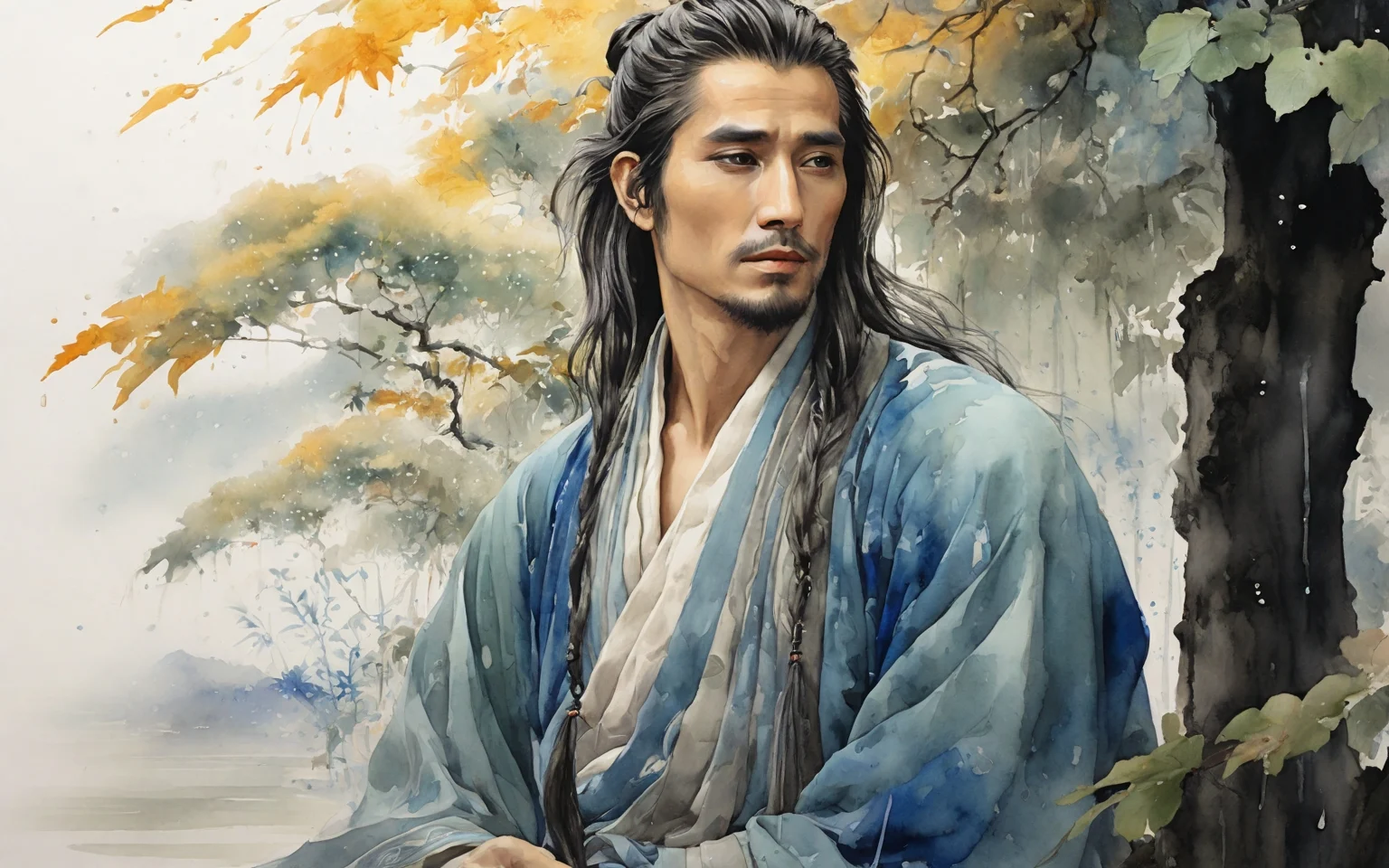
Du Fu (杜甫), 712 - 770 AD, was a great poet of the Tang Dynasty, known as the "Sage of Poetry". Born into a declining bureaucratic family, Du Fu had a rough life, and his turbulent and dislocated life made him keenly aware of the plight of the masses. Therefore, his poems were always closely related to the current affairs, reflecting the social life of that era in a more comprehensive way, with profound thoughts and a broad realm. In his poetic art, he was able to combine many styles, forming a unique style of "profound and thick", and becoming a great realist poet in the history of China.