To the Celestial Court a proposal was made,
And I am banished eight thousand li away.
To undo the misdeeds I would have given aid,
Dare I have spared myself with powers in decay?

The Ridge veiled in barred clouds, where can my home be seen?
The Blue Pass clad in snow, my horse won't forward go.
You have come from afar and I know what you mean:
Not to leave my bones there where miastic waves flow.
Original Poem
「左迁至蓝关示侄孙湘」
韩愈
一封朝奏九重天,夕贬潮州路八千。
欲为圣明除弊事,肯将衰朽惜残年!
云横秦岭家何在?雪拥蓝关马不前。
知汝远来应有意,好收吾骨瘴江边。
Interpretation
This poem was composed in the 14th year of Yuanhe during the reign of Emperor Xianzong of Tang (819 AD), the most perilous year of Han Yu's life. In the first month of that year, Emperor Xianzong sent envoys to welcome the Buddha's bone into the palace for veneration, sending the entire country into a frenzy. Disregarding his personal safety, Han Yu submitted the "Memorial on the Buddha's Bone" to vehemently remonstrate against it. The memorial's language was fierce, directly stating that Buddhism was a "barbarian doctrine," that rulers throughout history who served Buddha "did not enjoy long reigns," and even said that "serving Buddha to seek blessings actually brings more calamity"—this was no different from offending the dragon's scales. Emperor Xianzong was furious and wanted to impose the death penalty. Fortunately, thanks to the strenuous efforts of Pei Du, Cui Qun, and others, he was demoted to Prefect of Chaozhou.
Chaozhou was far in the Lingnan region, eight thousand li from Chang'an, considered in that era a land of miasmic diseases where exiled officials often went never to return. At fifty-two years of age, Han Yu hastily set out in the bitter cold of deep winter. When he reached Lantian Pass (i.e., Blue Pass), his grandnephew Han Xiang caught up to accompany him. Han Xiang is the Han Xiangzi later immortalized as one of the Eight Immortals in legend. His arrival at this time to accompany Han Yu moved and saddened the poet. Facing the perilous road ahead with "clouds barring the Qinling peaks" and "snows clogging the Blue Pass," the poet, with a tumult of emotions, wrote this eternally renowned masterpiece of profound and restrained sorrow. The poem contains both indignation at being punished for his loyalty, nostalgia for his hometown, and despair for the road ahead. But the most moving part is the composure in the line "好收吾骨瘴江边" (gather from the river my bones, miasmic, white)—knowing full well this journey held little chance of survival, yet remaining unswerving in his resolve. This is precisely a portrayal of Han Yu's character: "Where the Way lies, though ten thousand men oppose it, I will go."
First Couplet: "一封朝奏九重天,夕贬潮州路八千。"
Yī fēng zhāo zòu jiǔ chóng tiān, xī biǎn Cháozhōu lù bā qiān.
A morning memorial presented to the high throne,
By evening exiled eight thousand leagues to Chaozhou.
The opening line immediately uses the temporal contrast between "a morning memorial presented" and "by evening exiled" to convey the suddenness and severity of fate's turn. "A memorial" and "the high throne" emphasize the insignificance of the petition versus the supreme height of imperial power—the life, death, honor, and disgrace of a lowly subject hang on the emperor's whim. "Eight thousand leagues" writes of spatial remoteness and, more so, psychological despair—eight thousand leagues of road, mountain upon mountain, stream after stream, for a frail old man, was no different from a road of no return. These fourteen words concentrate within them the tragedy of a loyal minister punished, his safety from morning to evening uncertain; each word is startling.
Second Couplet: "欲为圣明除弊事,肯将衰朽惜残年!"
Yù wèi shèng míng chú bì shì, kěn jiāng shuāi xiǔ xī cán nián!
Wishing to clear the Court of evil ways,
Could I, though aged, begrudge my remaining days!
This couplet directly expresses the poet's innermost thoughts, using a rhetorical question to strengthen the tone. "Wishing to clear the Court of evil ways" clarifies his intent: all he did was for the court, for the people, absolutely not for personal gain. "Could I, though aged, begrudge my remaining days!" is even more resounding: with a frail body, spending his last years, he still dared to speak out and remonstrate. The word "肯" (could I), posed as a rhetorical question, is decisive and unyielding, showing his unwavering moral integrity. These two lines are Han Yu's defense of his actions, and moreover, an outcry of injustice at being punished for his loyalty.
Third Couplet: "云横秦岭家何在?雪拥蓝关马不前。"
Yún héng Qín Lǐng jiā hé zài? Xuě yōng Lán Guān mǎ bù qián.
Clouds bar the Qinling peaks—where is my home?
Snows clog the Blue Pass—my horse will not go on.
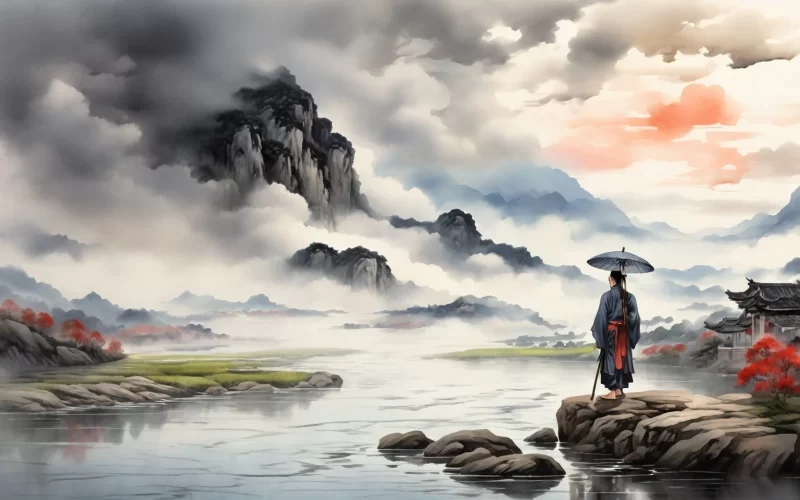
This couplet shifts from direct expression to scene description, using scenery to convey emotion, creating a vast, desolate atmosphere. "Clouds bar the Qinling peaks" looks back towards Chang'an; clouds and mountains block the way, obscuring the path taken and, even more, the hometown. The three words "家何在" (where is my home?) are both a geographical question and, more deeply, a spiritual bewilderment—his political life is finished, where is his spiritual home? "Snows clog the Blue Pass" writes of the perilous obstacles ahead; heavy snow seals the mountains, making progress impossible step by step. "马不前" (my horse will not go on) is both a literal description of the horse's reluctance to face the difficulty and, figuratively, the poet's inner hesitation and sorrow. These two lines have a broad, expansive realm and deep emotion, thoroughly expressing the sorrow of a hero losing his way.
Fourth Couplet: "知汝远来应有意,好收吾骨瘴江边。"
Zhī rǔ yuǎn lái yīng yǒu yì, hǎo shōu wú gǔ zhàng jiāng biān.
I know that you have come from afar with good intent,
To gather from the river my bones, miasmic, white.
The final couplet turns to his grandnephew Han Xiang. The tone shifts from sorrowful lament to poignant grief, yet carries a strange calm. "I know that you have come from afar with good intent"—the poet naturally understands the sentiment behind his grandnephew coming to see him off at this moment, but the three words "应有意" (with good intent) also carry a trace of clear-sighted recognition of fate: this parting is likely farewell forever. "好收吾骨瘴江边" (To gather from the river my bones, miasmic, white) is the most painful line of the entire poem, yet stated with such composure. The two words "好收" (gather) are like giving instructions for his funeral affairs, calm to the point of heartbreak. Chaozhou was a land of miasma; the poet had prepared himself to be buried in a foreign land, yet there is not a trace of pleading, not a word of regret. This is precisely Han Yu's steadfastness: "Where the Way lies, I give my life to it."
Overall Appreciation
This work is a masterpiece among Han Yu's seven-character regulated verse and also the strongest expression of the pain of exile in the history of Chinese literature. The entire poem begins with narration, continues with lyrical expression, turns with scene description, and concludes with instructions. It fuses indignation at being punished for loyalty, sorrow at a hero losing his way, and the composure of facing death as a return home. Reading it stirs the soul.
In terms of its emotional progression, the poem exhibits a dramatic, fluctuating rhythm. The first couplet, with the strong contrast of "a morning memorial presented" and "by evening exiled," conveys the sudden turn of fate, with intense emotion. The second couplet, with its resolute declaration, expresses the determination to uphold morality, with impassioned emotion. The third couplet, using vast, desolate scenery to write boundless sorrow, shifts the emotion from impassioned to profound and restrained. The fourth couplet concludes calmly with instructions for his funeral affairs, elevating the emotion from profound restraint to tragic grandeur. Between the four couplets, the emotions rise and fall dramatically, yet they are consistently threaded through with an unyielding spiritual vitality.
Artistically, the most moving aspect of this poem lies in the fusion of "emotion" and "scene" and the complementarity of the "direct" and the "indirect." The first couplet directly narrates the event, the second directly expresses emotion—both are "direct writing." The third couplet uses scene to convey emotion, placing boundless sorrow within the vast imagery of "clouds barring the Qinling peaks" and "snows clogging the Blue Pass." This is "indirect writing." The fourth couplet returns to "direct writing" with plain language giving instructions. This technique of intertwining direct and indirect writing gives the poem both the piercing force that penetrates the paper and the lingering subtlety of an echoing sound.
In terms of intellectual depth, the core of this poem is the conflict between the "Way" and "Fate." Han Yu saw himself as a defender of the Way, willing to "spend his last years" to "clear the Court of evil ways." This was his commitment to the "Way." Yet, "a morning memorial presented… by evening exiled," "eight thousand leagues," and "miasmic river" were Fate's merciless mockery of him. In the intense conflict between the "Way" and "Fate," the poet did not choose submission. Instead, with the composure of "gather from the river my bones," he completed his ultimate defense of the "Way. This spirit of "knowing it cannot be done yet doing it" is precisely the most precious quality of a Confucian scholar-official.
Artistic Features
- Strong Contrast, Full of Tension: The temporal contrast between "a morning memorial presented" and "by evening exiled," the spatial contrast between "the high throne" and "eight thousand leagues" make the sudden change of fate startling and soul-stirring. Tragedy is seen in contrast; force is displayed in tension.
- Direct Expression, Unyielding Integrity: "Wishing to clear the Court of evil ways, / Could I, though aged, begrudge my remaining days!" uses rhetorical questions, decisive and unyielding, without a trace of dejection, fully displaying Han Yu's upright, unyielding character. Direct writing expresses true feeling; each word is blood and tears.
- Using Scene to Convey Emotion, Vast and Desolate Atmosphere: "Clouds bar the Qinling peaks" and "snows clog the Blue Pass" use broad, desolate scenery to express utter inner loneliness and sorrow. The artistic conception is majestic, the emotion profound. Scene is created for emotion; emotion arises from scene; scene and emotion fuse.
- Concise Language, Rich Meaning: The entire poem, eight lines and fifty-six characters, fuses event, emotion, scenery, and philosophy. Phrases like "where is my home?", "my horse will not go on," and "gather from the river my bones" seem plain but contain endless meaning. The extraordinary is seen in the plain; depth is seen in the simple.
- Precise Structure, Clear Progression: The first couplet sets the scene through narration, the second deepens it with lyrical expression, the third shifts with vivid description, and the fourth brings closure with reflective instructions. The four couplets interlock seamlessly, forming a cohesive whole. The craftsmanship is exquisite—truly a model of its kind.
Insights
This poem, through a harrowing exile, speaks of the tragic grandeur of a scholar-official upholding morality under the heavy pressure of fate, offering profound insights for later generations. First, it makes us contemplate the conflict between the "Way" and "Fate," and the choices a person makes in this conflict. Han Yu knew full well that remonstrating about the Buddha's bone could lead to execution, yet he still submitted "一封朝奏九重天". He knew full well that the journey to Chaozhou held little chance of survival, yet he still declared, "肯将衰朽惜残年". This spirit of "knowing it cannot be done yet doing it" is precisely the most precious quality of a Confucian scholar-official. It enlightens us: The value of life lies not in whether one succeeds, but in whether one upholds the inner moral Way. The cruelty of fate cannot negate the dignity of choice.
The sorrowful lament of "云横秦岭家何在" and the composure of "好收吾骨瘴江边" in the poem show us how a person maintains spiritual independence in a desperate situation. The road ahead is vast, the hometown difficult to return to, yet he can calmly give instructions for his funeral, without pleading, without regret, only a calm acceptance of fate and a firm guardianship of morality. It tells us: True courage is not the absence of fear of death, but remaining unswerving in one's resolve in the face of death. True composure is not the absence of pain, but making pain the background of life.
On a deeper level, this poem also lets us see Han Yu's image as a Confucian who believes, "Where the Way lies, though ten thousand men oppose it, I will go." His tragedy is a personal tragedy, but also a tragedy of his time. Yet his steadfastness has left an eternal spiritual legacy for later generations. A thousand years on, when we read "云横秦岭家何在,雪拥蓝关马不前", we can still feel that unyielding heart beating, that steadfast Way shining.
Poem translator
Xu Yuanchong (许渊冲)
About the poet
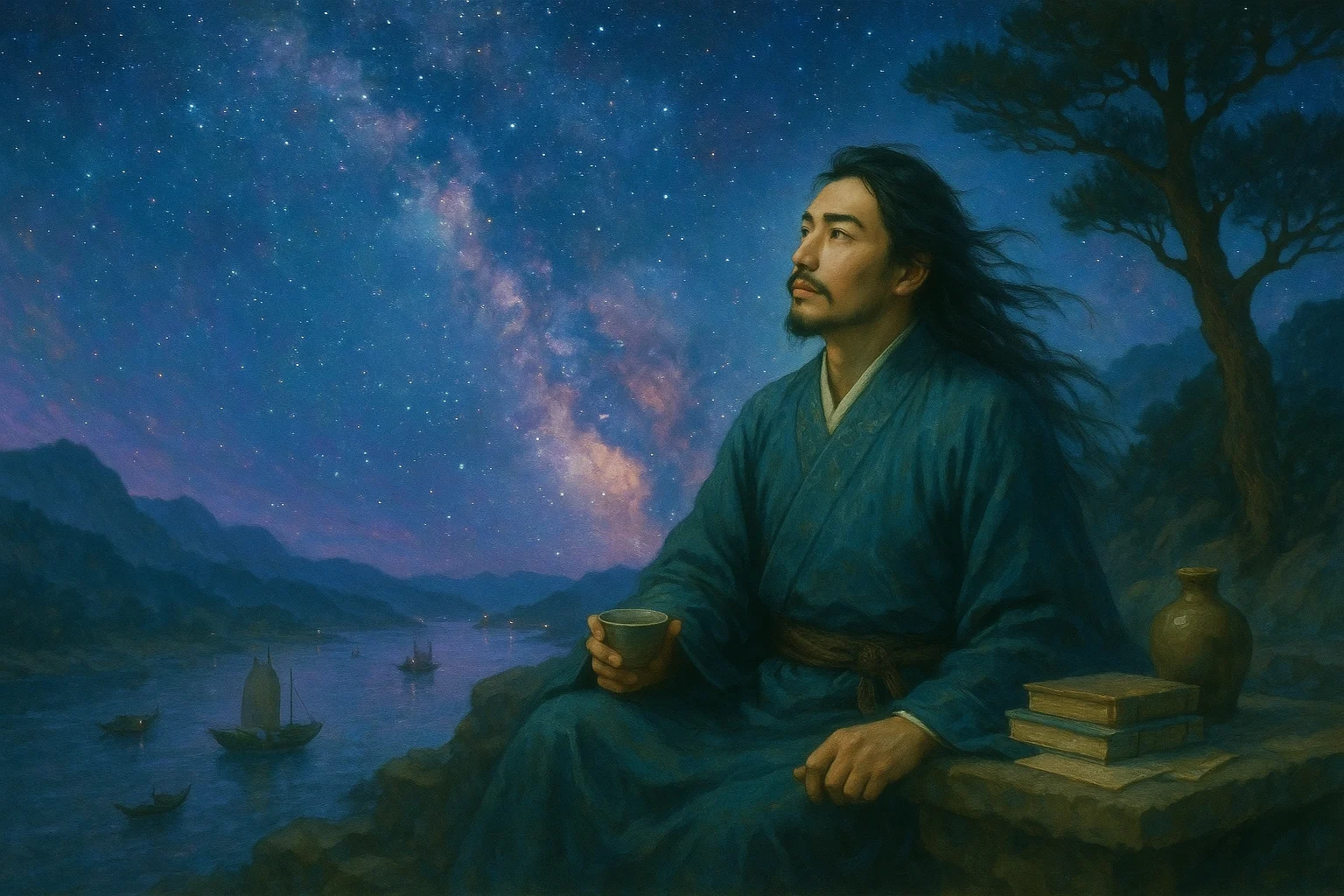
Han Yu (韩愈, 768 - 824), a native of Mengzhou, Henan Province, he was the leader of the Ancient Prose Movement in the Tang Dynasty. He became a jinshi (presented scholar) in the eighth year of the Zhenyuan era (792 AD). His prose was vigorous and powerful, and he patronized notable poets such as Meng Jiao and Jia Dao. Regarded as the foremost of the "Eight Great Masters of the Tang and Song Dynasties," Han Yu revolutionized both poetry and prose, exerting a profound and lasting influence. Later generations honored him as the "Literary Patriarch of a Hundred Generations."