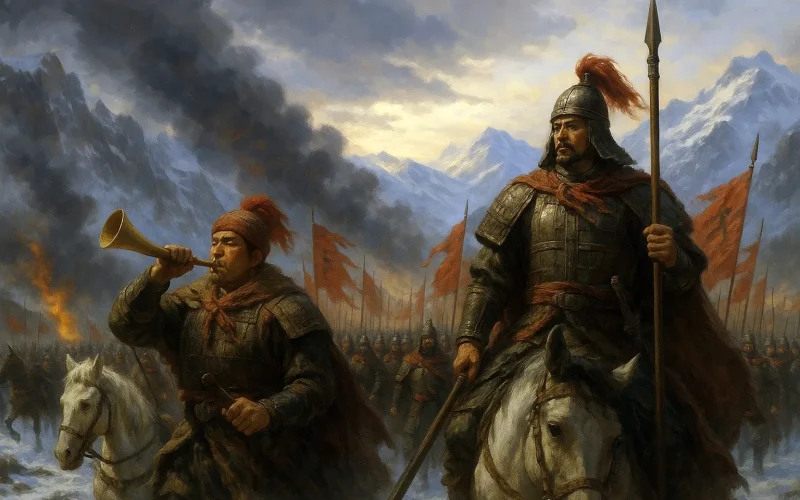



Look how swift to the snowy sea races Running-Horse River! --
And sand, up from the desert, flies yellow into heaven.
This Ninth-month night is blowing cold at Wheel Tower,
And valleys, like peck measures, fill with the broken boulders
That downward, headlong, follow the wind.
...In spite of grey grasses, Tartar horses are plump;
West of the Hill of Gold, smoke and dust gather.
O General of the Chinese troops, start your campaign!
Keep your iron armour on all night long,
Send your soldiers forward with a clattering of weapons!
...While the sharp wind's point cuts the face like a knife,
And snowy sweat steams on the horses' backs,
Freezing a pattern of five-flower coins,
Your challenge from camp, from an inkstand of ice,
Has chilled the barbarian chieftain's heart.
You will have no more need of an actual battle! --
We await the news of victory, here at the western pass!
Original Poem
「走马川行奉送封大夫出师西征」
岑参
君不见走马川行雪海边, 平沙莽莽黄入天。
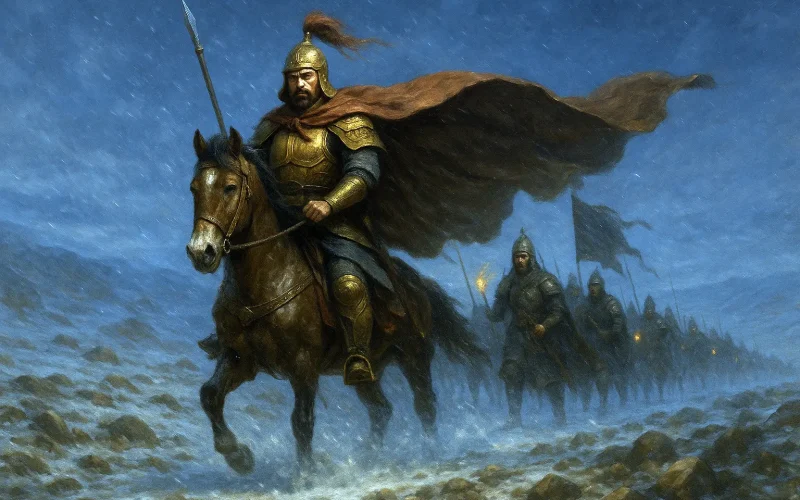
轮台九月风夜吼, 一川碎石大如斗,随风满地石乱走。
匈奴草黄马正肥,金山西见烟尘飞, 汉家大将西出师。
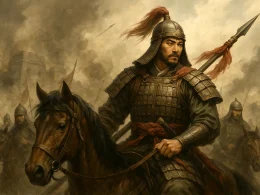
将军金甲夜不脱, 半夜军行戈相拨,风头如刀面如割。
马毛带雪汗气蒸,五花连钱旋作冰, 幕中草檄砚水凝。
虏骑闻之应胆慑, 料知短兵不敢接,车师西门伫献捷。
Interpretation
This poem was composed between 754 and 755 AD, during the Tianbao era of Emperor Xuanzong’s reign—the very period of Cen Shen’s second mission beyond the frontier. At the time, the poet served as an aide to the military governor of Anxi and Beiting, working on the staff of Feng Changqing. Feng, then protector-general of Beiting, military governor of Yixi, and commander of the Hanhai Army, led a campaign westward to Boxian (present-day Qiemo in Xinjiang) to secure the Western Regions. As a staff officer who personally experienced frontier life, Cen Shen witnessed not only the harsh environment where “winds howl through September nights at Wheel Tower” but also the actual campaigning conditions of Tang troops, whose “general keeps his golden armor on through the night.” This poem is precisely a rousing farewell piece born from this specific time and place. It blends the poet’s accumulated experiences from two tours of duty in the Western Regions, his admiration for Feng Changqing’s military bearing, and the energetic, forward-looking spirit of the High Tang era, making it one of the most vivid and impactful works in the entire frontier poetry tradition.
Stanza 1: 君不见走马川行雪海边,平沙莽莽黄入天。轮台九月风夜吼,一川碎石大如斗,随风满地石乱走。
Jūn bú jiàn Zǒumǎ Chuān xíng xuě hǎi biān, píng shā mǎngmǎng huáng rù tiān. Lúntái jiǔ yuè fēng yè hǒu, yì chuān suì shí dà rú dǒu, suí fēng mǎn dì shí luàn zǒu.
Have you not seen— / the Running-Horse River flow beside the Sea of Snow, / Where the wild plain of yellow sand invades the sky? / At Wheel Tower, the winds of September howl all night; / Stones, big as bushel-baskets, fill the riverbed— / And the gale sends them tumbling, rolling, far and wide.
The poem opens with the rhetorical call “Have you not seen—,” instantly drawing the reader into the temporal and spatial reality of the frontier. Three images—the Running-Horse River, the Sea of Snow, and the boundless yellow sands—unfold in layers, constructing a three-dimensional space: longitudinal (the river’s flow), latitudinal (the snowy plain), and vertical (sand merging with sky). Vastness here reveals grandeur. The next three lines shift to dynamic description: the autumn chill of September and the howling night winds create a dual pressure on time and the senses. The hyperbole of “stones big as bushel-baskets” and the spectacle of “tumbling, rolling” give concrete, visual form to the raging force of the frontier gales, turning it into a feast of upheaval. Here, Cen Shen breaks away from the conventional frontier-poetry tropes—like “in a hundred yellow-sand battles, golden armor is pierced”—and presents, with surreal strokes, a natural wonder unique to the Western Regions.
Stanza 2: 匈奴草黄马正肥,金山西见烟尘飞,汉家大将西出师。
Xiōngnú cǎo huáng mǎ zhèng féi, Jīnshān xī jiàn yānchén fēi, Hànjiā dàjiàng xī chū shī.
The Huns’ grass has yellowed, their horses grown sleek; / West of Gold Mountain, smoke and dust are seen to fly. / The great general of Han leads his army westward forth.
These three lines accomplish multiple narrative shifts. The first reveals the natural logic of the Huns’ border incursions (nomadic peoples habitually raided southward in autumn, when horses were fattened). The second, with the dynamic image “smoke and dust are seen to fly,” hints at urgent military developments. The last line introduces the commanding presence of the “great general of Han.” In only twenty-one characters, the poem establishes the war’s context, the posture of both friend and foe, and molds the imposing figure of Feng Changqing as the Han general. “Gold Mountain” serves as a geographical marker, specifying the Western Regions battlefield and adding an exotic hue. The three lines’ tight rhythm, like war drums quickening, naturally introduces the marching scene that follows.
Stanza 3: 将军金甲夜不脱,半夜军行戈相拨,风头如刀面如割。
Jiāngjūn jīn jiǎ yè bù tuō, bàn yè jūn xíng gē xiāng bō, fēng tou rú dāo miàn rú gē.
The general keeps his golden armor on through the night; / At midnight, the army marches—halberds clank and clatter; / The wind’s edge is like knives, slashing faces raw.
The focus narrows to the details of the march, rendered with fine precision. “Keeps his golden armor on through the night” is realistic—constant readiness for battle—but also symbolic: the general shares hardships with his men; discipline is strict. The metallic clang of “halberds clank and clatter” stands out sharply in the silent night; sound here accentuates the quiet, underscoring the army’s orderly advance and grim, tense atmosphere. Most brilliantly, “The wind’s edge is like knives, slashing faces raw” gives tangible, blade-like form to the intangible bitter wind. The verb “slashing” conveys not just physical pain but the direct confrontation between human will and nature’s violence. These three lines move from the visual (golden armor) to the auditory (clanking halberds) to the tactile (wind slashing faces), completing a full sensory narrative.
Stanza 4: 马毛带雪汗气蒸,五花连钱旋作冰,幕中草檄砚水凝。
Mǎ máo dài xuě hàn qì zhēng, wǔ huā lián qián xuán zuò bīng, mù zhōng cǎo xí yàn shuǐ níng.
Horses’ manes, snow-powdered, steam with sweat; / Dappled coats and piebald hides in moments turn to ice. / In headquarters, as proclamations are drafted, inkstone-water freezes.
This stanza presents three emblematic scenes of “extreme cold,” each intensifying the last. The first line describes the warhorses: “steam with sweat” meeting “snow-powdered” creates a startling clash of heat and cold. The second line’s “in moments turn to ice”—with the word “moments”—highlights the swiftness and ruthlessness of the bitter cold. The third line shifts to the clerical work of headquarters: the detail “inkstone-water freezes” is both starkly realistic and deeply symbolic. Even the tools of writing are frozen—such is the environment’s severity. These three shots, moving from animal to human, from martial to clerical, comprehensively depict the war machine operating under extreme conditions. Here, cold is elevated into the ultimate measure testing an army’s mettle.
Stanza 5: 虏骑闻之应胆慑,料知短兵不敢接,车师西门伫献捷。
Lǔ jì wén zhī yīng dǎn shè, liào zhī duǎn bīng bù gǎn jiē, Jūshī xīmén zhù xiàn jié.
The enemy’s cavalry, hearing of this, should tremble in fear; / We know they dare not close for hand-to-hand combat. / At the west gate of Jushi we’ll stand and await news of victory.
The conclusion leaps from the narrative of hardship to a prophecy of victory, achieving an emotional ascent. “Should tremble in fear” and “dare not close” are not blind confidence but reasonable inference based on the foregoing depiction—an army so undaunted by peril is sure to make the enemy quail at the mere report. The final line jumps forward in time and space: “west gate of Jushi” fixes the location of triumph; “stand and await” captures the poet’s posture of expectation, but also implies unwavering certainty of victory. This direct leap from present hardship to imagined triumph showcases the unique optimism and historical confidence characteristic of High Tang frontier poetry.
Holistic Appreciation
This work represents the pinnacle of Cen Shen’s frontier poetry. Its most striking feature is its ability to transform the natural marvels of the Western Regions into poetic aesthetic marvels. The poem achieves breakthroughs in three dimensions.
First, revolutionary handling of time and space. The poet breaks the linear narrative of traditional war poetry (“departure—battle—triumph”), focusing instead on the specific temporal-spatial slice of “marching.” Through the interweaving of temporal markers like “September at Wheel Tower” and “midnight march” with spatial coordinates like “Running-Horse River,” “Gold Mountain,” and “Jushi,” he constructs a chronotope of war that is both concretely real and richly symbolic. Particularly noteworthy is the image of “wind,” which runs through the entire poem: it is natural violence (stones tumbling, faces slashed), historical momentum (smoke and dust flying), and spiritual force (enemies trembling)—thus evolving from environmental description into spiritual symbol.
Second, a Western Regions-inspired reconstruction of the perceptual system. Cen Shen introduces into poetry sensory experiences seldom found in the works of Central Plains poets: the chaotic, boundless vision of “yellow sand invades the sky”; the cosmic roar of “winds howl all night”; the extreme tactile pain of “slashing faces raw”; even the thermodynamic marvel of the instantaneous phase change in “steam with sweat” and “turn to ice.” This all-encompassing, high-intensity, defamiliarizing sensory writing not only recreates the uniqueness of the Western Regions environment but also reshapes the perceptual boundaries of High Tang poetry.
Finally, a philosophical elevation of the aesthetics of war. Superficially, the poem depicts the hardships of a march; at a deeper level, it explores the philosophical question of “how will can transcend material limits.” Images like horse sweat turning to ice and inkstone water freezing essentially test the cold-endurance thresholds of life and spirit. When the poet finally declares “we’ll stand and await news of victory,” triumph is no longer just a military outcome but a symbolic ritual of human will overcoming natural violence. By raising a specific campaign to this ontological height, the poem transcends the documentary level of ordinary frontier poetry and gains enduring artistic vitality.
Artistic Merits
- Unconventional and Defamiliarized Imagery System
The poet discards conventional frontier imagery like “lonely fortress” or “Qiang flute,” opting instead for geographical features unique to the Western Regions—the “Sea of Snow,” “Running-Horse River,” and “stones big as bushel-baskets”—to construct an unfamiliar and striking aesthetic world. The hyperbolic description “stones, big as bushel-baskets…the gale sends them tumbling” visualizes and dramatizes the power of the Western gales, creating an unprecedented system of frontier imagery. - Innovative Experimentation with Rhythm and Structure
Breaking from the standard patterns of old yuefu titles, the entire poem employs an uneven meter of alternating three-three-seven and three-seven-seven character lines, creating a unique breath-like rhythm. The three lines beginning “At Wheel Tower, the winds of September howl all night” use the urgent, rhyming sequence “howl—baskets—wide” to mimic the gale’s shriek and the sensation of stones hurtling. The latter part shifts to dense alternations of rhymes like “sleek—fly—forth” and “night—clatter—raw,” creating a synesthetic resonance between the poem’s rhythm, the marching pace, and the clatter of weapons. - Multidimensional and Composite Sensory Presentation
Cen Shen translates his Western Regions experience into a panoramic sensory record: the chaotic, boundless vision of “yellow sand invades the sky”; the cosmic auditory boom of “winds howl all night”; the sharp tactile pain of “slashing faces raw”; even the thermodynamic marvel of the instantaneous phase change in “steam with sweat” and “turn to ice.” This holographic sensory rendering immerses the reader in a frontier experience, giving the poem a physiological impact that transcends its era. - Dramatic Tension Between Extreme Environment and Iron Will
The poet deliberately constructs multiple layers of extreme opposition: nature’s savagery (howling wind, tumbling stones) versus the army’s order (clanking halberds); the coagulating power of bitter cold (freezing inkstone water) versus the vital force of life (steaming sweat); present hardship versus future triumph. These tensions are brought to their peak in lines like “Horses’ manes, snow-powdered, steam with sweat; / Dappled coats and piebald hides in moments turn to ice.” Here, extreme cold is no longer mere backdrop but an antagonist wrestling with human will. - Montage Technique of Temporal-Spatial Compression and Scenic Leaps
Within its brief fifteen lines, the poem executes multiple leaps across time and space: from the vast panorama of the Running-Horse River (spatial expanse) to the close-up of September gales at Wheel Tower (temporal suspension); from the distant view of dust clouds west of Gold Mountain (strategic perspective) to the microscopic focus on freezing ink in headquarters (detailed observation); finally vaulting to the future triumph at Jushi’s west gate (temporal anticipation). This montage-like splicing of scenes shatters linear narrative, constructing a three-dimensional chronotope of war. - Symbolic Distillation of Military Aesthetics
The poet distills complex military operations into a series of highly symbolic images: “keeps his golden armor on through the night” becomes an icon of the general leading by example; “halberds clank and clatter” condenses the grim discipline of the night march; “inkstone-water freezes” as proclamations are drafted symbolizes the clerical system’s continued functioning under extreme conditions. These symbols collectively constitute a representational system for the martial might of the High Tang, elevating the poem beyond the record of a specific campaign into an enduring emblem of the martial spirit.
Insights
The insights Cen Shen’s poem offers contemporary readers lie first in re-evaluating the aesthetic value and spiritual productivity of “hardship.” In a modern society increasingly characterized by comfort and virtuality, experiences like “the wind’s edge is like knives, slashing faces raw” have grown unfamiliar. Yet Cen Shen reminds us: it is precisely through direct confrontation with extreme environments that humanity’s deepest vital forces and creative energies are sparked. Those predicaments where “inkstone-water freezes” are often the very whetstones that sharpen the mind for drafting proclamations.
Second, the poem demonstrates the wisdom of systematic resilience. Facing a harsh environment, the Tang army displays a comprehensive response: the general leads by example (golden armor on), equipment is adapted (horses endure cold), logistics are fully maintained (headquarters operates), and morale and conviction are firm (awaiting victory). This model of resilience—combining individual fortitude with systemic efficacy—holds reference value for any team that must confront challenges.
Finally, the spiritual path from “endurance” to “transcendence” embedded in the poem is especially precious. The first half details the suffering of endurance (wind slashing faces, sweat turning to ice), yet the latter half suddenly turns to the deterrence effect of “the enemy’s cavalry…should tremble in fear.” This leap reveals a secret of human spiritual strength: when endurance of difficulty reaches a certain threshold, it transforms into absolute psychological advantage over the adversary. This wisdom of achieving victory without battle through self-tempering goes far beyond ordinary military strategy, touching the essence of competitive philosophy.
In an age filled with various “soft challenges,” rereading this hardcore frontier poem may help us recalibrate our understanding of “difficulty.” Those seeming obstacles—“stones tumbling” or “wind like knives, frost like swords”—might be the very grit needed to temper the spiritual edge of individuals and organizations. And Cen Shen’s posture of “standing and awaiting news of victory” at Jushi’s west gate forever symbolizes a truly powerful optimism—one that maintains an unshakeable faith in ultimate triumph even after fully comprehending the difficulties.
Poem translator
Kiang Kanghu
About the poet
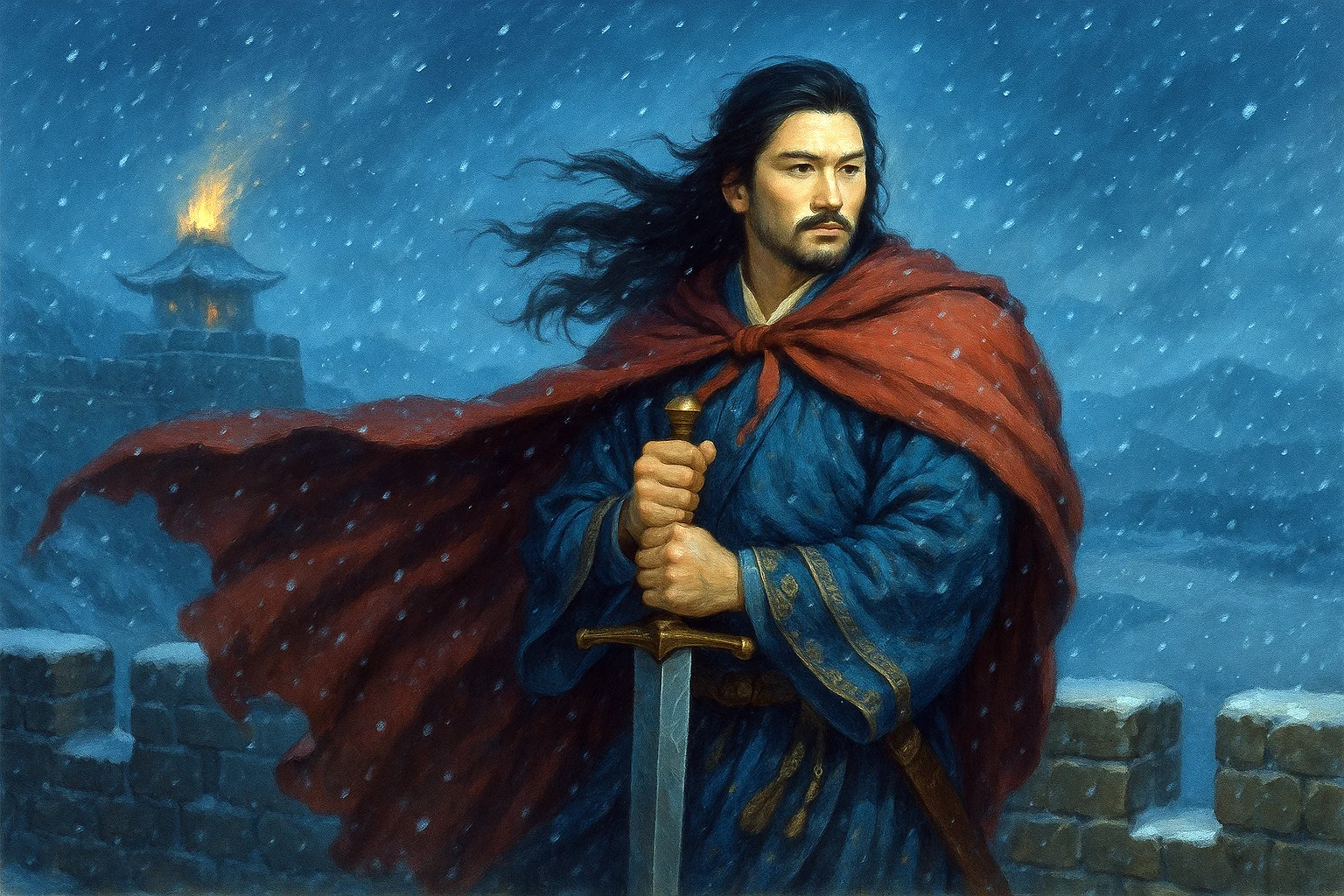
Cen Can(岑参), 715 - 770 AD, was a native of Jingzhou, Hubei Province. He studied at Mt. Songshan when he was young, and later traveled to Beijing, Luoyang and Shuohe. Cen Can was famous for his border poems, in which he wrote about the border scenery and the life of generals in a majestic and unrestrained manner, and together with Gao Shi, he was an outstanding representative of the border poetry school of the Sheng Tang Dynasty.