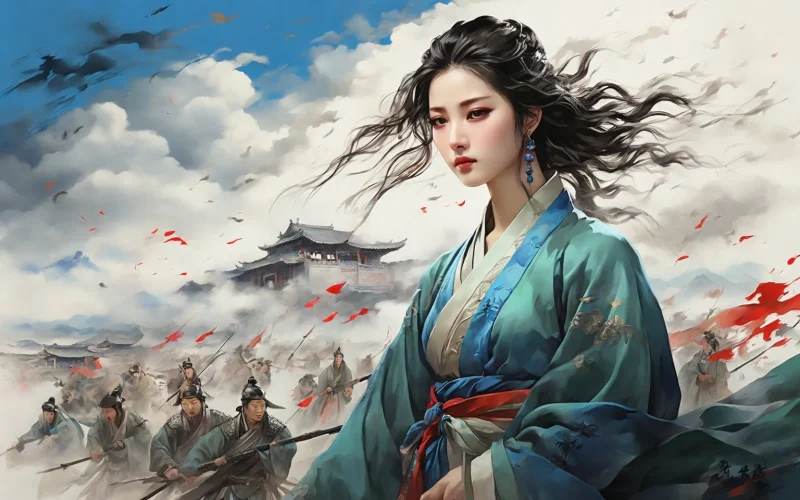



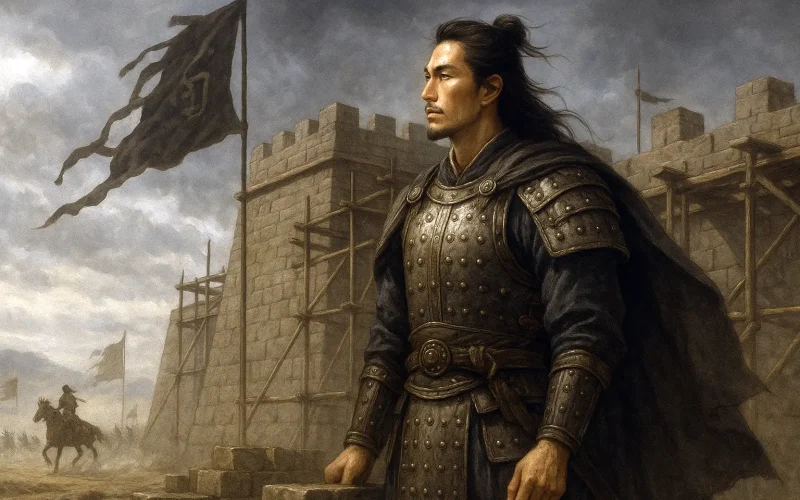
The Duke of Han planned to build three victorious walls
To stop the foe from coming near our capitals.
Could he anticipate the Western cavaliers,
After their victory, would not leave Northern frontiers?
The Pass could not prevent the foe from coming near;
After the dragon's rise, we can see our land clear.
Should the sovereign worry about the country's fate,
Generals could not have done their duty for the State.
Original Poem
「诸将五首 · 其二」
杜甫
韩公本意筑三城,拟绝天骄拔汉旌。
岂谓尽烦回纥马,翻然远救朔方兵。
胡来不觉潼关隘,龙起犹闻晋水清。
独使至尊忧社稷,诸君何以答升平。
Interpretation
This poem is the second in Du Fu’s series To the Generals, composed in the autumn of 766 CE, during the first year of the Dali era under Emperor Daizong. At the time, Du Fu was living in Kuizhou. Although the An Lushan Rebellion had been quelled in 763, a succession of crises followed: separatist warlords, invasions by the Tibetan Empire, and the growing power of the Uighurs, plunging the Tang Dynasty into a profound crisis beneath a superficial "restoration." With a tone of sorrow and sharp historical insight, the poem directly criticizes the court’s short‑sighted policy of borrowing Uighur troops to suppress the rebellion and the enduring disasters it caused. It showcases the deep historical reflection and strategic apprehension that mark Du Fu’s late work.
First Couplet: “韩公本意筑三城,拟绝天骄拔汉旌。”
Hán gōng běn yì zhù sān chéng, nǐ jué tiānjiāo bá Hàn jīng.
The Duke of Han built three fortress towns with this sole design: / To break the boastful nomads’ hope to seize the imperial sign.
The poem opens with a positive historical precedent, recalling the achievement of the eminent general Zhang Renyuan (posthumously Duke of Han) during Emperor Zhongzong’s reign. He constructed three "Surrender‑Cities" north of the Yellow River, forming a defensive triangle that for decades deterred the Turks from crossing the mountains to graze their horses, thus securing the northern frontier. The phrase "to break the boastful nomads’ hope" (where "boastful nomads" translates 天骄, a Han‑dynasty term for the Xiongnu, here referring to the Turks) captures the proactive, self‑reliant defense and national confidence characteristic of the early High Tang. This couplet establishes a clear, positive historical standard against which the present is measured.
Second Couplet: “岂谓尽烦回纥马,翻然远救朔方兵。”
Qǐ wèi jǐn fán Huíhé mǎ, fānrán yuǎn jiù Shuòfāng bīng.
Who could have dreamed we’d beg for every Uighur steed today, / To rescue, from afar, our own Shuofang troops’ decay?
The focus turns abruptly to the present disgrace. During the An Lushan Rebellion, the Tang court repeatedly borrowed Uighur forces to quell the rebels, at the cost of permitting the sack of Luoyang and Chang’an and incurring a long‑term, crippling political and economic burden. "Beg for every" conveys the totality and desperation of this dependence; "rescue, from afar" is heavy with irony—the Shuofang Army, which should have defended the nation, now required foreign troops to save it. This couplet exposes the humiliating reality that a hollowed‑out defense and incompetent generals forced the court to "invite the wolf into the house," creating a stark contrast with the preceding couplet.
Third Couplet: “胡来不觉潼关隘,龙起犹闻晋水清。”
Hú lái bù jué Tóngguān ài, lóng qǐ yóu wén Jìn shuǐ qīng.
When northern horsemen come, Tong Pass seems to lose its strategic might; / Yet we recall the dragon’s rise, the River Jin ran crystalline and bright.
The critique deepens through a juxtaposition of space and time. "Tong Pass seems to lose its strategic might" directly faults the generals’ incompetence and lax defenses, which rendered the famed natural fortress useless. "The dragon’s rise, the River Jin ran crystalline" recalls the auspicious omen and founding vigor of the dynasty (alluding to the legend that the Jin River turned clear when Emperor Gaozu raised his standard in Jinyang), implicitly lamenting the present court’s feebleness and low morale. The contrast between present failure and past glory conveys the poet’s profound disappointment in the government’s weakness.
Fourth Couplet: “独使至尊忧社稷,诸君何以答升平。”
Dú shǐ zhìzūn yōu shèjì, zhū jūn héyǐ dá shēngpíng.
Must the sovereign alone bear the realm’s grave weight and care? / Generals, how will you answer for the peace you claim to share?
The rhetorical question of the final couplet strikes like a thunderclap, directing criticism squarely at the ruling "generals." "The sovereign alone bear the realm’s grave weight" expresses a measured sympathy for Emperor Daizong’s struggle to maintain the state, but serves chiefly as a severe indictment of the civil and military officials who hold high office yet neglect their duties. The question, "how will you answer for the peace," rises above mere military critique to become an interrogation of the entire ruling elite’s political morality and historical responsibility. It is a sorrowful, powerful conclusion.
Holistic Appreciation
This poem is a masterpiece of Du Fu’s use of poetry for historical and political critique, demonstrating his rare strategic acumen and depth of historical analysis. The poem is structured around a series of "past versus present" contrasts: the Duke of Han’s proactive fortification (self‑reliance) versus the present reliance on Uighur aid (dependence on outsiders); the nullification of Tong Pass’s defensive value (failed guardianship) versus the potent omen at the dynasty’s founding (original vitality). The argument culminates in a collective indictment of the "generals" for their failure of the state.
Du Fu’s profundity lies in moving beyond criticism of military defeat to expose the chain of crises arising from failed state strategy, the degeneration of the military leadership, and the abdication of responsibility by the ruling class. Words and phrases like "who could have dreamed," "seems to lose," "sovereign alone," and "how will you answer" are charged with rhetorical force and deep disappointment, reflecting the more trenchant and direct tone that emerges within the profound melancholy and rhythmic force of his late style.
Artistic Merits
- The Brushwork of Historical Epic, Stark Juxtaposition: Through multiple historical contrasts—"the Duke of Han building towns" versus "begging for every Uighur horse," "Tong Pass losing its might" versus "the Jin River clearing at the dragon’s rise"—the poem constructs a broad spatial and temporal framework, lending the critique a powerful sense of historical depth.
- Precise, Pointed Allusion: Allusions to figures like Zhang Renyuan and to the omen of the Jin River do not merely use the past to comment on the present; they establish a clear standard for judging contemporary failings, strengthening the argument’s persuasiveness and the satire’s sharpness.
- Integrating Discourse into Poetry, Unflinching Critique: The poem uses reasoned discourse as its skeleton and deep emotion as its flesh, seamlessly blending historical insight, political judgment, and poetic feeling. Its language is sharp and direct, breaking from the traditional bounds of indirect expression and demonstrating Du Fu’s innovation in "using poetry as discursive argument."
- Rigorous Structure, Layered Argument: The logic proceeds from historical benchmark (first couplet) to present criticism (second couplet), from military‑geographic failure (first half of third couplet) to dynastic destiny (second half of third couplet), and finally ascends to political accountability (final couplet). The structure is tight and advances compellingly layer by layer.
Insights
This work transcends commentary on specific military affairs; it poses an enduring question of statecraft: Upon what foundation should a nation’s security and dignity rest? Through the lens of painful historical experience, Du Fu argues that reliance on external power is never a lasting strategy; genuine peace must be built on the foundation of a strong, self‑sufficient military, loyal and capable commanders, and independent state policy.
The crucial lesson of this poem for later generations is: National security cannot be entrusted to others; national dignity cannot be lightly mortgaged. In times of crisis, short‑sighted appeals for help may plant the seeds of longer‑lasting calamity. Furthermore, the predicament expressed in the line "the sovereign alone bear the realm’s grave weight" reminds us that a nation’s fate is never the burden of one person alone, but requires the entire ruling elite to share responsibility and face trials together. Du Fu’s profound questioning from a millennium ago still echoes at every historical juncture that tests the destiny of a nation.
Poem translator
Xu Yuanchong (许渊冲)
About the poet
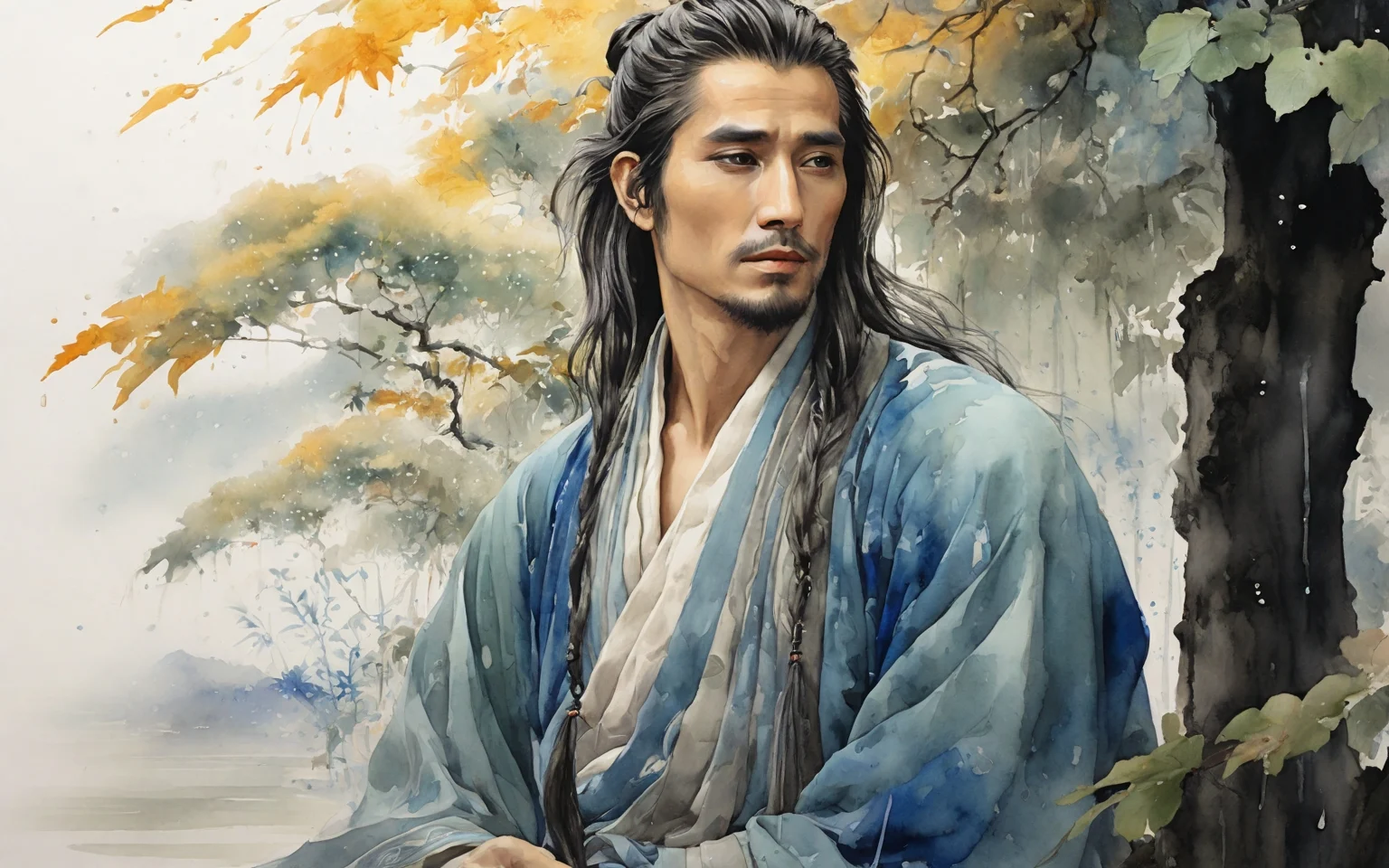
Du Fu (杜甫), 712 - 770 AD, was a great poet of the Tang Dynasty, known as the "Sage of Poetry". Born into a declining bureaucratic family, Du Fu had a rough life, and his turbulent and dislocated life made him keenly aware of the plight of the masses. Therefore, his poems were always closely related to the current affairs, reflecting the social life of that era in a more comprehensive way, with profound thoughts and a broad realm. In his poetic art, he was able to combine many styles, forming a unique style of "profound and thick", and becoming a great realist poet in the history of China.