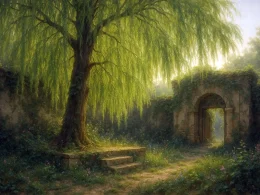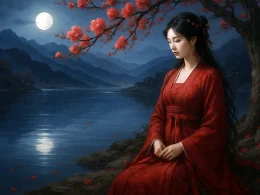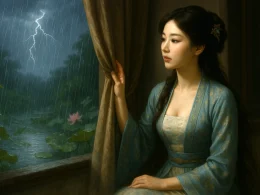



All the long night, a clear lute’s note seems drifting by;
The west wind wakes, and through the green‑trailed tendrils sigh.

The last glow‑worms lie couched on dew, like jewels spread;
The earliest wild geese brush the River overhead.

At dawn, the lofty trees their leafy thickets hold;
The distant hills in the clear light more peaks unfold.

One leaf falls in Huainan — and my soul knows, alone,
The wave that breaks on Dongting’s shore, though yet unknown.
Original Poem
「早秋」
许浑
遥夜泛清瑟,西风生翠萝。
残萤栖玉露,早雁拂金河。
高树晓还密,远山晴更多。
淮南一叶下,自觉洞庭波。
Interpretation
This poem is an excellent landscape poem by the late Tang poet Xu Hun, composed during his travels. Xu Hun, renowned for his skill in writing on historical themes and parting, frequently reflects on traces of the past, lamenting the rise and fall of dynasties. His language is elegant and pure, his conception profound and far-reaching, earning him praise like "A thousand poems by Xu Hun, a lifetime of sorrow by Du Fu." His official career was fraught with difficulties, and in his later years, he was often ill, frequently projecting his feelings about his own fate onto natural scenery.
Titled "Early Autumn," this poem depicts the scenery of mountains and waters in the early autumn season. Many late Tang poets held melancholic feelings towards autumn, whether due to the hardships of travel or the frustrations of official career, all easily stirred by autumn's desolate scenes. Xu Hun was no exception. Sitting alone through the long night, listening to the west wind rustle through green vines, watching remnant fireflies rest on dew, observing early wild geese fly past the Milky Way, his heart stirred with sensitivity to the changing seasons and contemplation on the flow of life. Yet, while the poem carries a sense of desolation, it is not without a realm of clarity—the brightness of "Tall trees in early morning look dense and high" and the philosophical insight of "I seem to see Dongting Lake with ripples rolled" lend the entire poem a sense of transcendence within melancholy, and a sense of openness within bleakness. It is a model of perfect fusion of emotion and scene, feeling and enlightenment in Xu Hun's landscape poetry.
First Couplet: "遥夜泛清瑟,西风生翠萝。"
Yáo yè fàn qīng sè, xī fēng shēng cuì luó.
The long, long night is filled with zither’s clear song; The west wind’s wafted o’er green moss along.
The poem opens with the two words "遥夜" (long, long night), creating an atmosphere of vast emptiness and cool clarity. "遥夜" (long, long night) emphasizes the night's length, also setting a quiet, tranquil backdrop for the entire poem. "泛清瑟" (filled with zither’s clear song) uses an auditory image to convey inner feeling—that clear, melodious zither music seems to drift from afar, yet also seems to be the embodiment of the poet's own inner melancholy. The next line, "西风生翠萝" (The west wind’s wafted o’er green moss along), shifts from auditory to visual. The west wind begins to rise, brushing over green vines; the word "生" (wafted) is used masterfully—the wind itself is formless, yet seems to gain life from the swaying of the green vines. This "清瑟" (clear zither) and "西风" (west wind), one imaginary, one real, one internal, one external, fuse the cool clarity of the autumn night with the poet's inner sensitivity.
Second Couplet: "残萤栖玉露,早雁拂金河。"
Cán yíng qī yù lù, zǎo yàn fú jīn hé.
The remnant fireflies alight on dewy lawn; Southbound wild geese fly past the Star River at dawn.
This couplet uses two highly seasonal images to depict the loneliness and flow of early autumn. "残萤" (remnant fireflies) are the lingering warmth of late summer, the last glimmer of life, now only able to "栖玉露" (alight on dewy lawn)—that jade-like dew is autumn's messenger, also a symbol of cold; the firefly resting on the dew is like the last warmth about to be engulfed by the chill. The next line, "早雁拂金河" (Southbound wild geese fly past the Star River at dawn), uses "早雁" (early/southbound wild geese) to signify autumn's arrival—wild geese flying south foretell the coming cold. "金河" (Star River) depicts the brilliance of the night sky, also subtly implying the passage of time. This "残萤" (remnant fireflies) and "早雁" (early wild geese), one low, one high, one near, one far, vividly portray the layered texture of early autumn, also metaphorically hinting at the brevity of life and the relentlessness of the seasons.
Third Couplet: "高树晓还密,远山晴更多。"
Gāo shù xiǎo hái mì, yuǎn shān qíng gèng duō.
Tall trees in early morning look dense and high; When it’s fine, distant hills come into the eye.
This couplet forms a sharp contrast with the first two, shifting from night to morning, from slight chill to clear weather, the mood also transitioning from melancholy towards openness. "高树晓还密" (Tall trees in early morning look dense and high) describes trees in the morning light—though it is early autumn, the trees have not yet withered, still lush and dense. "远山晴更多" (When it’s fine, distant hills come into the eye) describes distant mountains on a clear day—the sky is bright, the mountain ridges are layered, seemingly clearer and more magnificent than usual. The phrases "还密" (dense and high) and "更多" (come into the eye) use a bright brush to highlight another aspect of early autumn: autumn has arrived, yet the feel of summer is not gone; the scenery has changed, yet vitality remains. The poet's inner desolation finds temporary solace in this cheerful natural scene.
Fourth Couplet: "淮南一叶下,自觉洞庭波。"
Huái nán yí yè xià, zì jué Dòngtíng bō.
When a leaf in River Huai falls in autumn cold, I seem to see Dongting Lake with ripples rolled.
The final couplet is the soul of the poem, using an allusion to convey emotion, using the small to see the large. "淮南一叶下" (When a leaf in River Huai falls) alludes to a line from Huainanzi: "See one leaf fall and know the year is about to end," describing the perception of seasonal change triggered by a single falling leaf. "自觉洞庭波" (I seem to see Dongting Lake with ripples rolled) then connects the single leaf before his eyes to the distant waves of Lake Dongting. The two words "自觉" (seem to) signify the resonance between the poet's inner world and external objects—a single falling leaf, insignificant in itself, makes the poet feel the rippling waves of Lake Dongting a thousand miles away. This is both a natural association and an inner stirring: the change of seasons provokes the poet's deep reflections on life and worldly affairs. One leaf falls, and the world knows autumn; one subtle thought stirs, and ten thousand waves follow. Using the smallest image, the poet writes of the grandest realm, concluding the poem on a philosophical plane, with lingering resonance.
Holistic Appreciation
This is a divine work among Xu Hun's landscape poems. The entire poem consists of eight lines and forty characters. Using early autumn scenery as a starting point, it merges night and morning, near and far, feeling and enlightenment, displaying the poet's sensitive observation of seasonal change and profound philosophical contemplation on the flow of life.
Structurally, the poem shows a progression from night to morning, from melancholy to openness, from the concrete to the philosophical. The first couplet begins with "遥夜" (long, long night) and "清瑟" (clear zither), creating a cool, clear atmosphere. The second couplet uses "残萤" (remnant fireflies) and "早雁" (early wild geese) to depict early autumn imagery, deepening the melancholic mood. The third couplet shifts to the morning scene with "高树" (tall trees) and "远山" (distant hills), the mood turning from gloom to brightness. The fourth couplet concludes with "一叶下" (a leaf falls), elevating the scene before his eyes to philosophical reflection on life. Across the four couplets, the poem moves from dark to bright, from near to far, from emotion to reason, each layer deepening, forming a seamless whole.
Thematically, the core of this poem lies in the interplay between "一叶下" (a leaf falls) and "洞庭波" (Dongting Lake with ripples). That "一叶下" is a small scene before the eyes, the change of seasons. That "洞庭波" is a great wave in the heart, the resonance of emotion. Between this "一叶" (one leaf) and "洞庭" (Dongting) lies the poet's profound insight into the universe and life: all things are connected, the small can reveal the large; heart and matter resonate, the minute can also stir emotion. Using a single falling leaf, the poet stirs waves a thousand miles away; with a touch of autumn feeling, he evokes endless reflections. This technique of using the small to see the large is precisely the highest realm of classical Chinese poetry's "a single flower contains a world."
Artistically, the poem's most moving aspect lies in the subtle technique of "using scenery to convey emotion, using the minute to know the profound." The poet does not directly state autumn melancholy, but uses "残萤" (remnant fireflies) and "早雁" (early wild geese) to convey autumn's arrival; he does not directly express his feelings, but uses "一叶下" (a leaf falls) to lead to the waves of Dongting. Every scene is a vehicle for emotion; every image is a catalyst for philosophical thought. That "清瑟" (clear zither) is the inner whisper; that "玉露" (dewy lawn) is autumn's chill; that "高树" (tall trees) is the tenacity of life; that "远山" (distant hills) is the openness of vision; that "一叶" (one leaf) is the code of the seasons; that "洞庭" (Dongting) is the stirring of heart waves. The poet lays out these images one by one, letting the reader feel within the picture, and think within the feeling.
Artistic Merits
- Rich Imagery, Clear Layers: Using images like "遥夜" (long, long night), "西风" (west wind), "残萤" (remnant fireflies), "早雁" (early wild geese), "高树" (tall trees), "远山" (distant hills), "一叶" (one leaf), building a three-dimensional painting of early autumn layer by layer.
- Scene and Emotion Blended, Emotion Infused in Scene: Not directly stating autumn melancholy, but using "残萤栖玉露" (remnant fireflies alight on dewy lawn) to convey autumn's loneliness, using "高树晓还密" (Tall trees in early morning look dense and high) to convey life's tenacity. The language of scenery is the language of emotion; the images of objects are images of the heart.
- Small Details Reflecting Larger Themes, Profound Philosophy: The final couplet uses "一叶下" (a leaf falls) to lead to "洞庭波" (Dongting Lake with ripples), elevating the small scene before the eyes to a great insight about life, ending the words but not the meaning.
- Gentle Rhythm, Lasting Resonance: The entire poem progresses from night to morning, from near to far, from concrete to abstract, like a slowly unfurling landscape scroll, allowing one to savor deep meaning within tranquility.
Insights
This poem, through an observation of early autumn, speaks to an eternal theme—In the changing of seasons, all things are connected; within a single falling leaf, one can also perceive the world.
First, it lets us see "the vastness within the minute." A single falling leaf is insignificant in itself, yet the poet perceives from it the waves of Lake Dongting. This tells us: The mysteries of the world are often hidden in the most minute places; insights about life often originate from the most ordinary observations. When we learn to gaze at a single falling leaf, a single drop of dew, a single bird's call, we can perceive vastness within the minute, marvel within the ordinary.
On a deeper level, this poem makes us contemplate "the resonance between heart and object." The reason the poet can perceive "洞庭波" (Dongting Lake with ripples) from "一叶下" (a leaf falls) is because his heart is sensitive and open enough. Objects inherently have no heart; they become "sentient" because humans have hearts. Scenes inherently have no meaning; they become "realms" because humans have intention. This resonance between heart and object is the source of poetic feeling, and also our way of conversing with nature.
And what is most evocative is that "feeling without sorrow" composure in the poem. Facing early autumn, the poet, though possessing a sense of desolation, does not indulge in sorrow; though sighing over the passage of time, does not sink into dejection. The brightness of "高树晓还密" (Tall trees in early morning look dense and high) and the openness of "远山晴更多" (When it’s fine, distant hills come into the eye) lend the entire poem a sense of transcendence within melancholy, and hope within bleakness. This composure is the clarity that comes after weathering life's storms, and the peace that comes after reconciling with nature.
This poem writes of an early autumn in the late Tang, yet allows everyone who feels the seasons with their heart to find resonance within it. The tranquility of "遥夜泛清瑟" (The long, long night is filled with zither’s clear song) is the state of mind of everyone sitting alone on an autumn night. The loneliness of "残萤栖玉露" (The remnant fireflies alight on dewy lawn) is the realization of time's passage felt by every sensitive soul. The trigger of "淮南一叶下" (When a leaf in River Huai falls) is the moment when every thinker perceives the world from a minute detail. This is the vitality of poetry: it writes the insight of one poet, but one reads the shared observation of nature and life by all people.
About the poet
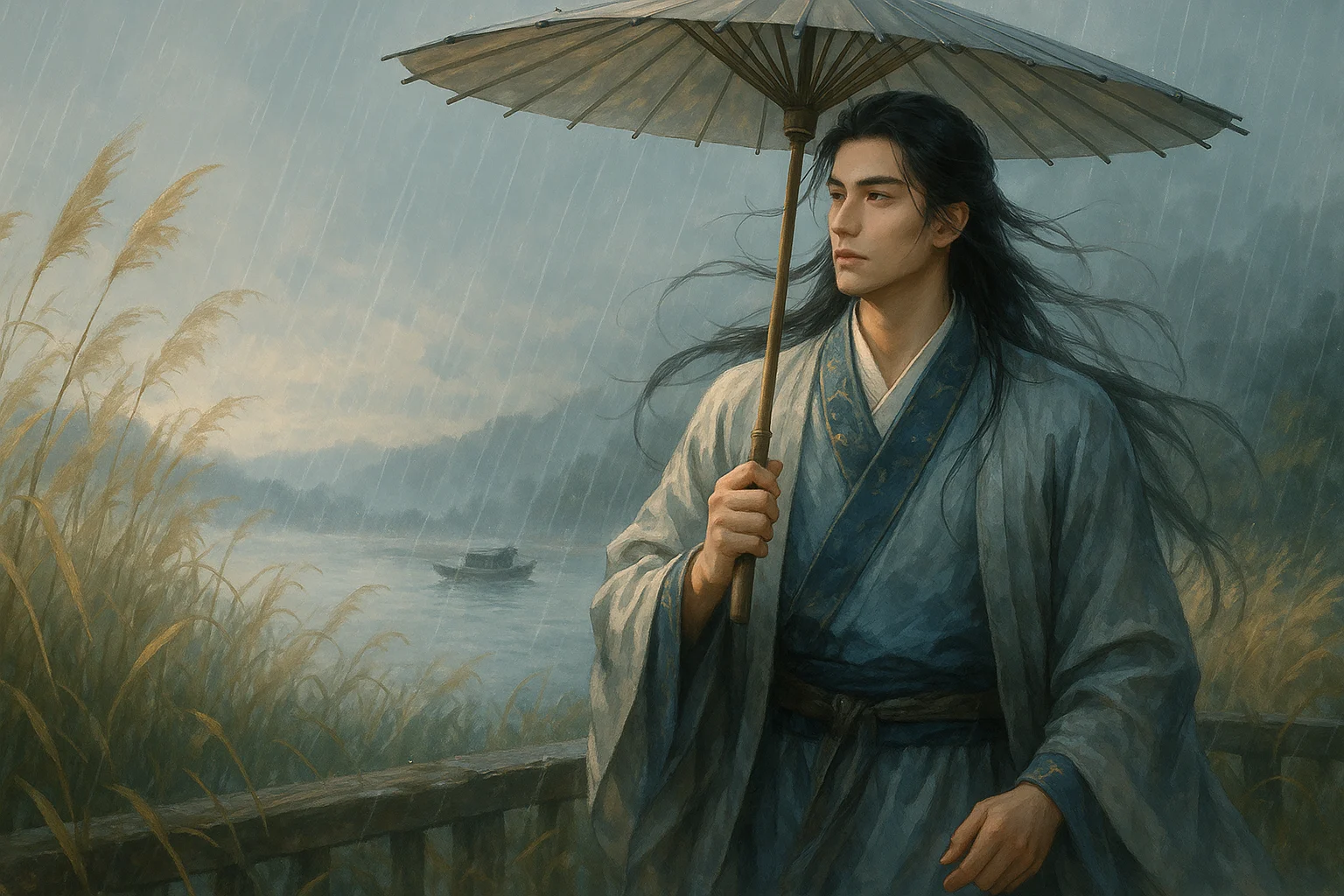
Xu Hun (许浑 c. 788 - c. 858), a native of Danyang, Jiangsu Province, was a renowned poet of the late Tang Dynasty. His ancestor was Xu Yushi, a chancellor during the reign of Empress Wu Zetian, and his family once held prominent status but had declined by Xu Hun's time. He obtained the jinshi degree in the sixth year of the Taihe era (832 AD) and successively served as magistrate of Dangtu and Taiping counties, eventually rising to the position of Vice Director of the Forestry and Crafts Bureau. As an important representative of the late Tang poetic circle, Xu Hun was celebrated for his mastery in depicting water and rain. His poetry often features nostalgic reflections on history, characterized by a desolate and solemn style. He excelled particularly in seven-character regulated verse, with language that is concise, refined, and harmonious in rhythm. Standing apart from Du Mu and Li Shangyin, he established his own distinctive school, exerting a profound influence on later poets such as Wei Zhuang and Luo Yin.