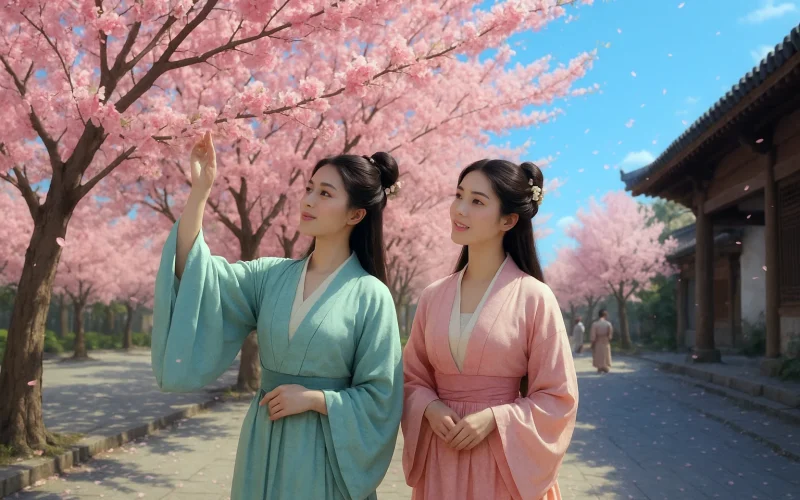



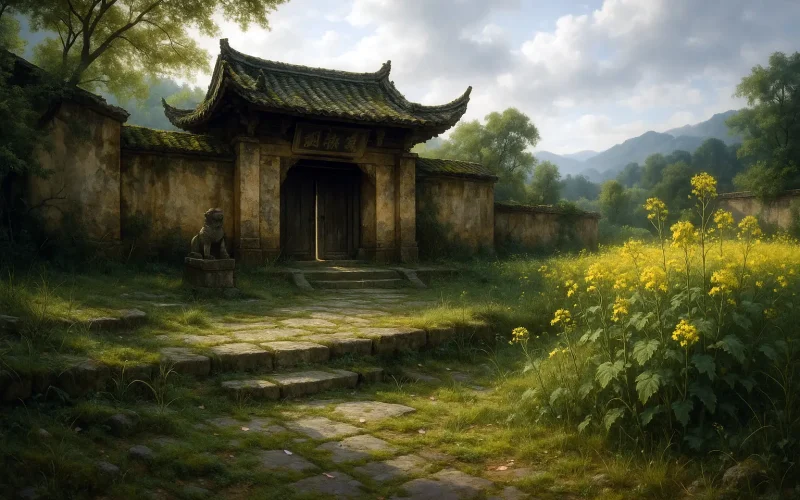
In half of the wide courtyard only mosses grow;
Peach blossoms all fallen, only rape-flowers blow.

Where is the Taoist planting peach trees in this place?
I come after I fell again into disgrace.
Original Poem
「再游玄都观」
刘禹锡
百亩庭中半是苔,桃花净尽菜花开。
种桃道士归何处,前度刘郎今又来。
Interpretation
This poem was composed in the second year of the Taihe era (828 AD) under Emperor Wenzong of Tang. Liu Yuxi was fifty-six years old. This year marked the end of his second, fourteen-year-long exile; he was recalled to Chang'an from his post as Prefect of He Prefecture and appointed Director of the Bureau of Receptions. Fourteen years earlier, in the tenth year of the Yuanhe era (815 AD), having just concluded a decade-long exile in Lang Prefecture, he returned to Chang'an. Visiting the Temple of Mystic Metropolis, he wrote "Playfully Presented to the Gentlemen Viewing Flowers upon Arriving in the Capital from Lang Prefecture in the Tenth Year of Yuanhe": "In the Temple of Mystic Metropolis, peach trees in full bloom / Were all planted after I, young Liu, left the room." The rulers at that time were newly risen nobles; Liu Yuxi used the peach trees as satire, his words carrying pointed mockery, and he was promptly exiled again, sent out as Prefect of Lian Prefecture. This departure lasted another fourteen years.
During those fourteen years, the imperial court underwent several changes. Emperor Xianzong passed away, Emperor Muzong ascended; Emperor Muzong passed away, Emperor Jingzong ascended; Emperor Jingzong passed away, Emperor Wenzong ascended. Those "Taoist priests who planted the peach trees" of yore—those in power who promoted the new nobles and purged dissidents—some had died, some had fallen, some had been exiled. And Liu Yuxi had actually survived and returned. In the spring of the second year of Taihe, he once again entered the Temple of Mystic Metropolis. The temple grounds, once filled with peach trees, were now utterly devoid of them. The courtyard was half-wild, overgrown with moss, with only a few plots of kitchen vegetables blooming with plain flowers. Standing in the empty courtyard, he wrote this seven-character quatrain hailed as "poetic history."
This is not an ordinary travelogue poem; it is a declaration to fate by one who has endured countless trials. Fourteen years ago, he was the exiled "young Liu"; fourteen years later, he remained that same "young Liu." The powerful nobles had long turned to dust, yet he was still writing poetry, still in Chang'an, still in the world of the living.
First Couplet: "百亩庭中半是苔,桃花净尽菜花开。"
Bǎi mǔ tíng zhōng bàn shì tái, táohuā jìng jìn càihuā kāi.
A hundred-acre courtyard: half is moss. Peach blossoms, utterly gone; vegetables bloom across.
The opening is a desolate, straightforward description. "A hundred-acre courtyard" emphasizes the former grandeur of the Temple of Mystic Metropolis; "half is moss" depicts its present neglect. Rise and fall are not stated, but implied in the silence. The poet does not describe how splendid the peach blossoms once were; he only writes of today's "utterly gone"—this is the violence of time, and also a political metaphor.
"Vegetables bloom" forms a sharp contrast with "peach blossoms gone." Peach blossoms symbolized wealth, power, and newly risen nobles; vegetable flowers represent humility, commonness, and rustic simplicity. Liu Yuxi expresses no regret, no lament; he merely records this fact coldly: those once-arrogant things now leave not even a shadow behind. The two words, "utterly gone," are decisive, leaving no room for doubt. This is the final verdict rendered by fourteen years of time.
Second Couplet: "种桃道士归何处,前度刘郎今又来。"
Zhòng táo dàoshi guī héchù, qiándù Liúláng jīn yòu lái.
Where have the Taoist priests who planted those peaches gone? / The Liu Lang of before has come again!
This couplet is the soul of the poem and one of the most famous political ironies in Chinese literary history.
"Taoist priests who planted those peaches" is a double entendre: literally, it refers to the Daoist priests who planted the peach trees in the temple grounds; figuratively, it covertly refers to those in power who promoted the new nobles and purged the old ministers. Liu Yuxi does not name names, but everyone knows whom he means. He does not rage, does not accuse; he merely asks lightly: "Where have they gone?"—Where are you now? The answer is self-evident: some dead, some fallen, some long forgotten. And that "young Liu" whom you exiled for fourteen years, "has come again."
"The Liu Lang of before" is the cultural persona Liu Yuxi created for himself. This self-reference contains both self-mockery and, even more, pride. Fourteen years ago he was "young Liu"; fourteen years later he is still "young Liu." He never changed, never bowed his head, never yielded to those "Taoist priests who planted the peaches." He simply returned, like fate's boomerang, piercing precisely through the veil of time. The three words, "has come again," are the poem's most resonant syllable. It is not "returned," "came back," or "come home"—it is "again" (yòu). Within this word lies the cycle of history, the irony of fate, and the most elegant challenge a defiant man can issue to power.
Holistic Appreciation
This poem is the most legendary piece in Liu Yuxi's life. Its four lines are structured like a folding fan: the first two lines are the fan surface, depicting the past and present transformation of the Temple of Mystic Metropolis; the last two lines are the fan ribs, abruptly converging and piercing towards the events of fourteen years ago. The poet condenses his personal ordeal into a contrast between two points in time, two visits—fourteen years ago, he was exiled for writing about peach trees; fourteen years later, the peach trees are gone, but Liu Lang remains. This contrast is not coincidence; it is a meticulously designed echo.
The poem's most startling aspect is that it contains no hatred, no anger, no resentment. Liu Yuxi does not question fate, does not accuse political foes, does not even reveal a trace of desolation. He merely walks calmly into that desolate temple, calmly observes the moss, the vegetable flowers, calmly asks: Where are those who planted the peaches? Calmly answers: Liu Lang has come again. This calmness possesses more destructive force than any vehement rebellion. It is not forgiveness; it is transcendence. It is not forgetting; it is bearing witness. Liu Yuxi stands on this shore of time, watching those once-arrogant nobles sink into the shadows of the opposite shore, while he himself stands in the sunlight.
Artistic Merits
- Exquisite Nesting of Temporal Structure: The poem implicitly contains three layers of time: the past splendor of the peach blossoms (not directly depicted), Liu Lang's first visit fourteen years ago, and Liu Lang's revisit today. These three temporal layers are interwoven and folded within the twenty-eight characters, creating a resonance between historical depth and personal fate.
- Political Encoding of the Imagery System: "Peach blossoms" metaphorize the newly risen nobles, those in power, the ones momentarily at the height of their power and influence; "vegetable flowers" metaphorize the humble, the rustic, the forgotten; "the Taoist priests who planted the peaches" metaphorize the ruling faction that promoted those new nobles; "young Liu" is the poet's self-reference. This metaphorical system is so precise that it became a prototypical model for interpreting political allegorical poetry in later ages.
- The Rhetorical Suspension of "Where have they gone?": While ending with a question is a common poetic technique, Liu Yuxi's question seeks no answer—because the answer is already glaringly obvious in the words "utterly gone." This rhetorical device of posing a question whose answer one already knows represents the highest form of irony.
- Cultural Self-Fashioning of "The Liu Lang of Before": Liu Yuxi spent fourteen years refining the self-reference "young Liu" into one of the toughest cultural personas in the history of Chinese literature. Thereafter, for millennia, "the Liu Lang of before" became synonymous with enduring countless trials while remaining unchanged in heart.
- Rhythmic Explosion of the Closing Line: The poem's first three lines consist of measured, descriptive narration and rhetorical questions; the final line, "has come again," strikes like a heavy hammer on a drum, concluding with abrupt force. The sudden, decisive shift in rhythm perfectly merges with the proud declaration in its content.
Insights
This poem conveys a simple truth: Time will handle many things for you; you just need to survive and retain the ability to bear witness.
Liu Yuxi did not overthrow a single political foe, did not seek redress, did not even complain in his poem. He merely wrote down the desolation he saw, wrote down his own return. When he placed these two facts side by side, "those who planted the peaches" and "the Liu Lang of before" automatically constituted history's judgment—not him judging his opponents, but time judging for him. His greatest strength was not talent, but endurance. Fourteen years of exile did not teach him to bow his head, did not make him renounce his former self. Using the self-reference "the Liu Lang of before," he declared that he had never changed. This stubbornness may not have been wise, but it sustained him through the long night.
For today's reader, the most valuable aspect of this poem is not "revenge" or "victory," but a way of dealing with setbacks. Not fierce confrontation, not succumbing to despondency thereafter, not feigned broad-mindedness—simply swallowing the grievance, living out the days, writing down what should be written. Perhaps you will not receive an apology; perhaps you can never prove yourself right. But you can outlive your opponents; you can record this piece of history. This is not heroism; it is the highest degree of resilience within an ordinary person's reach.
Poem translator
Xu Yuanchong (许渊冲)
About the poet
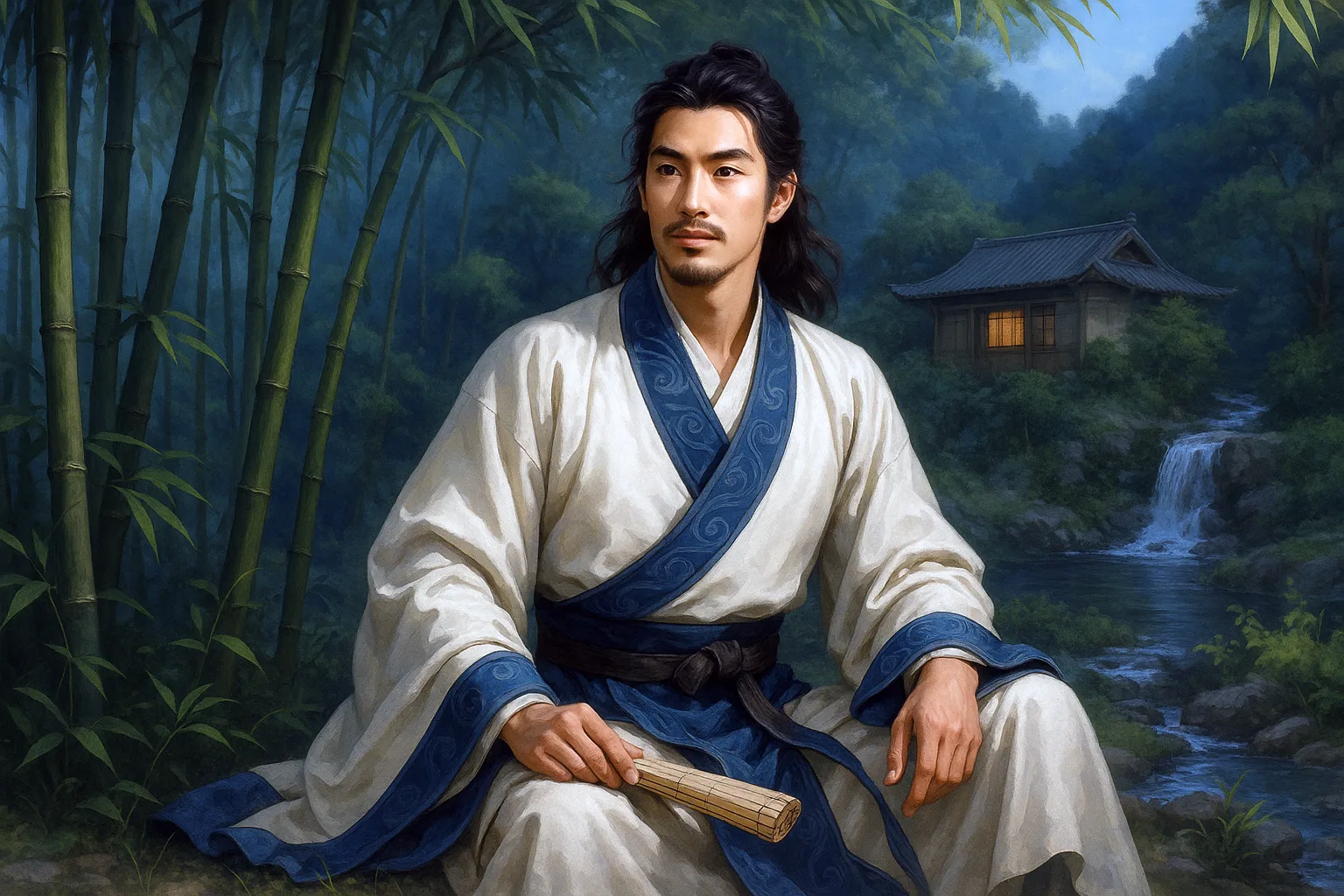
Liu Yuxi(刘禹锡), 772 - 842 AD, was a native of Hebei. He was a progressive statesman and thinker in the middle of the Tang Dynasty, and a poet with unique achievements in this period. In his compositions, there is no lack of poems reflecting current affairs and the plight of the people.