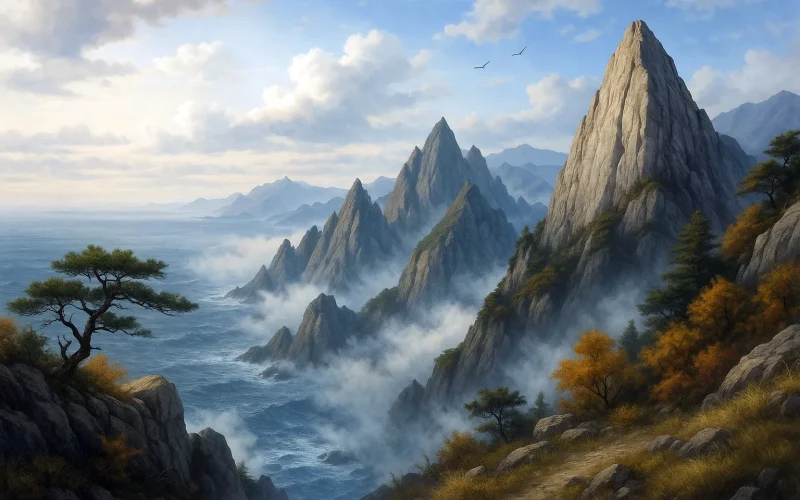
The seaside rocky hills look sharp like sword or dart;
They thrust out when autumn comes to cut and break my heart.
If I could be transformed into rocks, I would stand
Atop a thousand peaks to watch for my homeland.
Original Poem
「与浩初上人同看山寄京华亲故」
柳宗元
海畔尖山似剑铓,秋来处处割愁肠。
若为化得身千亿,散上峰头望故乡。
Interpretation
This poem was composed in the autumn of the 12th year of the Yuanhe era (817 AD) during Liu Zongyuan's tenure as Prefect of Liuzhou, a time of exile. By then, twelve years had passed since the failure of the Yongzhen Reforms, and over two years since his second demotion from Yongzhou to Liuzhou. Liuzhou, located in the Guangnan West Circuit, was even more remote and desolate than Yongzhou. As a prefect, though he had local administrative duties, Liu Zongyuan could never shake off the identity of a "convict"—a man discarded by the court, an exiled official who could never return north. The "Monk Haochu" mentioned in the poem was a monk with whom Liu Zongyuan was friends. While touring and viewing the mountains together, the scenery stirred the poet's emotions, prompting him to write this poem to send to his family and friends in Chang'an.
The core image of this poem is the "sharp peaks." Liuzhou abounds in rocky mountains, their peaks steep as swords, piercing the clouds. In the poet's eyes, these peaks are no longer natural scenery but blades stabbing at his heart. "When autumn comes, they pierce my heart with pain everywhere"—the desolation of autumn intertwines with the sharpness of the mountains, making the already intense sorrow unbearable. The latter two lines of the poem suddenly present a fantastic idea: "If I could turn myself into a billion selves, / I'd stand on every summit gazing towards my home." He wishes to transform into a billion selves, standing atop every peak, gazing northward—towards his homeland, his loved ones, the world to which he can never return.
First Couplet: "海畔尖山似剑铓,秋来处处割愁肠。"
Hǎi pàn jiān shān sì jiàn máng, qiū lái chù chù gē chóu cháng.
Like sword-points, sharp peaks pierce the sea-side skies;
When autumn comes, they pierce my heart with pain everywhere.
The opening uses a startling metaphor for a startling scene, and a startling scene for startling sorrow. "Sea-side" clarifies Liuzhou's geographical location—though not coastal, in the Tang context, "sea-side" often broadly referred to the coastal regions of Lingnan. "Sharp peaks pierce the sea-side skies" compares the mountain peaks to sharp sword-points, both capturing the unique topography of Liuzhou's rocky mountains (steep, pointed, like swords and halberds) and imbuing the natural landscape with intense emotional color.
"When autumn comes, they pierce my heart with pain everywhere"—autumn is inherently a season that multiplies sorrow, and the word "everywhere" spatializes the grief: each peak is a sword, cutting the poet's "guts" (heart, soul). The word "pierce" ("gē") is extremely harsh and heavy, transforming intangible sorrow into tangible pain, making the reader feel as if they can sense the sharp agony of the blade slicing through the heart. This couplet uses the sharpness of the mountains to write of the bitterness of the heart, blending object and self, deeply震撼.
Second Couplet: "若为化得身千亿,散上峰头望故乡。"
Ruò wéi huà dé shēn qiān yì, sǎn shàng fēng tóu wàng gù xiāng.
If I could turn myself into a billion selves,
I'd stand on every summit gazing towards my home.
This couplet turns from sorrow to fantasy, using extreme exaggeration to express extreme longing. "If I could" ("Ruò wéi") means "how could I" or "if only," expressing the poet's knowledge of impossibility while indulging in the imagination. "Turn myself into a billion selves" originates from Buddhist scripture, referring to the Buddha's ability to manifest in billions of forms. Perhaps inspired by Buddhist teachings during his outing with Monk Haochu, the poet conceived this strange idea. "I'd stand on every summit gazing towards my home"—the word "stand" ("sǎn") paints the image of billions of selves scattered across the peaks; the word "gazing" writes of that eternal stare. Unable to reach his homeland in person, the poet would have his billions of selves stand atop every peak, gazing north day and night. This posture of "gazing" is his only connection to his homeland, the ultimate expression of his irrepressible longing.
The fantasy in this couplet is both an outburst of emotion and a revelation of despair. Precisely because he cannot return, he needs to transform into billions; precisely because reality is hopeless, he can only entrust his feelings to imagination. Those billions of selves, billions of gazes, can ultimately only "gaze" without returning—behind this strange imagination lies even deeper sorrow.
Holistic Appreciation
This heptasyllabic quatrain uses "viewing the mountains" as the occasion, with "gazing towards home" as the theme, expressing deep sorrow through strange imagination. The first two lines describe the scenery, comparing mountains to swords, using "pierce" to write sorrow, merging external scene with internal feeling, creating a desolate and sharp emotional atmosphere. The last two lines express emotion, suddenly presenting the fantastic idea of transforming into billions to gaze homeward, magnifying personal longing to the extreme, and rendering that longing even more凄怆 due to its impossibility.
The entire poem is tightly structured, intensely emotional. The "sword-points" and "pierce my heart" of the first two lines foreshadow the "billion selves" of the last two—precisely because of these sword-like sharp peaks, he needs billions of selves to climb them; precisely because his "guts are wrenched," he longs even more to see his homeland. The parts echo each other, forming a seamless whole.
Compared to Liu Zongyuan's more subtle and restrained poems, this one's emotion is more exposed, its imagination stranger. The "sword-point" sharp peaks, the painful "piercing" of the guts, the fantasy of "a billion selves"—all reveal the depth of the poet's pent-up feelings and the intensity of his expression. Yet even so, the poem still shows restraint—he does not cry out, does not weep; he only lets those billion selves silently "gaze" towards home. This posture of "gazing" is more moving than any shout.
Artistic Merits
- Startling Metaphor, Sharp Imagery: The metaphor "Like sword-points, sharp peaks" captures both the unique topography of Liuzhou's landscape and imbues the scenery with intense emotional color, becoming the poem's poetic eye.
- Strange Imagination, Intense Emotion: The fantasy of "a billion selves" magnifies personal longing to the extreme, reflecting both the poet's deep attachment to his homeland and his despair at being unable to return.
- Infusing Scene with Feeling, Blending Object and Self: The first two lines use the sharpness of the mountains to write the bitterness of the heart; the last two lines use the化身 gazing homeward to write the depth of longing; scene and emotion, object and self are highly fused.
- Concise Language, Profound Artistic Conception: Within twenty-eight characters, there is strange scenery, strange metaphor, and strange imagination; the words are simple yet rich, the aftertaste long.
Insights
This poem first enlightens us on how to transform personal pain into artistic power. Liu Zongyuan, exiled to Liuzhou, far from his homeland, experienced pain that was genuine and heavy. Yet he did not remain at the level of groaning and lamenting; he condensed this pain into the startling metaphor of "sharp peaks" like "sword-points" and sublimated it into the fantastic idea of "a billion selves" gazing homeward. This ability to transform pain into art is literature's most precious gift, and a spiritual posture that everyone in adversity can learn—not to be consumed by pain, but to use pain to temper a light.
The word "pierce" ("gē") in "When autumn comes, they pierce my heart with pain everywhere" also makes us contemplate the sharpness and inescapability of pain. Liu Zongyuan's sorrow is not a faint melancholy but the acute pain of being "pierced." This kind of pain cannot be avoided, cannot be dissolved; it can only be endured. It enlightens us: Some pain is simply this sharp, this inescapable. Facing such pain, we need not force ourselves to "look on the bright side," need not force ourselves to "let go"; acknowledging its existence, acknowledging its sharpness, is itself a form of honesty.
The fantasy of "If I could turn myself into a billion selves, / I'd stand on every summit gazing towards my home" also makes us contemplate the nature and limits of longing. The poet wants to transform into billions, to stand on every peak gazing towards his homeland. But this "gazing" is ultimately only "gazing"—he can gaze, but cannot return; he can long, but cannot arrive. This eternal distance between longing and arrival is the fundamental dilemma of human emotion. Liu Zongyuan's poem tells us: Longing itself holds value; even if arrival is forever impossible, that posture of "gazing" is enough to define who we are.
The figure standing on the peak, gazing towards his homeland, is especially moving. He is not one person but billions of selves, scattered atop every peak. These billion figures, billion gazes, all face the same direction—north, home. This image is both the ultimate expression of despair and the ultimate expression of deep feeling. It teaches us: True deep feeling does not diminish with distance, does not fade with hopelessness; it will stand on every peak, will gaze in every autumn, until life's end.
About the poet:
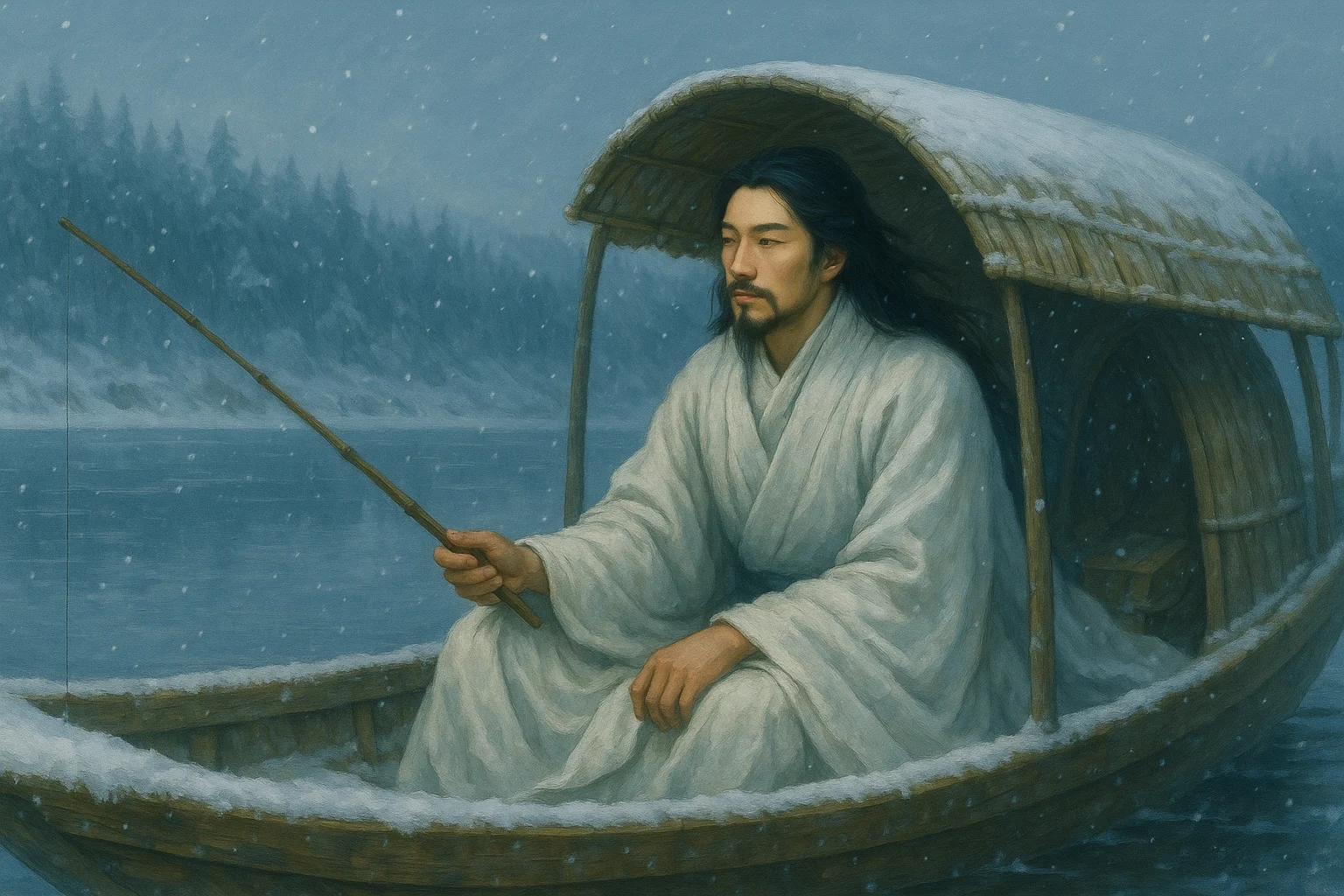
Liu Zongyuan (柳宗元), 773-819 A.D., a native of Yongji, Shanxi, was a progressive thinker, brilliant writer, and revolutionary statesman of the Tang Dynasty. Nineteen years before he was born, the An Shi Rebellion broke out, which dramatically changed the Tang Dynasty from prosperity to decline. The subsequent failure of the Yongzhen Reform was a historical tragedy that cut short Liu Zongyuan's political future, but made him one of the leading thinkers and literary figures of the Tang Dynasty.