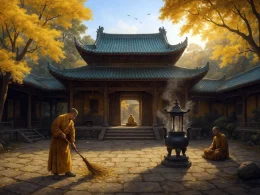



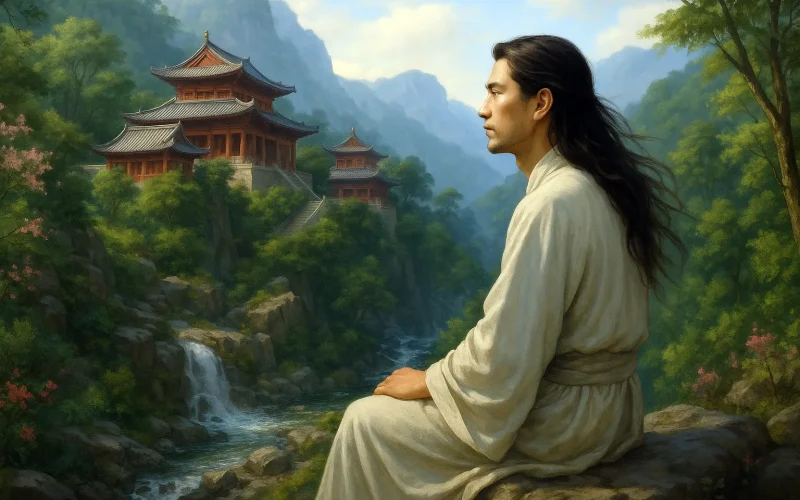
Playing with pebbles by the rill,
Looking for flowers around the hill.
I hear birds sing now and again,
And springs all o’er the ground complain.
Original Poem
「遗爱寺」
白居易
弄石临溪坐,寻花绕寺行。
时时闻鸟语,处处是泉声。
Interpretation
This poem was written between 815 and 818 AD, during the Yuanhe reign of Emperor Xianzong, a period when Bai Juyi served in the demoted post of Marshal of Jiangzhou. This demotion was a major setback in the poet's political career. However, in Jiangzhou, the majestic Mount Lu and its serene ancient temples provided him with a spiritual refuge and a space for mental healing. Yiai Temple is a product of this state of mind. It is not a grand ode to landscapes, but rather selects a few of the most ordinary moments from a corner of the mountain temple. Through a series of delicate actions and auditory experiences, it outlines the vivid process of how the poet, by immersing himself completely in nature and interacting with all things, finds inner peace. It is a miniature travelogue that embodies the concept of "poetic dwelling in exile."
First Couplet: 弄石临溪坐,寻花绕寺行。
Nòng shí lín xī zuò, xún huā rào sì xíng.
I sit by the stream, turning a stone in hand; / I walk round the temple, searching for blooms in the land.
Explication: The poem opens with two consecutive action shots, depicting the poet’s intimate interaction with nature. The word "turning… in hand" (弄) implies not casual play but appreciative, inquisitive touch—a direct dialogue between hand and nature’s creation. "Sit by the stream" places this action beside a clear flow, instantly conveying a posture of quiet observation and contemplation. "Walk round the temple, searching for blooms" shifts from stillness to movement. The word "searching" lends purpose and delight to the action, while "round" suggests a leisurely, meandering path—not heading straight for a goal, but enjoying the journey itself. The two lines, one sitting and one walking, one touching and one searching, through physical contact with space (by the stream, round the temple), reveal the poet’s leisurely demeanor and keen interest as he actively explores and immerses himself in the details of nature.
Second Couplet: 时时闻鸟语,处处是泉声。
Shíshí wén niǎo yǔ, chùchù shì quán shēng.
At every moment, birdsong comes to my ear; / In every place, the spring’s voice is all I hear.
Explication: This couplet shifts from the active seeking of visual and tactile experience to the passive immersion and all-encompassing embrace of sound. "At every moment" and "In every place" create a dual overlay in time and space, emphasizing the continuous and pervasive nature of these natural sounds—inescapable, yet with no desire to escape. "Birdsong" is a sound from above, lively, skipping, rich with the zest of life; "the spring’s voice" is a sound from the ground, constant, clear, and rhythmic. One high, one low; one lively and fleeting, the other constant and serene—they intertwine to form a three-dimensional, harmonious web of natural music enveloping the entire Yiai Temple environment. The poet no longer needs to deliberately "turn" or "search"; he is already completely embraced and soothed by this beautiful soundscape. The words "comes" and "is" calmly state this passive, yet richly fulfilling, sensory enjoyment.
Holistic Appreciation
This pentasyllabic quatrain is a dynamic portrait of a mind returning to seclusion. Its structure is exquisite, presenting two layers of the poet’s relationship with nature: the first two lines show "I approaching nature"—establishing connection through active physical deeds (turning, sitting, searching, walking), reflecting human agency and curiosity. The last two lines show "nature surrounding me"—where the ubiquitous natural music (birdsong, spring’s voice) takes the dominant role, gently enveloping the poet, reflecting nature’s capacity for embrace and healing. Together, the four lines complete a full experiential process: from active immersion to passive absorption, ultimately reaching a state of clarity where self and world merge. Not a word directly expresses emotion, yet the poet’s loneliness in exile is here transformed into专注 and delight in the subtle beauties of nature. A sense of temporary joy and transcendent thought—that "where the heart finds peace, there is my home"—vividly emerges from the page.
Artistic Merits
- Narrative Flow Through Verbs: The sequence of five verbs—"turning," "sit," "searching," "walk," "comes"—clearly outlines a complete journey, lending dynamic vitality and a flowing narrative quality to the static scenery. The reader is invited to follow the poet’s steps and senses on this stroll.
- A Multi-Dimensional Mood Built on Synesthesia: The first couplet emphasizes touch (turning a stone), sight (searching for blooms), and bodily sensation (sitting, walking). The second couplet fully deploys the sense of hearing (birdsong, the spring’s voice). Moving from the concrete to the abstract, from active perception to passive reception, the poem constructs a rich, three-dimensional atmosphere with layers progressing from specific action to a pervasive mood.
- Euphony Through Parallelism and Repetition: "Turning a stone" pairs with "searching for blooms"; "sit by the stream" with "walk round the temple"; "At every moment" with "In every place"; "comes to my ear" with "is all I hear." The precise parallelism and the use of repetitive phrases like "At every moment" and "In every place" create a light, circular rhythm that perfectly matches the poem’s leisurely, joyful mood.
- Highly Condensed Language and Plain Description: All twenty characters are common words, employing only plain description, yet the imagery is vivid and the atmosphere fully realized. Eschewing all ornamentation and direct lyrical expression, and presenting only actions and sounds themselves, it achieves the suggestive effect of "conveying the essence without explicitly stating the emotion." This reflects the artistic ideal in Bai Juyi’s later poetic style of returning to simplicity.
Insights
In the most unadorned way, this poem reveals the path to establishing a deep connection with nature: not through distant admiration, but through wholehearted immersion and interaction. Bai Juyi’s "turning a stone" and "searching for blooms" are acts of participation with childlike curiosity; his listening to "birdsong" and the "spring’s voice" represent complete acceptance after letting go of the self. In the hardship of exile, he did not wallow in sorrow but turned to the microscopic natural world, rediscovering life’s interest and the universe’s order in a single stone, a bloom, a bird’s call, a spring’s murmur.
This poem offers a poignant insight for modern spiritual life. In an age saturated with virtual experiences and grand narratives, have we lost the leisure for "sit by the stream, turning a stone in hand" and the patience for "At every moment, birdsong comes to my ear"? Bai Juyi shows us that the healing and tranquility of the mind often begin with专注 contact and attentive listening to the smallest, most concrete natural objects around us. Without traveling far, perhaps by simply seeking an interesting stone in a park, carefully identifying the name of a flower, or quietly listening for a moment to birdsong or the sound of flowing water, we, like the poet, can find our own inner "Yiai Temple" amidst the surrounding spring's voice. This is both an aesthetic of living and a wisdom for maintaining spiritual autonomy in a tumultuous world.
About the Poet
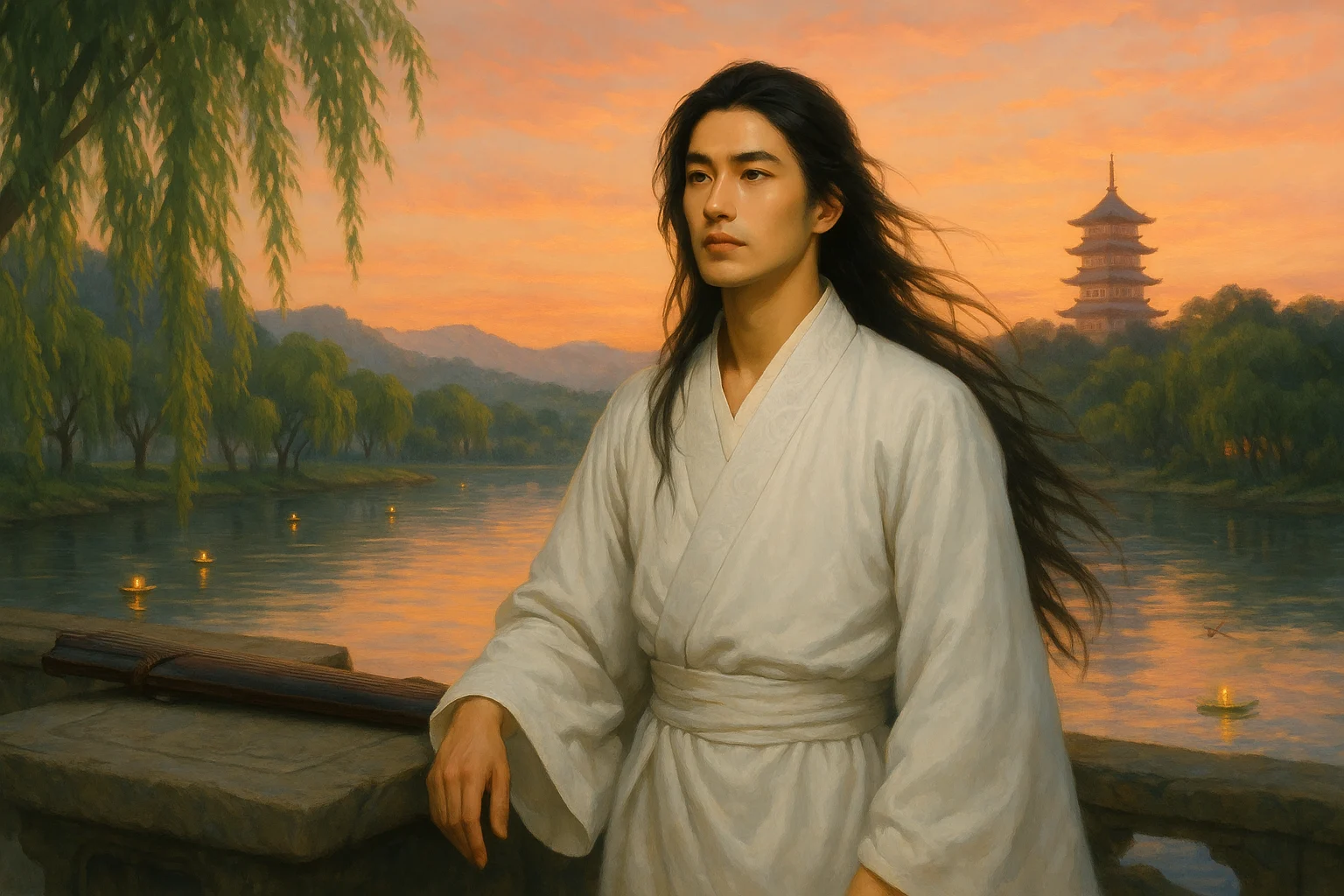
Bai Juyi (白居易), 772 - 846 AD, was originally from Taiyuan, then moved to Weinan in Shaanxi. Bai Juyi was the most prolific poet of the Tang Dynasty, with poems in the categories of satirical oracles, idleness, sentimentality, and miscellaneous rhythms, and the most influential poet after Li Bai Du Fu.