


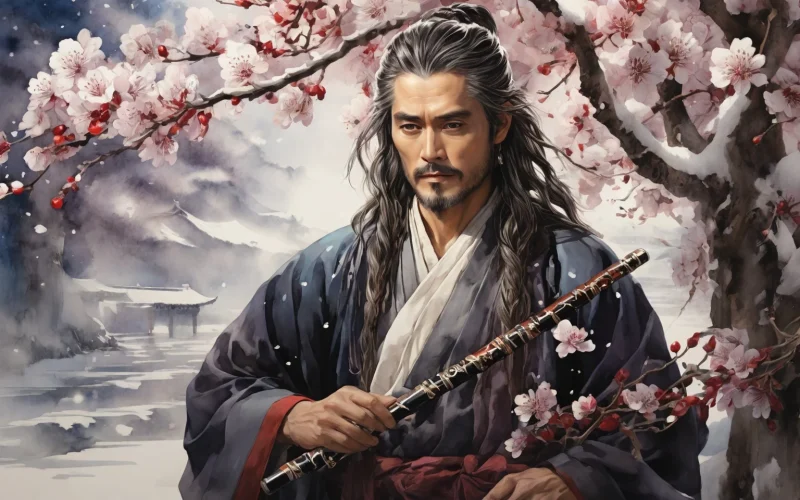
The flute played on "Mume Blossoms" on Northern Frontier,
"The Laurel Branch" to Southern River shore was dear.
They were sung in the former dynasties for long.
Now listen to my newly composed "Willow Song".
Original Poem
「杨柳枝词九首 · 其一」
刘禹锡
塞北梅花羌笛吹,淮南桂树小山词。
请君莫奏前朝曲,听唱新翻杨柳枝。
Interpretation
This poem was composed around the third year of the Kaicheng era (838 AD) under Emperor Wenzong of Tang, when Liu Yuxi was sixty-seven years old. Serving as the Crown Prince's Guest with duties in the Eastern Capital, he exchanged poetic compositions and shared wine with Bai Juyi in Luoyang, spending their later years together. This year marked twenty-three years since his re-exile for the lines "In the Temple of Mystic Metropolis, peach trees in full bloom/ Were all planted after I, young Liu, left the room"; and thirty-three years since his initial exile to Lang Prefecture, when he first embarked on the long road of banishment. The "Yongzhen Reform" of those years had long become a sealed case of the past. Of the ten men involved, the "Two Wangs and Eight Simas" had either died or been exiled; he was one of the few who had not only returned alive to Chang'an but had also retired alive to Luoyang.
It was this old man with frost-white hair who, amid the spring scenery of Luoyang, took up the ancient yuefu title "Willow Branch Song" along with Bai Juyi. The Han yuefu had "Breaking the Willow," the Northern and Southern Dynasties had "Monthly Festival Song of Breaking the Willow," and the Tang people also had the minor tune "Willow Branch Song"—originally folk ballads using the willow to symbolize parting and the branch to convey emotion. But Liu Yuxi and Bai Juyi intended to "renew" it with new meaning—each composed nine songs, responding to and answering each other, transforming this old tune into a new voice expressing literary ideals and life's reflections. "The Northern frontier plums blow on the Di flute; / The laurel in the south sings the poet's lute"—this is Liu Yuxi, before opening his own song, first making a deep bow to tradition. It was not that he did not know how fine these "songs of bygone days" were; he was simply saying: Please, step aside for a moment, and listen to this new tune this old man has composed. This bow is a tribute; this request to step aside is confidence.
First Couplet: "塞北梅花羌笛吹,淮南桂树小山词。"
Sàiběi méihuā qiāngdí chuī, Huáinán guìshù Xiǎoshān cí.
The Northern frontier plums blow on the Di flute; / The laurel in the south sings the poet's lute.
The beginning presents two distant cultural vignettes. "Plums" refers to the Han yuefu horizontal flute song "Plum Blossoms Fall," played on the Qiang flute, its tone desolate, often lamenting the wandering life on the frontier; "laurel" refers to the Western Han piece "Summoning the Recluse" by Huainan Xiaoshan: "Laurels grow thick in mountain shades profound," written in the style of the Chuci, expressing thoughts of secluded dwelling in wooded hills. One north, one south; one flute song, one poetic verse; one frontier soldier, one recluse—these two images are not connected, yet Liu Yuxi places them side by side in the same couplet.
This is not showing off erudition, but rather outlining the cultural landscape he faces in the most condensed manner. Han and Wei yuefu, the Chuci and sao style—all are "songs of bygone days" passed down for millennia. The poet clearly knows their value; otherwise, he would not solemnly mention them at the very outset. The tone of this couplet is respectful, serene, without any hint of disdain.
Yet respect does not mean stopping. The best way to honor predecessors is not to repeat them, but to continue walking forward on the path they opened.
Second Couplet: "请君莫奏前朝曲,听唱新翻杨柳枝。"
Qǐng jūn mò zòu qiáncháo qǔ, tīng chàng xīn fān yángliǔ zhī.
Please do not play the tunes of ages gone by; / Listen instead to the willow branch newly sung.
This couplet is the soul of the poem and also the ultimate declaration of Liu Yuxi's lifelong literary spirit.
"Please do not play"—it is not a reprimand, not a dismissal, not even a negation. It is a composed invitation, a confident suggestion. The poet does not say "the tunes of bygone days are bad"; he merely says: Please pause them for a moment, and listen to this new one of mine.
"Newly sung" is the poetic eye of the entire piece. It is not "newly composed," "newly created," or "newly made"—it is "renewed" (fān)—turning over, renovating, transforming the old tune to reveal another layer of artistic conception. Liu Yuxi does not believe he is starting from scratch; he is merely sowing seeds of the present day in soil cultivated by the ancients.
"Willow branch" is the vessel he chooses. This old yuefu theme once wrote exhaustively of parting sorrows, breaking willow branches for farewells afar; yet Liu Yuxi and Bai Juyi used it to write of local customs, seasons, worldly affairs, and the state of old age. It is still that willow tree, but its branches and leaves are now new growth.
In Bai Juyi's matching poem, he writes: "The ancient songs, the old tunes, sir, hear them no more; / Hear instead the willow branch newly sung." Two septuagenarian old men smiled at each other across the poetic page. They had experienced too much, lost too much, yet never lost their yearning for the "new."
Holistic Appreciation
This poem is the most concise, most perfect expression of Liu Yuxi's poetic philosophy in his later years. The poem has four lines, its structure extremely simple: the first two lines present the ancient, the last two speak of the present. Yet this "presentation of the ancient" is not the object of critique, but the silhouette to which homage is paid; this "speaking of the present" is not arrogant self-praise, but a composed invitation. Standing between Han-Wei yuefu and the Chuci/sao style, and also at the endpoint of his own creative journey spanning over sixty years, the poet extends to the world a willow branch newly sung.
In this poem, there is none of the desolation of "Sunken boats side by side, beyond, a thousand sails pass," none of the austere resilience of "Don't say the mulberry-grove late," none of the poignant bitterness of "I have long regretted that men's hearts are less secure than water." It possesses only a kind of composed confidence attained after weathering countless storms. Liu Yuxi no longer needed to prove anything to anyone, no longer needed to argue with anyone. He merely says softly: Those old tunes of bygone days, you have all heard them; now listen to this new melody of mine, an old man's tune. This is the gentlest line in the "Poetic Hero's" lifetime.
Artistic Merits
- Reverent Use of Allusion: "Plums" refers to "Plum Blossoms Fall"; "laurel" refers to "Summoning the Recluse." Unlike many poets of his time who used allusions for self-display, or unlike his younger self who used them to lodge sentiments, Liu Yuxi merely mentions them calmly, as if nodding in acknowledgment to two predecessors. This attitude of respect without sycophancy, citation without dependency is the mark of consummate mastery in his later years.
- The Expansive Elegance of Parallelism: The first couplet parallels "Northern frontier" with "south of Huai," "plums" with "laurel," "Di flute blow" with "poet's lute"—each character meticulously matched yet showing no trace of artifice. This realm of perfect craftsmanship that appears effortless, parallelism without rigidity is the result of sixty years of refinement.
- The Invitational Posture of "Please, Sir": The tonal anchor of the entire poem lies in "Please, sir" (Qǐng jūn). This is not a command from above, nor a cynical sneer, but an invitation to an elegant gathering among peers. The poet treats the reader as a kindred spirit with whom he can converse, treating "listen instead to the willow branch newly sung" as a literary and convivial gathering. This invitational posture is more powerful than any manifesto.
- The Dialectic of Time in "Newly Sung" and "Bygone Days": The poet does not oppose "new" and "old" as irreconcilable polar opposites. He first solemnly recounts the renowned pieces of the "tunes of bygone days," then composedly invites his listeners to turn to the "newly sung" work. This is innovation within continuity, not revolution through rupture. He deeply understood: without the nourishment of a millennium of "plums" and "laurel," there would be no new voice of today's "willow branch."
- The Self-Metaphor of the Imagery: "Willow branch" is the title of this poem, and also Liu Yuxi's self-metaphor in his later years. The willow is not a famous flower, not a pillar or beam, yet it is the plant that first dons green in spring, that most understands the feeling of the wind when it comes. It is pliant, easily broken, yet can grow anywhere. The "Poetic Hero's" willow that Liu Yuxi planted in Luoyang still hangs with new branches by the waterside of literary history.
Insights
This work tells us: True innovation is not smashing the lutes of the ancients, but tuning one's own strings. Liu Yuxi's attitude towards the "tunes of bygone days" is worth our deep reflection. He did not, like some radicals, view tradition as an obstacle that must be overthrown; nor did he, like some conservatives, revere ancient tunes as an insurmountable peak. He simply listened to them respectfully, and then said: Please listen to mine.
This is the healthiest attitude towards tradition—knowing its worth, yet not confined by that worth; bearing its weight, yet not burdened by that weight. With the two words "newly sung," he defined the essence of innovation: it is not creation from nothing, but growing the flesh and blood of a new voice within the skeleton of the old tune. Facing innovation, contemporaries often fall into two extremes: either viewing tradition as shackles, resolutely "overthrowing the house of Confucius"; or viewing tradition as the standard, slavishly "returning to Han and Tang." Liu Yuxi offers a more mature paradigm: demoting tradition from "authority" to "resource." He no longer kneels to listen to the tunes of bygone days, nor does he smash the lute and never play again. He simply retunes the strings and plays a song of his own. This sixty-seven-year-old man was still using a new voice to converse with the world. He did not know how much time he had left, nor how far these newly sung willow branches would travel. He simply sat in the spring breeze of Luoyang, extending a gentle invitation to every listener who passed by.
A thousand years later, we are all the invited.
Poem translator
Xu Yuanchong (许渊冲)
About the poet
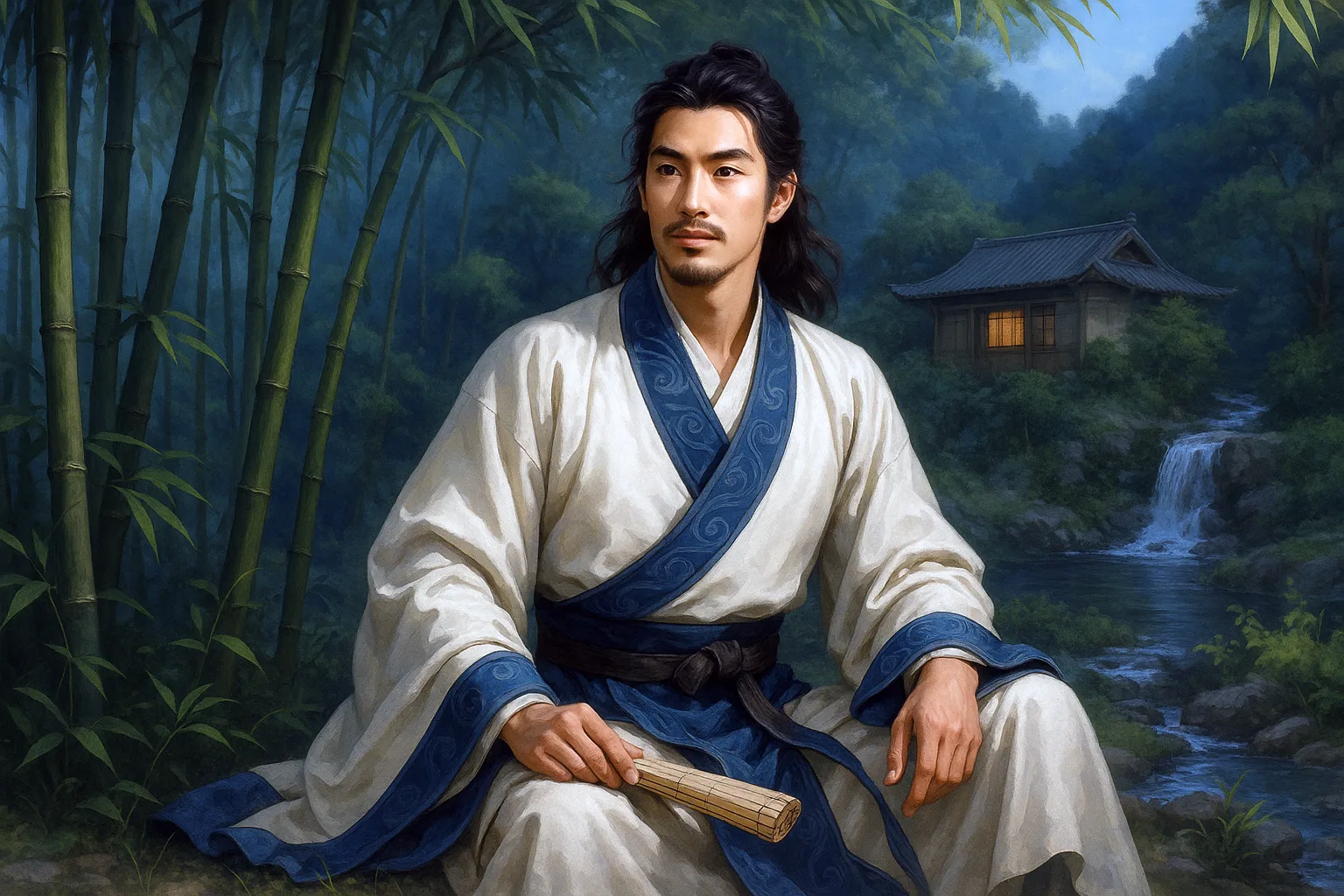
Liu Yuxi(刘禹锡), 772 - 842 AD, was a native of Hebei. He was a progressive statesman and thinker in the middle of the Tang Dynasty, and a poet with unique achievements in this period. In his compositions, there is no lack of poems reflecting current affairs and the plight of the people.