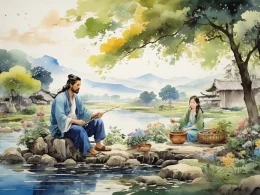



I have but seen the wild geese towards Loyang fare,
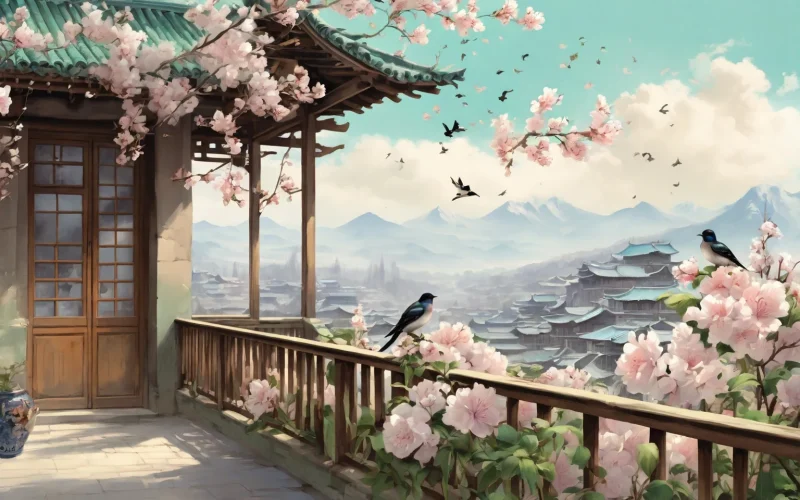
And now the dark swallows for the spring‑tide are here;

The lute of jade, the flute of the same fair stone —
No mind, no heart, no music, and alone.

Vain, all vain, the strings, the stops, the breath;
Leave it for the spider to spin out death;
Leave it for the dust to gather, and the air
To make it, in the end, but mute ash there.
Original Poem
「燕子楼 · 其三」
张仲素
适看鸿雁洛阳回,又睹玄禽逼社来。
瑶瑟玉箫无意绪,任从蛛网任从灰。
Interpretation
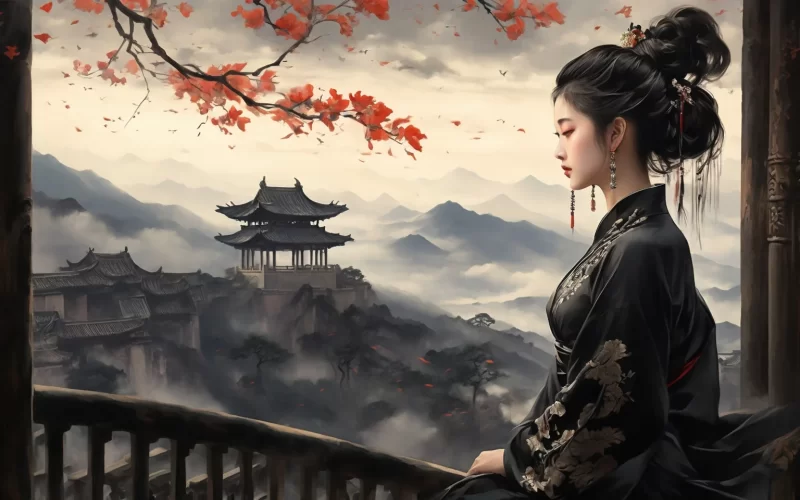
"The Swallow Tower" is a set of three famous poems by the Mid-Tang poet Zhang Zhongsuh; this is the third. Swallow Tower was located in Xuzhou, built by the renowned Tang general Zhang Yin for his beloved concubine, Guan Panpan. After Zhang Yin's death, Panpan, cherishing their old love, did not remarry. She lived alone in this tower for over a decade, ultimately starving herself to death, leaving behind a poignant and moving love story. This poem concludes the set, and its theme is "resignation and finality." The first poem described her morning after a sleepless night, using "The lonely sleeper rises from the lovebird bed" to write the pain of objects remaining but people changed. The second poem described her ten years of remembrance in the tower, using "For ten long years my dancing sleeves have lost their sweet perfume" to write the weight of time. This poem writes of her utter abandonment—the jeweled zithers and jasper flutes, she lets them gather dust and cobwebs; youth and prime, she lets them waste away and vanish. That resolute "To let them gather dust and be covered with cobwebs" is her farewell to the past, and also her answer to fate: since he is not here, all past splendor is meaningless.
In classical poetry, many works praising a woman's fidelity extol her steadfastness; many poems of longing recount her pain. Zhang Zhongsuh's poem, however, is uniquely conceived. It uses the seasonal shift of "No sooner seen off swans returning" and "Then I see dark-winged birds coming back" to write of her year-after-year waiting. It uses the dusty neglect of "zithers of jade" to write of her final rejection of past splendor. The wild geese come from Luoyang—Zhang Yin's burial place—but bring back no news. The swallows fly in pairs, forming a stark contrast to her solitary life in Swallow Tower. And the "zithers of jade" were the instruments of the joyous feasts and songs of the past; now she has "no heart" to play, letting them gather cobwebs and dust. This word "let" is her farewell to the past, and also her exile of herself—it is not a lack of ability to play, but that playing has lost its meaning; it is not that she doesn't want to reclaim past splendor, but that splendor left with him.
First Couplet: "适看鸿雁洛阳回,又睹玄禽逼社来。"
Shì kàn hóngyàn Luòyáng huí, yòu dǔ xuán qín bī shè lái.
No sooner seen off swans returning to Northern shore Than I see dark-winged birds coming back once more.
The poem opens with seasonal changes to write of Panpan's year-after-year waiting. "适看鸿雁洛阳回" writes of autumn's passing—the wild geese flying south. The poet imagines they come from Luoyang, simply because Zhang Yin's tomb is there. These wild geese thus become her only "connection" to the deceased. "又睹玄禽逼社来" writes of spring's arrival—the swallows return, flying in pairs, just as the Spring Festival approaches. The word "逼" (coming) conveys the approach of the festival and also the pressure their pairing places on her heart. Between the "wild geese" and the "dark-winged birds" lies the cycle of autumn departing and spring arriving, the watchfulness year after year; between "No sooner seen off" and "I see" lies her disappointment time and again, and her waiting time and again.
Second Couplet: "瑶瑟玉箫无意绪,任从蛛网任从灰。"
Yáo sè yù xiāo wú yì xù, rèn cóng zhū wǎng rèn cóng huī.
I’ve no heart to play on zithers of jade with strings, To let them gather dust and be covered with cobwebs.
This couplet is the soul of the entire poem. It shifts from scene to feeling, directly writing Panpan's resignation. "瑶瑟玉箫" (zithers of jade) were the instruments of the joyous feasts and songs of the past, the witnesses of her youth. "无意绪" (no heart) in three characters expresses the extinction within her heart—it is not a lack of ability to play, but that playing has lost its meaning; it is not that she doesn't want to reclaim past splendor, but that splendor left with him. The next line, "任从蛛网任从灰" (let them gather dust and be covered with cobwebs), concludes the poem with two instances of "任从" (let). This word "任" (let) is her finality, and also her exile—let cobwebs cover the jeweled zithers, let dust settle on the jade flutes; she will never touch them again. Because those instruments were played for him; those songs and dances were performed for him. He is not here, so everything is meaningless. This couplet uses objects to symbolize emotion, writing Panpan's posture of utter abandonment with subtlety and power—she does not cry or wail, does not complain or lament; she simply lets those things that once witnessed her youth and love quietly gather dust, cobwebs, and turn to ashes.
Holistic Appreciation
This is the final poem of Zhang Zhongsuh's set, and the one with the deepest emotion and most resolute stance. The entire poem consists of four lines and twenty-eight characters. It begins with the change of seasons and concludes with the neglect of musical instruments, blending Panpan's year-after-year waiting, her resolute abandonment, and the sorrow of wasted youth into one.
Structurally, the poem presents a progression from external to internal, from season to heart. The first couplet uses "No sooner seen off swans returning" and "Then I see dark-winged birds coming back" to write of the shift from autumn to spring. This is a scene of nature, and also a testament to Panpan's year-after-year waiting. The second couplet uses "zithers of jade" to write of the neglected instruments. This is a personal object, and also a symbol of the extinction within her heart. Between the four lines, it moves from scene to object, from object to heart, progressing layer by layer, forming a seamless whole.
Thematically, the core of this poem lies in the two words "任从" (let). That line, "To let them gather dust and be covered with cobwebs," is Panpan's farewell to the past, and also her exile of herself. It is not that she cannot play, but that playing has lost its meaning; it is not that she doesn't want to reclaim past splendor, but that splendor left with him. This word "let" is more powerful than any loud wailing of grief—because true despair is not loud sobbing, but not even bothering to cry; true abandonment is not smashing everything, but letting everything quietly gather dust, cobwebs, and turn to ashes.
Artistically, the poem's most moving aspect lies in the subtle technique of "using objects to write the heart, using stillness to write sorrow." The poet does not write how Panpan weeps, nor how she suffers. He writes only of her indifference of "no heart," only of her silence in "let them gather dust and be covered with cobwebs." The dusty neglect of the "zithers of jade" is the mark of time, and also the witness to the extinction within her heart; the resignation of "let" is a silent declaration, and also the deepest elegy.
Artistic Merits
- Using Seasons to Write Waiting, Subtle and Profound: Using "swans returning" to write autumn's passing, and "dark-winged birds coming back" to write spring's arrival. Amidst the shift of seasons lies her year-after-year watchfulness.
- Using Objects to Write State of Mind, Profoundly Meaningful: The "zithers of jade" were once symbols of joy; now she lets them gather dust and cobwebs, externalizing the extinction within her heart into tangible objects.
- Precise Diction, Each Word Weighty: The word "逼" (coming) writes of the festival's approach and also the pressure of the birds' pairing on her; the word "任" (let) writes of finality and also of exile. The words are plain, yet each word strikes the heart.
- Complete Structure, Emotional Progression: Moving from the scene of the seasons to personal objects, from external to internal, progressing layer by layer, gradually unveiling Panpan's state of mind over ten years of vigil, leaving endless aftertaste.
Insights
This third poem, through the dusty neglect of jeweled zithers and jade flutes, speaks to an eternal theme—True despair is not loud sobbing, but not even bothering to cry; true farewell is not smashing everything, but letting everything quietly gather dust, cobwebs, and turn to ashes.
First, it lets us see "the end of waiting." The seasonal shift between "No sooner seen off swans" and "Then I see dark-winged birds" is her year-after-year waiting. Yet the end of waiting is not reunion, but finality—she finally understands he will never return. It tells us: Some waiting is destined to bear no fruit; some vigil is destined to be known only to oneself.
On a deeper level, this poem makes us contemplate "the dignity of abandonment." She does not smash the jeweled zithers and jade flutes, nor burn everything. Instead, she "let[s] them gather dust and be covered with cobwebs"—lets them quietly age, quietly vanish. This abandonment is not anger, but peace; not resistance, but acceptance. It makes us understand: True farewell needs no ritual, no declaration; it only requires letting everything naturally gather dust, cobwebs, and turn to ashes in time.
And what is most moving is the poem's sense of "silent fidelity." She abandons the jeweled zithers and jade flutes, abandons her youth and prime, abandons a life of splendor, yet she does not abandon Swallow Tower, nor her longing for him. This finality of "let them gather dust and be covered with cobwebs" is not betrayal, but another form of loyalty—what she guards is not the tower, but that love to which no one will ever return.
This poem is set in the Mid-Tang Swallow Tower, yet it allows everyone who has experienced waiting, who understands farewell, to find resonance within it. The distant gaze of "swans returning" is the direction in the eyes of every long-er. The pairing of "dark-winged birds coming back" is the sting in the heart of every solitary watcher. The dusty neglect of the "zithers of jade" is the once-treasured possession of everyone who has let go. The resolute "let them gather dust and be covered with cobwebs" is the final posture of everyone quietly growing old in the depths of time. This is the vitality of poetry: it writes of Guan Panpan's story, but one reads of people in all eras who grow old in waiting and remain steadfast in their finality.
About the poet
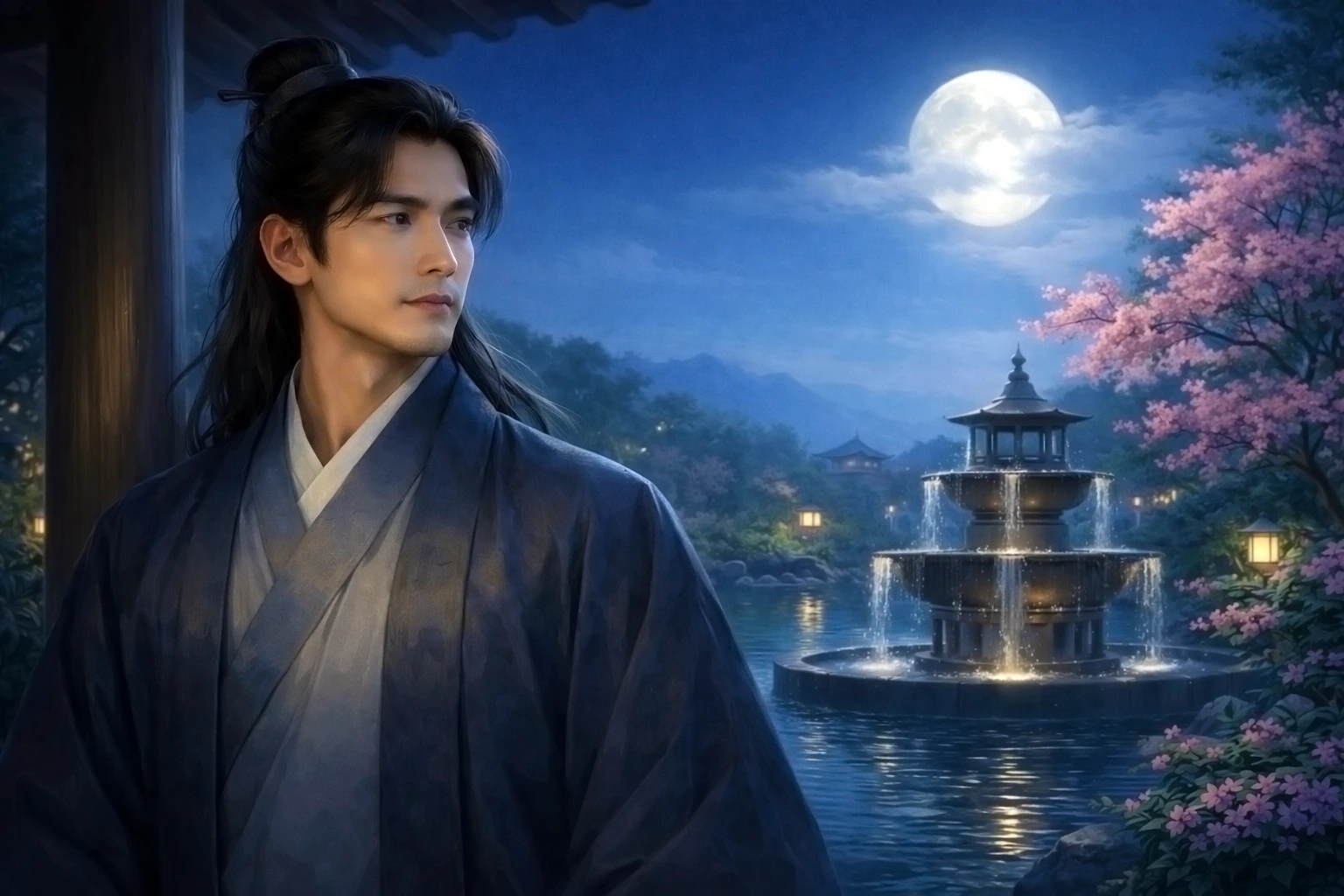
Zhang Zhongsu (张仲素 c. 769 - c. 819), a native of Hejian City, Hebei Province, was a renowned poet of the Mid-Tang period. He passed the jinshi examination in the fourteenth year of the Zhenyuan era (798 AD) and also succeeded in the Boxue Hongci (Erudite Scholar) examination. He held official positions including Hanlin Academician and Drafter of the Central Secretariat. His poetry excelled in the yuefu (Music Bureau) style, particularly in depicting the sentiments of women longing for their absent husbands. His poetic style is characterized by a delicate, refreshing clarity combined with a touch of heroic vigor. Together with Linghu Chu and Wang Ya, both also Drafter of the Central Secretariat, he engaged in poetic exchanges, forming a triumvirate that stood alongside Bai Juyi’s popular school and Han Yu’s unconventional school in the literary landscape of the time.