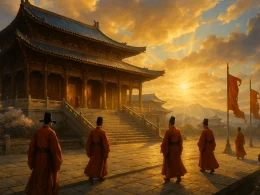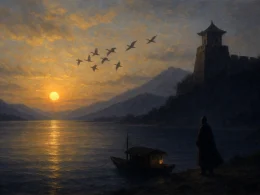



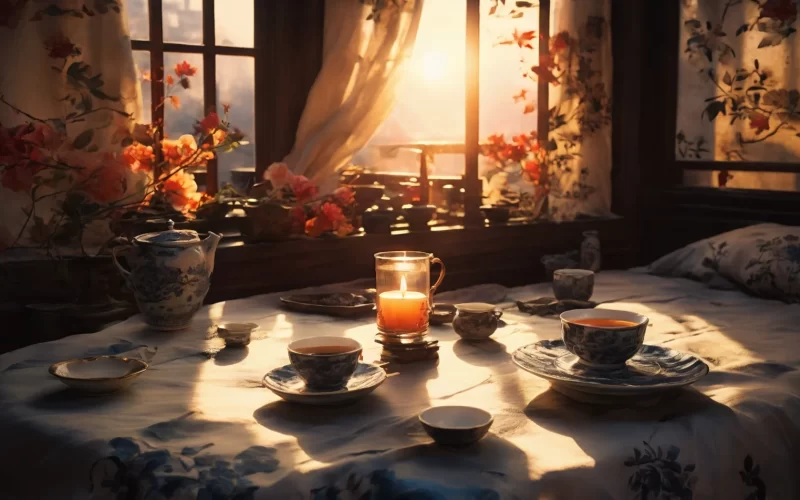
A lamp‑flame spent, with morning frost for mate;
And she who, waking, must arise alone
From the wide bed where once love kept his state.

How much of love, how much of grief, last night
Were held within her heart’s unanswering zone?

The utmost span of earth, the farthest star’s far height,
Are not so long — are not so long — as her delight
That is a pain, and as her moan
That is a silent, an unmeasured stone.
Original Poem
「燕子楼 · 其一」
张仲素
楼上残灯伴晓霜,独眠人起合欢床。
相思一夜情多少,地角天涯未是长。
Interpretation
"The Swallow Tower" is a set of three famous poems by the Mid-Tang poet Zhang Zhongsuh; this is the first. Swallow Tower was located in Xuzhou, built by the renowned Tang general Zhang Yin for his beloved concubine, Guan Panpan. After Zhang Yin's death, Panpan, cherishing their old love, did not remarry. She lived alone in this tower for over a decade, ultimately starving herself to death, leaving behind a poignant and moving love story. This poem opens the set, and its theme is "solitary fidelity." The poet does not elaborate on Panpan's more than ten years of solitude. Instead, he focuses on one morning from countless sleepless nights—the lamp wick flickering out, dawn frost already cold, she rises alone from the lovebird bed. The detail of "The lonely sleeper rises from the lovebird bed" is the desolation of objects remaining but people changed. The lament of "The ends of the earth cannot compare with it" is the persistence of boundless longing. This first poem describes her morning after a sleepless night, using "one night" to write of "ten years," using "solitary sleep" to write of "fidelity," establishing a deeply affectionate and lonely tone for the entire set.
In classical poetry, many have written of longing wives, but Zhang Zhongsuh's poem is uniquely conceived. It uses "Guttering lamp... accompanies dawn’s frost" to write the loneliness of a sleepless night, "The lonely sleeper rises from the lovebird bed" to write the desolation of objects remaining but people changed, "Could I know the love growing in one long, long night?" to write the depth of longing, and "The ends of the earth cannot compare with it" to write the enduring length of feeling. The three words "lovebird bed" were originally a symbol of marital affection, but now only the "lonely sleeper" rises from it. The three words "cannot compare" use spatial distance to contrast the depth of emotion. The entire poem begins with scene and ends with feeling, fusing the feeling of one night with the longing of ten years within twenty-eight characters, a masterpiece among Tang dynasty boudoir-plaint poetry.
First Couplet: "楼上残灯伴晓霜,独眠人起合欢床。"
Lóu shàng cán dēng bàn xiǎo shuāng, dú mián rén qǐ héhuān chuáng.
Guttering lamp on the tower accompanies dawn’s frost white; The lonely sleeper rises from the lovebird bed.
The poem opens with the two images of "guttering lamp" and "dawn’s frost" creating an atmosphere of desolate loneliness. "残灯" (guttering lamp) writes of a sleepless night—the lamp gutters, the person has not slept; the flickering candle flame accompanied her through the long night. "伴晓霜" (accompanies dawn’s frost) writes the chill of dawn. The word "伴" (accompanies) places the dying lamp and dawn's frost side by side, as if the lamp is as lonely as the person, and the person is as cold as the frost. The next line, "独眠人起合欢床" (The lonely sleeper rises from the lovebird bed), shifts from scene to person. "合欢床" (lovebird bed) was originally a symbol of marital affection, but now only the "lonely sleeper" rises from it—the contrast between "独" (lonely) and "合欢" (lovebird) writes the desolation of objects remaining but people changed with penetrating depth. Within this couplet, the poet uses the three images of the guttering lamp, dawn's frost, and the lovebird bed to encompass Panpan's situation of a long, sleepless night and a solitary dawn.
Second Couplet: "相思一夜情多少,地角天涯未是长。"
Xiāngsī yī yè qíng duō shǎo, dìjiǎo tiānyá wèi shì cháng.
Could I know the love growing in one long, long night? The ends of the earth cannot compare with it, I’m afraid.
This couplet is the soul of the entire poem. It shifts from scene to feeling, directly expressing the heart's intent. "相思一夜情多少" (Could I know the love growing in one long, long night?) uses a rhetorical question to express the weight of one night's longing—this night is not an ordinary night, but one night that is like ten years; this question is not an ordinary question, but immeasurably deep affection. The next line, "地角天涯未是长" (The ends of the earth cannot compare with it, I’m afraid), concludes the poem with a contrast. People often say "the ends of the earth" describes great distance, but in Panpan's eyes, that distance is not as long as the love growing in her one night of longing. The three words "未是长" (cannot compare) are the "pivotal phrase" of the entire poem: it is not that the ends of the earth are not long, but that longing is longer; it is not that space is not vast enough, but that longing is vaster than space. This line writes Panpan's persistent, unchanging vigil of over ten years with subtlety and power—she does not say how long she has waited, only that the love of one night is longer than the ends of the earth; she does not say how much she has suffered, only that the ends of the earth are not far enough.
Holistic Appreciation
This is a divine work among Zhang Zhongsuh's boudoir-plaint poetry. The entire poem consists of four lines and twenty-eight characters. Using the dawn scene of a guttering lamp and frost as the backdrop, the detail of the lonely sleeper rising from the lovebird bed, the question of the love growing in one night, and the conclusion that the ends of the earth cannot compare, it writes of Panpan's deep affection during her more than ten years of solitary fidelity in Swallow Tower after her husband's death with subtlety and power.
Structurally, the poem presents a progression from scene to feeling, layer upon layer. The first couplet uses "guttering lamp" and "dawn’s frost" to write the cold of an autumn dawn, and "The lonely sleeper rises from the lovebird bed" to write the pain of objects remaining but people changed. The second couplet uses "Could I know the love growing in one long, long night?" to question the weight of longing, and concludes with "The ends of the earth cannot compare with it", finally releasing the emotion accumulated earlier. Between the four lines, it moves from scene to person, from person to feeling, from feeling to question, progressing layer by layer, forming a seamless whole.
Thematically, the core of this poem lies in the contrast between "lovebird bed" and "cannot compare." The three words "lovebird bed" were originally a testament to marital affection, but now only the "lonely sleeper" rises from it—the contrast between "lonely" and "lovebird" is the desolation of objects remaining but people changed. The line "The ends of the earth cannot compare with it" uses spatial distance to contrast the depth of emotion—the contrast between "cannot compare" and "the ends of the earth" is the persistence of boundless longing. This double contrast writes Panpan's deep, unchanging affection over more than ten years with utter vividness.
Artistically, the poem's most moving aspect lies in the clever conception of "using objects to write feeling, using contrast to write depth." The poet uses the "guttering lamp" to write a sleepless night, "dawn’s frost" to write the dawn's chill, the "lovebird bed" to write objects remaining but people changed, and "the ends of the earth" to write spatial distance—every image is a vessel for emotion; every point of contrast is a footnote to deep feeling. The detail of "The lonely sleeper rises from the lovebird bed" and the lament of "The ends of the earth cannot compare with it" write Panpan's mental state of persistent fidelity and a heart difficult to convey with subtlety and power.
Artistic Merits
- Using Objects to Write Feeling, Subtle and Profound: Using images like the "guttering lamp," "dawn’s frost," and "lovebird bed" to write the character's loneliness and longing. Without speaking of sorrow, sorrow is seen; without speaking of feeling, feeling is deep.
- Vivid Contrast, Powerful Juxtaposition: The contrast between "lonely sleeper" and "lovebird bed"; the juxtaposition of "the ends of the earth" and "cannot compare." Under this double contrast, deep feeling appears all the more evident.
- Using Question to Advance, Using Answer to Conclude: "Could I know the love growing in one long, long night?" uses a rhetorical question to intensify emotion, answered by "The ends of the earth cannot compare with it." Between question and answer, emotion is pushed to its climax.
- Concise Language, Rich Meaning: The entire poem has twenty-eight characters. It contains scene and feeling, moving from description to direct expression. Every word carries great weight, with enduring resonance.
Insights
This poem, through a morning rising, speaks to an eternal theme—The deepest feeling is not the distance of the ends of the earth, but that the love of one night is longer than the ends of the earth.
First, it lets us see "the desolation of objects remaining but people changed." That "lovebird bed" was originally a testament to marital affection, but now only the "lonely sleeper" rises from it. The bed is still that bed, but the person is no longer there—this contrast of "objects remaining but people changed" is the deepest pain in the world. It reminds us: True longing is not a passionate declaration, but the things once shared, now faced by one person alone.
On a deeper level, this poem makes us contemplate "the distance of time and space." People often say "the ends of the earth" describes great distance, but in Panpan's eyes, that distance is not as long as the love growing in her one night of longing. It makes us understand: True distance is not spatial remoteness, but the length of longing; true time is not the measure on a clock, but the depth of waiting.
And what is most moving is the poem's sense of "ten years as one day" persistence. The poet writes only of one night, yet it makes one think of ten years; writes only of one morning, yet it makes one think of countless such mornings. This technique of "using one night to write of ten years" is precisely the high skill of Chinese classical poetry in "seeing the large through the small." It lets us see: True deep feeling is not a momentary impulse, but a ten-year vigil like a single day; true fidelity is not a passionate vow, but the daily routine of rising alone from the lovebird bed every morning.
This poem is set in the Mid-Tang Swallow Tower, yet it allows everyone who has experienced longing, who understands waiting, to find resonance within it. The desolation of "Guttering lamp... accompanies dawn’s frost" is the scenery in the eyes of every sleepless person. The sorrow of "The lonely sleeper rises from the lovebird bed" is the pain in the heart of everyone who has lost a partner. The lament of "The ends of the earth cannot compare with it" is the deepest echo in the hearts of everyone who has loved deeply and longed. This is the vitality of poetry: it writes of Guan Panpan's story, but one reads of people in all eras who wait in longing and grow old in waiting.
About the poet
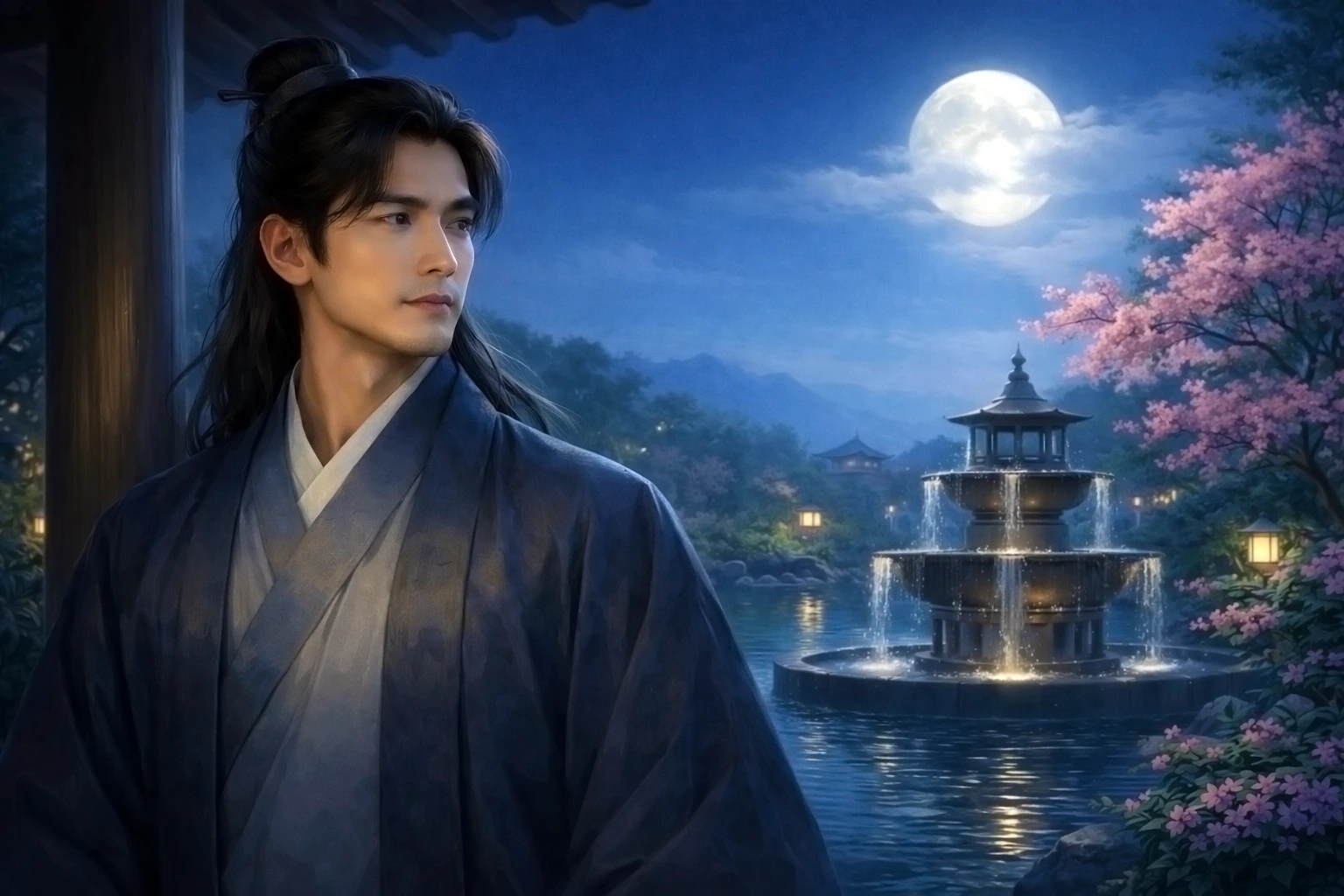
Zhang Zhongsu (张仲素 c. 769 - c. 819), a native of Hejian City, Hebei Province, was a renowned poet of the Mid-Tang period. He passed the jinshi examination in the fourteenth year of the Zhenyuan era (798 AD) and also succeeded in the Boxue Hongci (Erudite Scholar) examination. He held official positions including Hanlin Academician and Drafter of the Central Secretariat. His poetry excelled in the yuefu (Music Bureau) style, particularly in depicting the sentiments of women longing for their absent husbands. His poetic style is characterized by a delicate, refreshing clarity combined with a touch of heroic vigor. Together with Linghu Chu and Wang Ya, both also Drafter of the Central Secretariat, he engaged in poetic exchanges, forming a triumvirate that stood alongside Bai Juyi’s popular school and Han Yu’s unconventional school in the literary landscape of the time.