


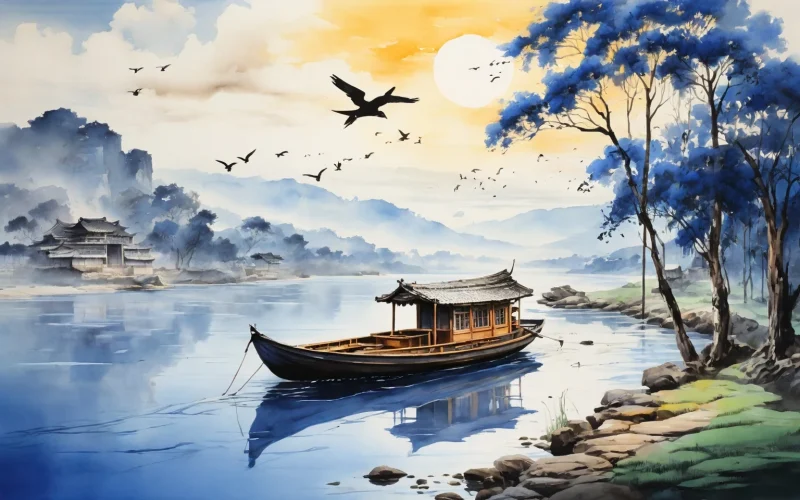
Another spring in boat I stay;
Again swallows peck clods of clay.
You know me in my native land;
Now gazing from afar you stand.

Ah, here and there you build your nest;
Now and again I find no rest.
You greet me and then leave the mast;
My tears stream down to see you past.
Original Poem
「燕子来舟中作」
杜甫
湖南为客动经春,燕子衔泥两度新。
旧入故园尝识主,如今社日远看人。
可怜处处巢居室,何异飘飘托此身。
暂语船樯还起去,穿花贴水益沾巾。
Interpretation
This poem was composed in the spring of 769 CE, the fourth year of the Dali era under Emperor Daizong, as Du Fu drifted on a boat to Tanzhou (present‑day Changsha) in Hunan. Having left Kuizhou the previous year, he had wandered along the rivers and lakes of the region, making his boat his home, afflicted by poverty and illness. The poet was then fifty‑eight years old, entering the final three years of his life as a wanderer. His homeland was ten thousand li away, with no hope of return; though the spring sacrifice day brought swallows, he remained a solitary stranger at the world’s edge. In this poem, the swallow serves as a mirror, reflecting the fragility and resilience of a great soul in his twilight years, adrift between heaven and earth.
First Couplet: “湖南为客动经春,燕子衔泥两度新。”
Húnán wéi kè dòng jīng chūn, yànzi xián ní liǎng dù xīn.
South of the lake, a stranger through another spring; / Twice now the swallows come with mud to build, a fresh‑built thing.
The poem opens with a plain notation of time. “Through another spring” speaks of time slipping away unnoticed in his wanderings, carrying a tone of weariness. “Twice now… a fresh‑built thing” uses the newness of the swallows’ nest to contrast with the unchanged nature of the poet’s own condition—still adrift, with return as remote as ever. The swallows have a seasonal routine and can build anew, whereas the poet remains a perennial stranger, his home existing only in dreams. The contrast between man and swallow unfolds quietly within this ordinary narration.
Second Couplet: “旧入故园尝识主,如今社日远看人。”
Jiù rù gùyuán cháng shí zhǔ, rújīn shè rì yuǎn kàn rén.
Once in my old garden you knew me as your host; / Now on this spring‑sacrifice day, you watch me from afar, almost.
Here the tone shifts to an intimate imagination, treating the swallow as an old friend across time and space. “Once in my old garden” recalls a warm scene from memory—the swallow recognizing its host hints at the relatively stable life Du Fu once led in places like Chang’an and Luoyang. “Now… watch me from afar” is the cold reality; the swallow no longer draws near, as if both fate and homeland have grown distant. The spring‑sacrifice day, originally a time for communal worship and prayer for abundance, here becomes a measure of solitude. The subtle change in distance between poet and swallow is, in truth, a metaphor for his relationship with the entire world.
Third Couplet: “可怜处处巢居室,何异飘飘托此身。”
Kělián chù chù cháo jū shì, hé yì piāopiāo tuō cǐ shēn.
Pitiable—everywhere you build your nesting place; / How different from my own frail self that floats without a base?
Turning from swallow to self, the couplet directly states the theme of “shared exile under heaven.” Yet, upon closer reflection, the swallow’s “everywhere you build your nesting place” is a natural way of life, repeated year after year; the poet’s “my own frail self that floats without a base” is an endless exile forced by war and fate. When the poet says “how different,” he knows perfectly well that the difference is vast—the swallow’s wandering holds a cycle and a hope, while human wandering may be an exile without end. This is pity for the swallow, but even more so self‑pity; the language is calm, the sorrow deep.
Fourth Couplet: “暂语船樯还起去,穿花贴水益沾巾。”
Zàn yǔ chuán qiáng hái qǐ qù, chuān huā tiē shuǐ yì zhān jīn.
You pause to chirp awhile beside my boat, then rise and fly; / Through blossoms, skimming water—all the more it wets my eye.
Here the poem’s emotion gathers, surges, and subsides into loneliness. “Pause to chirp awhile” is wonderfully poignant: the swallow seems to understand, offering a momentary, illusory comfort. “Then rise and fly” tells of that comfort’s brevity and inevitable passing. In the end, the swallow flits gracefully into the spring scene (“through blossoms, skimming water”), while the poet is left alone, his eyes brimming with tears. Movement and stillness, freedom and entrapment, vitality and decline—in this moment they form a heart‑rending contrast.
Holistic Appreciation
This poem stands among the finest of Du Fu’s wanderer‑poems. Its brilliance lies in creating a profound loneliness expressed through “dialogue with a creature.” The whole poem unfolds as an address to the swallow, which is not merely a metaphor or symbol but rather a constructed interlocutor, witness, and counterpoint for the poet.
Structurally, it follows a circular, deepening progression: sighting the swallow sparks feeling (first couplet) → memory brought by the swallow evokes longing (second couplet) → moving from swallow to self clarifies sorrow (third couplet) → the swallow’s departure brings tears (fourth couplet). Emotion flows from calm narration, gradually swelling into waves, finally breaking into tears—like a stream merging into a deep pool, silent yet filled with grief.
More importantly, the poem presents a double reflection of wandering: the swallow’s wandering is part of nature’s rhythm, light and full of life; the poet’s wandering is a scar of his times, heavy and weathered. Du Fu does not simply compare his fate to the natural image; he “grafts” his own destiny onto it, seeking a frame of reference for personal suffering within the order of heaven and earth, thereby attaining a transcendent compassion—grieving for himself, yet also for all things adrift in impermanence.
Artistic Merits
- Vast Depth Revealed through Minute Detail: Through a single swallow by his boat, the poem reflects his entire late‑life wandering, longing for home, and the dislocation of his era. The subject is exceedingly small, yet the vision is immensely broad, demonstrating Du Fu’s artistic power to suggest “ten thousand li within a foot.”
- Personification with Controlled Distance: The poem personifies the swallow throughout (“knew me as your host,” “watch me,” “pause to chirp”), yet maintains a subtle distance. The swallow remains an “other”; its freedom to come and go contrasts with human helplessness; its “watch me from afar” and “rise and fly” imply the illusory nature of solace. This approach conveys loneliness more powerfully than direct statement.
- Layering and Pressure of Temporal Imagery: Repeated time‑markers like “through another spring,” “twice now,” and “spring‑sacrifice day” create a cyclical sense of time, suggesting endless wandering. This stands in tension with the swallow’s punctual, “natural time,” highlighting the cruelty of human “historical time.”
- Pictorial Tension in the Closing Couplet: “Through blossoms, skimming water” exquisitely captures the beauty of the swallow’s flight and the richness of spring; “all the more it wets my eye” expresses the poet’s inner grief. Using joyful scenery to convey sorrow, movement to convey still grief, the contrast is extreme, the emotional impact powerful—restrained yet devastating.
Insights
This work teaches us that the deepest loneliness is seeing one’s own lack of anchorage reflected in one’s connection to the world. Du Fu’s greatness lies in never succumbing to self‑pity amid personal suffering. He integrates his own wandering into an observation of all living things, thereby elevating personal grief into a universal compassion for life.
For modern readers, the poem raises questions: How do we coexist with our own sense of “drifting”? In an era of constant change, where is the heart’s “old garden”? Du Fu’s choice was to establish coordinates through poetry and connect with all things through compassion. That he sees the swallow and speaks to it is itself an act of resistance—using emotional connection to resist a fate of abandonment, using aesthetic contemplation to lend meaning to an existence without refuge.
That swallow which “pauses to chirp awhile beside my boat, then rises and flies away” ultimately flies out of Du Fu’s tearful eyes and into the hearts of readers a thousand years later. It reminds us that a true home may lie not in reaching a certain place, but in preserving, as Du Fu did, a sensitivity to life, warmth toward the world, and the nobility and resilience to still “see” and “speak” even in the most desperate circumstances.
Poem translator
Xu Yuanchong (许渊冲)
About the poet
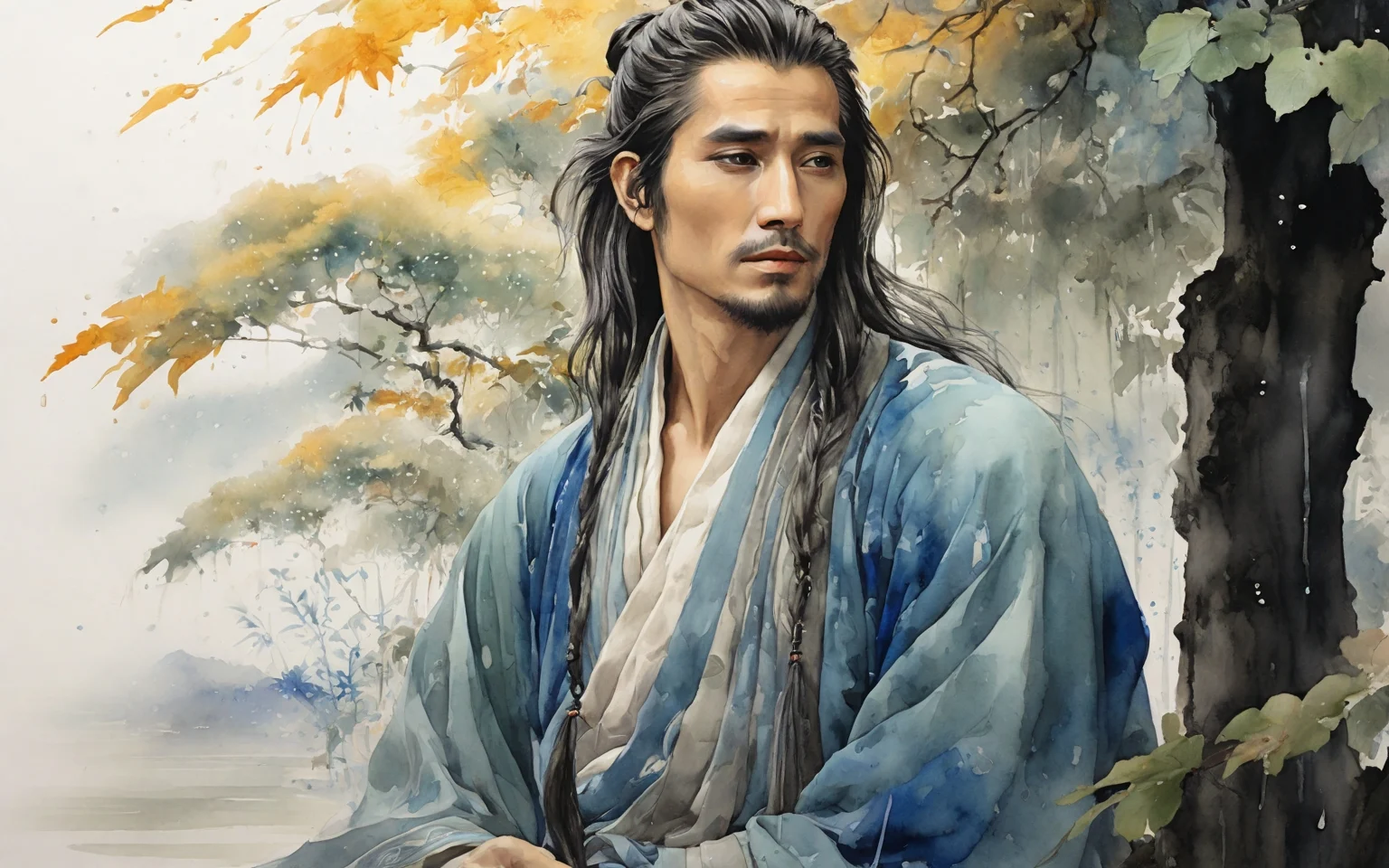
Du Fu (杜甫), 712 - 770 AD, was a great poet of the Tang Dynasty, known as the "Sage of Poetry". Born into a declining bureaucratic family, Du Fu had a rough life, and his turbulent and dislocated life made him keenly aware of the plight of the masses. Therefore, his poems were always closely related to the current affairs, reflecting the social life of that era in a more comprehensive way, with profound thoughts and a broad realm. In his poetic art, he was able to combine many styles, forming a unique style of "profound and thick", and becoming a great realist poet in the history of China.