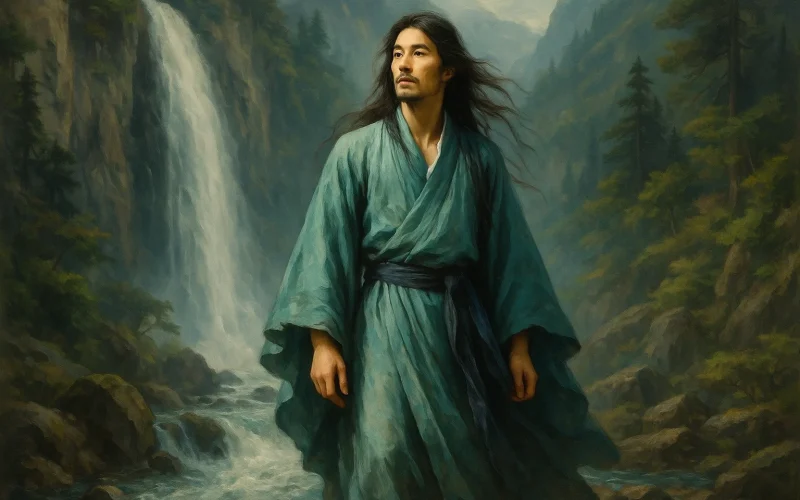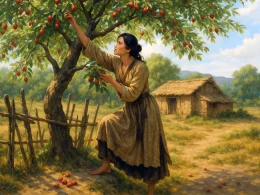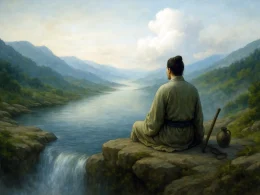



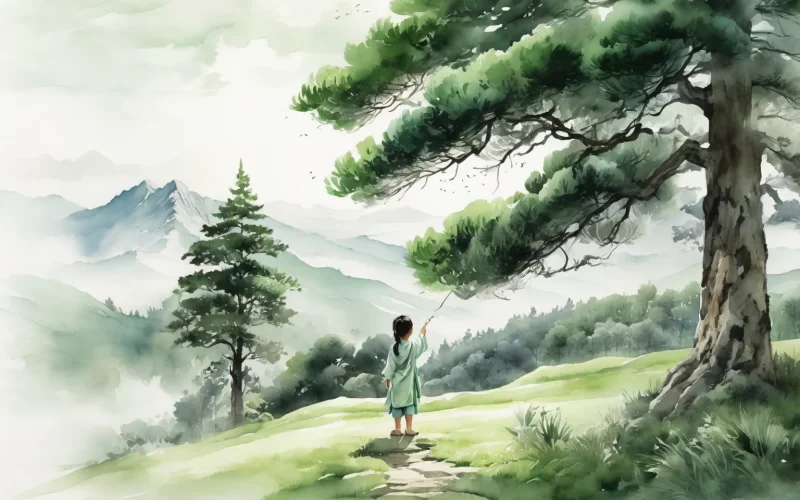
When I questioned your pupil, under a pine-tree,
" My teacher," he answered, " went for herbs,
But toward which corner of the mountain,
How can I tell, through all these clouds? "
Original Poem
「寻隐者不遇」
松下问童子,言师采药去。
只在此山中,云深不知处。
Interpretation
This celebrated poem was composed by the Tang Dynasty poet Jia Dao, likely during the period after he returned to secular life and traveled among mountains and forests. Jia Dao became a monk in his youth, taking the Dharma name "Wuben" (Without Origin), and frequently associated with recluses, Daoists, and monks, harboring a deep longing for a life of secluded dwelling in nature. Later, though he returned to secular life encouraged by Han Yu, his official career was fraught with difficulty, marked by repeated examination failures and a life of poverty. During the mid-to-late Tang Dynasty, court politics were corrupt, regional military governors fragmented the realm, wars were frequent, and social conflicts intensified. Many capable individuals, finding it difficult to apply their talents, turned instead to withdrawing from the world and retreating into reclusion, finding solace in landscapes. Jia Dao's poems often depict the quiet, secluded realms of mountains and forests, and his exchanges and poetic responses with recluses and monks precisely reflect this yearning for a reclusive life and his helplessness in the face of reality.
The recluse sought in this poem was likely an unworldly friend of Jia Dao's, dwelling deep in the mountains. The poet, drawn by his reputation, went to visit but failed to meet him, encountering only a young attendant under a pine tree in a brief exchange. Yet this regret of "not meeting" created the most famous instance of "leaving blank space" in the history of poetry—the five characters, "云深不知处", conceal the recluse's transcendence, the depth of the mountain forest, and the poet's melancholy entirely within the mist and clouds.
First Couplet: "松下问童子,言师采药去。"
Sōng xià wèn tóng zǐ, yán shī cǎi yào qù.
Beneath a pine I asked the little lad;
"My master's gone to gather herbs," he said.
The opening line, with the phrase "beneath a pine," sketches an atmosphere of serene seclusion. The pine tree often symbolizes nobility and steadfastness; the poet inquiring beneath it already hints at his admiration for the recluse's character. The poet omits his own question, presenting only the lad's reply: "My master's gone to gather herbs." The phrase "gather herbs" portrays the recluse's daily life and subtly implies his transcendent lifestyle, companion to nature. Between this question and answer, the poet arrives to find the recluse already gone, and a sense of regret quietly arises.
Second Couplet: "只在此山中,云深不知处。"
Zhǐ zài cǐ shān zhōng, yún shēn bù zhī chù.
"He's somewhere on the mountain-side, so deep
In clouds I cannot tell exactly where."
This couplet advances the poetic idea through the lad's continued reply. The line "He's somewhere on the mountain-side" leaves the poet a thread of hope—the recluse has not gone far; he is right in this mountain. Yet the following line, "so deep in clouds I cannot tell exactly where," gently erases that hope. The phrase "deep in clouds" is both a concrete description of the mist-wrapped mountain scenery and an abstract portrayal of the recluse's transcendent spiritual realm, removed from the worldly dust. That mist separates the recluse from the mundane world and also separates the poet from the recluse; that "cannot tell exactly where" refers both to the unknowable location and the unreachable state. Though the poet did not meet the recluse, within the artistic conception of "deep in clouds, unknown where," he encounters the recluse's spirit.
Holistic Appreciation
This is a masterpiece among Jia Dao's poems and a paradigm in Chinese literary history of using simplicity to control complexity, achieving much with little. The entire poem, four lines and twenty characters, begins with "asking," continues with "answering," turns with "is here," and concludes with "do not know," elevating an experience of an unsuccessful visit into a celebration of the reclusive realm.
Structurally, the poem displays a unique technique of "implying the question within the answer." The poet omits his own questioning words, allowing the reader to naturally infer the poet's questions through the lad's three replies: "gone to gather herbs," "on the mountain-side," and "deep in clouds, unknown where." This omission makes the poetic meaning more subtle and lasting, also leaving rich space for imagination. The three replies progress layer by layer: the first informs of the direction; the second confirms the scope; the third concludes with "do not know," gently dissolving the hope of the first two.
Conceptually, the poem's core lies in the "meeting" within the "not meeting." The poet did not meet the recluse, yet within the artistic conception of "deep in clouds, unknown where," he encounters the recluse's spiritual world; he did not achieve a face-to-face meeting, yet within the exchange beneath the pine, he feels the recluse's transcendence and nobility. This kind of "meeting within not meeting" is more thought-provoking than an ordinary encounter and more fitting to the recluse's true nature of "not seeking to be known." Just as Tao Yuanming wrote, "此中有真意,欲辨已忘言" Jia Dao, in this poem, also conceals that longing for reclusion and helplessness in the face of reality within the depth of the clouds.
Artistically, the poem's most moving feature is its subtlety of "speaking by not speaking." The poet expresses not a single sigh of emotion, reveals not a trace of personal feeling, merely recording a question and answer plainly and simply. Yet precisely within this plain record, the poet's admiration, longing, melancholy, and acceptance surface one by one. The figure beneath the pine, the lad's reply, the clouds and mist on the mountain together form a complete emotional world, where the reader lingers, reluctant to leave.
Artistic Merits
- Implying the Question within the Answer, Subtle and Lasting: The poet omits the questions, advancing the poetic idea solely through the lad's three replies, allowing readers to naturally infer the questions—a clever technique with enduring charm. Not a word of questioning is written, yet its charm is fully captured.
- Blending the Concrete and Abstract, Profound Artistic Conception: "Deep in clouds, unknown where" is both realistic description and symbol; it is both language of scene and language of emotion. Between the concrete and abstract, the artistic conception fully emerges. The concrete contains the abstract; the abstract contains the concrete.
- Concise Language, Rich Connotation: The entire poem is twenty characters, yet it contains the process of the visit, the image of the recluse, the depth of the mountain forest, and the poet's emotions. Brevity yields comprehensiveness; each word is a polished gem.
- Layered Progression, Skillful Transition: The three replies progress from "gone" to "is here" to "do not know," layering the meaning, finally concluding with "do not know," deepening the poetic idea through the transition. Layers are seen within the progression; craftsmanship is revealed within the transition.
- Concluding Scene with Emotion, Enduring Resonance: The final line, "deep in clouds, unknown where," concludes with the language of scene, concealing boundless melancholy and longing within the clouds and mist, leaving endless aftertaste. Scene concludes the emotion; the sound lingers.
Insights
This poem, through the experience of an unsuccessful visit, speaks to the universal human experience of "seeking but not obtaining" and offers profound insight. It leads us to contemplate the dialectical relationship between "meeting" and "not meeting." The poet went to visit, full of anticipation, yet failed to meet. An ordinary person might feel disappointment, might complain. But Jia Dao, in this "not meeting," encountered the clear breeze beneath the pine, encountered the lad's reply, encountered the artistic conception of "deep in clouds, unknown where." It enlightens us: many of life's "not meetings" may be another form of "meeting." What is sought but not obtained is not necessarily the most precious; what is gained inadvertently may instead become eternal poetry.
The artistic conception of "云深不知处" in the poem leads us to contemplate the relationship between "distance" and "longing." The recluse is right in the mountain, yet cannot be seen because the clouds and mist block the way. This state of "visible yet unattainable" precisely inspires deeper longing in the poet. That mist is both a barrier and a protection—it separates the recluse from the dusty world, guarding that transcendent tranquility. It tells us: some beauties shine forever precisely because they maintain a distance; some realms forever inspire yearning precisely because they cannot be easily reached.
On a deeper level, this poem also allows us to see the true essence of the reclusive spirit. The recluse "gathers herbs" in the mountains not to escape, but to seek; not to hide, but to merge with nature. He "只在此山中" yet "云深不知处"—this is a state of being in the worldly dust yet transcending it. It enlightens us: true reclusion lies not in where one is, but in the state of one's mind. Even in the bustling city, as long as the heart holds the clarity of "deep in clouds, unknown where," one can meet the recluse in spirit.
Poem translator
Kiang Kanghu
About the Poet
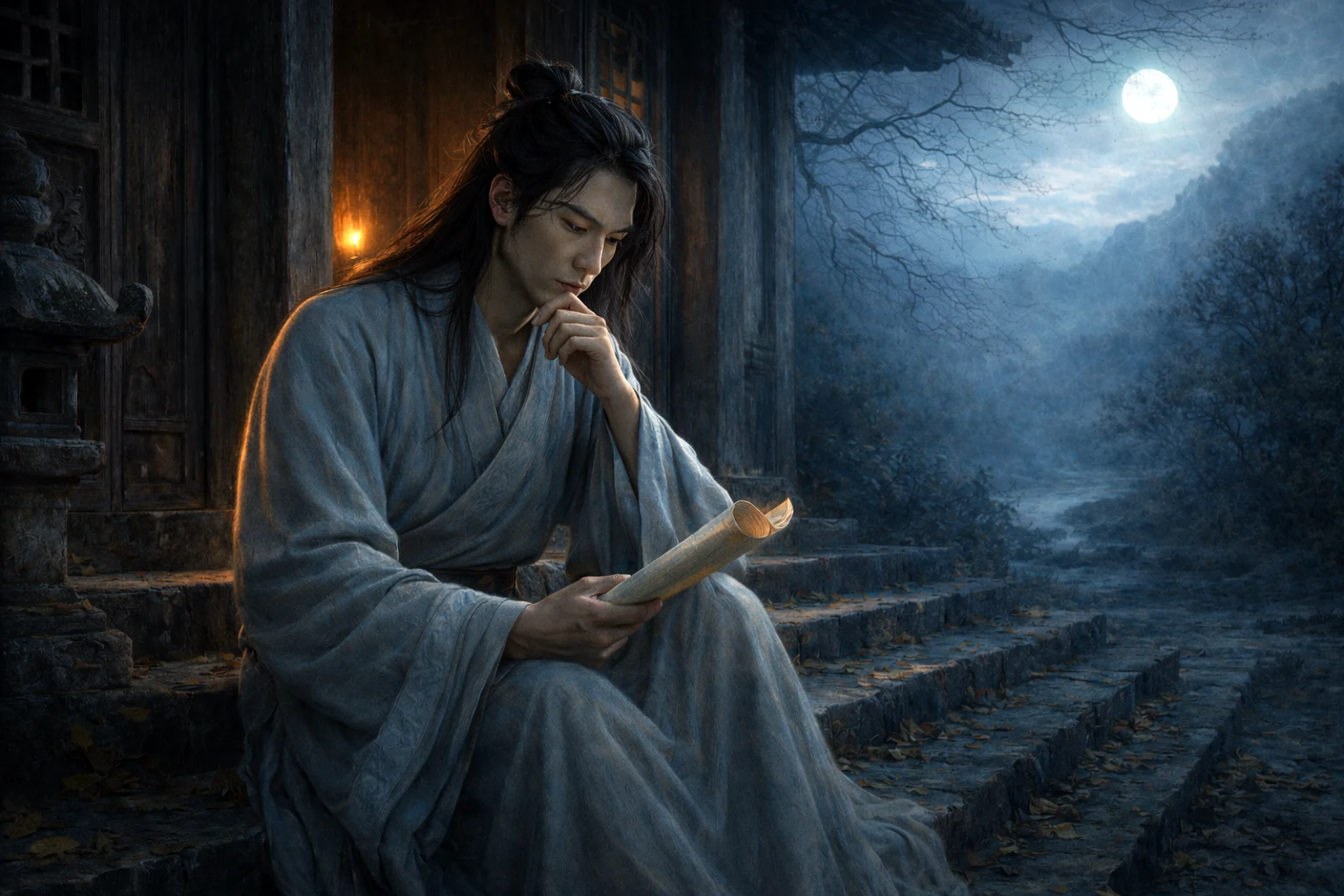
Jia Dao (贾岛 779 - 843), a native of the vicinity of present-day Beijing, was a renowned poet of the Mid-Tang dynasty. In his early years, he became a Buddhist monk under the dharma name Wuben. Later, he returned to lay life to sit for the imperial examinations, but never passed them throughout his life. In his later years, he served as Registrar of Changjiang County, earning him the sobriquet "Jia Changjiang." He was famous for his "painstaking composition" (ku yin), and together with Meng Jiao, they were known as "Meng's cold, Jia's thinness." His poetry pursued meticulous refinement of every word and line. His poems often depict desolate, barren, and lonely landscapes, excelling in the five-character regulated verse form. He exerted a profound influence on later "painstaking" poets such as Li Dong of the Late Tang and the "Four Lings" of the Southern Song.