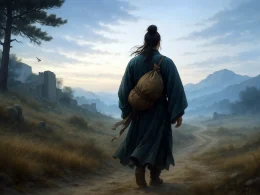



New Year's only deepens my longing,
Adds to the lonely tears of an exile
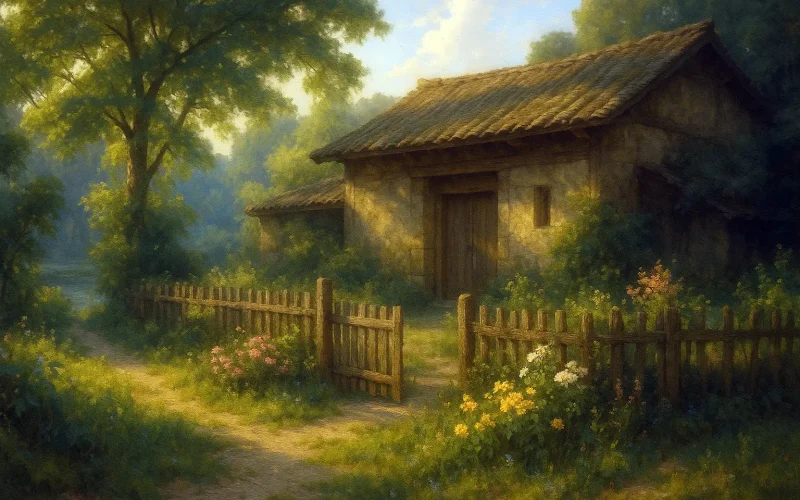
Who, growing old and still in harness,
Is left here by the homing spring...

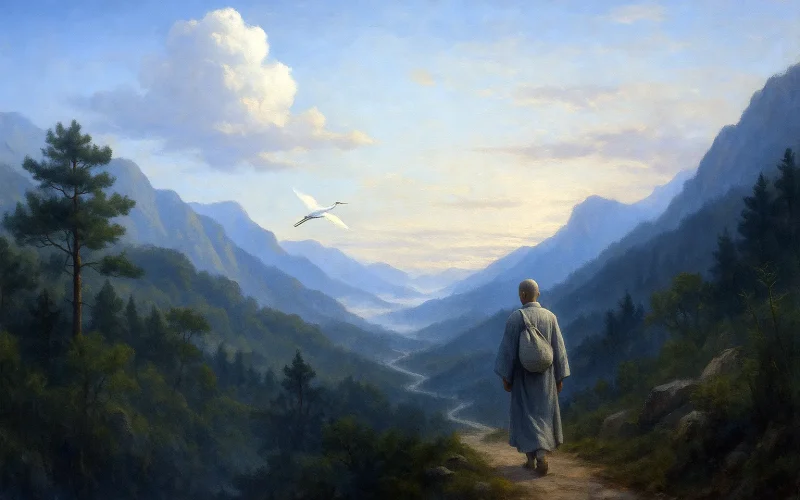
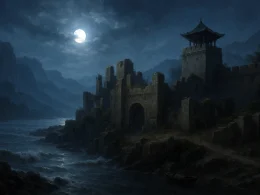
Monkeys come down from the mountains to haunt me.
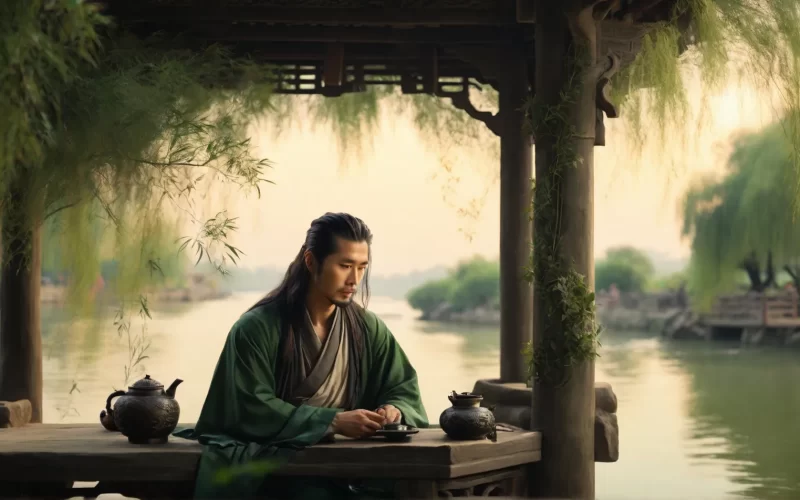
I bend like a willow, when it rains on the river.
I think of Chia Yi, who taught here and died here -
And I wonder what my term shall be.
Original Poem
「新年作」
刘长卿
乡心新岁切,天畔独潸然。
老至居人下,春归在客先。
岭猿同旦暮,江柳共风烟。
已似长沙傅,从今又几年。
Interpretation
This poem was written when Liu Zhangqing was demoted to the post of Vice-Magistrate of Nanba County in Panzhou. During the reign of Emperor Suzong of Tang, the poet, known for his integrity and unyielding character, was slandered and demoted from his post as the interim Transport Commissioner of Exi-E'zhou to Panzhou in Lingnan (modern Maoming, Guangdong). "刚而犯上,两遭迁谪" (Unyielding and offending superiors, twice demoted)—these eight words nearly sum up the second half of Liu Zhangqing's life, and this demotion to Lingnan was the darkest page of his official career.
Panzhou was located in the remote borderlands of Lingnan, historically a region of miasma dreaded by scholars from the Central Plains. To be exiled to this place in his declining years—the depth of his anguish is imaginable. Even more tragic is that the poem is precisely about the New Year—that holiday which should be a time for family reunion and ushering in the new. In thousands of households, firecrackers crackle, and families gather by the hearth for night talk, while he drifts alone at the ends of the earth, facing the unfamiliar mountains and rivers of Lingnan, longing for a homeland impossibly far away. This pain of "A lonely stranger in a strange land, I pine for my kinfolk on a holiday doubly" becomes, against the backdrop of exile, all the more intense and inescapable.
The poem's self-comparison to Jia Yi is a hallmark of Liu Zhangqing's style of expressing his feelings through ancient figures. Jia Yi, talented and young, was valued by Emperor Wen of Han, yet was slandered, demoted to Changsha, and died in depression. Liu Zhangqing held a special affinity for this "fellow sufferer" from a thousand years ago, frequently mentioning him in his poems precisely because their fates were so strikingly similar—both valued for their talent and learning, both rejected by the court for their loyalty and integrity, both exiled to remote places. The tragedy of "the Tutor of Changsha" was reenacted a millennium later in Liu Zhangqing himself. The poem's concluding question, "已似长沙傅,从今又几年" (Already like Jia Yi in Changsha, how many years lie ahead for me?), expresses both sorrow for Jia Yi's fate and a bewildered questioning of his own future.
First Couplet: "乡心新岁切,天畔独潸然。"
Xiāng xīn xīn suì qiè, tiān pàn dú shān rán.
At home my heart is cut in two on New Year's Day; Alone by heaven's end, I cannot but shed tears.
The poem opens with "New Year," striking straight to the heart. The juxtaposition of "乡心" (xiāng xīn, homesick heart) and "新岁" (xīn suì, New Year) creates a powerful contrast—New Year is a time for reunion, yet the longing for home intensifies because of it. The word "切" (qiè, keen, acute, cutting) is used with heavy emphasis: not a faint longing, not a shallow sorrow, but a pain that cuts to the bone, a yearning that gnaws. The next line, "天畔独潸然" (tiān pàn dú shān rán, at heaven's end, alone, shedding tears), pushes this sorrow to its extreme. The two words "天畔" (heaven's end) emphasize the great geographical distance and the desolation of his situation; and the word "独" (dú, alone) is the emotional focus of the entire poem—alone in a strange land, alone spending the holiday, alone shedding tears. This couplet, unadorned and direct in expressing emotion, is deeply moving because of its genuine, heartfelt feeling.
Second Couplet: "老至居人下,春归在客先。"
Lǎo zhì jū rén xià, chūn guī zài kè xiān.
Growing old, I'm humbled 'neath others I've left behind; Coming back, spring goes before me, a stranger to the land.
This couplet is the poetic core of the entire poem and a famous line through the ages. "老至居人下" (lǎo zhì jū rén xià, growing old, I'm beneath others) uses five characters to express the misery of official frustration—years increase, yet his official rank remains as lowly as ever, even having to bow and take orders from juniors. This is not just the humiliation of rank; it is the heart-piercing pain of talent and ambition being betrayed. The next line, "春归在客先" (chūn guī zài kè xiān, spring returns, before the traveler), is even more ingenious in conception. Spring, an inanimate thing, returns according to season; there is inherently no concept of "before" or "after." But the poet insists spring returns "before the traveler," as if spring itself knows to rush home first, while he, the "traveler," is forgotten at the ends of the earth. This technique of personifying the inanimate incorporates complex emotions like envy, jealousy, self-sorrow, and helplessness. No wonder this couplet has been passed down through the ages, for it gives voice to the shared lament of all disappointed people under heaven.
Third Couplet: "岭猿同旦暮,江柳共风烟。"
Lǐng yuán tóng dàn mù, jiāng liǔ gòng fēng yān.
Monkeys wail at dawn and dusk with me on mountain crest; River willows share with me the wind and misty haze.
This couplet shifts to describing the environment of his Lingnan place of exile. "岭猿同旦暮" (lǐng yuán tóng dàn mù, mountain monkeys share my morn and night)—day and night, only the monkeys on the ridge keep him company. The cries of monkeys are already mournful; to the ears of an exile, they add even more bitterness. And the three words "同旦暮" (share morn and night) further reveal the poet's loneliness: from morning to night, from spring to winter, his only companions are these wailing monkeys. "江柳共风烟" (jiāng liǔ gòng fēng yān, river willows share the wind and haze) describes spending time with the riverside willows—hazy mist, willows green, ordinarily a common sight, but in the poet's eyes, they become his only "companions." The words "同" (tóng, share/together) and "共" (gòng, share/together) seem to describe companionship, but in reality describe loneliness: because there is no one to accompany him, he therefore makes companions of monkeys and shares with willows. This technique of writing sorrow through joyful scenery, companionship through solitude, is subtle, profound, and evocative.
Fourth Couplet: "已似长沙傅,从今又几年。"
Yǐ sì Chángshā fù, cóng jīn yòu jǐ nián.
Already like Jia Yi banished to Changsha, alas! I wonder how many years will again pass!
The final couplet concludes the whole by comparing himself to Jia Yi. "已似长沙傅" (yǐ sì Chángshā fù, already like the Tutor of Changsha) is both a self-description and self-sorrow—Jia Yi, young and talented, was demoted to Changsha and died in depression; the poet, in his declining years, demoted to Lingnan, how similar their fates. These five characters contain sorrow for the ancient figure, lament for himself, and silent accusation against the injustice of fate. The next line, "从今又几年" (cóng jīn yòu jǐ nián, from now on, how many more years), concludes with a question, its resonance lingering. The two words "几年" (jǐ nián, how many years) question both his future and his fate; both the court and heaven. No one can give him an answer, just as Jia Yi, back then, also did not know how many more years he would spend in Changsha. This question pushes the poem's lament to its climax, yet in the questioning returns to silence, leaving the reader deeply pensive.
Holistic Appreciation
This is another powerful work among Liu Zhangqing's exile poems. The entire poem consists of eight lines and forty characters. Using the New Year as its entry point, it merges longing for home, sorrow of aging and illness, the pain of exile, and the lament of personal circumstances, revealing the deep-seated solitary indignation and melancholy in the poet's heart as he spends his first New Year in his Lingnan place of exile.
Structurally, the poem presents a progressive layering from self to home, home to self, self to environment, environment to person. The first couplet directly expresses emotion, introducing the theme with "homesick heart" and "New Year," establishing the poem's lamenting tone with "alone shedding tears." The second couplet deepens reflection, writing the sorrow of official life with "growing old, I'm beneath others" and the keenness of homesickness with "spring returns, before the traveler," blending emotion and reason with penetrating depth. The third couplet shifts to describing the environment, outlining the desolate cold of the exile site with "mountain monkeys" and "river willows," highlighting the solitary situation with "share my morn and night" and "share the wind and haze." The final couplet concludes by comparing himself to an ancient figure, using Jia Yi's story to close the poem, ending with the question "how many more years," which releases the emotion accumulated in the first six lines. Between the four couplets, moving from emotion to reason, reason to scene, scene to allusion, the poem deepens layer by layer, forming a seamless whole.
Thematically, the core of this poem lies in the words "独" (alone) and "悲" (sorrow). The "alone shedding tears" of the first couplet is the outward manifestation of loneliness; the "beneath others" and "before the traveler" of the second are the roots of loneliness; the "share my morn and night" and "share the wind and haze" of the third are the portrait of loneliness; the "like the Tutor of Changsha" of the fourth is the reflection of loneliness. This word "alone" runs through the entire poem, while the word "sorrow" permeates every line—sorrow that old age approaches while achievement is lacking, sorrow that spring has returned while he cannot, sorrow that in a savage place he has no confidant, sorrow that Jia Yi of old still had someone to mourn him, while he himself today has no one to tell. This technique of integrating personal experience into season, scenery, and allusion gives the poem's lament both individual depth and universal significance.
Artistically, the poem's most moving aspect lies in the contrasting technique of "writing sorrow through a joyous festival." The New Year is originally a time of celebration, yet the poet writes of sorrow everywhere—using reunion to contrast solitude, spring's return to contrast his own detention, Jia Yi's talent to contrast his own situation. This contrast makes sorrow more sorrowful, grief more grievous, just as Wang Fuzhi said: "Using joyful scenery to write sorrow, using sorrowful scenery to write joy, doubles the sorrow or joy." Furthermore, the poem's personification in "spring returns, before the traveler," the mutual pity between thing and self in "mountain monkeys share my morn and night," and the subtle conclusion ending with a question in the final couplet are all marks of the poem's artistic excellence.
Artistic Merits
- Writing Sorrow Through Joyous Festival, Powerful Contrast: Using New Year reunion to contrast his own solitude, using spring returning first to contrast his inability to return, writing sorrow through joyful scenery, doubling the sorrow.
- Emotion and Reason Blended, Memorable Lines Abound: The couplet "Growing old, I'm humbled 'neath others I've left behind; Coming back, spring goes before me, a stranger to the land" merges the sorrow of official life with the keenness of homesickness, excelling in both emotion and reason, passed down through the ages.
- Using Objects to Portray People, Subtle and Profound: The couplet "Monkeys wail at dawn and dusk with me on mountain crest; River willows share with me the wind and misty haze" uses companionship with monkeys and willows to fully portray the solitary situation; without directly stating loneliness, loneliness permeates the page.
- Allusion Used Naturally, Conclusion Forceful: The final couplet comparing himself to Jia Yi both fits his status as an exile and implicitly matches the fate of being banished for loyalty, one allusion serving a double purpose, concluding with a question, its resonance lingering.
Insights
Using the New Year as its backdrop, this poem speaks to an eternal theme—On festive occasions more than ever we think of our dear ones far away, especially when in exile.
It first allows us to see the "weight of the holiday." The New Year is originally a symbol of celebration, but for wanderers far from home, for people in adversity, the holiday's热闹 (rènào, bustle) instead becomes a magnifying glass for loneliness. The warmth of countless household lights only illuminates one's own solitary figure; the clamor of firecrackers only contrasts the desolation within. Liu Zhangqing opens with "At home my heart is cut in two on New Year's Day" precisely to tell us: the meaning of a holiday is never objective; it is determined by one's state of mind.
On a deeper level, this poem prompts us to contemplate the relationship between "time and fate." "Growing old, I'm humbled 'neath others"—years increase, yet fate sinks; time passes, yet circumstances worsen. This is a double sorrow: ashamed before the youth of the past, hopeless for a turnaround in the future. And "spring returns, before the traveler" makes this helplessness concrete: spring returns punctually year after year, yet one's own return date is distant and uncertain. This feeling of being abandoned by time is the deepest pain of the exile.
And what is most moving is the poem's restrained quality of "sorrowful yet not resentful." The poet compares himself to Jia Yi but does not directly accuse the court; he sighs "how many more years" but does not demand an answer. He simply transforms his full-hearted indignation into a light sigh, a silent questioning. This restraint is not weakness, but character—true lament does not need to be frantic; true sorrow is often deepest in wordlessness.
This poem writes of a Tang dynasty exiled literatus, yet allows everyone drifting alone during a holiday to find resonance within it. The figure of "alone by heaven's end, I cannot but shed tears" is the portrayal of every traveler in a strange land; the sigh of "spring returns, before the traveler" is the shared sentiment of all who cannot return home; the question of "how many more years" is the bewilderment and hope for the future of everyone in a difficult situation. This is the vitality of poetry: it writes of one person's experience, but reads as the heart's concern of all.
About the Poet
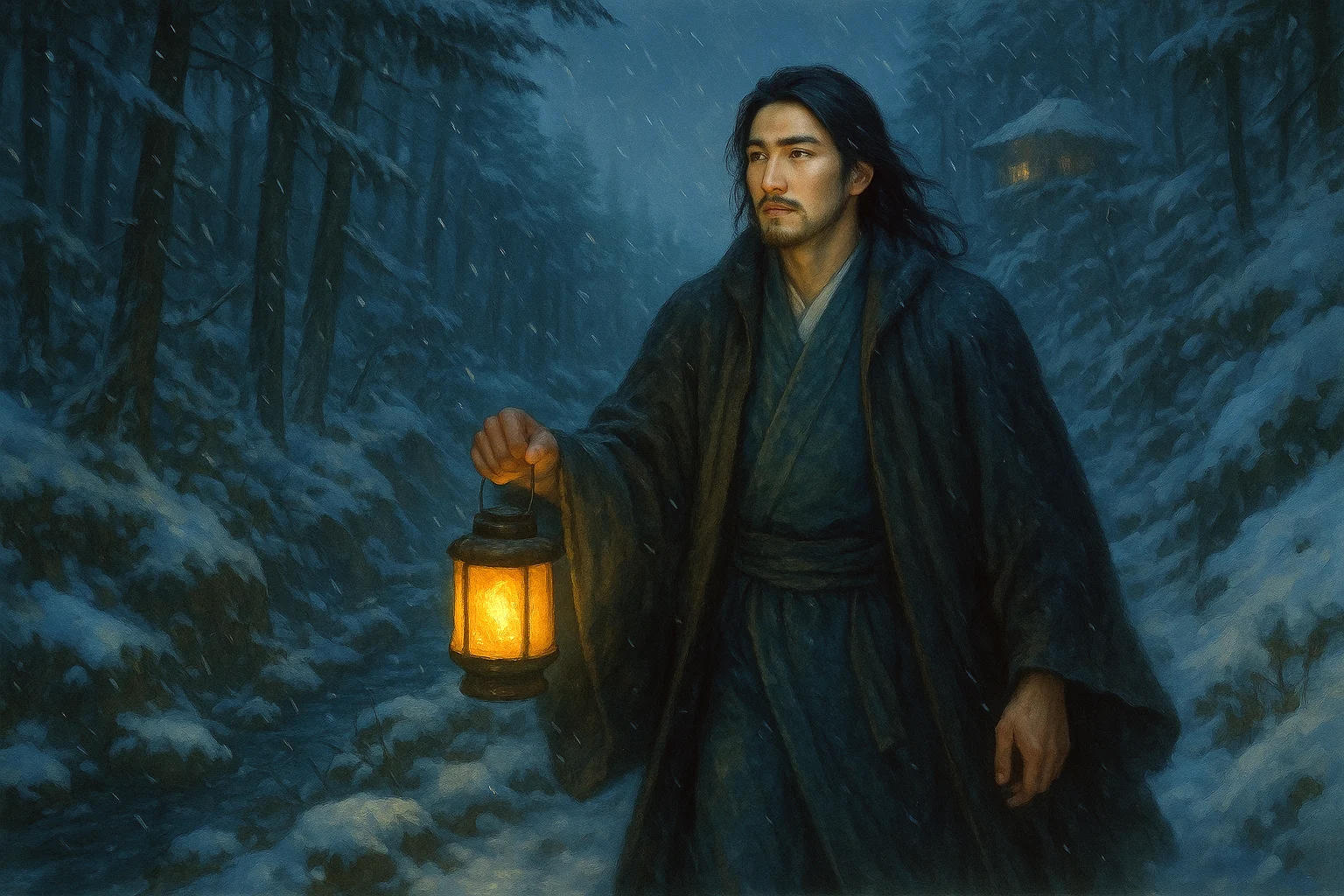
Liu Zhangqing (刘长卿 c. 726 – c. 786), a native of Xuancheng, Anhui Province, was a poet of the Mid-Tang Dynasty. He obtained the jinshi degree (presented scholar) in the late Tianbao era and successively held official posts such as Sheriff of Changzhou and Investigating Censor. Due to his upright and unyielding character, he was exiled twice. His poetry, particularly his five-character verses, achieved the highest distinction, often depicting the melancholy of exile and the joys of reclusion in landscapes. His poetic style is refined, elegant, and ethereal, blending a desolate undertone with the meticulousness characteristic of the Ten Talented Poets of the Dali era. He excelled in using plain sketching to create an atmosphere of tranquil emptiness and profound remoteness. As a pivotal poet bridging the High Tang and Mid-Tang periods, his work inherits the idyllic charm of Wang Wei and Meng Haoran while foreshadowing the bleak and cool elegance of Dali poetry. He exerted a certain influence on late Tang poets such as Yao He and Jia Dao, who belonged to the "painstaking school."
The poet naturally missed his hometown and his family in the New Year. But he was relegated to a distant land in the sky, thousands of miles, want to return can not, but alone weeping tears. Coupled with the poet's advanced age but humble official position, under the people, it is more sad. People can not return home, but the spring breeze has returned home, the poet can not help but envy the spring breeze. The poet sighs that he is in a foreign land, can only live with the mountain apes, and the river willows to enjoy the wind and smoke, like this, similar to Jia Yi's relegation to Changsha, I don't know how many more years before the end of the day?
This poem is not only about expressing nostalgia for the New Year. The poet compares himself to Jia Yi and expresses his indignation at what he has suffered.
Poem translator:
Kiang Kanghu