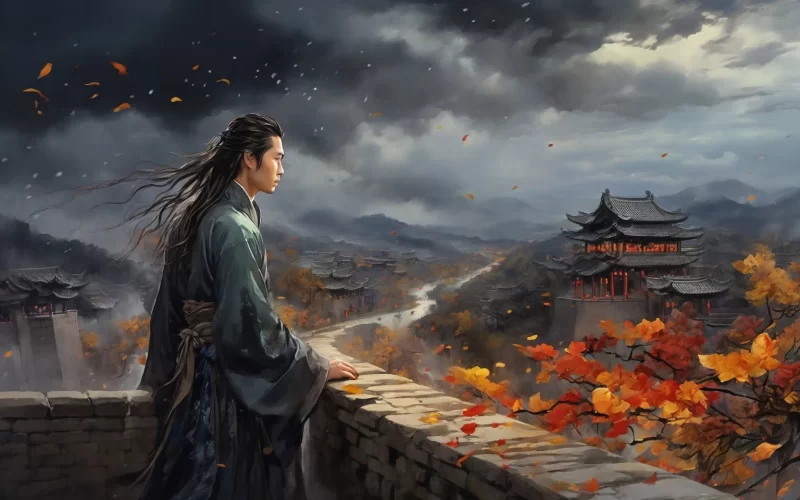

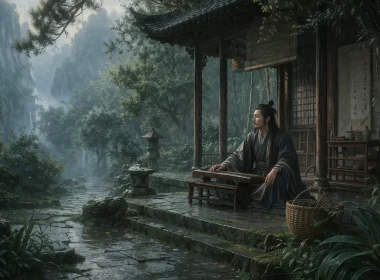
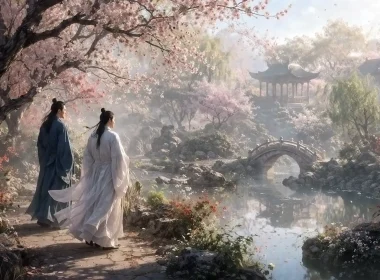

After the parting song, the boat is set free to glide;
Red leaves on green hills, the rushing river tide.

At day’s end, sobering from wine, I find he’s long gone;
In a sky full of wind and rain, I descend the west tower alone.
Original Poem
「谢亭送别」
许浑
劳歌一曲解行舟,红叶青山水急流。
日暮酒醒人已远,满天风雨下西楼。
Interpretation
This poem is a renowned farewell piece by the late Tang poet Xu Hun, composed after parting with a friend at the Pavilion of Xie in Xuanzhou (present-day Xuancheng, Anhui). Xu Hun, famous for his poems meditating on the past and on parting, often reflected on traces of history in landscapes, lamenting the meetings and separations of life. His language is elegant and pure, his conception profound and far-reaching, earning him praise like "A thousand poems by Xu Hun, a lifetime of sorrow by Du Fu."
The Pavilion of Xie, or Xie Tiao's Pavilion, was built by the Southern Dynasties poet Xie Tiao when he served as Governor of Xuanzhou and was a famous local site for farewells. Xu Hun's official career was fraught with difficulties, and in his later years, traveling in Jiangnan, he deeply experienced the pain of parting. This poem depicts the scene after parting, not the reluctance at the moment of farewell, but the time of sobering from wine—the bewilderment of "Awake from wine, I find you're far away" and the loneliness of "In wind and rain alone I go down the western tower," expressing the sorrow of parting with subtlety and depth. The bright beauty of "red leaves on green hills" in the poem forms a stark contrast with the vast desolation of "wind and rain," using the change in scenery to convey the change in emotion, using the richness of the scene to express the emptiness of the heart, making it one of Xu Hun's most moving farewell poems.
First Couplet: "劳歌一曲解行舟,红叶青山水急流。"
Láo gē yī qǔ jiě xíng zhōu, hóng yè qīng shān shuǐ jí liú.
Hearing a farewell song, I see your boat go by; Green hills and red leaves seem to vie with running stream far and nigh.
The poem opens with "劳歌" (a farewell song) introducing the act of parting. "劳歌" were songs sung at farewells in ancient times; the start of the song immediately evokes the sorrow of parting. "解行舟" (I see your boat go by)—three words capture the moment the friend boards the boat and casts off. The action is crisp, yet it leaves the one left behind suddenly feeling hollow. The next line, "红叶青山水急流" (Green hills and red leaves seem to vie with running stream far and nigh), paints the scene before the eyes in rich colors—autumn hills dyed with color, red leaves like fire, clear green water. This should be a picture of perfect beauty. However, the poet abruptly turns with the two words "急流" (running stream): the water flows too swiftly, the boat moves too fast, and in an instant, the friend is already carried far away by the current. This word "急" (swift) signifies both the rushing water and the haste of parting. The more beautiful the scene, the more it contrasts the poet's helplessness and melancholy at "being unable to keep" the friend.
Second Couplet: "日暮酒醒人已远,满天风雨下西楼。"
Rì mù jiǔ xǐng rén yǐ yuǎn, mǎn tiān fēng yǔ xià xī lóu.
Awake from wine, I find you're far away. In wind and rain alone I go down the western tower grey.
This couplet shifts from the moment of parting to the time after, and is the soul of the poem. "日暮酒醒" (Awake from wine)—four words mark the passage of time. The parting might have been at noon; the poet drowns his sorrows in wine, falls asleep drunk, and awakens at dusk to find the friend long gone from sight. "人已远" (I find you're far away)—three words express utter emptiness. It is not a gradual receding into the distance, but "already far"—a distance that can no longer be seen, can no longer be caught. The next line, "满天风雨下西楼" (In wind and rain alone I go down the western tower grey), uses scenery to conclude the emotion, pushing the sorrow of parting to its peak. That "满天风雨" (wind and rain) is both the natural storm and the storm in the heart. The word "下" (go down) in "下西楼" (go down the western tower) uses action to convey the state of mind—it is not descending the tower calmly, but walking down alone from the high tower once shared with the friend. The tower is empty, the friend gone, wind and rain misty and dreary. The poet's lonely figure recedes into the vast dusk, leaving the reader with endless melancholy.
Holistic Appreciation
This is a divine work among Xu Hun's farewell poems. The entire poem consists of four lines and twenty-eight characters. Using the farewell at the Pavilion of Xie as a starting point, it merges the haste of parting, the loneliness afterward, the bright beauty of the scenery, and the vast desolation of the storm, showcasing the poet's deep understanding of the sorrow of parting.
Structurally, the poem shows a progression from light to dark, from togetherness to separation. The first couplet depicts the scene at parting—"red leaves on green hills," bright and colorful, yet the "急流" (running stream) subtly contains the haste of parting. The second couplet expresses the feeling after parting—"Awake from wine" at dusk, wind and rain filling the tower, concluding with "下西楼" (go down the western tower). Between the two lines, the poem moves from day to night, from clear to stormy, from shared company to solitary return, each layer advancing, forming a seamless whole.
Thematically, the core of this poem lies in the interplay between the word "急" (swift) and the word "远" (far away). The "急" in "水急流" (running stream) is the haste of parting, the relentlessness of time. The "远" in "人已远" (you're far away) is the distance in space, and also the sense of loss from being out of reach. Between this "急" and "远" lies the poet's deepest experience of life's meetings and partings: beautiful gatherings are always too brief, while the emptiness after parting is too long. The poet does not state this meaning directly, but expresses it through the scene, and the meaning is already within it.
Artistically, the poem's most moving aspect lies in the contrasting technique of "using a happy scene to express sorrow, concluding emotion with the language of scenery." The first couplet uses the bright, beautiful scene of "红叶青山" (red leaves on green hills) to contrast the sorrow of parting—the more beautiful the scene, the deeper the sorrow. The second couplet uses the vast, desolate scene of "满天风雨" (wind and rain) to highlight the inner loneliness—the greater the storm, the emptier the heart. This technique of using scenery to convey emotion, with emotion residing within the scenery, is precisely the highest realm of classical Chinese poetry's "subtlety and implication."
Artistic Merits
- Using Happy Scenes to Express Sorrow, Powerful Contrast: Using the bright, beautiful scene of "红叶青山" (red leaves on green hills) to contrast the sorrow of parting. The more beautiful the scene, the deeper the sorrow.
- Concluding Emotion with Scenery, Lasting Resonance: The second couplet's "满天风雨下西楼" (In wind and rain alone I go down the western tower grey) concludes with scenery, entrusting the endless sorrow of parting to the wind and rain; the words end but the meaning is endless.
- Temporal Progression, Clear Layers: From the parting moment of "解行舟" (your boat go by) to the after-parting time of "日暮酒醒" (Awake from wine at dusk), emotion deepens layer by layer with the passage of time.
- Vivid Action, Strong Visual Imagery: "解行舟" (your boat go by) conveys the swiftness of parting; "下西楼" (go down the western tower) conveys the loneliness of returning alone. Using action to depict state of mind, as if before the eyes.
Insights
This poem, through a single farewell, speaks to an eternal theme—After parting, the hardest part is not the moment of waving goodbye, but the solitary return after sobering from wine, amidst the wind and rain.
First, it lets us see "the emptiness after parting." At the moment of farewell, there is still a parting song, there are still tearful eyes meeting. However, the hardest part is after the bustle fades, the moment after sobering from wine when you realize the person is already far away. True sorrow of parting often lies not in the instant of goodbye, but in every moment after the goodbye.
On a deeper level, this poem makes us contemplate "the relationship between scene and emotion." The beautiful scene of "红叶青山" (red leaves on green hills) should uplift the spirit, yet in the eyes of the one left behind, it becomes a catalyst for sorrow. The dreary "满天风雨" (wind and rain) is inherently melancholy, yet precisely becomes the best reflection of the inner state. It tells us: When the heart holds emotion, all things take on its color; when the heart holds sorrow, even beautiful scenes become scenes of grief.
And what is most evocative is that loneliness of "going down the tower alone." The friend is far away, wind and rain fill the sky, the poet walks down the western tower alone. Within this action of "下" (go down) lies melancholy, helplessness, and also acceptance. True growth is often accomplished in these repeated acts of "going down alone."
This poem writes of a Tang dynasty farewell, yet allows everyone who has experienced parting to find resonance within it. The haste of that "水急流" (running stream) is the helplessness felt by everyone who has parted. The bewilderment of that "日暮酒醒" (Awake from wine) is the emptiness experienced by everyone who has been alone. The silhouette of that "满天风雨下西楼" (In wind and rain alone I go down the western tower) is the final, shared posture of everyone who has bid farewell. This is the vitality of poetry: it writes the heart's matters of one poet, but one reads the sorrow of parting of all people.
About the poet
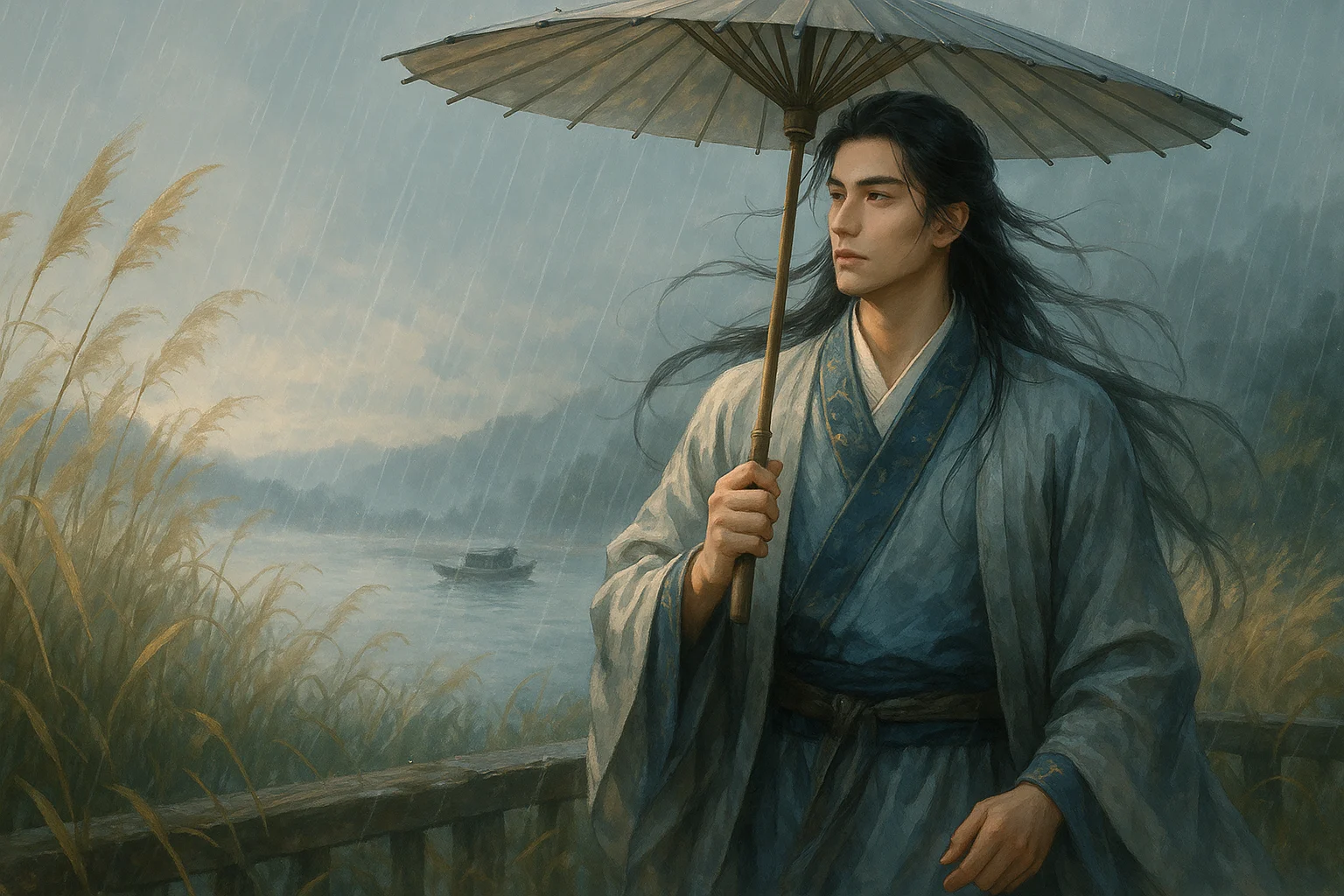
Xu Hun (许浑 c. 788 – c. 858), a native of Danyang, Jiangsu Province, was a renowned poet of the late Tang Dynasty. His ancestor was Xu Yushi, a chancellor during the reign of Empress Wu Zetian, and his family once held prominent status but had declined by Xu Hun's time. He obtained the jinshi degree in the sixth year of the Taihe era (832 AD) and successively served as magistrate of Dangtu and Taiping counties, eventually rising to the position of Vice Director of the Forestry and Crafts Bureau. As an important representative of the late Tang poetic circle, Xu Hun was celebrated for his mastery in depicting water and rain. His poetry often features nostalgic reflections on history, characterized by a desolate and solemn style. He excelled particularly in seven-character regulated verse, with language that is concise, refined, and harmonious in rhythm. Standing apart from Du Mu and Li Shangyin, he established his own distinctive school, exerting a profound influence on later poets such as Wei Zhuang and Luo Yin.