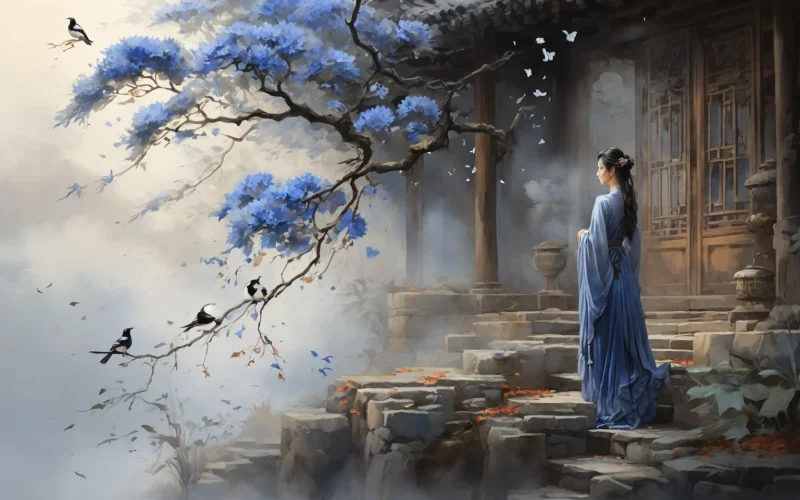



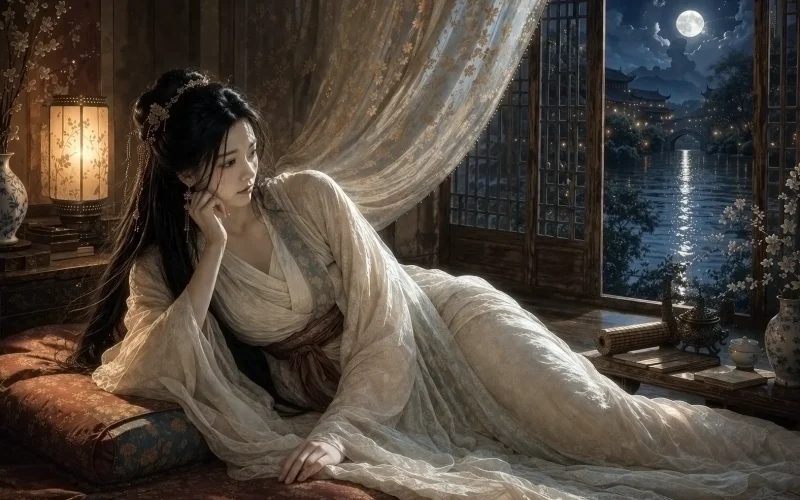
On bamboo mat I long for you without a break,
Coming from afar, you don't keep the date you make.
From now on, I won't care for any lovely night;
In vain on the west tower may the moon shine bright.
Original Poem
「写情」
李益
水纹珍簟思悠悠,千里佳期一夕休。
从此无心爱良夜,任他明月下西楼。
Interpretation
The Mid-Tang poet Li Yi is renowned for his frontier poems, often crafting desolate lines like, “不知何处吹芦管,一夜征人尽望乡” ("But now I hear the lu-pipe blown, I know not where; / O'er all the border, warriors gaze homeward that night."). Yet he was also skilled at writing of boudoir sentiments, capturing those soft and vulnerable parts deep within the human heart. The historical background of this particular poem is not clearly recorded. However, considering Li Yi's life, two plausible readings emerge.
The first points to a real emotional experience. According to the Tang-era tale "The Tale of Huo Xiaoyu" by Jiang Fang, Li Yi in his youth fell in love with the famous courtesan Huo Xiaoyu and pledged to marry her. Later, after passing the jinshi exam and being appointed Assistant Magistrate of Zheng County, he broke his vow and married his cousin, a Ms. Lu. Huo Xiaoyu, consumed by worry and resentment, fell ill and died with a heart full of regret. While this story is a legend and not necessarily entirely true, it is an undeniable fact that Li Yi was a passionate man throughout his life, and his poems frequently reveal a sense of disappointment. The line in the poem, “千里佳期一夕休” ("A thousand li away, our happy date is broken in a night"), can indeed be read as his remorse and self-reproach over a past affair.
The second reading points towards a broader sense of life's disappointments. In classical poetry, "happy date" (佳期, jiāqī) could refer to a lovers' tryst, but also to an audience with the sovereign, or the expectation of official success. After becoming a jinshi, Li Yi remained in lowly posts for a long time, unable to realize his ambitions. That "happy date a thousand li away" might have been a hope for his career, an opportunity long awaited, that ultimately vanished overnight. This kind of loss is fundamentally akin to disappointment in love.
Regardless of interpretation, the core of this poem lies in the three words: "broken in a night" (一夕休, yī xī xiū). A heart full of expectation turns to nothing in a single night. Henceforth, no matter how fine the night, no matter how full the moon, it has nothing to do with you anymore. This state of mind is understood by those disappointed in love, and by those thwarted in their careers. Li Yi captured this state of mind in twenty-eight characters, allowing readers centuries later to still feel that bone-deep chill.
First Couplet: "水纹珍簟思悠悠,千里佳期一夕休。"
Shuǐ wén zhēn diàn sī yōuyōu, qiānlǐ jiāqī yī xī xiū.
On patterned mat of water-design, my longing thoughts stretch far and wide.
A thousand li away, our happy date is broken in a night.
The poem opens with "patterned mat of water-design" setting the physical scene. The mat (簟, diàn) is bamboo, its pattern like water ripples, describing the object while also subtly suggesting the undulations of the speaker's heart. "My longing thoughts stretch far and wide" (思悠悠, sī yōuyōu) expresses that drawn-out, inescapable sorrow. The next line, “千里佳期一夕休” ("A thousand li away, our happy date is broken in a night"), is the poem's most painful point—a tryst promised from a thousand li away, once the focus of all his longing, is now, in a single night, utterly shattered. The word "broken" (休, xiū) is clean, decisive, yet conceals so much unwillingness and helplessness.
Second Couplet: "从此无心爱良夜,任他明月下西楼。"
Cóngcǐ wúxīn ài liángyè, rèn tā míngyuè xià xīlóu.
From this time on, I have no heart to love a perfect night,
But let the moon go down of itself on the western tower.
This couplet shifts from the turmoil of the night the promise was broken to a resolute statement about the future. "From this time on, I have no heart to love a perfect night"—the perfect night itself is not at fault, nor is the moon, but the poet has lost the heart to appreciate them. "Have no heart to love" (无心爱, wúxīn ài) speaks not of hatred, but of a deadened heart. The next line, "But let the moon go down of itself on the western tower," takes it a step further. "Let... of itself" (任他, rèn tā) conveys abandonment, indifference, utter disregard. The moon rises and sets as usual, the world turns as usual, but all of it is now irrelevant to the poet.
Holistic Appreciation
This is a heptasyllabic quatrain that masters complexity through simplicity. In its four lines and twenty-eight characters, it meticulously and profoundly depicts the psychological collapse following a broken promise. Starting with the "patterned mat" and concluding with the "moon on the western tower," the poem traverses the emotional journey from anticipation to despair, from turmoil to deadened silence, within an extremely compact form.
Structurally, the poem presents a clear, two-part progression: "The Event" and "Ever After." The first two lines describe the sudden change on that night: "On patterned mat of water-design, my longing thoughts stretch far and wide" captures the state at the moment—the mat's pattern like water, the heart's feelings like waves; “千里佳期一夕休” ("A thousand li away, our happy date is broken in a night") is the change itself—full of expectation, shattered overnight. The last two lines describe the state of mind henceforth: "From this time on, I have no heart to love a perfect night" is the fundamental shift in attitude; "But let the moon go down of itself on the western tower" is the final, fixed state of the heart. Across the four lines, the poem moves from the pain of a moment to the wound of a lifetime, with the span of time and the depth of emotion advancing in sync.
In terms of conception, the poem's core lies in the utter despair conveyed by "have no heart" (无心, wúxīn) and "let... of itself" (任他, rèn tā). The poet does not write of weeping, of cursing, of any violent reaction; he simply states calmly: I will no longer love fine nights; let the moon do as it will. This calmness is more heartbreaking than any accusation. It reveals a cruel truth: true despair is not anger, not sorrow, but complete indifference—indifference to fine nights, to the bright moon, to how the world turns.
Artistically, the poem's most moving aspect is the skillful combination of "using scene to convey emotion" and "using the hypothetical to depict reality." The patterned mat is an ordinary object, but tinged with "my longing thoughts stretch far and wide," it becomes a symbol of a troubled heart; the moon on the western tower is an ordinary scene, but concluded with "let... of itself," it becomes a reflection of a desolate heart. The subjunctive mood of "let the moon go down of itself" fuses the poet's resolve and helplessness into a single image, letting the reader almost see that moon rising and setting on its own, while the poet has long since turned away, never to look back.
The entire poem contains not a single word for "sorrow" (愁, chóu) or "bitterness" (苦, kǔ), yet the feeling of sorrow and bitterness is everywhere. The poet hides all emotion within the scenery and action—the water pattern, the fine mat, the bright moon, the western tower are all common things, but transformed by the poet, they become vessels of sorrow. This reserved beauty of "not using a single word, yet capturing the essence" (不著一字,尽得风流) is the highest realm of classical Chinese poetry.
Artistic Merits
- Using Scene to Convey Emotion, Reserved and Profound: The patterned mat is a scene, and also a symbol of the heart's state; the moon on the western tower is a scene, and also a reflection of the state of mind. The scene contains emotion; emotion emerges through the scene.
- Forceful Turn, Emotional Progression: The first two lines describe the night of the event, the last two lines describe the time thereafter. The poem moves from the pain of a moment to the wound of a lifetime, layer upon layer, deepening the emotion.
- Concise Language, Rich Connotation: The poem's twenty-eight characters exhaustively depict the psychological collapse from a broken promise. Words like "broken in a night," "have no heart to love," and "let... of itself" carry immense weight.
- Using the Hypothetical to Depict Reality, Lingering Resonance: "But let the moon go down of itself on the western tower" is expressed in a subjunctive mood, fusing the poet's resolve and helplessness into a single image, leaving endless aftertaste.
- Vivid Contrast, Strong Juxtaposition: The contrast between a "happy date a thousand li away" and "broken in a night," and between a "perfect night" with a "bright moon" and "have no heart to love," intensifies the poem's emotional power through juxtaposition.
Insights
This poem is about a broken promise, and also about lost love, and more broadly, about all those moments in life of "long-awaited hope that comes to nothing."
First, consider the seven characters: “千里佳期一夕休” ("A thousand li away, our happy date is broken in a night"). A thousand li expresses the duration and distance of the expectation; "in a night" expresses the speed and finality of the disillusionment. The word "broken" is the cruelest—it is not a postponement, not a change, but a complete end. You prepared for it for a long time, thought of it for a long time, hoped for it for a long time, and then, in a single night, nothing remained. This disparity can shatter a person.
The most meaningful part of the poem is the last two lines. The poet does not blame heaven or others; he only says, "From this time on, I have no heart to love a perfect night, / But let the moon go down of itself on the western tower." The moon rises and sets as usual, the world turns as usual; he simply no longer cares. This "letting be" (任他) is more startling than any fierce accusation—because fierceness still indicates caring; "letting be" is true heart-death.
On a deeper level, this poem reveals a truth: a person's attitude towards the world often depends not on the world itself, but on what fills the heart. The perfect night is still that perfect night; the moon is still that moon. When the heart is filled with expectation, they are beautiful, worth striving for; when the heart is empty, they too become empty, even painful. The world has not changed; the heart viewing the world has changed.
Yet the poem holds another layer of meaning. The poet says, "From this time on, I have no heart to love a perfect night," yet he still wrote this poem. If he truly had no heart, if he truly cared for nothing, these twenty-eight characters would not exist in the world. The act of writing the poem itself proves he still cares, still hurts, is still trying to use words to oppose that word "broken." The despair is real, but that bit of unwillingness within the despair is also real.
Therefore, the insight this poem offers might be this: Life always has moments of "a happy date a thousand li away broken in a night." You can be heartbroken, you can turn away, you can henceforth not look upon fine nights. But if you can still write this heartbreak into poetry, if you can still speak of this turning away, then you have not completely fallen. True despair is silence, is not even bothering to say "let it be." As long as you can still say, "let the moon go down of itself on the western tower," a breath of life remains, and it is still possible that on some moonlit night, you will raise your head again.
Poem Translator
Xu Yuanchong (许渊冲)
About the Poet
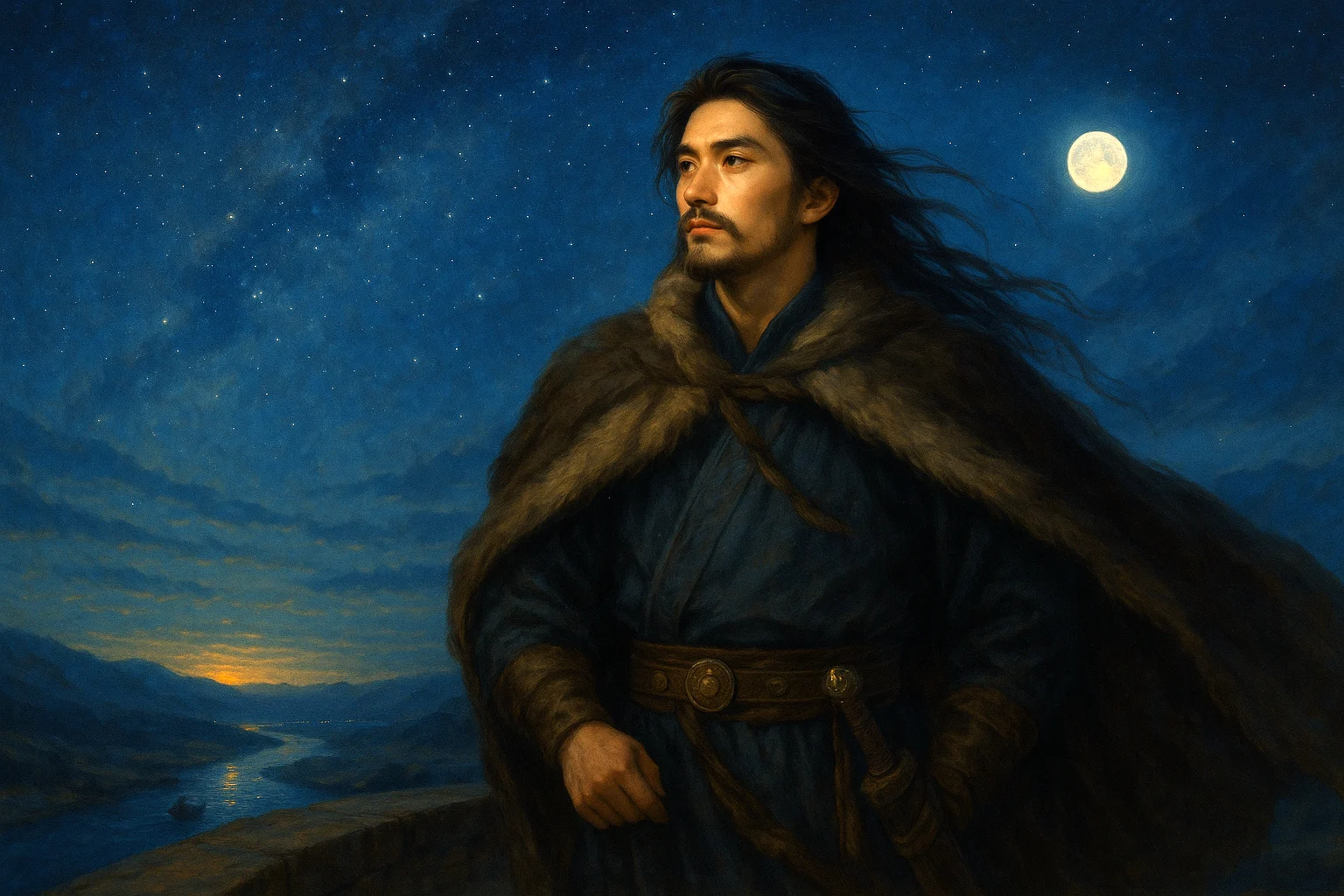
Li Yi (李益 748 - 829), a native of Wuwei, Gansu Province, was a representative poet of the Frontier Fortress School in the Mid-Tang period. He became a jinshi (presented scholar) in the fourth year of the Dali era (769 AD) and served through the reigns of Emperor Xianzong and Emperor Wenzong, eventually rising to the position of Minister of Rites. His poetry is particularly renowned for its seven-character quatrains, characterized by a style that is both solemn and poignant, blending the grandeur of High Tang frontier poetry with the plaintive elegance of the Mid-Tang. Inheriting the legacy of Wang Changling and inspiring later poets like Li He, his frontier poems carved out a unique and distinctive place in the Mid-Tang literary world.