


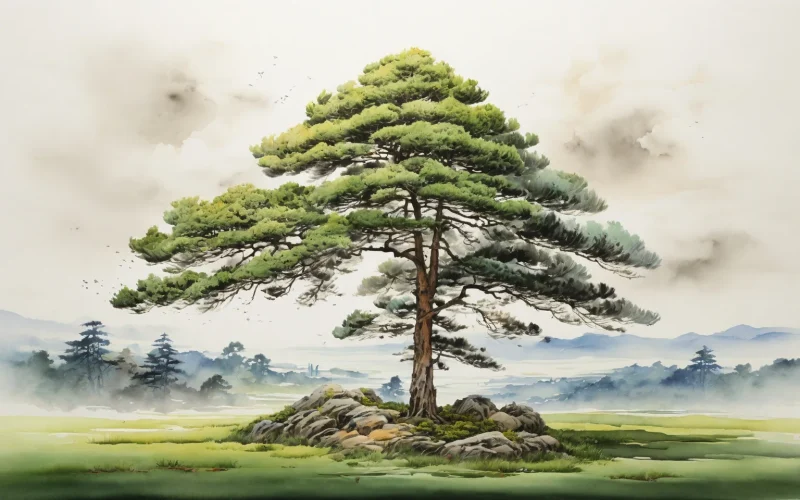
While young, the pine tree thrusts its head amid tall grass;
Now by and by we find it outgrow weed in mass.
People don't realize it will grow to scrape the sky;
Seeing it tower in cloud, then they know it's high.
Original Poem
「小松」
杜荀鹤
自小刺头深草里,而今渐觉出蓬蒿。
时人不识凌云木,直待凌云始道高。
Interpretation
This poem was composed by the late Tang poet Du Xunhe. Born into humble circumstances, Du repeatedly failed the imperial examinations in his youth, finally passing the jinshi at the age of forty-six. However, his official career remained troubled due to the turbulent times, and he ultimately never gained significant recognition. The late Tang period was marked by political corruption and a dark, unjust examination system, where talented individuals often languished in obscurity, while the incompetent rose rapidly by currying favor with the powerful. Having endured hardship throughout his life, the poet felt the pain of neglected talent keenly. Using the young pine as a metaphor for a person, he expresses his own frustration at unrecognized talent while offering a sharp critique of the shortsightedness and injustice in how society identifies and utilizes talent. This short poem is thus a profound indictment of the ills of his time and a heartfelt solace for all the "sky-reaching trees" neglected by the world.
First Couplet: "自小刺头深草里,而今渐觉出蓬蒿。"
Zì xiǎo cì tóu shēn cǎo lǐ, ér jīn jiàn jué chū pénghāo.
Since its youth, its spiky head thrusts from deep grass;
And now it's sensed that it outgrows the common weeds.
The opening image, "spiky head," is remarkably vivid. A young pine's needles are sharp, pointing skyward. The word "thrusts" captures not only its form but also its spirit—it is the defiant edge of life, the proud bone of innate talent. Yet this sharp, exposed young pine grows "from deep grass," hidden by wild weeds, unseen by anyone. This precisely depicts the poet himself and all unrecognized scholars of humble origin: endowed with talent, yet trapped amidst obscurity, unseen and unappreciated.
The second line, "And now it's sensed that it outgrows the common weeds," shifts the focus from the past to the present. The words "sensed that" are rich in implication; growth is not instantaneous but accumulates imperceptibly until it finally breaks through the encirclement. "Outgrows the common weeds" is both a realistic depiction of the pine's growth and a symbol of talent silently gathering strength amidst adversity, destined one day to emerge. This line subtly praises the tenacious: as long as one does not cease growing, one can eventually surpass the weeds that obscure it. Viewed together, the first two lines trace the pine's initial transformation, unfolding from "since its youth" to "and now."
Second Couplet: "时人不识凌云木,直待凌云始道高。"
Shí rén bù shí língyún mù, zhí dài língyún shǐ dào gāo.
Worldly eyes fail to know a sky-reaching tree;
Not until it scrapes the clouds do they praise its height.
The final couplet shifts from the object to people, directly targeting worldly attitudes. "Worldly eyes" refers to short-sighted people who see only the present, unable to discern potential. "Sky-reaching tree" is the poet's hope and the pine's future, but who recognizes it before it reaches the sky? This line is a sharp critique of society's slowness in recognizing talent, saturated with the poet's own bitterness at being overlooked.
The closing line concludes the poem with a powerful contrast. The pine finally "scrapes the clouds," and only then do worldly people praise its height. Yet, who cast a glance its way when it struggled amidst the deep grass? The interplay between "not until" and "do they praise" lays bare the opportunism and shortsightedness of worldly judgment. The poet offers no direct condemnation; instead, through calm narration, the satire emerges naturally from the contrast, rich in meaning. Taken together, the last two lines, moving from "fail to know" to "do they praise," reveal the lag and absurdity of societal appraisal.
Overall Appreciation
This is a "poem celebrating an object to express an ideal" (yongwu shi). In just twenty characters, it uses the growth of a young pine as a thread to outline a complete metaphor for human life. Using the pine to symbolize a person, the poet both expresses his own lament at unrecognized talent and demonstrates profound insight into the patterns of talent development.
Structurally, the poem presents a clear trajectory of growth. The first two lines describe the pine's upward struggle from "deep grass" to "outgrows the common weeds." The last two lines describe the belated reaction of the world, from "fail to know" to "do they praise." The four lines progress through time, with emotions deepening step by step—from endurance to emergence, from indignation to satire—forming a distinct and coherent sequence.
In terms of conception, the poem's core lies in the contrast between "knowing" and "not knowing." The stages of being in "deep grass" and "outgrowing the common weeds" are critical periods of growth for the pine, yet they are precisely the stages "worldly eyes fail to know." Once it reaches the clouds, people come to praise it, but they have already missed the best time for support. This phenomenon of "failing to recognize it early, only praising it late" is the greatest flaw in society's mechanism for selecting talent. The poet uses this to warn the world: true discernment should recognize the sky-reaching potential in a sapling and offer support to talent before it has fully emerged.
Artistically, the poem's greatest success lies in its choice of imagery and the aptness of its symbolism. The pine tree has since ancient times symbolized steadfastness and noble character, but Du Xunhe uniquely focuses on a young pine, concentrating on the stage of its growth when it is overlooked. Each image—the "spiky head" in form, the "deep grass" as its environment, the transformation of "outgrowing," and the aspiration of "sky-reaching"—corresponds precisely to the stages of a talented person's development, naturally and aptly, without any sense of strain.
Particularly valuable is that, although the poem is filled with indignation, it is not despondent. The young pine ultimately "outgrows the common weeds" and ultimately "scrapes the clouds." The poet's faith is thus revealed: true talent will not be buried forever; as long as one persists in growing, the day of reaching the clouds will come. This tone, which contains hope within its critique, gives the poem both the sharp edge of reality and the brilliance of idealism.
Artistic Features
- Using an Object to Symbolize a Person, Profound in Meaning: The growth of the young pine serves as a metaphor for the development of talent. Every line describes the pine, yet every line also describes a person. Object and self merge into one, naturally and effortlessly.
- Vivid Contrast, Sharp Satire: The strong contrast between "worldly eyes fail to know" and "not until it scrapes the clouds" lays bare the shortsightedness and opportunism of worldly judgment. Not a single word of direct censure is used, yet censure emerges of itself.
- Condensed Language, Vivid Imagery: The phrase "spiky head" captures both form and spirit; "sensed that" carries subtle suggestiveness; "sky-reaching" evokes a sense of vast grandeur. Throughout the poem, every word carries weight, yielding a richness of meaning.
- Careful Structure, Progressive Layers: Moving from "since its youth" to "and now," from "deep grass" to "common weeds," from "fail to know" to "do they praise," time and emotion advance in sync. The structure of introduction, development, turn, and conclusion forms a seamless whole.
- Reason and Emotion Intertwined, Provoking Deep Thought: It is both a celebration of an object and an expression of feeling; both a critique and an encouragement. It possesses both the depth of reality and the warmth of idealism.
Insights
Through the growth of a single young pine, this poem articulates the timeless sorrow of neglected talent and offers profound insights for later generations.
First, it encourages those in difficult circumstances: True value requires the test of time; being overlooked does not mean being without worth. The young pine, born in deep grass, obscured by weeds, never ceased to grow. The words "spiky head" embody precisely that proud, innate bone and defiant edge—even if no one sees, it still stretches toward the sky. The poet Du Xunhe endured a life of hardship, repeatedly failing the exams, yet he never abandoned his steadfast belief in his talent. Using the young pine as a metaphor for himself, he tells us: In the days when no one appreciates you, what is most precious is not external recognition but inner certainty. A true, sky-reaching ambition never exists for others to "praise its height"; it stems from life's own inherent desire to grow upward. This tenacity and self-confidence maintained amidst adversity is more valuable than any success.
Second, it warns the world: The discerning eye should recognize potential before it is fully realized. The contrast in the lines "时人不识凌云木,直待凌云始道高" sharply reveals the lag and opportunism of societal appraisal. People often see only the result, not the process; they value fame after achievement, not latent potential. However, truly far-sighted discernment should recognize sky-reaching potential in a sapling and offer support to talent before it has fully emerged. This wisdom of "early recognition" concerns not only individual fate but also the vitality of society. A society that only knows how to praise the successful, but cannot recognize potential, will ultimately lose the soil for innovation.
On a deeper level, this poem also illuminates the dialectical relationship between "process" and "result." People see only the "height" when it reaches the clouds, not the "thrust" in the deep grass or the "outgrowing" amidst the weeds. Yet, it is precisely these overlooked stages of growth that form a person's true foundation. It reminds us: To evaluate a person, we should look not only at the height of their achievements but also at the path they have walked, the hardships they have endured, the beliefs they have held fast to. In this era of eager pursuit of quick success, this poem offers solace to everyone still struggling in the "deep grass" and a reminder to everyone who holds the power of discernment: Please have more patience for those young pines that are still growing, for today's inconspicuous "spiky head" may be tomorrow's "sky-reaching tree" that holds up the sky.
Poem translator
Xu Yuanchong (许渊冲)
About the Poet
Du Xunhe (杜荀鹤 846 - 904), a native of Shitai, Anhui, was a realist poet of the late Tang Dynasty. He became a jinshi (presented scholar) in the second year of the Dashun era (891 AD). During the Later Liang Dynasty, he was appointed to the Hanlin Academy but passed away just five days later. His poetry carried forward the spirit of the new yuefu (Music Bureau) tradition established by Du Fu and Bai Juyi, focusing exclusively on the sufferings of the common people. His poetic style was simple, unadorned, and deeply poignant. He often employed a relatively free metrical form, later known as the "Du Xunhe Style," which stood out as a unique and powerful voice amidst the ornate and decadent poetic trends of the late Tang period.