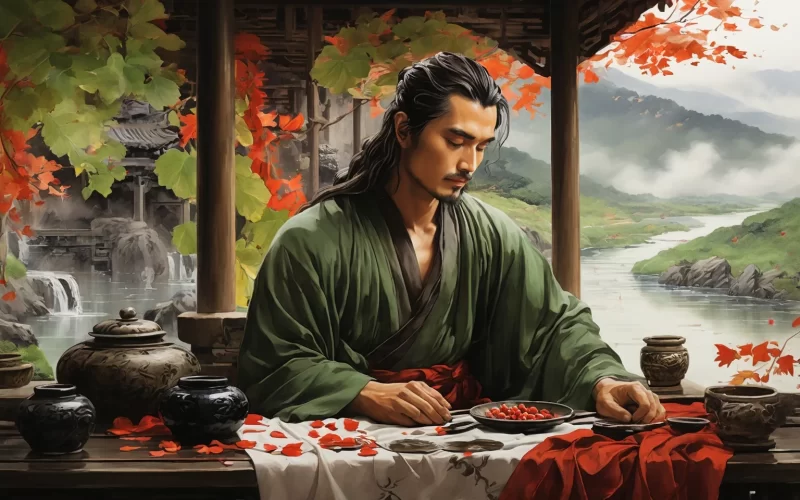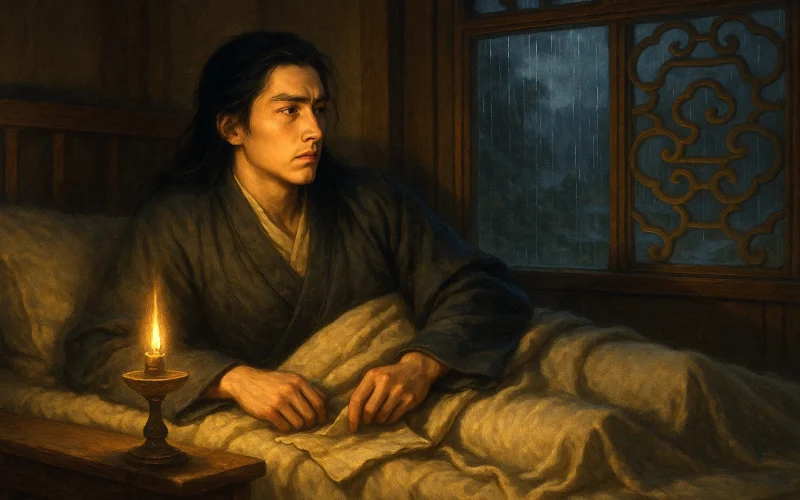

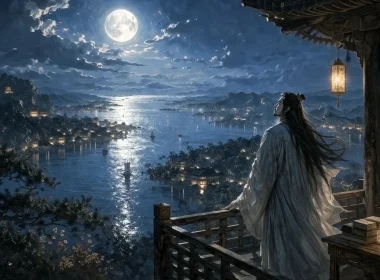
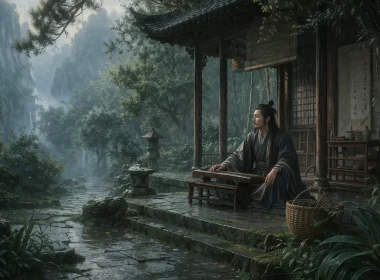
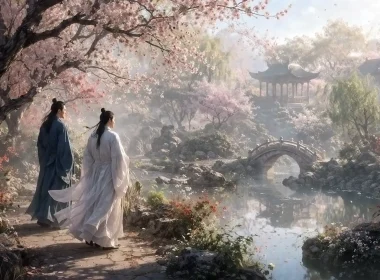
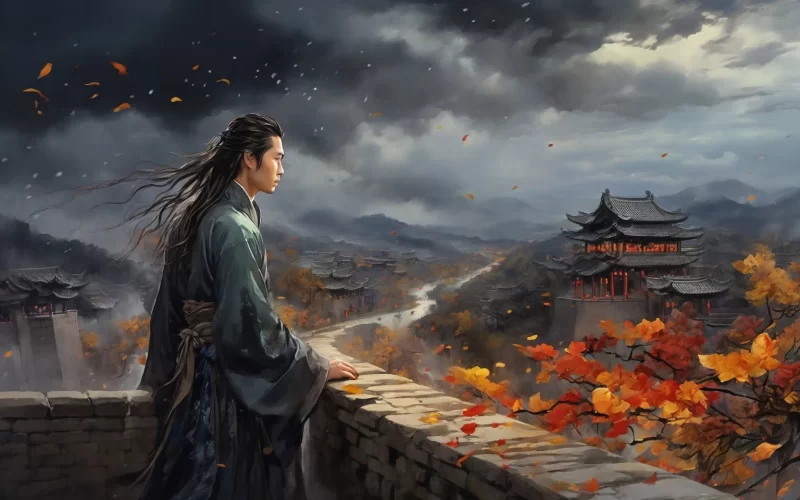
I climb the tower — and sorrow, wide as earth, I meet;
The reeds and willows seem an isle where river‑waters beat.

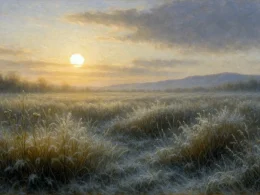
Clouds o’er the stream are born, the sun sinks past the hall;
The mountain‑rain draws near — the tower‑wind foretells its fall.

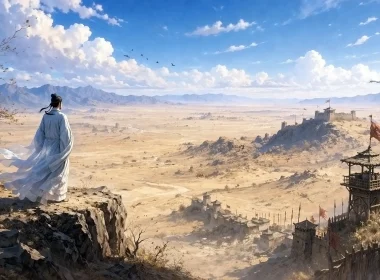
Birds seek the green‑grown waste, where Qin’s proud gardens lay;
Cicadas cry in leaves that shroud the Han’s decay.

Ask not, O wayfarer, of deeds that time has slain —
The River Wei flows east, and will not turn again.
Original Poem
「咸阳城西楼晚眺」
许浑
一上高城万里愁,蒹葭杨柳似汀洲。
溪云初起日沉阁,山雨欲来风满楼。
鸟下绿芜秦苑夕,蝉鸣黄叶汉宫秋。
行人莫问当年事,故国东来渭水流。
Interpretation
This poem is a monumental work among the late Tang poet Xu Hun's reflections on history while ascending heights, composed on an autumn evening around 849 AD during the reign of Emperor Xuanzong. Xu Hun, renowned for his skill in writing on historical themes and often ranked alongside Du Mu, frequently reflects on traces of the past, lamenting the rise and fall of dynasties. His language is elegant and pure, his conception profound and far-reaching, earning him praise like "A thousand poems by Xu Hun, a lifetime of sorrow by Du Fu."
Xianyang, the capital of the Qin dynasty, renamed Weicheng during the Han, was located northwest of Chang'an, north of the Wei River. The western tower of Xianyang where the poet ascended was on the site of the former Qin capital. At this time, the late Tang state was weakening, with regional warlords holding power and eunuchs monopolizing authority. Ascending the tower and gazing afar, the poet saw the desolate scene of "ducksweeds and willows" and felt the deep melancholy of "grief overgrow the land." The dusk of "clouds rise as sinks the sun" and the tension of "wind filled the tower before the mountain shower" are both the actual scene before his eyes and a metaphor for the turbulent political situation. The couplet "At dusk the birds alight on green weeds o'er the old Qin garden wall; The cicada shrills o'er yellow leaves in the palace of the Han's fall" further juxtaposes the splendor of Qin and Han with the present desolation, making the sense of historical vicissitudes palpable. The entire poem is unified by the word "愁" (grief/sorrow), concludes with the "渭水流" (River Wei water still flow), fusing personal nostalgia, historical rise and fall, and the anxieties of the age into one, making it a pinnacle of ancient Chinese poetry reflecting on history from a height.
First Couplet: "一上高城万里愁,蒹葭杨柳似汀洲。"
Yī shàng gāo chéng wàn lǐ chóu, Jiān jiā yáng liǔ sì tīng zhōu.
On city wall I see grief overgrow the land; Riverside like a dreary sandbar where ducksweeds and willows stand.
The poem opens startlingly with "一上高城万里愁" (On city wall I see grief overgrow the land). The contrast between "一上" (on...I see) and "万里" (overgrow the land) creates immense tension—the moment he ascends the tower, sorrow already pervades the land, as if this grief does not arise from his heart but rushes upon him from heaven and earth. The next line, "蒹葭杨柳似汀洲" (Riverside like a dreary sandbar where ducksweeds and willows stand), connects the scene before his eyes to the sorrow in his heart. Ducksweeds lush and green, willows swaying gently—these are images of longing for someone from the Book of Songs, yet at this moment they make the poet feel as if he is in a Jiangnan waterside scene. The three words "似汀洲" (like a dreary sandbar) are both a description of the actual scene and a trigger for nostalgia—isn't that distant hometown also a scene of waterside beauty? Within this couplet, the sorrow of ascending the tower and the feeling of longing for home are already seamlessly fused.
Second Couplet: "溪云初起日沉阁,山雨欲来风满楼。"
Xī yún chū qǐ rì chén gé, Shān yù yù lái fēng mǎn lóu.
O'er the stream clouds rise as sinks the sun beyond the bower; The wind filled the tower before the mountain shower.
This couplet is a celebrated line through the ages, painting a scene with profound meaning. "溪云初起" (clouds rise) and "日沉阁" (sinks the sun beyond the bower)—one rising, one sinking—depict the fleeting changes in the twilight sky. "山雨欲来" (before the mountain shower) and "风满楼" (wind filled the tower)—one about to arrive, one already present—convey the tense atmosphere before a storm breaks. The three words "风满楼" (wind filled the tower) describe both the natural gale and the turbulent political situation; the two words "欲来" (before) are both a prophecy of the mountain rain and a metaphor for the state of the nation. With an extremely economical brush, the poet perfectly merges the scene before his eyes with the matters in his heart, allowing the reader to feel the changes in nature while also sensing the precariousness of the times.
Third Couplet: "鸟下绿芜秦苑夕,蝉鸣黄叶汉宫秋。"
Niǎo xià lǜ wú Qín yuàn xī, Chán míng huáng yè Hàn gōng qiū.
At dusk the birds alight on green weeds o'er the old Qin garden wall; The cicada shrills o'er yellow leaves in the palace of the Han's fall.
This couplet shifts from the present scene to historical reflection, juxtaposing the desolation of reality with the splendor of history. "秦苑" (Qin garden) and "汉宫" (palace of the Han) were the most splendid sites of the Qin and Han dynasties, yet now only "绿芜" (green weeds) and "黄叶" (yellow leaves) remain. "鸟下" (birds alight) and "蝉鸣" (cicada shrills) use movement to depict stillness, sound to depict silence—where birds alight was once an imperial hunting ground; where the cicada shrills was once a palace of revelry and song. This powerful contrast between past and present makes the sense of historical vicissitudes palpable. The poet does not speak of sorrow, yet sorrow is evident; he does not speak of rise and fall, yet rise and fall are already within it.
Fourth Couplet: "行人莫问当年事,故国东来渭水流。"
Xíng rén mò wèn dāng nián shì, Gù guó dōng lái Wèi shuǐ liú.
Wayfarers, do not ask about the days gone by! I come from east; I see the River Wei water still flow by.
The final couplet concludes the whole piece with words of consolation, elevating the historical lament to eternity. "行人莫问当年事" (Wayfarers, do not ask about the days gone by)—on the surface, it advises passersby not to ask, but in reality, it is because asking is futile. That glory and decline are already past; what use is asking? The next line, "故国东来渭水流" (I come from east; I see the River Wei water still flow by), concludes with scenery, its resonance lingering. The Wei River still flows east, ceaseless day and night, just as it did a thousand years ago; yet the once-splendid palaces of Qin and Han have long vanished without a trace. The three words "渭水流" (River Wei water still flow) use eternal nature to contrast transient human affairs, using the relentless flow to reflect the poignant sorrow, bringing forth the poem's melancholy and historical sense, ending the words but not the meaning.
Holistic Appreciation
This is a divine work among Xu Hun's poems reflecting on history from heights. The entire poem consists of eight lines and fifty-six characters. Using the evening view from the Xianyang city tower as a starting point, it fuses personal nostalgia, historical rise and fall, and the anxieties of the age, showcasing the poet's profound contemplation of history and reality.
Structurally, the poem shows a progression from near to far, from present tracing to past, from concrete to abstract. The first couplet begins with ascending the tower giving rise to sorrow, using "蒹葭杨柳" (ducksweeds and willows) to evoke thoughts of home. The second couplet uses "溪云" (clouds rise) and "山雨" (mountain shower) to describe the shifting scene before his eyes, subtly alluding to the turbulent political situation. The third couplet juxtaposes reality and history with "秦苑" (Qin garden) and "汉宫" (Han palace), pointing out the feeling of rise and fall. The fourth couplet concludes with "渭水流" (Wei River flows), entrusting endless emotion to the eternal river. Across the four couplets, the poem moves from self to object, from present to past, from object to principle, each layer deepening, forming a seamless whole.
Thematically, the core of this poem lies in the interplay between the word "愁" (grief/sorrow) and the word "流" (flow). The "愁" in "万里愁" (grief overgrow the land) is the emotional outburst at the moment of ascending. The "流" in "渭水流" (Wei River flows) is the silent witness of eternal history. Between this "愁" and "流" lies the poet's complete perception of history and life: personal sorrow will ultimately dissipate, historical rise and fall will ultimately become the past; only that Wei River continues to flow east, witnessing everything, and also submerging everything.
Artistically, the poem's most moving aspect lies in its dual structure of "scene and emotion blended, past and present juxtaposed." The poet merges the scene before his eyes with the feelings in his heart, making "风满楼" (wind filled the tower) both nature and the times; he juxtaposes the splendor of Qin and Han with the present desolation, making "鸟下绿芜" (birds alight on green weeds) both actual scene and history. This technique of fusing personal feeling with historical reflection is precisely the highest realm of classical Chinese poetry's "ascending heights and reflecting on the past."
Artistic Merits
- Scene and Emotion Blended, Meaning Profound: "山雨欲来风满楼" (wind filled the tower before the mountain shower) is both scene description and metaphor, perfectly merging natural change with the worries of the times.
- Past and Present Juxtaposed, Sense of Vicissitudes Strong: Contrasting "秦苑" (Qin garden) and "汉宫" (Han palace) with "绿芜" (green weeds) and "黄叶" (yellow leaves), creating a powerful contrast between historical splendor and present desolation.
- Language Concise, Imagery Vast: Phrases like "万里愁" (grief overgrow the land) and "渭水流" (Wei River flows) use extremely economical language to express extremely deep emotion, each word carrying immense weight.
- Concluding Emotion with Scene, Resonance Lingering: The final couplet concludes with "渭水流" (Wei River flows), entrusting endless emotion to the eternal river, ending the words but not the meaning.
Insights
This poem, through a single act of ascending a tower and gazing afar, speaks to an eternal theme—The long river of history flows ceaselessly, personal joys and sorrows ultimately become the past; only the eternal landscape remains silently witnessing.
First, it lets us see the contrast between "the momentary and the eternal." The moment the poet ascends the tower, sorrow pervades the land; yet this sorrow will ultimately vanish along with the poet. Only the Wei River continues to flow east, from Qin and Han to late Tang, from late Tang to today. It reminds us: Before eternal nature, personal joys and sorrows are so insignificant; yet it is this insignificant life that can feel, can think, can utter the sigh of "万里愁" (grief overgrow the land)—this sigh is the dignity of humans transcending nature.
On a deeper level, this poem makes us contemplate "the meaning of history." "行人莫问当年事" (Wayfarers, do not ask about the days gone by)—does the poet advise us not to ask because asking is futile? No, precisely because history is too heavy, too complex, too speechless. Yet not asking does not mean forgetting; not inquiring does not mean not contemplating. True historical consciousness is not inquiring about details, but drawing lessons from rise and fall, comprehending eternity from change.
And what is most evocative is that premonition of "the coming storm" in the poem. The poet writes of the late Tang, but is it not also writing of every age? Whenever society is turbulent, the state weakening, sensitive poets can always sense the tension of "wind filled the tower before the mountain shower." This premonition is the poet's sensitivity, and also history's warning.
This poem writes of the Xianyang of the late Tang, yet allows everyone standing by the river of time to find resonance within it. The weight of that "万里愁" (grief overgrow the land) is the shared feeling of every thinker ascending heights. The tension of that "山雨欲来" (before the mountain shower) is the shared premonition of the sensitive in every age. The eternity of that "渭水流" (Wei River flows) is the shared gaze of everyone facing history. This is the vitality of poetry: it writes the lament of one poet, but one reads the heart's matters of all people.
About the poet
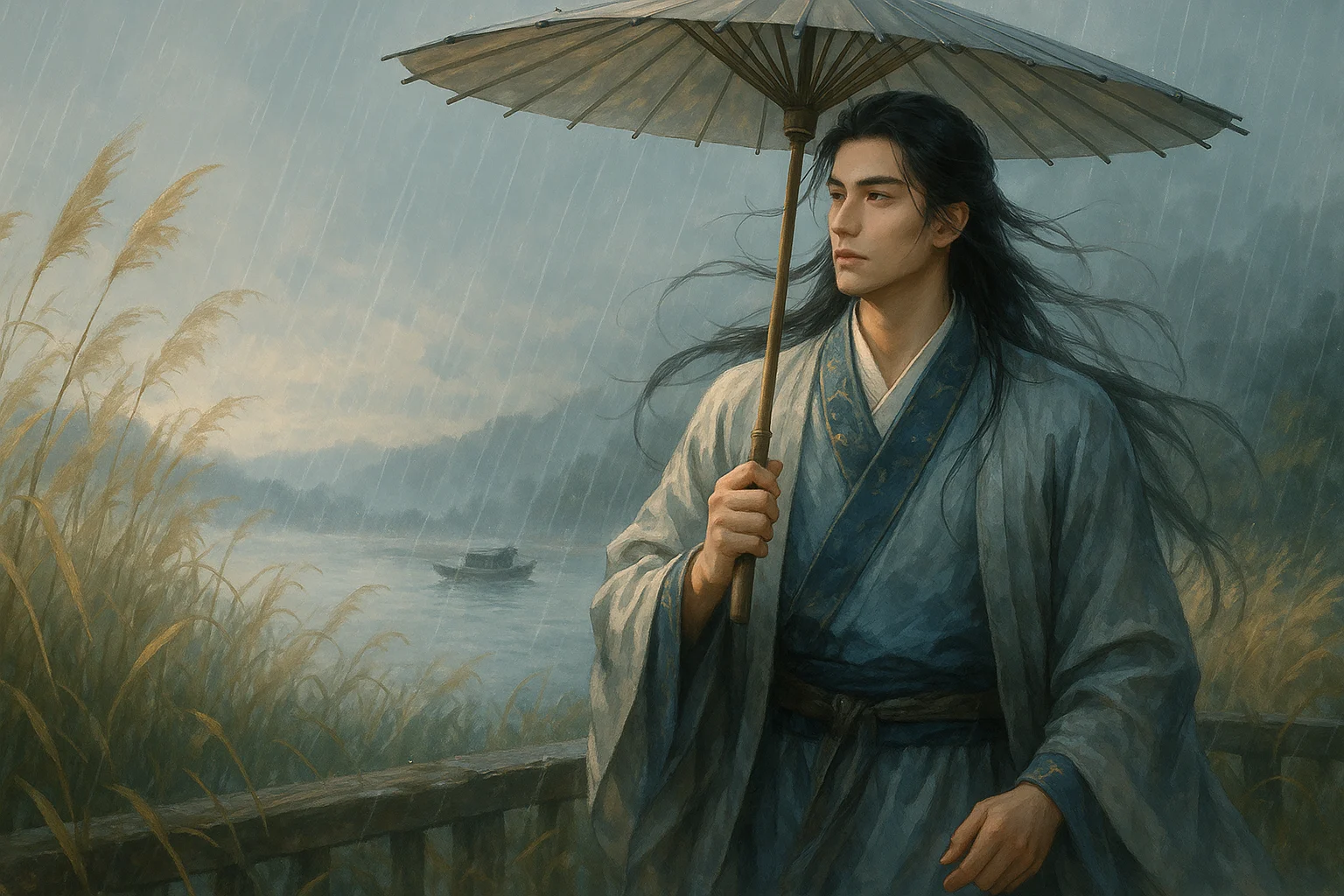
Xu Hun (许浑 c. 788 – c. 858), a native of Danyang, Jiangsu Province, was a renowned poet of the late Tang Dynasty. His ancestor was Xu Yushi, a chancellor during the reign of Empress Wu Zetian, and his family once held prominent status but had declined by Xu Hun's time. He obtained the jinshi degree in the sixth year of the Taihe era (832 AD) and successively served as magistrate of Dangtu and Taiping counties, eventually rising to the position of Vice Director of the Forestry and Crafts Bureau. As an important representative of the late Tang poetic circle, Xu Hun was celebrated for his mastery in depicting water and rain. His poetry often features nostalgic reflections on history, characterized by a desolate and solemn style. He excelled particularly in seven-character regulated verse, with language that is concise, refined, and harmonious in rhythm. Standing apart from Du Mu and Li Shangyin, he established his own distinctive school, exerting a profound influence on later poets such as Wei Zhuang and Luo Yin.